
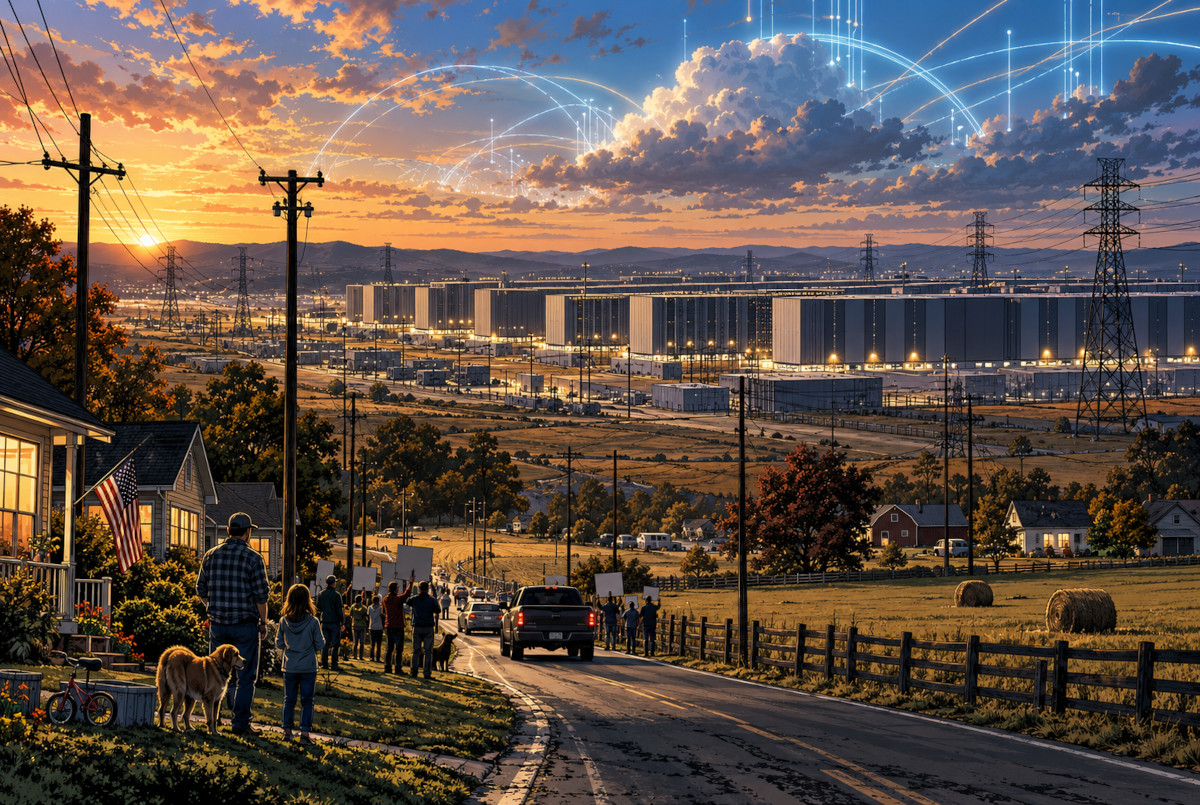
When people use ChatGPT, few stop to wonder where the AI answering them actually is. The technology feels almost weightless, as if it exists somewhere beyond the screen in “the cloud.”
But the cloud has an address. It sits inside enormous data centers built on the edges of suburbs and rural towns, where thousands of servers consume electricity around the clock. Some facilities also require significant amounts of water for cooling, while fans, transformers and other infrastructure keep running 24 hours a day.
This article examines the data center backlash that became increasingly visible across the United States from late 2025 through September 2026. Communities began pushing back against the giant facilities that support AI and other digital services, and by the summer of 2026 protests had spread across multiple states. The dispute did not stop at environmental concerns. Some of the residents who fought data center projects began running for local office — and some had already won seats.
People may like AI and still oppose the data center next door
A 2026 national survey by the Annenberg Public Policy Center at the University of Pennsylvania found that 61% of Americans opposed building a new data center in their local community. Just a few months earlier, the figure had been 49%.
The more interesting result was that even among people who use AI frequently, opposition remained around 60%. In other words, this is not simply a story about people who dislike artificial intelligence. Many people appear perfectly happy to use AI while feeling very differently about the physical infrastructure required to run it.
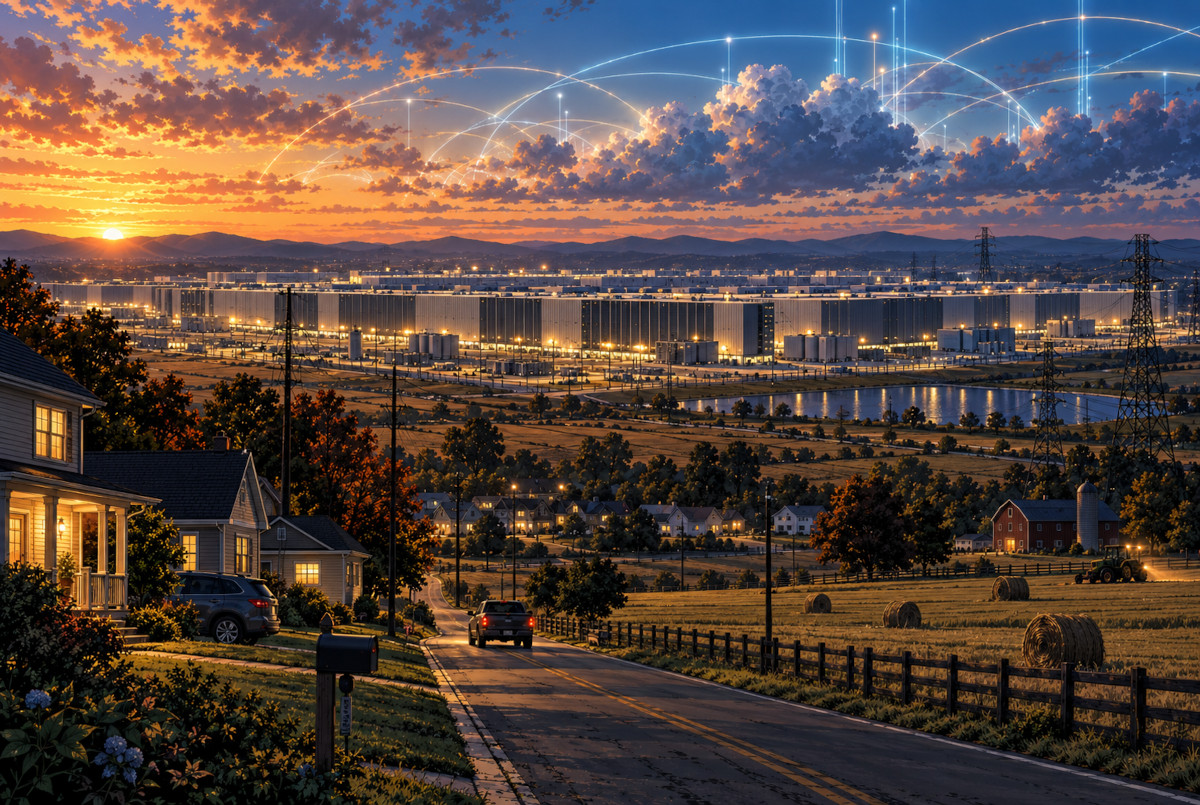 AI-generated illustration. It does not depict an actual facility, location or person.
The cloud consumes a very real amount of electricity
Not every data center is dedicated to AI. These facilities also support cloud services, video streaming, corporate systems, storage and countless other digital services. But the rapid expansion of generative AI has helped accelerate both new construction and electricity demand.
According to a report from Lawrence Berkeley National Laboratory published by the U.S. Department of Energy, American data centers consumed about 176 terawatt-hours of electricity in 2023, equivalent to roughly 4.4% of total U.S. electricity consumption. By 2028, that share could rise to between 6.7% and 12%.
That raises a less glamorous question than the future of artificial intelligence: who pays for the power plants, transmission lines and substations required to serve these facilities?
In June 2026, Texas Governor Greg Abbott directed state regulators to ensure that the cost of new infrastructure built for data centers would not simply be shifted onto residential electricity customers. In August, he went further, ordering a broad review of data center projects seeking connections to the Texas grid. The review includes electricity demand, water use, cooling systems, tax incentives, noise and other local impacts.
ERCOT, the operator of most of the Texas power grid, had received more than 474 gigawatts of requests for large new loads. According to the governor’s office, roughly 90% were related to data centers. That does not mean 474 gigawatts of projects will actually be built. Many proposed projects may never reach construction. Still, the queue became large enough for the state to effectively say: hold on, we need to know what all of this is going to require.
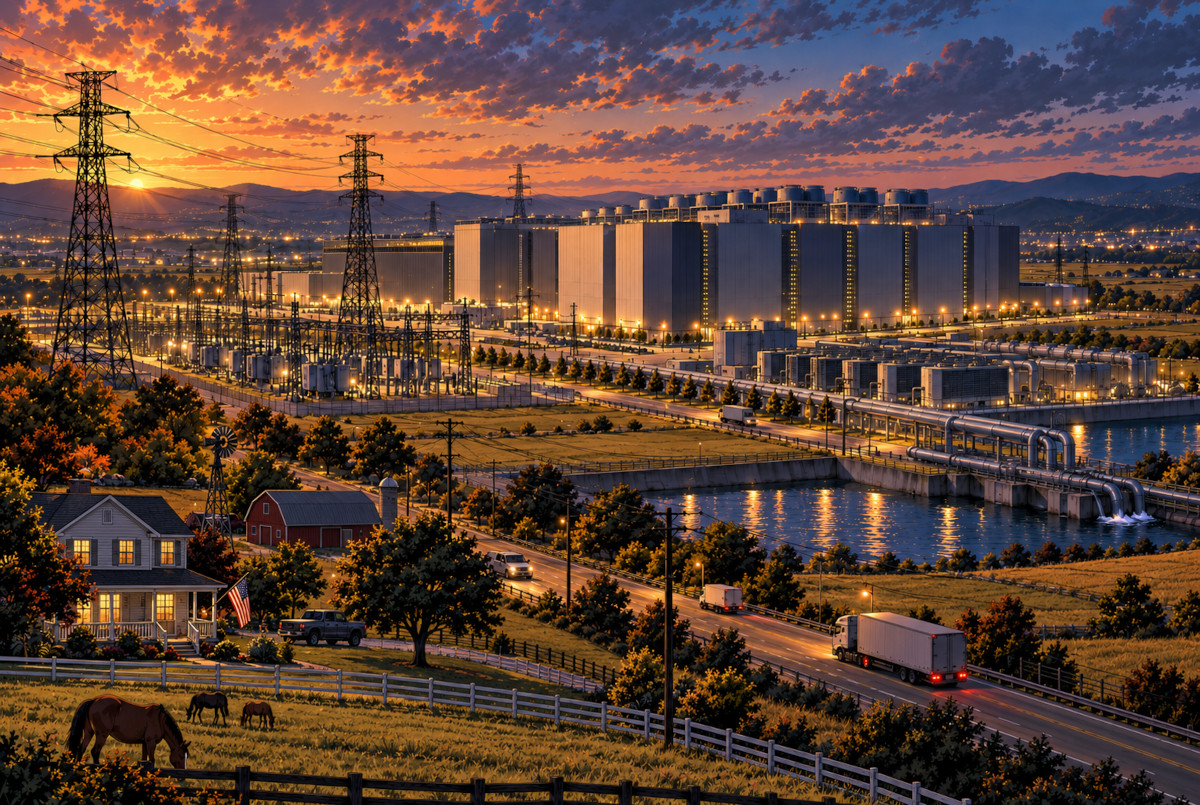 AI-generated illustration. It does not depict an actual facility, location or person.
Data centers use water — but the story is not that simple
Water has become one of the most visible arguments against large data center projects. Some cooling systems can require substantial amounts of water, and in September 2026 Texas ordered stricter enforcement against large users, including data centers, that fail to submit legally required water-use surveys.
But this is where the story becomes less convenient for anyone looking for a simple villain.
In Marana, Arizona, a roughly 600-acre data center campus is being planned with air cooling rather than conventional water-intensive cooling. The town has also prohibited the use of municipal drinking water for data center cooling.
At public meetings in late 2025 and early 2026, the developer said the land currently used for agriculture consumes about 2,000 acre-feet of water per year, while the completed data center campus would use roughly 40 acre-feet annually. If that estimate proves accurate, water consumption would fall by about 98%.
That figure comes from the developer, not from years of operating data, so it should not be treated as a universal rule. But it does show why the popular shorthand — “data centers always use more water than whatever was there before” — does not hold everywhere.
The real fight is over who gets the benefits and who absorbs the costs
So why do these projects produce so much resistance?
Because water and electricity are only part of the argument. Residents also raise concerns about land use, constant low-level noise, visual impact, tax incentives, road construction, local employment and whether major development decisions were made before the public fully understood what was being proposed.
At the same time, data centers can be extraordinarily valuable to local governments. Loudoun County, Virginia — one of the largest data center markets in the world — expected roughly $1.2 billion in data-center-related property tax revenue in fiscal 2026, accounting for about 39% of the county budget.
The employment picture is more complicated. A Virginia legislative study found that a typical 250,000-square-foot data center may employ only around 50 permanent workers once operating, even though construction employment can peak at roughly 1,500 workers.
So a data center is not necessarily a traditional factory that permanently employs thousands of local residents. But it can still generate enormous construction activity and tax revenue. For a town, a data center can be both an unwanted neighbor and a very large ATM.
The opposition has moved from public meetings to elections
In July 2026, coordinated protests against data center development were held at 142 locations across 42 U.S. states. Turnout varied widely, so this was not a nationwide uprising in the literal sense. But the fact that the same issue generated organized demonstrations across much of the country showed how far the backlash had spread.
By September 2026, another shift was visible: residents who had fought projects were entering politics themselves.
In Monterey Park, California, voters approved a measure prohibiting data centers throughout the city, and Steven Kung, who had been involved in the opposition campaign, later ran for city council. In Marana, Arizona, Jackie McGuire, another critic of local data center development, won a seat on the town council in July 2026.
 AI-generated illustration. It does not depict an actual public hearing, facility or individual.
AI has an address
Reducing this story to “AI companies versus environmentalists” misses what makes it interesting.
Some opponents use AI themselves. Some data centers use relatively little cooling water. Some communities receive enormous tax revenues from them. Yet resistance still grows.
The real dispute is not simply whether AI is good or bad. It is about who provides the land, electricity, transmission capacity, water and tax incentives needed to run AI infrastructure — and who ultimately receives the benefits. Just as importantly, it is about how much say local residents should have before the project arrives.
The word “cloud” is remarkably convenient. It makes digital infrastructure sound as if it floats somewhere above ordinary life. In reality, the cloud buys land, connects to substations, runs fans, pays taxes and sometimes irritates the neighbors.
AI has an address. And across the United States, people are increasingly arguing over where that address should be.
Editor’s Note
I use AI almost every day, so I am hardly in a position to argue that data centers should simply disappear. Every time I ask an AI a question, somewhere a machine is doing the work.
Still, the word “cloud” now strikes me as almost suspiciously convenient. It sounds clean, invisible and weightless. The actual system is none of those things. It occupies land, plugs into the grid, needs roads and cooling systems, and becomes part of somebody’s neighborhood.
Seen from Japan, that contrast is especially interesting. AI arrives on our screens as the cutting edge of the future, but once you look behind the screen, the argument becomes surprisingly ordinary: Who pays for the electricity? Who gets the tax revenue? Who has to listen to the equipment at night? That is the B-side of the AI boom — and perhaps the part that tells us more about the future than another shiny product launch ever could.
References
- U.S. Department of Energy — “DOE Releases New Report Evaluating Increase in Electricity Demand from Data Centers”
- Annenberg Public Policy Center — “Opposition to Local Data Centers Rises Sharply, Annenberg Survey Finds”
- Office of the Texas Governor — “Governor Abbott Directs PUC And ERCOT To Shield Texans From Data Center Infrastructure Costs”
- Office of the Texas Governor — “Governor Abbott Directs Comprehensive Data Center Audit”
- Office of the Texas Governor — “Governor Abbott Directs TWDB To Penalize Data Center Reporting Failures”
- Town of Marana, Arizona — “Luckett Road North and South Data Centers”
- Town of Marana — January 6, 2026 Town Council Meeting — includes the developer’s estimate comparing agricultural water use with the proposed data center campus
- Virginia Joint Legislative Audit and Review Commission — “Data Centers in Virginia”
- Loudoun County — “Data Centers: The Loudoun Story” / “Tax Revenues & County Budget”
- City of Monterey Park — “Measure NDC: Proposition to Prohibit Data Centers in Monterey Park”
- Reuters — “Data center opponents stage 142 protests across 42 US states” (July 18, 2026)
- The Guardian — “They fought against datacenters. Now they are running for local offices” (September 15, 2026)