
When a Dream Became an “Eviction Order”: Seven Families Targeted in Thailand Over Black-Magic Claims

夢が「追放令」になった村――タイ北部、“黒魔術”を疑われ7世帯に退去圧力

What happens when someone says they saw you in a dream—and that dream becomes evidence that your family put a curse on them?

Some people would dismiss it immediately. Others might wonder whether the dream meant something. Belief in ghosts, omens and curses is deeply personal, and this story is not about mocking people for believing in things that cannot be seen.

But in October 2026, in Sop Moei district of Mae Hong Son province in northern Thailand, a dream reportedly moved beyond private belief and became the starting point for an attempt to push a family out of its village.

The pressure eventually expanded to seven households. More than 30 relatives were reportedly included in demands that the wider family leave, while more than 40 family members and relatives were said to have been affected by the dispute.

A symbolic illustration of a young person dreaming of elderly figures in a northern Thai mountain villageAI-generated explanatory illustration. It does not depict the actual people, location, ethnic group or events involved in the case.


Read more

Vietnam’s Nearly 800 Fake Gambling Videos Weren’t About Gambling — They Were Sales Pitches

ベトナムで800本の“ヤラセ賭博動画”――8人組が売っていたのはイカサマ道具だった

On September 28, 2026, Vietnam’s Ministry of Public Security and Hải Phòng City Police announced an unusual case: a group of eight people had allegedly built what looked less like a gambling operation and more like a small video-production business.

The group staged gambling scenes, assigned roles, wrote scripts and uploaded the resulting clips to Facebook. Police say they posted nearly 800 videos.

But the gambling itself was not really the product. Embedded in the videos were advertisements for devices promoted as tools for cheating at gambling.

The gambling was staged. The sales pitch was real.

Read more

A Coffin Fell Out of a Hearse in São Paulo — Who Is Allowed to Transport the Dead?

霊柩車から棺桶が落ちた――サンパウロ「死者を運ぶ4社」の意外な仕組み

If this were a ghost story, a coffin falling out of a moving hearse would almost invite a supernatural explanation.

But what happened in São Paulo, Brazil, on September 23, 2026, appears to have been much more earthly. In São Miguel Paulista, on the city’s eastern side, a coffin carrying a deceased person fell from a hearse and ended up on the road.

That is strange enough on its own. Yet the more interesting part of the story appears behind the accident itself: in São Paulo, transporting the dead is not simply a matter for any funeral company with a suitable vehicle. It is part of a tightly regulated public-service system.

Read more

Traffic Ticket or Frog Jumps? Why “Ranas” Keep Appearing in Peruvian Traffic Stops

ペルー警官、交通違反者に「カエル跳び」――切符の代わりの“ranas”はなぜ起きる?

Get stopped for a traffic violation and the next step is usually predictable: a warning, a citation, or a fine.

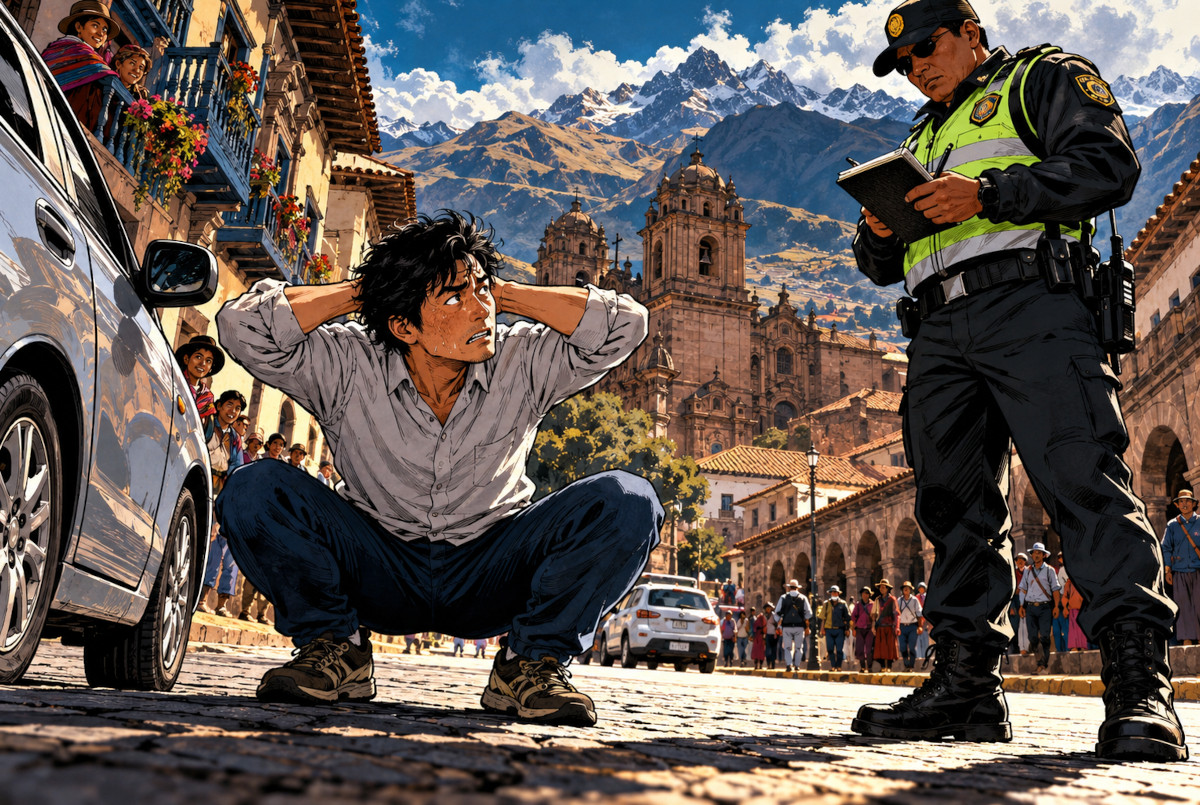
But in Cusco, southern Peru, one driver ended up crouching in the street and repeatedly moving up and down while a police officer watched. This was not roadside fitness training. The officer was reported to have made the driver perform an exercise known locally as “ranas” instead of issuing a traffic citation.

In footage reported by Peruvian broadcaster ATV on October 1, 2026, the officer can be heard telling the driver, in substance, that the exercise had spared him from getting a ticket. When the driver questioned why he had nearly been cited, the officer continued telling him to exercise and “warm up” so he would not feel cold.

Read more

When Bangkok’s Roads Became Rivers, the Skywalk Became a Shelter

道路は川、スカイウォークは寝床に。バンコク洪水で生まれた「二階の街」

On September 27, 2026, parts of Bang Kapi in eastern Bangkok were still under deep floodwater. Around the Happy Land intersection, cars and buses sat stranded while roads that normally carried heavy city traffic had effectively become waterways.

But the stranger scene was above the street. Residents had carried bags of clothes, valuables and basic supplies onto an elevated pedestrian skywalk. Some were no longer simply passing through it. They were using it as a place to stay — and, for at least one family, a place to spend the night.

Read more

A Flooded-Car Rescue Turned Deadly in Thailand — The Danger Was Above the Water

水没車を救おうとして2人死亡 タイ洪水、クレーンが電線に触れた「二次災害」

At around 1:20 a.m. on September 27, 2026, in Bang Phli, Samut Prakan Province, just outside Bangkok, an attempt to save a flooded car turned into another disaster.

Floodwater in the residential area had risen above 1.2 meters. According to local reporting and an account from the homeowner’s wife, a truck-mounted crane had been brought in to move a submerged sedan to higher ground. During the operation, the tip of the crane boom came into contact with an overhead power line. The 31-year-old crane operator suffered an electric shock and collapsed into the floodwater. The 40-year-old car owner rushed in to help and was also shocked. Both men died.

An operation meant to save a car from flood damage had become a fatal secondary disaster.

Read more

When Ambulances Couldn’t Get Through: Why Bangkok Flood Medics Had to Switch Vehicles

救急車まで入れない――バンコク洪水、医療チームが軍用GMCへ“乗り継いだ”理由

In late September 2026, days of heavy rain left large parts of Bangkok flooded. Cars sat stranded in brown water, streets became channels, and once again the city was confronted with the familiar problem of moving people through neighborhoods that had effectively stopped functioning as roads.

But this time, one detail stood out. Some of the vehicles sent in to help could no longer get through either.

Standard six-wheel trucks used by the Bangkok Metropolitan Administration (BMA) became unusable in some of the deepest-flooded areas. Ambulances also ran into trouble. In response, doctors and emergency personnel had to travel as far as an ambulance could safely go, then transfer to high-clearance GMC trucks for the final leg into flooded residential districts.

Read more

Nepal’s “Bride Brokers” for Chinese Men: Marriage or Trafficking?

ネパールで中国人向け「花嫁仲介所」を摘発 正式な結婚なのになぜ人身売買と疑われるのか?

On November 14, 2025, immigration authorities in Kathmandu detained four Chinese nationals—three men and one woman. What drew attention was not an ordinary travel agency or staffing business. The group was allegedly involved in arranging marriages between Nepali women and Chinese men.

According to Nepal’s Department of Immigration, the four held business visas but could not provide information showing that they were operating a registered company. Investigators said economically vulnerable Nepali women had allegedly been approached with offers to create content for TikTok and other short-form video platforms, then introduced to Chinese men for marriage. Some women were reportedly sent to China, while rented properties in Kathmandu’s Maipi area were used to accommodate them.

Was this job recruitment, international matchmaking, or human trafficking? That is what makes the case so difficult—and far more interesting than a simple story about an illegal marriage bureau.

Read more

Laos Lottery Error: Prize Reversed After 30 Minutes—How Did It Reach the Bank?

ラオス宝くじ、当選番号を誤表示→賞金入金→30分後に消えた なぜ銀行口座まで届いた?

On February 6, 2026, something peculiar happened during a Lao Development Lottery draw. The officially certified six-digit winning number was 837430. But viewers watching Lao National Television saw a different number on screen: 387430.

At first glance, this sounds like an ordinary broadcast mistake: one digit in the wrong place, an apology, end of story. But by the time the broadcaster acknowledged the error on February 7, the problem had apparently traveled much further. A lottery buyer named PaNoy Bouttavong said the incorrectly displayed number had been recognized by the lottery app as a six-digit winner, the prize money was transferred to a bank account, and the transaction was reversed roughly 30 minutes later.

Read more

How a Florida Drone Dispute Escalated Into an Alleged $5,000 Murder-for-Hire Plot

ドローン騒動から5000ドルの殺人依頼疑惑へ 米フロリダの隣人トラブルはなぜ暴走したのか

A drone over the neighborhood. Complaints about speed. A teenager riding a dirt bike. None of these sounds especially unusual as the starting point of a neighborhood dispute.

But in Lake County, Florida, a 69-year-old man with a history of conflicts involving nearby residents ended up in jail — and was then accused of asking another inmate to kill one of his neighbors. According to a probable cause affidavit reviewed by local media, the alleged offer included $5,000 up front.

The strangest part is that the case did not suddenly jump from “drone dispute” to “murder-for-hire allegation.” Over roughly six months, a series of relatively small neighborhood conflicts appears to have escalated one step at a time.

Read more