

On June 3, 2026, a municipal order took effect in Villeneuve-sur-Lot, a town in southwestern France, restricting laundry that can be seen from public spaces in parts of its historic center. In French administrative terms, the measure is an arrêté municipal—a municipal executive order rather than a bylaw passed by a local council.
At first glance, the story sounds almost too easy to summarize: beautiful European streets come first, everyday life comes second. But once the case is examined more closely, it stops being a quirky story about underwear and balconies. It turns into a much larger question involving heritage preservation, tourism, poverty, aging housing, energy use, and just how far local government should be able to regulate ordinary domestic life.
It was not a total ban on drying laundry outdoors
The first point worth clearing up is that Villeneuve-sur-Lot did not ban outdoor laundry across the entire town. According to local reporting, the rule applies to parts of the historic center and nearby areas, targeting laundry hung from windows, balconies, façades or other places where it is visible from public space.
The municipality’s reasoning is unusually direct. The areas covered by the measure are described as having “heritage, tourism or commercial character” that should be preserved. The issue, then, is not that laundry itself is unsanitary. The logic is that visible laundry can disrupt the appearance of building façades and the image of the town.
It is easy to understand the urban-planning argument. A medieval-looking historic center, restored at public expense and promoted to visitors, is more marketable when it resembles the postcard version of itself. But there is another way to read the same policy: one of the most ordinary signs that people actually live there has been reclassified as visual clutter.
 AI-generated explanatory illustration. It does not depict the actual streets, signs, residents or enforcement activity in Villeneuve-sur-Lot.
The historic center is not simply a wealthy postcard district
This is where the story becomes much more complicated. Villeneuve-sur-Lot itself had a poverty rate of 24% in 2023, while 13.7% of its housing stock was vacant. Within the central area is also a designated priority neighborhood called Bastide des deux rives, part of France’s urban policy system for economically disadvantaged districts.
Official government data for that priority neighborhood lists a population of 2,906, a poverty rate of 42.0%, a 31.1% share of 16-to-25-year-olds who are neither in education nor employment, and a 27.2% share of single-parent households. Local authorities also state that the historic Bastide center contains 2,593 housing units, 84% of which are either rented or vacant, with some buildings suffering from serious deterioration.
The opposition has argued that the laundry restriction also affects residents in this socially disadvantaged part of the center. That distinction matters: the regulation zone and the priority-neighborhood boundary should not simply be treated as identical. But the broader point remains. The area the town wants to polish as a heritage and tourism asset is also a place where people with limited housing options actually live.
Without that context, the story is just “France has another strange rule.” With it, the question changes completely.
Protecting the view can make everyday life harder
Critics of the measure argue that not every household has a garden, a rear balcony, a laundry room or a tumble dryer. In small apartments—some opponents have pointed to homes of around 35 square meters—the window or street-facing balcony may be one of the few practical places to dry clothes.
From the municipality’s point of view, the request is simple: dry the laundry somewhere that cannot be seen from the street. For some residents, however, that “somewhere” may barely exist. The burden of a visual rule is therefore not necessarily distributed evenly. People with larger homes and more private outdoor space have more alternatives than people living in small, older rental units.
The timing also creates an awkward energy-policy paradox. France’s ecological transition agency, ADEME, lists tumble dryers among household appliances that can consume significant electricity, with example figures ranging from roughly 100 to 230 kWh per year depending on efficiency. Air-drying, in energy terms, is the obvious alternative.
But ADEME also notes that drying wet laundry indoors is one of the most significant sources of indoor humidity. In poorly ventilated housing, that can create its own problems. Do not hang it outside where people can see it; a dryer uses electricity; hanging it indoors increases moisture. The three-way conflict becomes particularly uncomfortable in old, small apartments.
 AI-generated conceptual illustration. It does not depict an actual resident, apartment or documented indoor condition in Villeneuve-sur-Lot.
The municipality has a case too—but it is not legally untouchable
It would be too easy to present the town hall as simply hostile to ordinary residents. Villeneuve-sur-Lot and the surrounding intermunicipal authority have been investing in the rehabilitation of the historic center. One housing-renewal program mobilized close to €2 million from multiple partners to encourage renovation of older buildings and bring vacant properties back into use.
The area is also covered by a Site Patrimonial Remarquable, France’s framework for protecting historically and architecturally significant urban areas. From the municipality’s perspective, the logic is understandable: if public money is being spent to restore streets, façades and historic character, the appearance of those façades becomes part of the overall policy.
Still, the legal side is not entirely straightforward. In 2013, the Administrative Court of Appeal of Marseille struck down a municipal order issued in the southern French commune of Reillanne that prohibited laundry from being hung on public property. The court found that the municipality had not demonstrated that the practice actually threatened public order, tranquility or hygiene.
The Reillanne case is not identical to Villeneuve-sur-Lot. It concerned public property, while the 2026 measure also reaches laundry hung from private windows and balconies when visible from public space. The local heritage framework is different as well. So it would be wrong to claim that the earlier ruling automatically makes the new restriction unlawful.
What it does show is that “it improves the appearance of the town” is not an unlimited legal argument. Restrictions on ordinary behavior still need a defensible basis.
Seen from Japan, the difference is less about taste than method
From a Japanese perspective, the comparison is interesting because Japan also has local governments that care intensely about urban appearance. Yet the method is often different.
For example, Ashiya City, a wealthy residential city in Hyogo Prefecture, was asked whether laundry or bedding hung on balconies could be restricted for landscape reasons. The city’s official answer was clear: there is no law or municipal ordinance prohibiting it. Apartment-management rules may restrict such behavior, but the city itself does not directly enforce it.
At the same time, some Japanese local governments encourage apartment design that makes laundry less visible from the street. In other words, instead of telling residents what they may or may not hang outside, the visual problem can be handled through balcony screens, railings and building design.
That does not mean Japan has found a universally better solution. It simply highlights two different approaches to the same desire: reducing visible domestic clutter. One approach regulates behavior. The other tries to design the clutter out of sight.
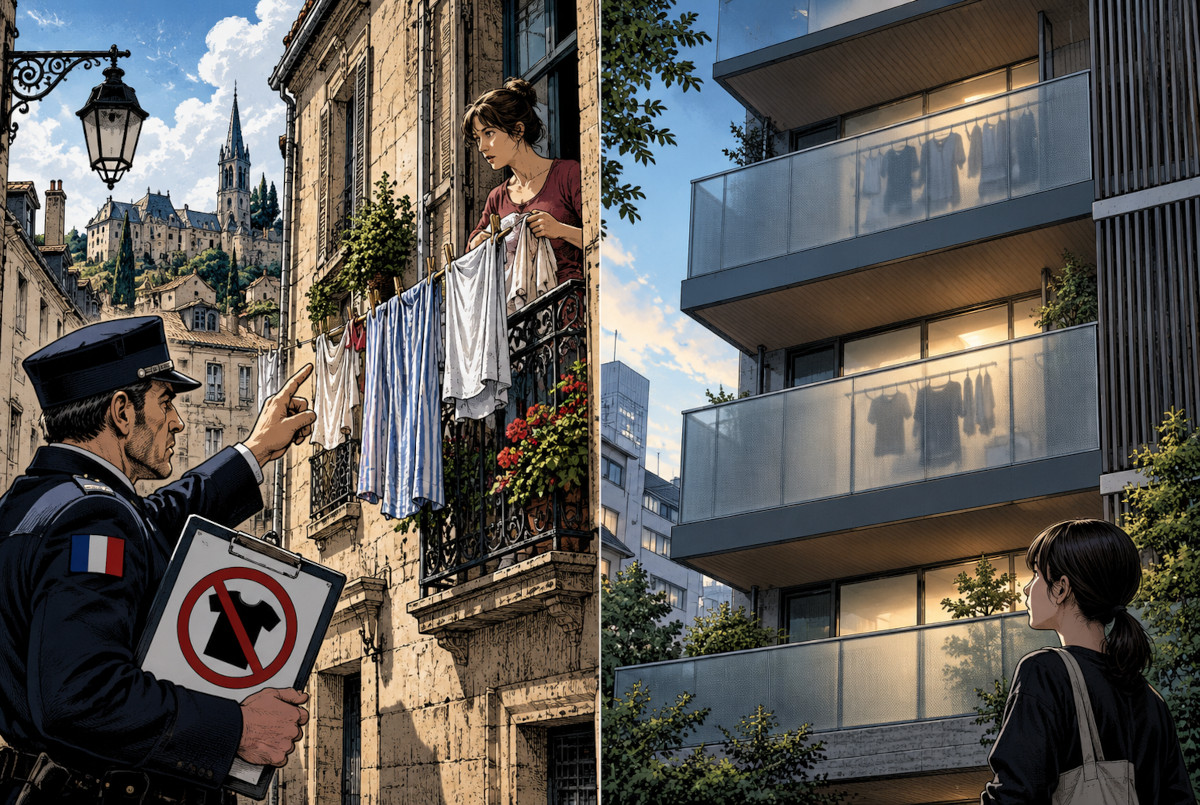 AI-generated comparative illustration. It generalizes French and Japanese approaches and does not depict specific real buildings, residents or enforcement scenes.
When does a living historic town become a curated backdrop?
The most interesting part of this story is not really the laundry. It is the question underneath it: Should a historic district be preserved as a place where people live, or as a carefully edited image of how that place is supposed to look?
Stone streets, old churches and traditional façades are worth protecting. Few people would seriously argue otherwise. But residents also cook, dry clothes, store bicycles, install air conditioners, leave children’s toys outside and do all the other visually inconvenient things that living people do.
If the preservation of a historic town gradually means removing every visible sign of ordinary modern life, the town may become more beautiful for visitors while becoming less natural for the people who actually inhabit it.
That is the real B-side of Villeneuve-sur-Lot’s laundry rule. What looks like a minor aesthetic regulation turns into a much harder question: who is expected to absorb the cost of making a town look beautiful?
Editor’s Note
This is the part that bothers me. I understand why a town wants to protect an old center. If you spend years restoring streets and façades, you probably do not want the result to look chaotic the moment someone hangs a bedsheet outside.
But towns are not movie sets. People live there. They wash things, dry things, make noise, leave ordinary objects in ordinary places. Seen from Japan, what feels especially unusual is that the local government did not simply try to hide the problem through architecture or design—it moved toward regulating the resident’s behavior itself.
Once a beautiful town reaches the point where even someone’s laundry has become a matter for municipal control, I start wondering what exactly is being preserved. The historic town itself—or the version of it that looks best from the street?
References
- INSEE: Territorial statistics for Villeneuve-sur-Lot (Commune 47323)
- SIG Politique de la Ville: 2024 Priority Neighborhood — Bastide des deux rives
- Communauté d’Agglomération du Grand Villeneuvois: Rental permit and substandard housing in Villeneuve-sur-Lot
- Communauté d’Agglomération du Grand Villeneuvois: OPAH 3 housing-renewal program for central Villeneuve-sur-Lot
- Communauté d’Agglomération du Grand Villeneuvois: Site Patrimonial Remarquable heritage-protection framework
- ADEME: Household appliance electricity consumption
- ADEME: Indoor air quality and laundry drying
- Légifrance: Administrative Court of Appeal of Marseille, March 21, 2013, No. 11MA00401
- Ashiya City: Official FAQ on landscape rules for bedding and laundry on balconies
- La Dépêche du Midi: Debate over visible-laundry restrictions in Villeneuve-sur-Lot, September 9, 2026