
A Delivery Robot Ran a Red Light. Did It Flee the Scene of a Tallinn Bus Crash?

赤信号無視の配達ロボットは“逃走”したのか?――エストニアのバス事故と意外な交通ルール

On October 26, 2026, at around 6 p.m., an unusual traffic accident unfolded in Tallinn, Estonia’s capital.

A small autonomous delivery robot entered a pedestrian crossing against a red light. A city bus driver braked sharply, sending standing passengers tumbling inside the vehicle. According to Tallinn’s public transport operator, as many as nine people were injured.

Bus-camera footage also showed the vehicle making contact with the robot and pushing it along the road.

Then came an even stranger detail: the robot reportedly drove away from the accident scene.

A delivery robot had apparently run a red light, caused a bus accident, and then fled. But a closer look at subsequent reports reveals that the word “fled” tells only one side of the story.
Read more

A Coffin Fell Out of a Hearse in São Paulo — Who Is Allowed to Transport the Dead?

霊柩車から棺桶が落ちた――サンパウロ「死者を運ぶ4社」の意外な仕組み

If this were a ghost story, a coffin falling out of a moving hearse would almost invite a supernatural explanation.

But what happened in São Paulo, Brazil, on September 23, 2026, appears to have been much more earthly. In São Miguel Paulista, on the city’s eastern side, a coffin carrying a deceased person fell from a hearse and ended up on the road.

That is strange enough on its own. Yet the more interesting part of the story appears behind the accident itself: in São Paulo, transporting the dead is not simply a matter for any funeral company with a suitable vehicle. It is part of a tightly regulated public-service system.

Read more

Traffic Ticket or Frog Jumps? Why “Ranas” Keep Appearing in Peruvian Traffic Stops

ペルー警官、交通違反者に「カエル跳び」――切符の代わりの“ranas”はなぜ起きる?

Get stopped for a traffic violation and the next step is usually predictable: a warning, a citation, or a fine.

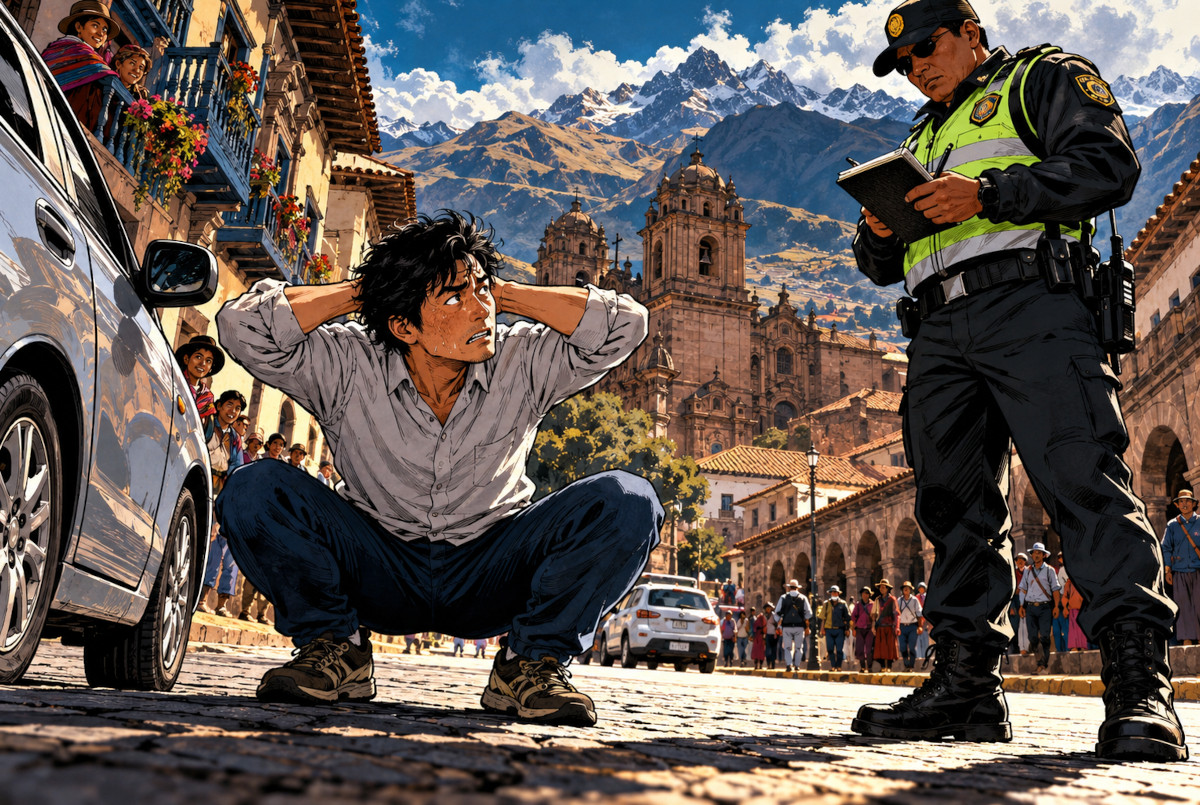
But in Cusco, southern Peru, one driver ended up crouching in the street and repeatedly moving up and down while a police officer watched. This was not roadside fitness training. The officer was reported to have made the driver perform an exercise known locally as “ranas” instead of issuing a traffic citation.

In footage reported by Peruvian broadcaster ATV on October 1, 2026, the officer can be heard telling the driver, in substance, that the exercise had spared him from getting a ticket. When the driver questioned why he had nearly been cited, the officer continued telling him to exercise and “warm up” so he would not feel cold.

Read more

When Ambulances Couldn’t Get Through: Why Bangkok Flood Medics Had to Switch Vehicles

救急車まで入れない――バンコク洪水、医療チームが軍用GMCへ“乗り継いだ”理由

In late September 2026, days of heavy rain left large parts of Bangkok flooded. Cars sat stranded in brown water, streets became channels, and once again the city was confronted with the familiar problem of moving people through neighborhoods that had effectively stopped functioning as roads.

But this time, one detail stood out. Some of the vehicles sent in to help could no longer get through either.

Standard six-wheel trucks used by the Bangkok Metropolitan Administration (BMA) became unusable in some of the deepest-flooded areas. Ambulances also ran into trouble. In response, doctors and emergency personnel had to travel as far as an ambulance could safely go, then transfer to high-clearance GMC trucks for the final leg into flooded residential districts.

Read more

Did a Cleaner Really Steal a Train? The Truth Behind Sweden’s 2013 Runaway Train Crash

「清掃員が列車を盗んで暴走」は本当だったのか?2013年スウェーデン列車事故、3日後に覆った真相

At 2:23:55 a.m. on January 15, 2013, a commuter train sitting at the Neglinge depot outside Stockholm, Sweden, suddenly began moving toward the terminus at Saltsjöbaden.

The train consisted of two C10/C11 two-car units, four cars in total. In the Swedish Accident Investigation Authority’s analysis, the consist was treated as weighing roughly 90 metric tons. It traveled about 1.7 kilometers (1.1 miles) in roughly one minute and forty seconds, accelerating to around 80 km/h (50 mph), before breaking through the buffer stop and crashing into a residential building about 30 meters (100 feet) beyond the end of the track.

Only one person was aboard: a woman who had been cleaning the train. She was seriously injured. No one else, including residents of the building, was reported injured.

The following day, Japan’s AFPBB News ran a striking headline saying that a cleaner had stolen an unmanned train, driven it at high speed and crashed it into a house.

But within three days, that “train thief” story had fallen apart.

Read more

Freight Train Hit Amtrak Twice Near Memphis — What an 82-Car Shoving Move Really Tells Us

貨物列車がAmtrakに2度衝突――「ブレーキの抵抗」と思った82両の後退運転で何が起きたのか

At about 11:00 a.m. on February 22, 2026, an Illinois Central Railroad Company (IC) freight train, Z19491-21, struck a stopped Amtrak train on the same track near Memphis, Tennessee, at milepost 9.6 on the Shelby Subdivision.

The freight consisted of two locomotives and 82 railcars. Amtrak 59-21 had one locomotive and seven passenger cars, carrying 118 passengers and seven Amtrak employees. The IC train was shoving north on Main Track 1 at about 10 mph when the leading end of the freight consist reached the Amtrak locomotive.

That would already qualify as a low-speed train collision. But the National Transportation Safety Board’s preliminary investigation contains a second, much stranger part.

The IC crew told investigators that they interpreted the resistance from the first collision as resistance associated with an air-brake problem. They then moved forward, reversed again, and about three minutes after the first impact, struck the same Amtrak train a second time at low speed.

Two Amtrak employees and two passengers suffered minor injuries. The bigger puzzle is obvious: how does a train hit another train once, then return and hit it again? To understand that, the accident itself is only half the story. The other half is how U.S. railroads handle switching moves, restricted-speed operation and Positive Train Control.

Read more

Spain’s “Trains Too Big for Tunnels”: What the 2026 Audit Found

スペイン「トンネルに入らない列車」の真相――実は1編成も完成していなかった

In January 2023, a strange railway story emerged from Asturias in northern Spain and quickly travelled far beyond the country: Spain had ordered new trains that were too large to fit through its own tunnels.

The story concerned the former FEVE meter-gauge network serving Asturias, Cantabria and other parts of northern Spain. Renfe had commissioned new rolling stock from CAF, but the train specifications turned out to conflict with clearances around old tunnels and other infrastructure.

There was, however, a major difference between the viral version and what actually happened. When the problem became public in 2023, there was no completed fleet of 31 oversized trains. No train using the incompatible dimensions had been manufactured.

That much was already clear from the original investigation. But in May 2026, Spain’s Court of Auditors published a detailed audit of the procurement. Its findings revealed a deeper story: the real failure was not simply the size of a train.

Read more

The Yellow Volkswagen of Karak Highway: Where Did Malaysia’s Ghost-Car Legend Come From?

You are driving along a highway at night when a yellow Volkswagen Beetle appears ahead. It is moving strangely slowly, so you pass it. A few minutes later, the same yellow Beetle is in front of you again.

You overtake it once more. It comes back again. And when you finally pull alongside it, there is nobody in the driver’s seat.

This is the Malaysian urban legend commonly known as Volkswagen Kuning—literally, the “Yellow Volkswagen.” Today it is closely associated with the Kuala Lumpur–Karak Highway, one of Malaysia’s best-known mountain expressways. But once you start digging into the story, things become less tidy. There is no clearly documented first witness, no confirmed date when the legend began, and no verified accident that can be identified as its origin. Even stranger, older online accounts suggest that the ghost car may not always have belonged to Karak at all.

Read more