On January 30, 2025, authorities in Brunei shut down an unusual kind of beauty clinic. It was not operating from a hospital, medical center, or even a beauty salon. It was operating from a hotel room.
According to Brunei’s Ministry of Health, a foreign woman had been advertising IV drips for skin whitening and slimming, along with thread lifting and filler treatments, through social media. When enforcement officers entered the hotel room, she was in the middle of administering an IV drip to a customer.
But reducing the case to “someone got caught giving suspicious IV treatments in a hotel” misses the more interesting part. Court records later showed something much more modern: a temporary, almost pop-up form of cosmetic medicine built around social media, messaging apps, portable supplies, and rented hotel rooms.
TikTok was the storefront, WhatsApp was the reception desk
A judgment issued by the High Court of Brunei Darussalam on April 4, 2026 identifies the defendant as 43-year-old Malaysian national Marinah binti Abdullah. She promoted her services on TikTok under names including “Beauty Clinic” and “Beauty Clinic Brunei.”
Potential customers contacted her through WhatsApp and paid deposits to secure appointments. Services included vitamin C drips, glutathione infusions, collagen injections, and a package marketed as “Miracle White.” Prices ranged from BND180 to BND541, and some customers received treatments over several consecutive days.
Marinah entered Brunei from the Malaysian state of Sabah on January 26, 2025, accompanied by her husband and others. According to the court, she brought medicines into the country that were not registered in Brunei and for which she did not have the required import authorization. From January 27 to 30, she carried out IV procedures in hotel rooms in Jerudong and Kiulap.
Advertising, booking, payment, premises and medical supplies no longer had to exist in the same physical business. Put them together digitally, and something resembling a beauty clinic could appear almost anywhere.
On January 30, authorities entered the Higher Hotel in Kiulap while an IV procedure was taking place. Court records identify the hotel as the location of the treatment and raid, but there is no indication in those records that the hotel itself was involved in operating the service.
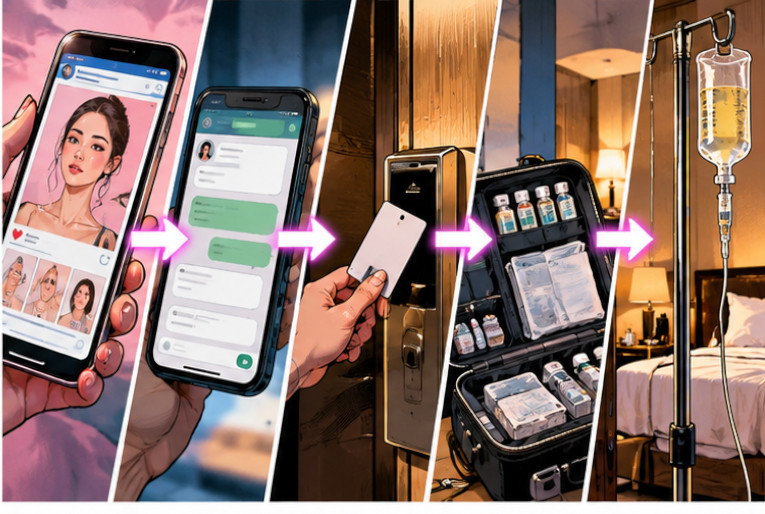 AI-generated illustration. It does not reproduce the actual social-media accounts, hotel room, people or medical supplies involved in the case.
She had nursing experience — but learned these procedures online
There is an important detail that makes this case less simple than it first appears. Marinah was not someone with no exposure to healthcare at all. According to the judgment, she had previously worked as a nurse outside Brunei.
That did not authorize her to perform these procedures in Brunei. She was neither registered nor exempted under the country’s medical regulatory system for the work she was carrying out. More unusually, the High Court found that the methods she used for these cosmetic IV procedures had been learned through online tutorials rather than formal medical instruction.
So describing the case as “a total amateur learning medicine from the internet” would be misleading. The more uncomfortable point is almost the opposite: someone with some healthcare experience appears to have added cosmetic procedures learned online and packaged them into a service that could look credible to customers.
Needles, cannulas, unregistered medicines — and customer records
In its February 2025 announcement, Brunei’s Ministry of Health said officers found needles, syringes, intravenous cannulas, IV sets, unregistered medicines and cosmetic products, along with records relating to customers who had received treatments.
The ministry said the services advertised online included IV treatments promoted for skin whitening and slimming, thread lifting and fillers. It also warned that invasive aesthetic procedures carried out by unauthorized providers could expose customers to risks including infection, allergic reactions and organ damage.
There is an equally important fact on the other side of that warning. The High Court noted that there was no proven evidence that any customer had actually suffered a medical complication. A potential medical risk and a documented injury are not the same thing.
It would also be too strong to say that authorities caught her specifically administering a “slimming drip.” The Ministry of Health confirmed that whitening and slimming IV services had been advertised, but the records do not establish that the exact IV bag being used at the moment of the raid was a slimming treatment. What can be stated safely is that an IV procedure was underway when officers entered the room.
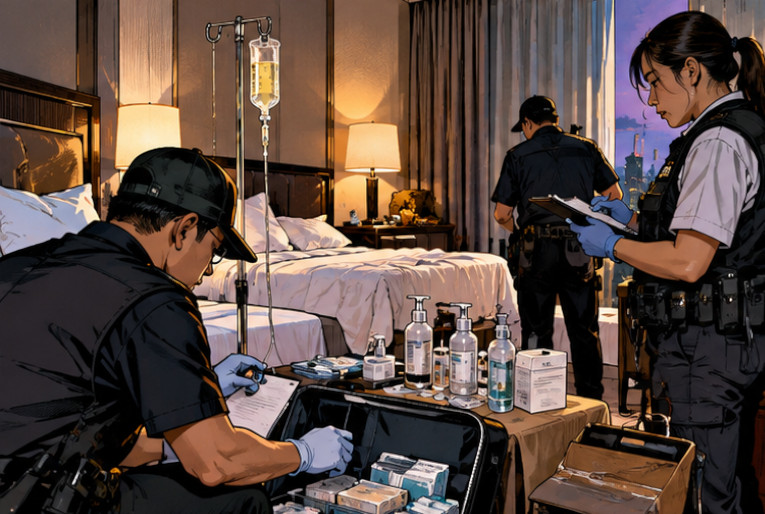 AI-generated illustration. It does not depict the actual enforcement officers, hotel room or seized items from the case.
Ten charges, 30 months in prison — then reduced to 24
The story did not end with the raid. On September 25, 2025, Marinah pleaded guilty to ten charges and received a total sentence of 30 months’ imprisonment and a BND4,500 fine.
The offences involved carrying out medical practice without the required registration, importing unregistered medicines without authorization, and customs-related violations. In other words, describing something as a beauty service did not place injections and IV infusions outside Brunei’s medical and medicines laws.
She later appealed against the sentence. On April 4, 2026, the High Court left the convictions and the individual sentences intact, but changed the way some of the prison terms ran. The court treated the medicines offence and the later medical activity as part of the same overall course of conduct and ordered the six-month sentence under the Medicines Act to run concurrently with other terms.
The result was a reduction in the total prison term from 30 months to 24 months. That did not amount to a finding that the conduct had been harmless. The High Court still emphasized the invasive nature of the procedures, the commercial motive, and the deliberate importation of medicines for the operation.
The strange part is not the hotel — it is that medicine became portable
This is where B-Side Earth moves from the court record to interpretation.
The oddest part of the case is not simply that cosmetic procedures took place inside a hotel room. TikTok could function as the storefront, WhatsApp as the reception desk, a hotel room as the treatment room, and imported medicines as inventory. A clinic-like business could be assembled without a permanent clinic at all.
Nor was this completely without precedent in Brunei. In 2020, authorities also raided an unauthorized beauty operation being run from a rented house. At the time, Brunei police said the services included whitening and slimming treatments as well as cosmetic procedures involving the face, breasts and buttocks.
Social media changes what customers encounter first. Instead of seeing a licensed clinic, a signboard or a reception desk, they may first see a polished video, a testimonial-style post or a professional-looking account. Once the booking conversation moves into a messaging app, the physical location may begin to feel almost secondary.
Seen from Japan, the phrase “IV drip in a hotel room” immediately sounds suspicious. But focusing only on the room risks missing the broader point. In an era when advertising, booking and payment can all happen on a phone, even the appearance of medical credibility can become portable.
 AI-generated illustration. It does not depict the actual hotel, room, person or view involved in the incident.
Editor’s Note
My first reaction to “IV drip in a hotel room” is probably the same as a lot of people’s: seriously, you are going to let someone put a needle in your arm there?
But the more I looked at the case, the less interesting that reaction became. If the service appears on TikTok, appointments happen normally through WhatsApp, the person offering it has nursing experience, and there is even something resembling a medical questionnaire, the whole thing can suddenly acquire a layer of legitimacy.
That is the part that bothers me. You no longer need to build a hospital to build the appearance of medical credibility. The hotel room was only the physical location. In a sense, the real clinic had already been built on the customer’s phone.
From Japan, this looks like one of those strange overseas stories that is easy to laugh off. I do not think it is. Once medicine starts behaving like any other on-demand service, the strange part is no longer the hotel. It is how little physical infrastructure may be needed to make something feel medically legitimate.
References
- Brunei Ministry of Health — enforcement action against unlicensed aesthetic and beauty services (published February 2025, Malay-language official notice)
- High Court of Brunei Darussalam — Marinah Binti Abdullah v Public Prosecutor, HACM 19 of 2025 (judgment dated April 4, 2026)
- Pelita Brunei — report on the prison sentence and fine imposed for the illegal medical practice case (September 25, 2025, Malay)
- Pelita Brunei / Royal Brunei Police Force — report on a 2020 raid against unauthorized beauty services (Malay)
- Attorney General’s Chambers, Brunei Darussalam — Medical Practitioners and Dentists Act, Chapter 112
- Attorney General’s Chambers, Brunei Darussalam — Medicines Act, Chapter 285