
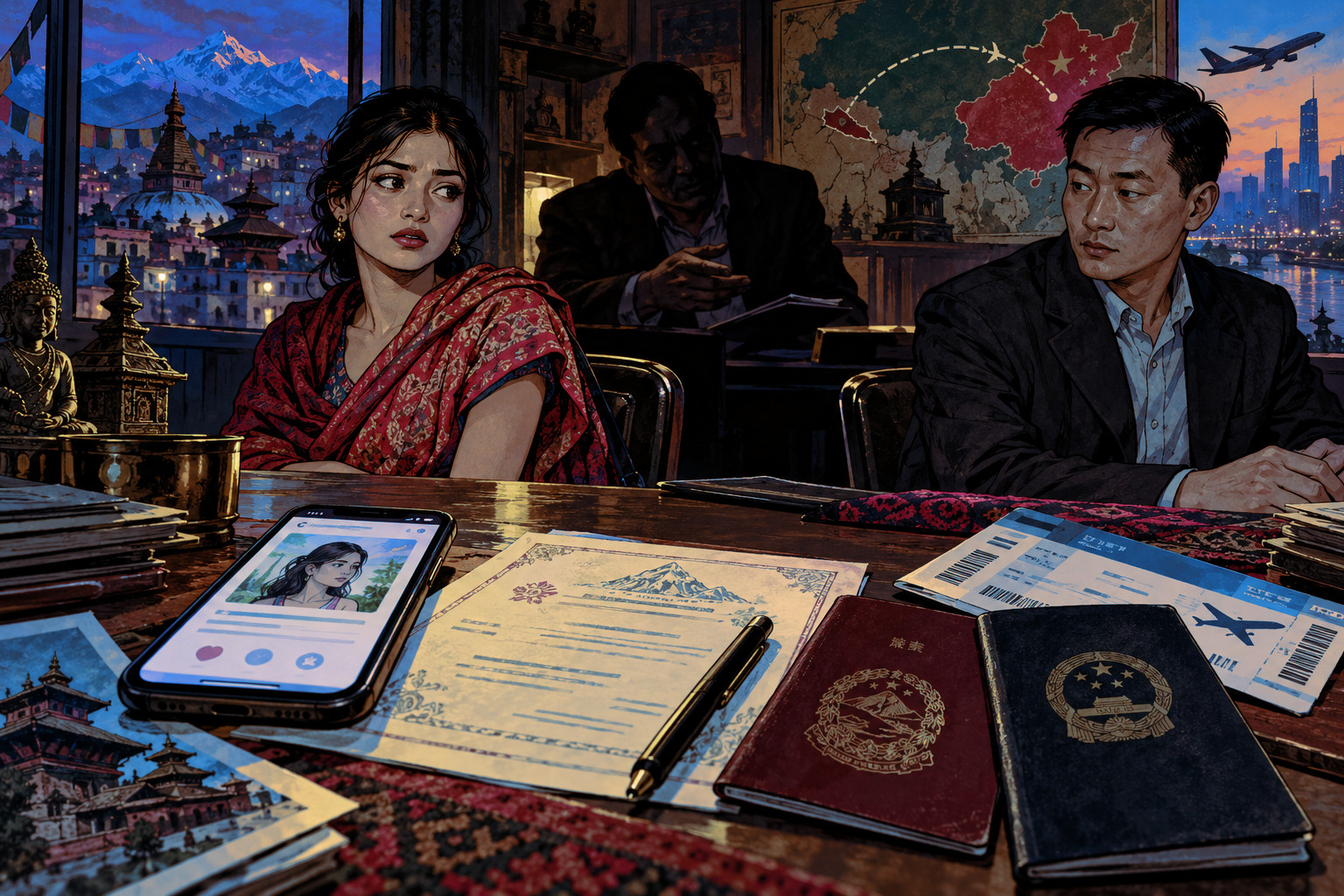
On November 14, 2025, immigration authorities in Kathmandu detained four Chinese nationals—three men and one woman. What drew attention was not an ordinary travel agency or staffing business. The group was allegedly involved in arranging marriages between Nepali women and Chinese men.
According to Nepal’s Department of Immigration, the four held business visas but could not provide information showing that they were operating a registered company. Investigators said economically vulnerable Nepali women had allegedly been approached with offers to create content for TikTok and other short-form video platforms, then introduced to Chinese men for marriage. Some women were reportedly sent to China, while rented properties in Kathmandu’s Maipi area were used to accommodate them.
Was this job recruitment, international matchmaking, or human trafficking? That is what makes the case so difficult—and far more interesting than a simple story about an illegal marriage bureau.
A Suspicious Marriage Is Not Automatically Human Trafficking
A February 2026 follow-up by The Kathmandu Post reported that the four Chinese nationals were each fined 50,000 Nepali rupees, deported, and banned from re-entering Nepal for three years. The publicly reported penalties were based primarily on activities that violated the conditions of their visas, rather than a trafficking conviction.
That distinction matters. A Chinese man and a Nepali woman choosing to marry is not a crime. Under Nepal’s civil law, marriage generally requires mutual consent, both parties to be at least 20 years old, and neither party to already be married. When a foreign national marries in Nepal, questions of marriage eligibility under the foreign national’s home-country law may also apply.
Nepal’s anti-trafficking law, however, goes beyond the literal buying and selling of people. It also covers conduct involving deception, inducement, abuse of vulnerability, or control over a person for purposes such as prostitution or exploitation. A marriage certificate, therefore, is not an automatic guarantee that trafficking did not occur.
 AI-generated explanatory illustration. It does not depict the actual people, location, documents or events involved in the case.
This Did Not Begin With TikTok
The 2025 case may look like a new form of social-media-assisted crime. It is not. Similar marriage-brokerage cases have surfaced in Nepal for more than a decade.
In March 2015, Nepal Police’s Central Investigation Bureau exposed a marriage bureau involved in arranging what investigators described as “paper marriages” between Nepali women and men from China and South Korea. Initial investigations suggested that at least 83 similar bureaus were operating in Nepal. One reported case involved a 17-year-old girl, while foreign men were said to be paying marriage companies between 1.5 million and 2.5 million Nepali rupees.
Then, on August 31, 2019, Nepal Police arrested 10 people, including four Chinese nationals, on suspicion of human trafficking. Women were rescued after investigators uncovered a network in which intermediaries approached women—often from outside Kathmandu—with promises of a better life in China, showed them photographs of prospective husbands and moved the marriage process forward within a very short period.
In other words, the “bride brokerage” business did not suddenly appear in 2025. What has changed is the front end. Paper photographs, binders and face-to-face introductions can now be replaced or supplemented by social media, short videos and smartphone profiles. The economic vulnerability behind the recruitment, however, looks remarkably familiar.
 AI-generated explanatory illustration. It does not recreate an actual marriage bureau, broker, social-media account or individual involved in these cases.
Money Changes Hands—but There Is No Simple “Bride Price”
In 2024, Nepal Police announced multiple arrests involving women allegedly trafficked to China under the pretext of marriage. In one case, investigators said a woman had been sold to a Chinese national for 150,000 Nepali rupees. In another case, police reported a payment of 500,000 rupees.
But it would be misleading to turn those figures into a headline such as “the price of a Nepali bride.” Different cases involve different types of money: payments made by Chinese men to brokers, gifts or payments to families, travel and paperwork expenses, and the broker’s own cut. In the 2019 investigation, police said some Chinese men were paying around 1.5 million rupees to marry Nepali women.
Marriage costs, brokerage fees, family payments and the outright buying and selling of a person are not the same thing. The disturbing part is that, in some cases, all of them can appear inside the same transaction.
Legal Marriage Papers Are Not a Certificate of Safety
An investigation by the Centre for Investigative Journalism Nepal found that 135 Nepali women had registered marriages with Chinese citizens in Kathmandu district alone over a 14-month period. The same investigation reported that 41 Nepali women who had married and were preparing to travel to China were stopped at the airport in August and September 2024 because immigration officers had trafficking concerns.
Those numbers do not mean that every Nepal-China marriage is fraudulent or abusive. That distinction is essential. International marriages between consenting adults are ordinary legal relationships, and nationality alone tells us nothing about whether a marriage is genuine.
The difficulty appears when all the paperwork looks normal—marriage registration, visas, family approval—while the couple may barely be able to communicate, may have known each other for only days or weeks, and large payments have been made to intermediaries. At that point, authorities cannot simply look at a marriage certificate and assume the story ends there.
 AI-generated explanatory illustration. It does not depict actual victims, suspects, passports, marriage certificates or other evidence from the real cases.
Even the Chinese Embassy Has Warned Men About This
One of the strongest pieces of evidence that this is not simply anti-Chinese speculation comes from the Chinese government itself.
In a 2019 travel advisory, the Embassy of the People’s Republic of China in Nepal warned Chinese citizens considering marriage in Nepal to be extremely cautious. It specifically noted that paying marriage brokers, giving money or bride-price payments to a woman’s family, marrying after only a short acquaintance, having little emotional relationship, and being unable to communicate in a common language could all become important evidence in a suspected human-trafficking case.
On December 26, 2025, the embassy issued an even more direct warning. Chinese citizens were told not to trust illegal marriage agencies and come to Nepal looking for a wife. The advisory also warned against cross-border matchmaking advertisements on short-video platforms and noted that Chinese nationals had previously been arrested in Nepal on suspicion of crimes including trafficking and child marriage.
The idea that a man can simply travel abroad and “find a cheaper wife” comes with enormous legal and human risks. By this point, the danger is not a secret known only to traffickers and police. The Chinese embassy itself has been warning its own citizens about it.
The Strange Part Is How Ordinary the Paperwork Looks
Human trafficking is often imagined as something visibly criminal: forged passports, hidden border crossings, threats, locked rooms. Cases involving marriage can look very different.
The process may include a court-registered marriage, a passport, a visa, airline tickets and even the approval of the woman’s family. On paper, it can look like an ordinary international marriage. Yet if the relationship was created through deception, economic vulnerability, financial transactions and an intention to exploit the woman after she leaves Nepal, those same perfectly ordinary documents may become part of a trafficking case.
That is also why the reverse assumption is dangerous. A Chinese man marrying a Nepali woman is not evidence of trafficking. The issue is not nationality or international marriage itself. The issue is what happened before and after the paperwork: what the woman was told, what she understood, who was paid, who controlled the process, and what awaited her after arrival.
Between a love marriage and a trafficking operation lies a long gray zone: arranged introductions, commercial matchmaking, family expectations, promises of a better life abroad, brokerage fees and unequal access to information. That gray zone is exactly what makes these cases so difficult for investigators—and what makes this story a genuine B-side of international marriage.
Editor’s Note
What bothers me most about this story is that it does not look like the version of human trafficking most of us have in our heads. Nobody necessarily has to be dragged across a border in the middle of the night. There can be a marriage certificate. The parents may know about it. The woman herself may initially say, “Yes, I want to go.”
And then you look at the machinery behind it: someone was paid to find her, someone sold her a dream about life overseas, someone rushed the paperwork, and someone may have known far more about the real arrangement than she did.
Seen from Japan, that is the part that feels especially unsettling—not because international marriage is strange, but because the whole thing can look so bureaucratically normal. A passport. A marriage registration. An airline ticket. Nothing about those objects looks criminal.
Yet Nepal was investigating similar schemes in 2015, again in 2019, again in 2024, and still dealing with illegal marriage bureaus in 2025. The technology changed. The paperwork stayed respectable. The underlying vulnerability did not disappear. That gap between what looks legal and what may actually be happening underneath is the real B-side of this story.
References
- Embassy of the People’s Republic of China in Nepal — Travel advisory for Chinese tourists visiting Nepal during the 2019 Mid-Autumn Festival and National Day holiday (September 11, 2019; Chinese)
- Embassy of the People’s Republic of China in Nepal — “Five Dos and Five Don’ts” for Chinese citizens traveling to Nepal during New Year and Spring Festival (December 26, 2025; Chinese)
- Nepal Police — Woman arrested for allegedly trafficking a victim to China under the guise of marriage (Nepali)
- Nepal Police — Woman arrested in another alleged China-bound trafficking case disguised as marriage (Nepali)
- Nepal Law Commission — National Civil Code Act, 2017: marriage provisions (Nepali)
- Nepal Law Commission — Human Trafficking and Transportation (Control) Act (Nepali)
- The Kathmandu Post — “Four Chinese nationals arrested in Kathmandu” (November 14, 2025)
- The Kathmandu Post — “333 foreigners arrested in six months on various charges” (February 6, 2026)
- The Kathmandu Post — “Trafficking in disguise: China, Korea marriage racket busted” (March 7, 2015)
- The Kathmandu Post — “Nepali women are being trafficked to China and sold as wives” (September 9, 2019)
- Centre for Investigative Journalism Nepal — “Nepali Women Trafficked to China” (December 13, 2024)