
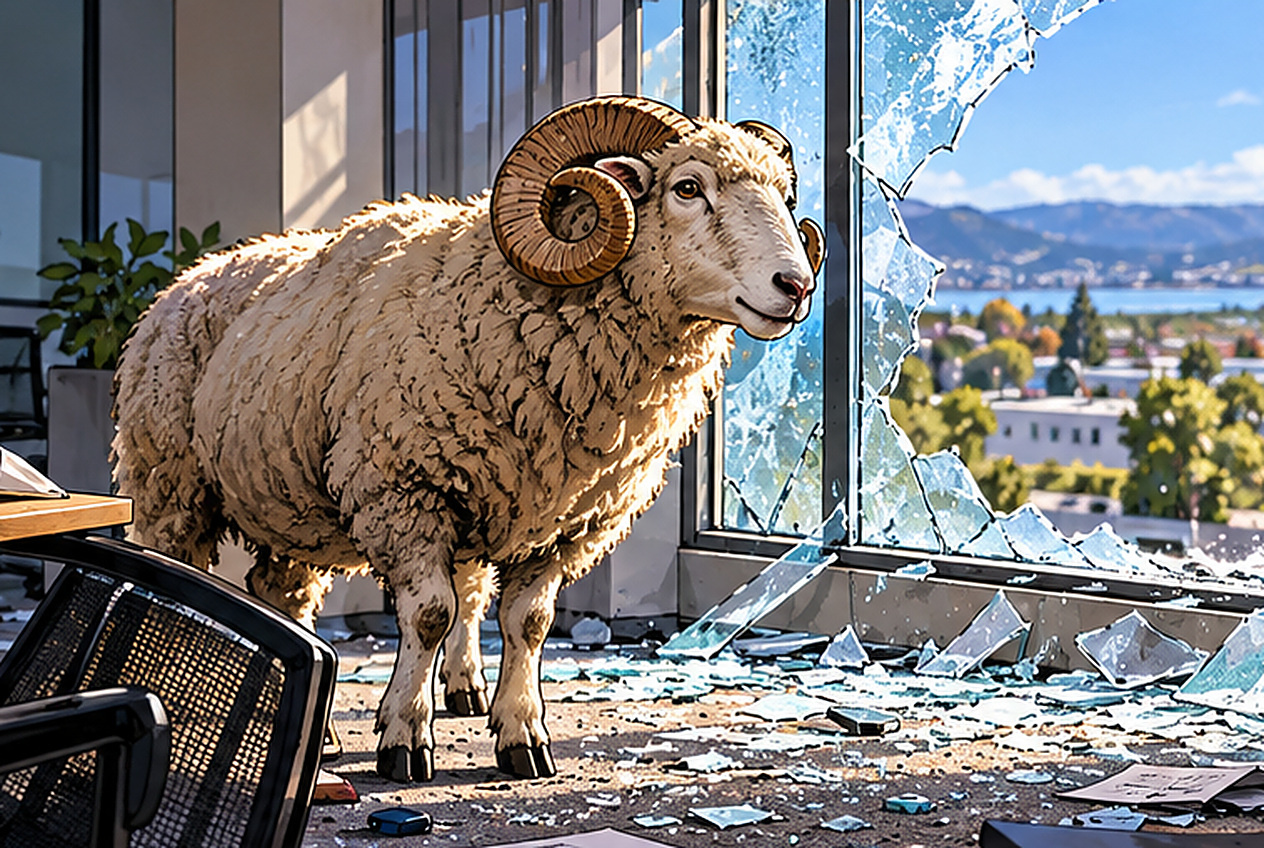
On October 24, 2026, a ram made an extraordinary entrance into an office building in Christchurch, New Zealand. It did not use the front door.
Just before 10 a.m. on Saturday, the animal charged through a ground-floor glass window. Once inside, it damaged tables in meeting rooms, smashed through an internal glass partition and left a considerable mess behind.
Police believed the ram had been on the run for about three days. Officers and animal control staff responded to the building, and the animal was taken into the care of Christchurch City Council.
But the strangest part of the story was the possible explanation offered by the organisation whose office had been damaged.
What if the ram had seen its own reflection in the glass and charged at what it thought was another sheep?
If that theory is correct, the animal effectively picked a fight with itself, broke a window and ended up wrecking somebody else’s office.
That raises an oddly specific question: Do sheep really attack their own reflections? Surprisingly, there is scientific research that helps us examine the possibility.
Three Days on the Run, Then Straight Through an Office Window
The damaged building belonged to Comcare Trust, a nonprofit organisation based at 334 Lincoln Road in Addington, Christchurch.
Comcare provides mental health and addiction support services, along with community housing and other assistance for people living with mental health challenges.
According to an October 27 report by the Otago Daily Times, the ram entered through a ground-floor window and made its way into meeting rooms. Tables and an internal partition were damaged, broken glass was scattered across the premises, and sheep droppings added to the clean-up.
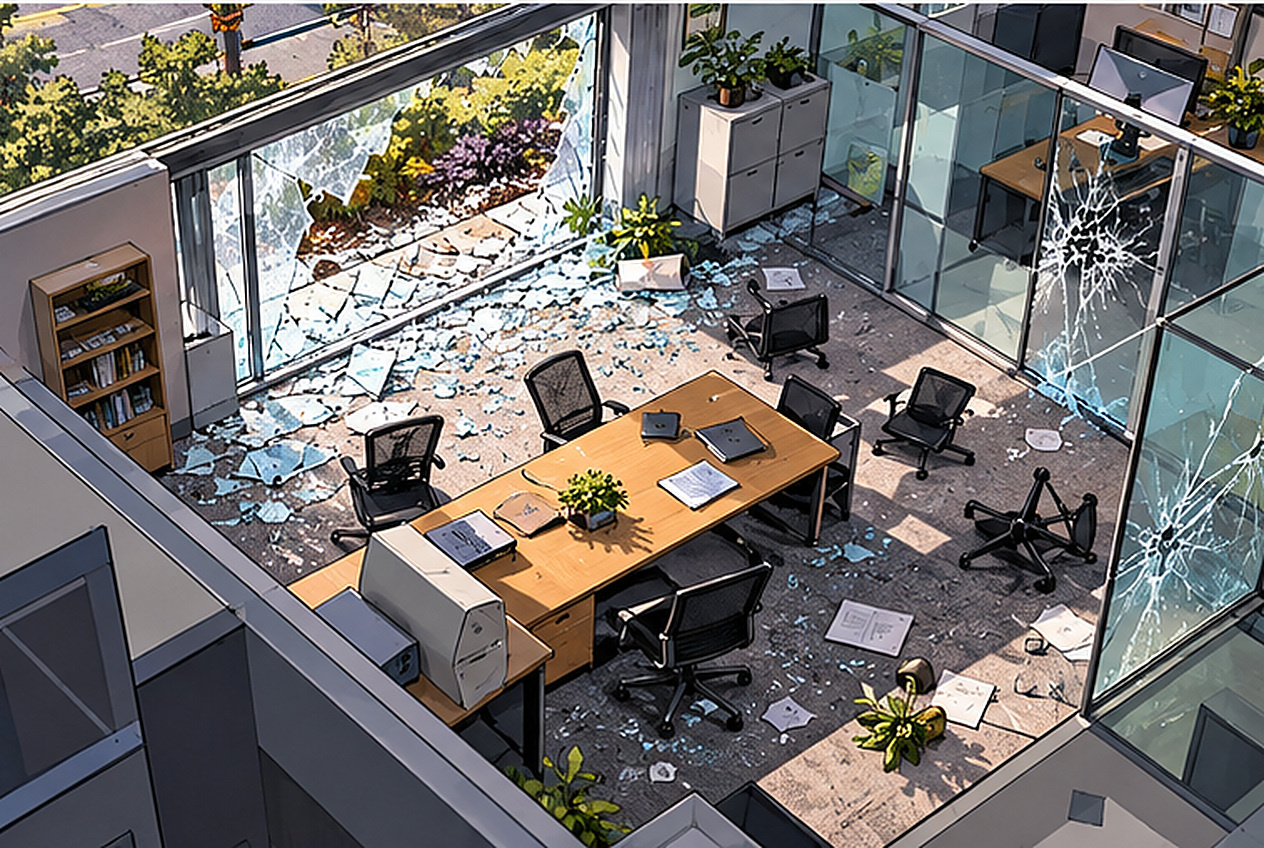
AI-generated conceptual illustration based on reported damage. It does not reproduce the building’s actual layout or the precise extent of the damage.
Police believed the animal may have come from the Aidanfield area of Christchurch, but its exact route and original location were not established in the public reports.
Fortunately, nobody was inside the building when it happened. The timing was unusually lucky: Monday, October 26, was New Zealand’s Labour Day, meaning the incident occurred at the beginning of a three-day holiday weekend.
Staff arranged cleaning and temporary repairs so the premises would be ready for employees returning on Tuesday. The damage was covered by insurance.
Christchurch City Council was holding the ram while attempting to locate its owner. The publicly available reports reviewed for this article did not establish whether the owner was eventually found or the animal returned.
Do Sheep Head-Butt Mirrors? A Study Recorded Six Doing Just That
Comcare chief executive Lindsey Webber suggested that the ram might have spotted its reflection in the mirrored glass and attacked what it saw.
It is an appealing explanation for such a bizarre incident. But is there any scientific reason to take it seriously?
A 2015 paper published in the journal Animal Cognition provides an intriguing piece of evidence.
Researchers S. D. McBride, N. Perentos and A. J. Morton studied 29 sheep from three breeds: Welsh Mountain, Norfolk Horned and Borderdale. Their experiments examined how sheep responded to mirrors and whether they could use reflected images to help locate food.
The most relevant finding for the Christchurch incident appears in the paper’s observations of the animals’ behaviour around mirrors.
Six sheep were observed physically attacking the mirror through head-butting. The researchers also recorded sideways body-barging against the reflective surface.
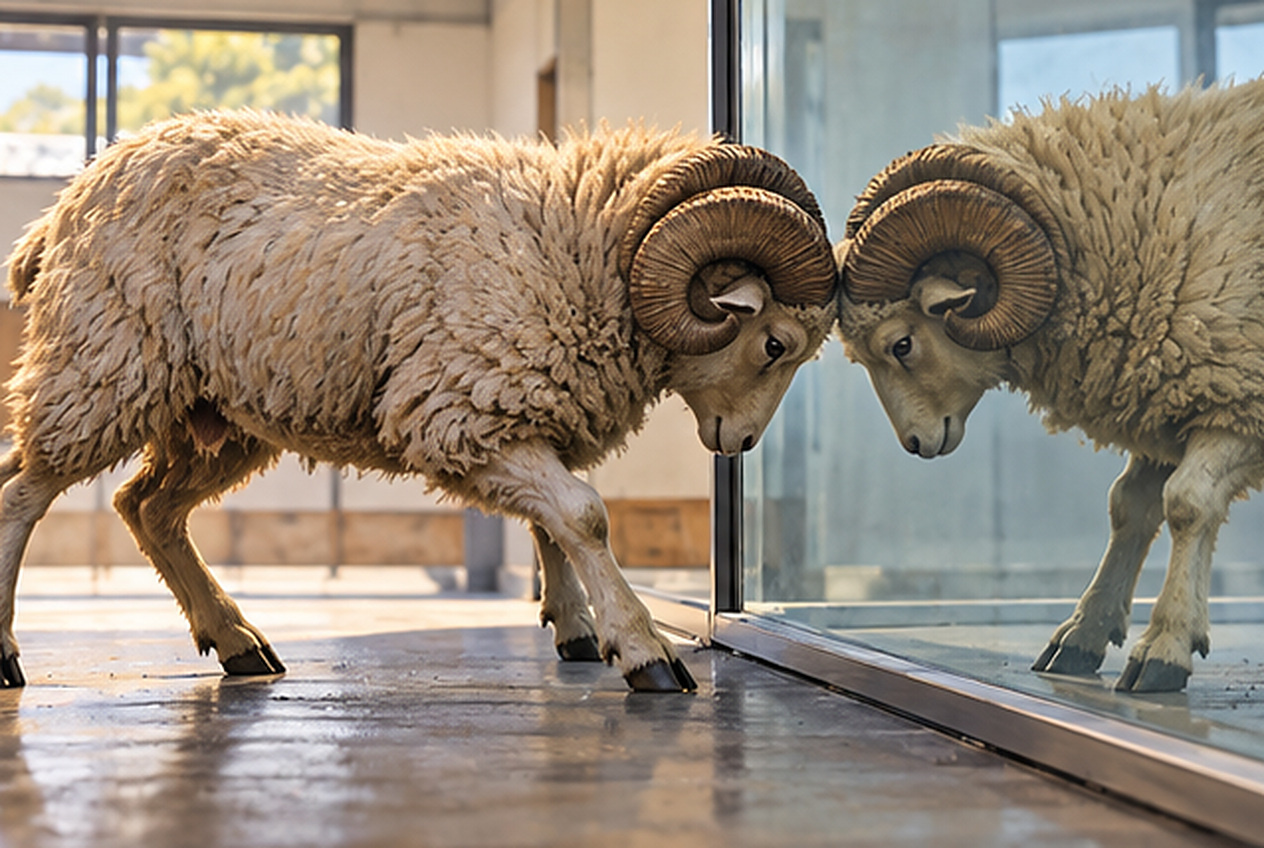
AI-generated illustration of mirror-related behaviour. It is not a photograph of the experiment and does not establish that the animal recognised itself or perceived an opponent.
That is a remarkable detail. Sheep attacking a reflection is not merely a convenient explanation invented after the office incident; comparable behaviour has been documented under controlled observation.
But the distinction matters.
The study did not establish that sheep recognise their reflections as themselves. Nor did prior exposure to a mirror produce a clear overall improvement in their performance on the mirror-based food-location task.
The experiment supports the possibility that a sheep may head-butt a reflective surface. It does not prove that the Christchurch ram mistook its reflection for a rival.
Other explanations remain possible. The animal may have been trying to move through the glass, or it may have become frightened and disoriented after the initial impact. The noise and security alarms could also have contributed to its behaviour inside the building.
Webber herself expressed concern that the ram must have been frightened by the ordeal.
Not the First Sheep to Make an Unscheduled Visit
Digging through earlier New Zealand reports reveals another twist: this was not the country’s first unusually literal “ram raid.”
Two earlier incidents offer a useful comparison.
| When and where | What happened |
|---|---|
| May 2022 Onehunga, Auckland |
An escaped sheep repeatedly head-butted a shop window. Security footage reportedly showed the glass shattering on the third impact. |
| April 2024 Te Kūiti |
During the Great New Zealand Muster, 14 sheep wandered into a Liquorland store and spent about 40 minutes in the staff room. |
| October 2026 Christchurch |
A runaway ram broke through an office window, entered meeting rooms and damaged furniture and an internal glass partition. |
The 2022 case, reported by UPI, is particularly relevant because it involved repeated impacts against a reflective shop window.
The 2024 incident had a different explanation. Sheep taking part in a public event wandered into a liquor store rather than breaking through its glass. Local reports put the number at 14 and their stay at roughly 40 minutes.
There is also an unusually solid paper trail for that story. In an April 30, 2024 council report, Waitomo District Mayor John Robertson referred to sheep that had taken a detour into Liquorland during Te Kūiti’s annual festivities.
The council document confirms the incident, while local reporting supplies the number of animals and the time spent inside the store.
What distinguishes the 2026 Christchurch incident is that the damage continued beyond the initial broken window, extending to furniture and an internal glass partition.
The earlier examples do not prove what motivated the latest ram. They do, however, show that sheep entering buildings, and even breaking glass, are not entirely unprecedented events.
A Real Ram Committed a “Ram Raid”—But Not a Crime
There is a second layer to the story, and it depends on the English language.
In New Zealand, a ram raid normally refers to a burglary or robbery in which a vehicle is used to enter, or attempt to enter, a building. New Zealand Police uses this definition in its Retail Crime Prevention guidance.
Such incidents generally involve vehicles being driven into shopfronts to gain entry.
But ram also means an adult male sheep. As a verb, it means to strike or drive into something with force.
In Christchurch, there was no getaway car, no stolen merchandise and no human burglar. Instead, an actual ram used its own body to break into a building.
That is why the local media described the incident as a “ram raid.” It was a pun, not a suggestion that the animal had committed a criminal offence or been formally arrested.
The cause of the collision remains uncertain. Yet the story becomes more interesting when compared with the scientific study and the earlier New Zealand incidents.
What initially looks like a one-line joke turns out to raise a genuine question about how animals respond to reflections, unfamiliar environments and sudden disturbances.
Editor’s Note
If someone drives a car through a shopfront, designers can at least consider protective bollards and other security measures. But what are you supposed to do about a ram that might decide its own reflection is worth charging?
Imagine adding that to a building designer’s list of possible hazards. Vehicles, strong winds, earthquakes… and a sheep with a personal grudge against its mirror image.
Of course, the reflection theory is still only a theory. If it happens to be correct, this ram managed to start an argument with itself and leave somebody else’s office with the repair bill.
There is a less amusing side, though. Shattering glass, alarms and unfamiliar surroundings would hardly have been pleasant for the animal. The greatest stroke of luck was that the office was empty. A ridiculous story for us, perhaps, but probably a thoroughly miserable day for the sheep.
References
- Comcare Trust — About Us — Official information on the organisation and its services.
- New Zealand Police — Retail Crime Prevention Hub: Frequently Asked Questions — Official definition of a ram raid.
- McBride, S. D., Perentos, N., and Morton, A. J. (2015), “Understanding the concept of a reflective surface: Can sheep improve navigational ability through the use of a mirror?” Animal Cognition, 18, 361–371 — Peer-reviewed research involving 29 sheep and observations of mirror-related behaviour.
- Waitomo District Council — Mayor’s Report, April 2024 (Council Agenda, PDF, p. 21) — Official reference to sheep wandering into a Liquorland store during the Te Kūiti event.
- New Zealand Government — Dates for Public Holidays and Anniversary Days — Confirmation that Labour Day fell on October 26 in 2026.
- Otago Daily Times (October 27, 2026), “Nothing sheepish about this bizarre ram-raid” — Reporting on the Christchurch incident, including accounts from police, Comcare and Christchurch City Council.
- UPI (May 9, 2022), “Sheep fighting its own reflection smashes business window in New Zealand” — Reporting on the 2022 Onehunga incident.
- rova (April 9, 2024), “Te Kuiti sheep ‘ram raid’ local Liquorland during Great New Zealand muster” — Reporting on the 14 sheep that entered a liquor store in 2024.