
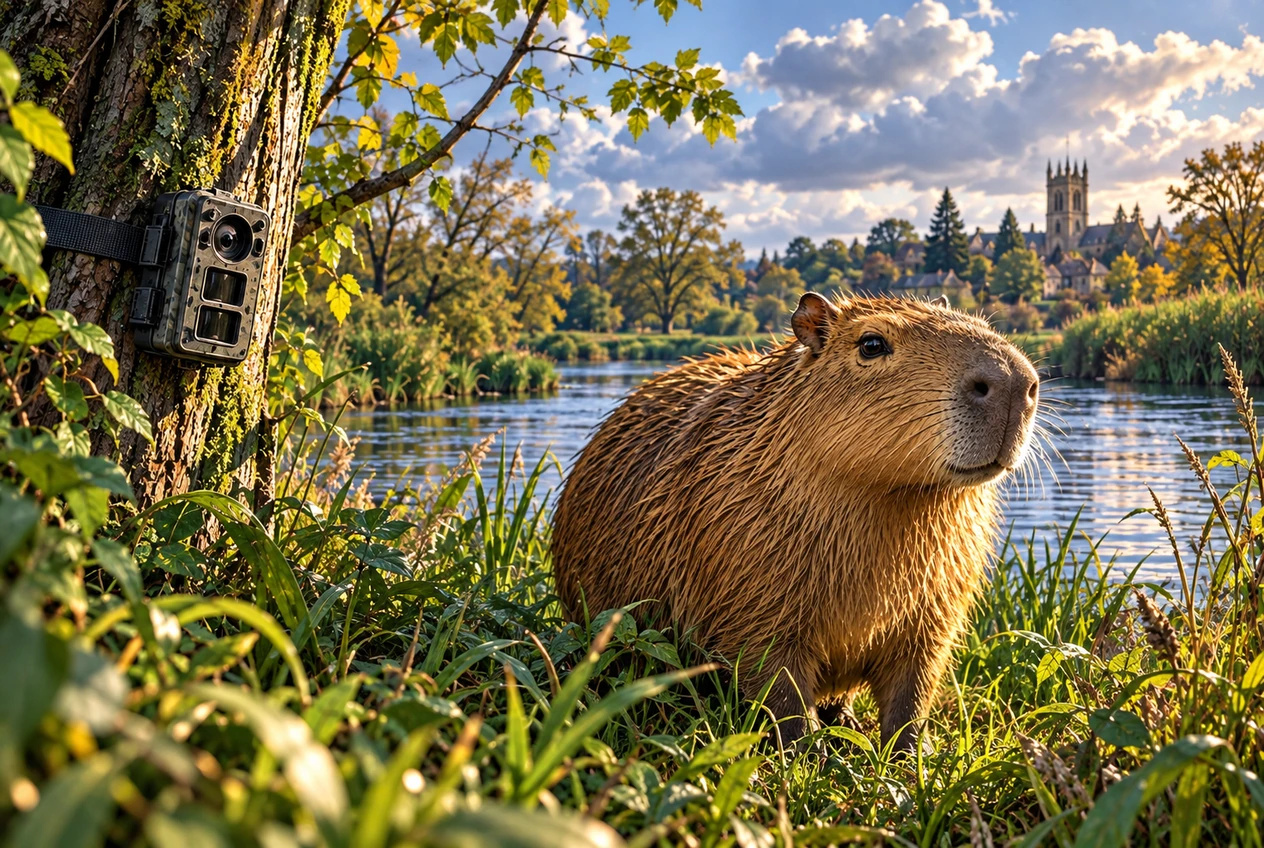
On October 27, 2026, Marwell Zoo in Hampshire, England, released new camera-trap images of a capybara that had been on the run for more than seven months.
Her name is Samba, a young female capybara originally brought to the zoo from another wildlife park. Capybaras are the world’s largest rodents, native to South America.
Since her escape, search teams have deployed thermal-imaging drones, tracking dogs, wildlife cameras and more than 20 staff members. Two of the cameras were even stolen during the search.
Yet Samba remains at large.
Here is the strange part: the zoo now knows the general area where Samba is living. It still cannot simply go in and bring her home.
Why not? Marwell’s official search records, together with the story of another escaped British capybara, reveal why locating an animal and safely recovering it are two very different challenges.
She Escaped Less Than a Day After Arriving
Samba’s adventure began on March 17, 2026, just one day after she and her sister, Tango, arrived at Marwell Zoo from Jimmy’s Farm & Wildlife Park in Suffolk.
The two females were approximately nine months old. While their permanent habitat was being completed, they were staying in a temporary holding area for routine health checks.
Both escaped.
Tango stayed within the zoo grounds and was quickly recovered from nearby bushes. Samba went considerably further, making her way beyond the zoo perimeter.
Zoo staff believe the sisters may have squeezed through a small gap beneath a gate, although the precise escape route has not been conclusively established.
On March 22, a dog walker filmed Samba along the River Itchen near Colden Common. The following day, Marwell Wildlife’s chief executive, Laura Read, spotted her in dense riverside undergrowth. The team still could not retrieve her.
That was the beginning of a search that would stretch from spring into autumn.
More Than 150 Sightings—Most Were Actually Deer
By May 8, Marwell’s animal team had investigated more than 150 possible sightings of Samba.
There was just one problem.
The vast majority turned out to be muntjac deer.
Muntjacs are small deer found in parts of Britain. From a distance, their brown colouring and size can resemble those of a young capybara, especially when vegetation hides much of the animal.
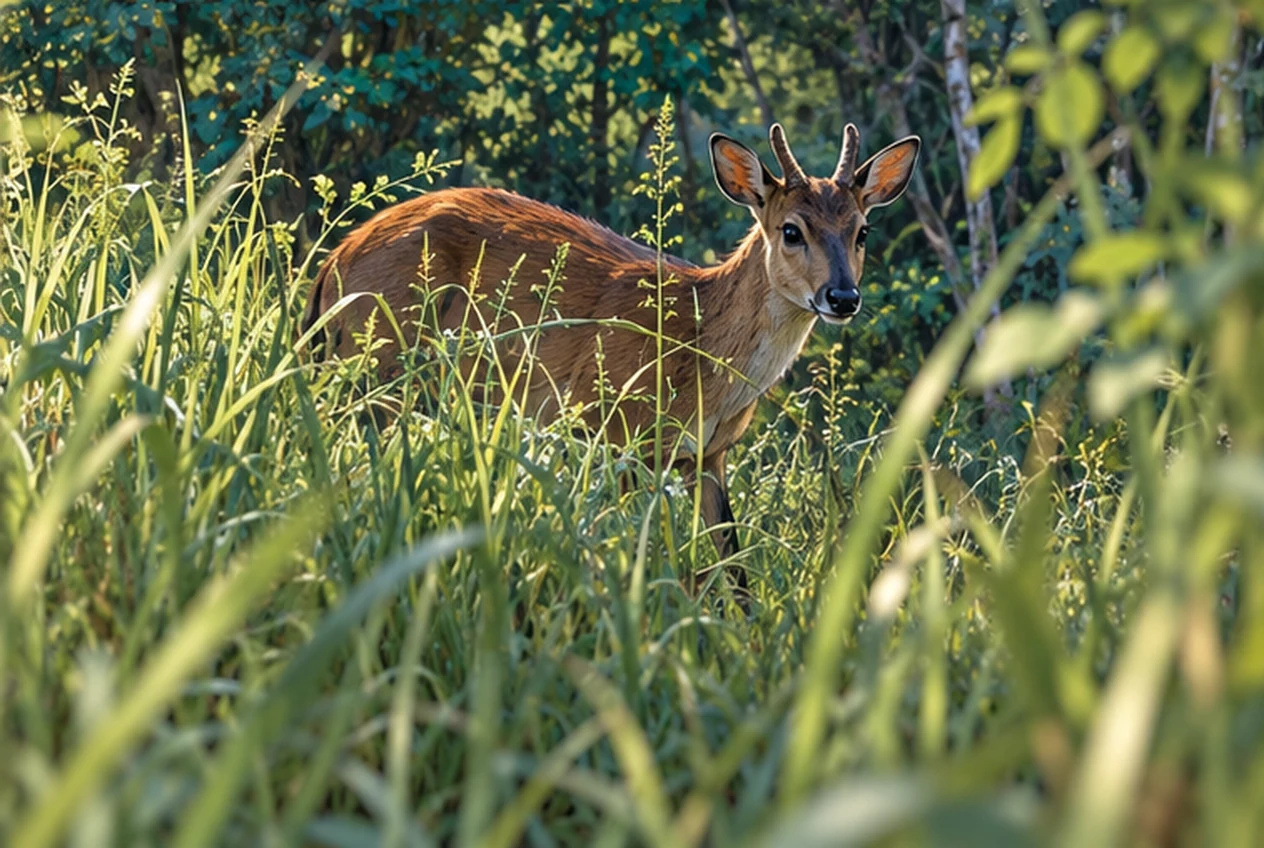
AI-generated illustration of a muntjac. This is not an actual sighting photograph from the Samba search.
The zoo has not published the exact number of reports identified as muntjacs. The figure of 150 refers to possible sightings investigated, not 150 confirmed misidentifications.
Meanwhile, the search itself was becoming increasingly elaborate. In May, the zoo acquired another ten camera traps. On June 5, more than 20 staff members searched for footprints, droppings and other evidence. On June 29, a thermal-imaging drone surveyed an area near Brambridge following a credible report, but Samba was not located that evening.
Then there was an unexpected complication: Marwell reported that two of its camera traps had been stolen in April.
So the search involved hundreds of hours of effort, more than 150 possible sightings, a surprising number of mistaken deer—and equipment disappearing before the missing capybara did.
It was turning into quite a production for one relatively small animal.
Why Thermal Drones Cannot See Through Everything
Thermal-imaging drones sound like the ideal tool for finding a warm-blooded animal hiding in the countryside. They detect differences in thermal radiation, making animals easier to spot even in darkness.
But there is an important limitation: a thermal camera cannot simply see through a thick canopy of leaves and branches.
A 2023 study published in Ecological Informatics examined ground visibility in thermal drone surveys of forests. It found that tree cover can prevent animals from being detected and that detection depends partly on how much of the ground is visible from above.
This does not prove that vegetation was responsible for every unsuccessful search for Samba. It does, however, explain why flying a thermal camera over dense woodland is not a guaranteed solution.
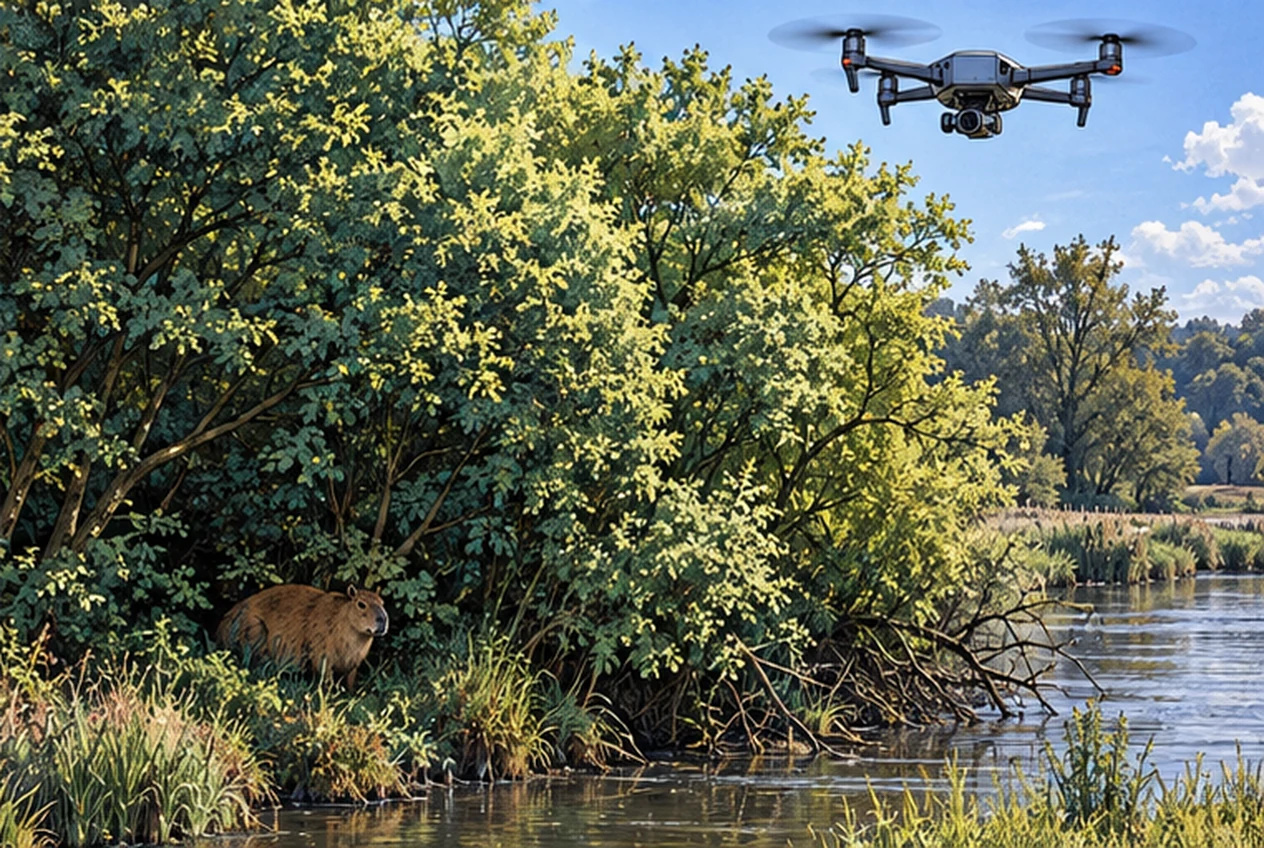
AI-generated explanatory illustration showing how dense vegetation can obstruct aerial searches. It does not reproduce the actual search location.
Capybaras also have another advantage: water.
According to San Diego Zoo, capybaras can remain submerged for up to five minutes to avoid danger. Their eyes, ears and nostrils are positioned high on the head, allowing them to keep much of their body underwater.
There is no evidence that Samba herself stayed underwater for five minutes during a search. Still, her species’ aquatic abilities, combined with the thick vegetation along the River Itchen, help explain why recovering her has proved so difficult.
Another British Capybara Escaped. She Was Back in Seven Days.
Samba is not Britain’s first runaway capybara.
In September 2024, a female called Cinnamon escaped from Hoo Zoo and Dinosaur World near Telford, Shropshire. Her disappearance also prompted a major search involving staff and drones.
Cinnamon escaped on September 13. A drone spotted her on September 17, about 200 metres (660 feet) from her enclosure. She was seen again the following day, but the team still could not capture her.
She was finally recovered from a pond on September 20.
Comparing the official records from the two zoos produces a striking difference.
| Comparison | Cinnamon | Samba |
|---|---|---|
| Year | 2024 | 2026 |
| Escape date | September 13 | March 17 |
| Drone searches | Yes | Yes |
| Time at large | 7 days before recovery | 224 days and still missing |
Source: Official records published by Hoo Zoo and Marwell Zoo. Samba’s figure is calculated through October 27, 2026. This comparison does not establish a British record for the longest capybara escape.
The calculation is straightforward:
224 ÷ 7 = 32.
As of October 27, Samba’s escape had lasted 32 times as long as Cinnamon’s.
That does not make Samba 32 times more elusive. Different animals, landscapes and recovery conditions cannot be treated as a controlled experiment.
But there is a more revealing similarity.
On September 18, 2024, Hoo Zoo temporarily paused attempts to capture Cinnamon because the team feared that disturbing her could drive her onto neighbouring Ministry of Defence land.
In both cases, spotting the capybara was one problem. Getting her back without frightening her into another escape was a different problem entirely.
They Know the Area. Why Not Just Catch Samba?
The search made significant progress in August 2026, when a member of the public supplied photographic evidence of Samba. Further camera traps produced additional pictures in October.
On October 27, Marwell confirmed that it knew the general area where Samba was staying. The precise location was being kept confidential because the animal was on private land and unnecessary disturbance could disrupt the recovery effort.
Instead of organising an aggressive pursuit, staff had begun establishing a feeding area, hoping Samba would grow accustomed to visiting the same place regularly.
The logic is surprisingly simple. If people rush towards her, she may panic and relocate, forcing the team to start searching again. If she returns voluntarily to a familiar feeding spot, a controlled recovery becomes more feasible.
In other words, more people, more equipment and more activity do not automatically make a wildlife recovery operation more effective.
Sometimes, the most useful thing a search team can do is stop chasing.
Seven Months on the Run. But Can Samba Survive a British Winter?
There is another question the search cannot ignore: the weather.
Capybaras are native to South America. Samba has survived outdoors in southern England since March, but she has not yet spent an entire British winter in the wild.
The Association of Zoos and Aquariums’ 2021 Capybara Care Manual says capybaras may be kept outdoors in places where temperatures fall to around 4°C (40°F), provided they have access to heated shelter and suitable bedding.
That condition matters. The manual is describing managed animal care with protection from the cold—not establishing a temperature below which a capybara cannot survive.
For comparison, UK Met Office climate averages for Southampton’s Mayflower Park, covering 1991–2020, show a January average minimum temperature of 3.16°C (about 38°F). The station records an average of 6.65 days of air frost in January, meaning days when the minimum air temperature falls below freezing.
Southampton is not Samba’s exact location, and these figures are long-term averages rather than a forecast of the coming winter.
The available evidence therefore cannot establish whether Samba will survive the winter outdoors. Access to food and water, suitable shelter, local conditions and her health will all matter.
Back at Marwell, Tango has acquired a new companion. In July, the zoo welcomed Ripple, a seven-year-old male capybara from Blackpool Zoo. Marwell explained that the move was intended to protect Tango’s welfare by providing appropriate companionship—not to signal that the search for Samba had ended.
As of the zoo’s October 27 update, Samba had still not been brought home. The hope now is that a patient recovery strategy can succeed before winter conditions become more difficult.
Editor’s Note
What gets me about this story isn’t simply that a capybara has managed to stay ahead of thermal drones and tracking dogs for seven months. It’s that the zoo knows roughly where she is—and approaching her could make things worse.
We can send machines into the air to detect body heat, analyse the terrain and watch for movement. But none of that means we can persuade one stubborn rodent to cooperate.
The older Cinnamon case tells much the same story. More technology doesn’t necessarily mean more control.
And after all those cameras, searches and mistaken deer sightings, the final decision may still rest with the capybara. There’s something wonderfully absurd about that.
References
- Marwell Zoo — Samba Update: Official Search Timeline and October 27, 2026 Update
- Marwell Zoo — Statement: Capybara Escape (March 19, 2026)
- Marwell Zoo — Animal News March 2026: Samba and Tango
- Marwell Zoo — Update on Samba the Capybara (May 7, 2026)
- Hoo Zoo and Dinosaur World — Escapee Capybara Captured by Zoo Experts After One Week on the Run (September 2024)
- San Diego Zoo Wildlife Alliance — Capybara: Species Information
- Pagacz and Witczuk — Estimating Ground Surface Visibility on Thermal Images from Drone Wildlife Surveys in Forests, Ecological Informatics (2023)
- Association of Zoos and Aquariums — Capybara Care Manual (2021, PDF)
- UK Met Office — Southampton, Mayflower Park: 1991–2020 Climate Averages
- ITV News Meridian — Capybara Samba Still Alive and at Large After Being Spotted on Wildlife Camera (October 27, 2026)
- The Guardian — In Search of Samba, the Fearless Fugitive Capybara (September 30, 2026)