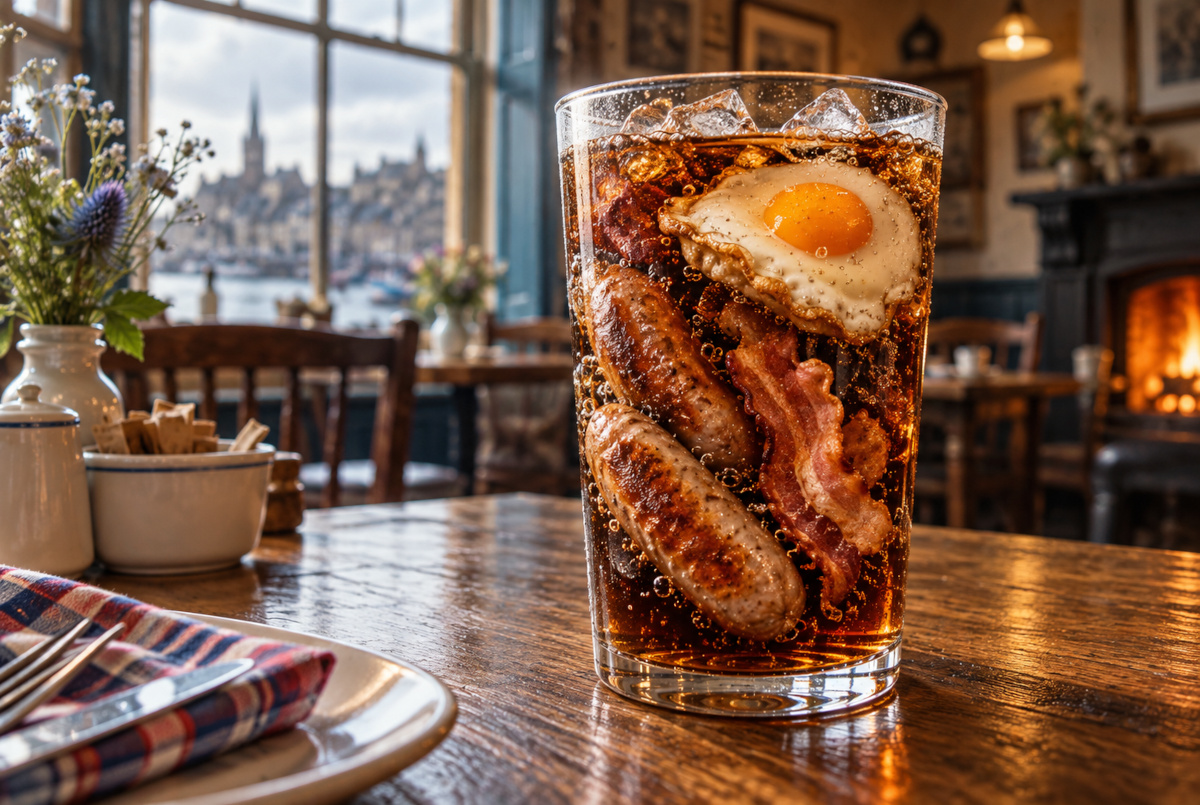
On October 19, 2026, British media reported that food delivery platform Just Eat had apologised for some remarkably strange menu images.
One showed what looked like a glass of cola. Floating inside were sausages, bacon and a fried egg.
No, this wasn’t an experimental breakfast drink. An AI image generator had apparently interpreted a menu item called “Breakfast Soda” as a fizzy drink containing breakfast ingredients.
Just Eat had been trialling AI-enhanced images for restaurants without photographs of their dishes. But after a series of bizarre results came to light, the company paused the rollout.
Here’s the particularly curious part: according to Just Eat, every AI-generated image had been manually checked by a person.
So what exactly did the AI misunderstand? And how did images like these get through human review? To find out, we compared local reporting with actual restaurant menus on Just Eat.
Breakfast Soda Is Bread, Not a Drink
One of the strangest examples came from Northern Ireland, which is part of the United Kingdom. Soda bread has a long place in the region’s food culture, particularly as part of a traditional cooked breakfast.
Its name comes from the baking soda (sodium bicarbonate) used to help the dough rise, rather than relying on yeast.
In Northern Ireland, “soda” can also refer to the bread itself. Fill that bread with sausages, bacon and egg, and you have a perfectly ordinary breakfast sandwich. There is no soft drink involved.
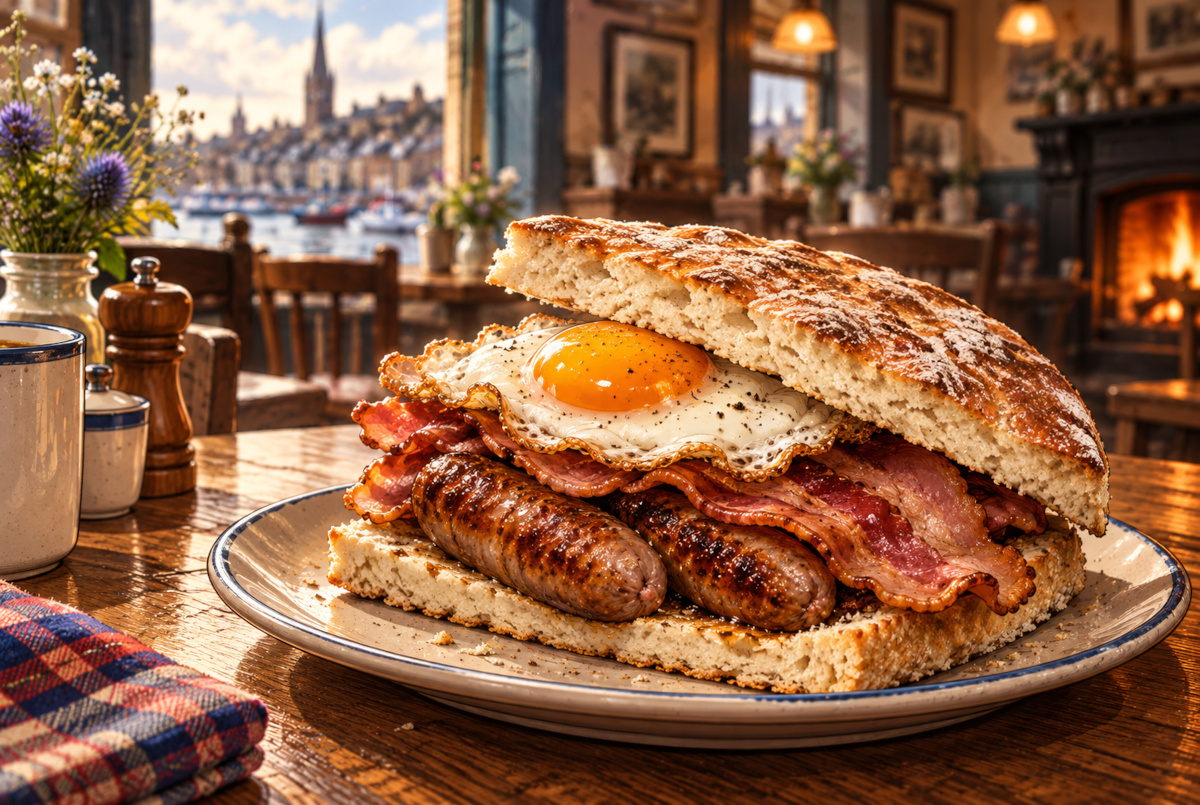
Illustration of a soda bread breakfast sandwich. This is not a photograph of a dish served by any of the restaurants mentioned.
Rather than relying entirely on news reports, we checked the menus of two Belfast restaurants listed on Just Eat.
At Fuchsia Cafe, an item is listed under the exact name “Breakfast Soda”. Its description specifies two sausages, two portions of bacon and a fried egg, all served inside the bread.
Another Belfast establishment, Charlotte’s Café, lists a “Bacon and Egg Soda”, described as bacon and egg in fried soda bread.
These are actual menu listings, not hypothetical examples. They independently establish that “soda” can mean bread in this local food context.
We could not establish whether either of these restaurants was responsible for the particular AI images that circulated online. The menus are evidence of the dish’s real meaning, not proof of which restaurant was involved.
Garlic Bread Planes and Cheese-Filled Sushi
The Breakfast Soda was hardly the only menu item to receive an unexpected makeover.
Reports from British trade publication The Grocer and Irish news outlet The Journal described several other failures. Grouping them by the apparent type of misunderstanding reveals a more interesting pattern than simply collecting funny pictures.
| Menu wording | What the AI depicted | Likely misunderstanding |
|---|---|---|
| Breakfast Soda | Breakfast ingredients floating in a fizzy drink | Regional food terminology |
| Garlic Bread Plane | An aeroplane made from bread | A spelling error interpreted literally |
| Cheese Roll | Sushi rolls filled with cheese | Multiple meanings of “roll” |
| Burger Sauce | A miniature burger inside a sauce pot | A sauce name interpreted as its contents |
| Sauvignon Blanc | Pieces of watermelon floating in wine | Flavour notes treated as actual ingredients |
| Smoked Cod | Fish topped with loose flour | Ingredient information treated as part of the finished dish |
“Garlic Bread Plane” is an especially revealing example. The intended word appears to have been “plain”, but the menu said “plane”. Instead of interpreting that as a possible typo, the AI produced an aircraft made of garlic bread.
The wine image followed a different route to absurdity. Watermelon was mentioned in the flavour notes for a Sauvignon Blanc, and the resulting image showed actual pieces of watermelon in the glass.
Look at these examples together and the failures are not all the same.
Regional language, spelling errors, ambiguous words, and the distinction between ingredients and flavour descriptions all seem to have played a part.
That does not tell us exactly what happened inside the image generator. Just Eat has not publicly identified the model or released the full prompts and processing instructions used for these examples. The categories above describe the visible errors, not a verified reconstruction of the AI’s internal reasoning.
Every Image Was Human-Checked. So What Was Being Checked?
The Journal reported a particularly important detail after contacting Just Eat: the company said every AI-generated image was manually checked by a person.
Yet pictures of flour-covered fish and sushi-like dishes still appeared on takeaway menus.
What does it actually mean to check an AI-generated food image?
There are at least three distinct tasks. First, does the image look visually plausible? Second, does it correspond to the menu item’s name? Third, does it accurately represent the food that this particular restaurant serves?
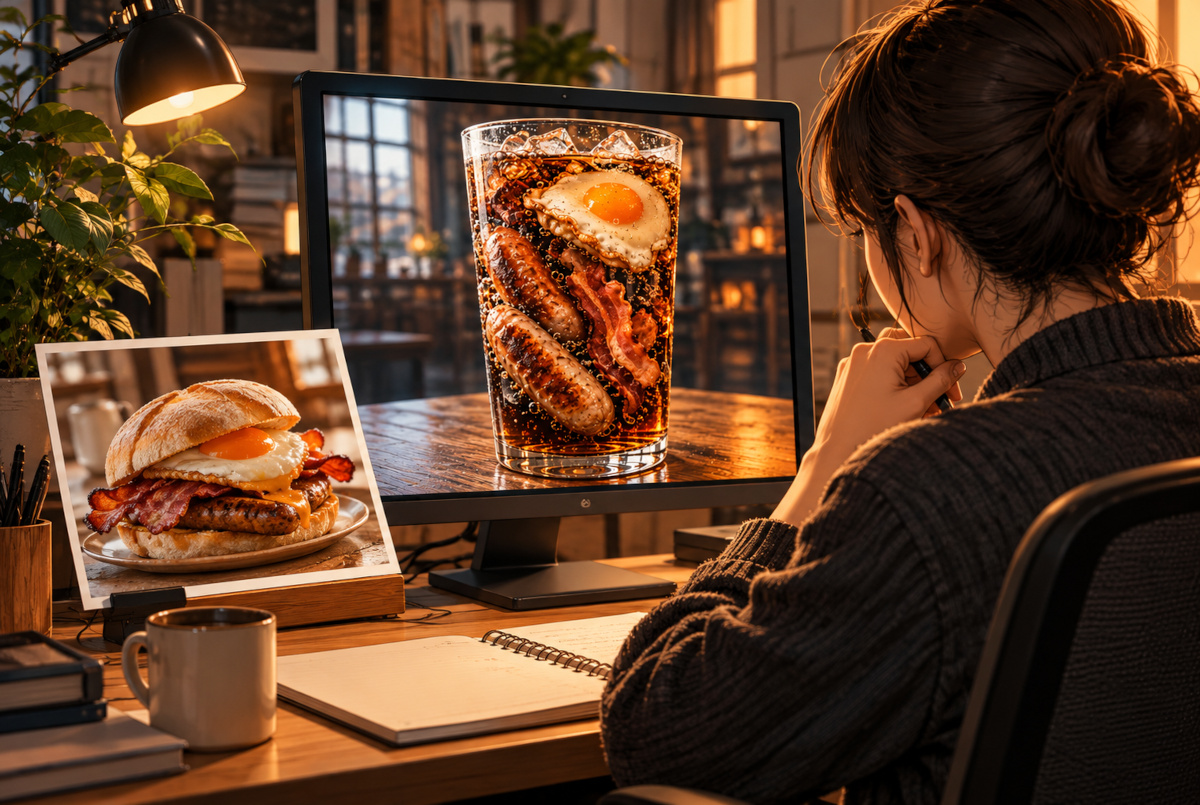
Conceptual illustration of food-image verification. It does not depict Just Eat’s actual staff, review process or internal systems.
A convincing-looking image can still be completely wrong if the reviewer doesn’t recognise the dish. And recognising the dish isn’t necessarily enough to establish that its ingredients and presentation match what an individual restaurant sells.
An image being “human-checked” is not the same as that image being verified against the actual product.
There is an important limit to what we can conclude. Just Eat has not disclosed precisely which criteria its reviewers used or how the checks were performed. There is no evidence that reviewers deliberately ignored the mistakes or approved images without looking at them.
The question is not whether humans are useless at checking AI output. It is whether the review process was designed to detect the right kinds of errors.
Does an “AI-Generated” Label Make an Inaccurate Menu Image Acceptable?
Just Eat labelled the images as “AI-generated”. That disclosed how the pictures were produced, but it raises a separate question: did the images accurately describe the products customers could order?
The UK’s Competition and Markets Authority (CMA) explains in its guidance on the Digital Markets, Competition and Consumers Act 2024 that misleading commercial practices can be unlawful when they affect consumer decisions.
Rule 3.1 of the UK’s CAP Code also prohibits marketing communications that materially mislead consumers or are likely to do so. Whether that particular advertising rule applies to these individual menu listings depends on the nature and context of the communications.
We have not identified any published regulatory finding that Just Eat’s specific AI-generated menu images breached either set of rules.
But the underlying distinction remains straightforward. Telling customers that an image was generated by AI does not, by itself, establish that the image is an accurate representation of the product.
The pictures may be funny. The purpose of a menu image, however, is to help someone decide what to order.
Why Did Just Eat Use AI for Food Pictures?
The idea behind the trial was not inherently unreasonable.
Hiring a professional photographer to shoot every dish can be expensive for a small independent takeaway. AI-generated or AI-enhanced images offer a potential way to fill gaps in a digital menu without the same production costs.
Just Eat also says it supports restaurants with food photography, including funding professional local photographers.
Following the controversy, the company said it was removing inaccurate AI images and pausing the rollout while it continued developing the tool. It had not announced that the technology was being abandoned altogether.
The total number of images generated, the number of restaurants involved, the error rate and any confirmed relaunch date remain unclear in the available public information.
What this episode illustrates is not that AI food images must always fail. It is the difficulty of deciding what a generated image should be checked against before it becomes part of a real commercial menu.
Editor’s Note
A fried egg floating in cola is certainly memorable. If that appeared on a takeaway menu, I’d have to look twice. Possibly three times.
But the bit that bothers me isn’t the AI misunderstanding a local dish. I can see how that happened. What bothers me is that the pictures reportedly went through human review as well.
If the reviewer doesn’t know the dish either, what exactly is being checked?
You could ask each restaurant to approve every image before it goes live. That sounds sensible enough. But if you’re putting all that work back on the restaurant, how much work was the AI supposed to save in the first place?
It’s funny when the result is bacon floating in a soft drink. It becomes less amusing if the same approach is used to illustrate machinery components or medical products.
The real problem may not be that AI makes mistakes. It’s that a system can give everyone the impression those mistakes have already been caught.
References
- Just Eat — Fuchsia Cafe, Belfast: Breakfast Menu
- Just Eat — Charlotte’s Café, Belfast: Breakfast Menu
- Visit Belfast — Local Cuisine in Belfast (October 6, 2026)
- The Independent — JustEat apologises over AI menu pictures including bacon and eggs floating in cola (October 19, 2026)
- The Grocer — Just Eat pauses AI imagery trial in wake of ‘absolutely rank’ outputs (October 20, 2026)
- The Journal — JustEat apologises for AI-generated slop after bizarre takeaway pictures found on Irish menus (October 20, 2026)
- UK Competition and Markets Authority — What businesses need to know about unfair commercial practices
- Advertising Standards Authority / CAP — CAP Code, Section 3: Misleading Advertising