

A drone over the neighborhood. Complaints about speed. A teenager riding a dirt bike. None of these sounds especially unusual as the starting point of a neighborhood dispute.
But in Lake County, Florida, a 69-year-old man with a history of conflicts involving nearby residents ended up in jail — and was then accused of asking another inmate to kill one of his neighbors. According to a probable cause affidavit reviewed by local media, the alleged offer included $5,000 up front.
The strangest part is that the case did not suddenly jump from “drone dispute” to “murder-for-hire allegation.” Over roughly six months, a series of relatively small neighborhood conflicts appears to have escalated one step at a time.

AI-generated illustration showing the structure of the case. It does not depict the actual people, vehicle, damage, homes or detention facility involved.
The drone was not where this story began
The man at the center of the case is David John Butka, 69, of Clermont, Florida. According to local reporting based on arrest records, Butka was arrested in March 2026 after a confrontation involving a 15-year-old riding a dirt bike through the neighborhood. Deputies accused him of pushing the teenager and damaging the dirt bike.
Then came July 22. This time, the conflict involved what authorities described as an ongoing civil dispute over Butka’s drone use. During the confrontation, witnesses told deputies that Butka threw a rock at a passing truck. The vehicle was left with dents and marks, and Butka was arrested on an aggravated assault charge. He denied throwing anything.
In other words, this was not simply a case in which someone flew a drone and suddenly decided to arrange a killing. Friction with people in the neighborhood had already been building. The drone appears to have been another trigger in a much longer pattern of conflict.
He posted bond — and then went back to jail
After the July arrest, Butka posted a $5,000 bond and was released. Authorities later said he violated the conditions of his bond by attempting to leave the country, and he was returned to custody on September 1.
According to investigators, sometime around September 7 or 8, Butka approached another inmate and asked him to kill a neighbor. The intended target was also a witness in previous criminal cases involving Butka.
The alleged request was remarkably specific. According to the probable cause affidavit, Butka provided the person’s name, physical description, morning routine and information that could be used to locate the home. He allegedly said he had about $1.3 million in the bank and offered $5,000 up front.
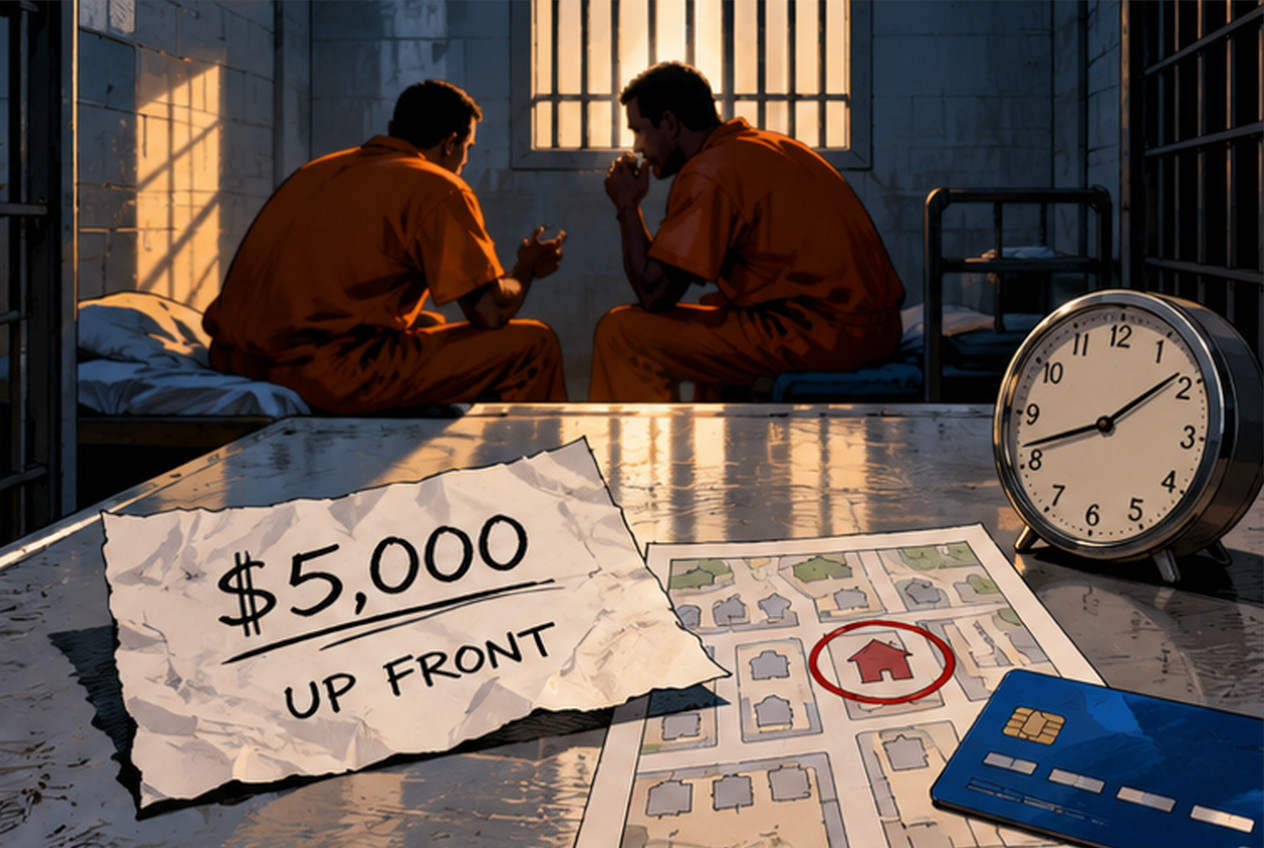
AI-generated explanatory illustration. It does not reproduce the actual jail, inmates, handwritten note, map or credit card involved in the investigation.
The strange trail of paper and money
What prevented the allegation from remaining just another jailhouse conversation was the trail investigators say it left behind.
According to local reporting on the affidavit, Butka completed a property-release form allowing his credit card to be collected by the other inmate’s wife. Investigators said that $300 was later transferred from Butka’s card into the inmate’s commissary account. Detectives also obtained a handwritten note containing information about the intended target’s home and a reference to “$5,000 up front” from the card.
On September 16, an inmate reported the alleged plot to detention staff. Butka had been scheduled for court and release the following day, September 17. Instead, he was arrested on a new charge of solicitation to commit first-degree murder.
That timing may be the most puzzling part of the case. If Butka was about to be released, why allegedly try to arrange the killing of a witness from inside the jail? A Lake County Sheriff’s Office spokesperson said investigators were still unclear about the motive, while suggesting anger or revenge as possible explanations. Those possibilities have not been established as fact.
Butka says there was no murder-for-hire deal
None of this has been proven in court, and Butka denied soliciting anyone to kill his neighbor.
When interviewed by detectives, he acknowledged discussing money and his pending case with another inmate but said the financial arrangement involved $2,400 for hiring a new attorney. He denied authorizing the release of his credit card to the inmate’s wife and told investigators he believed he was being defrauded.
So the central allegation — that the $5,000 was a down payment for a killing — remains exactly that: an allegation to be tested in the legal process. Investigators, however, say their case involves more than one inmate’s word, pointing to the handwritten note, the card-release paperwork and the $300 transfer.
The drone itself may not have been illegal
There is another detail worth separating from the more sensational headlines: flying the drone was not, by itself, the criminal charge at the center of the July arrest.
Florida’s Freedom from Unwarranted Surveillance Act restricts certain uses of camera-equipped drones to conduct surveillance of private property or people where there is a reasonable expectation of privacy. But there is no indication in the reporting reviewed for this article that Butka was charged under that law. The July records instead described the drone issue as an “ongoing civil issue.”
Reducing the story to “angry drone pilot tries to hire a hitman” misses its real B-side. The unusual part is the escalation: a dispute involving a teenager and a dirt bike, another dispute involving a drone, an alleged rock thrown at a truck, an arrest, a bond violation, a return to jail — and finally an alleged solicitation to kill a witness.
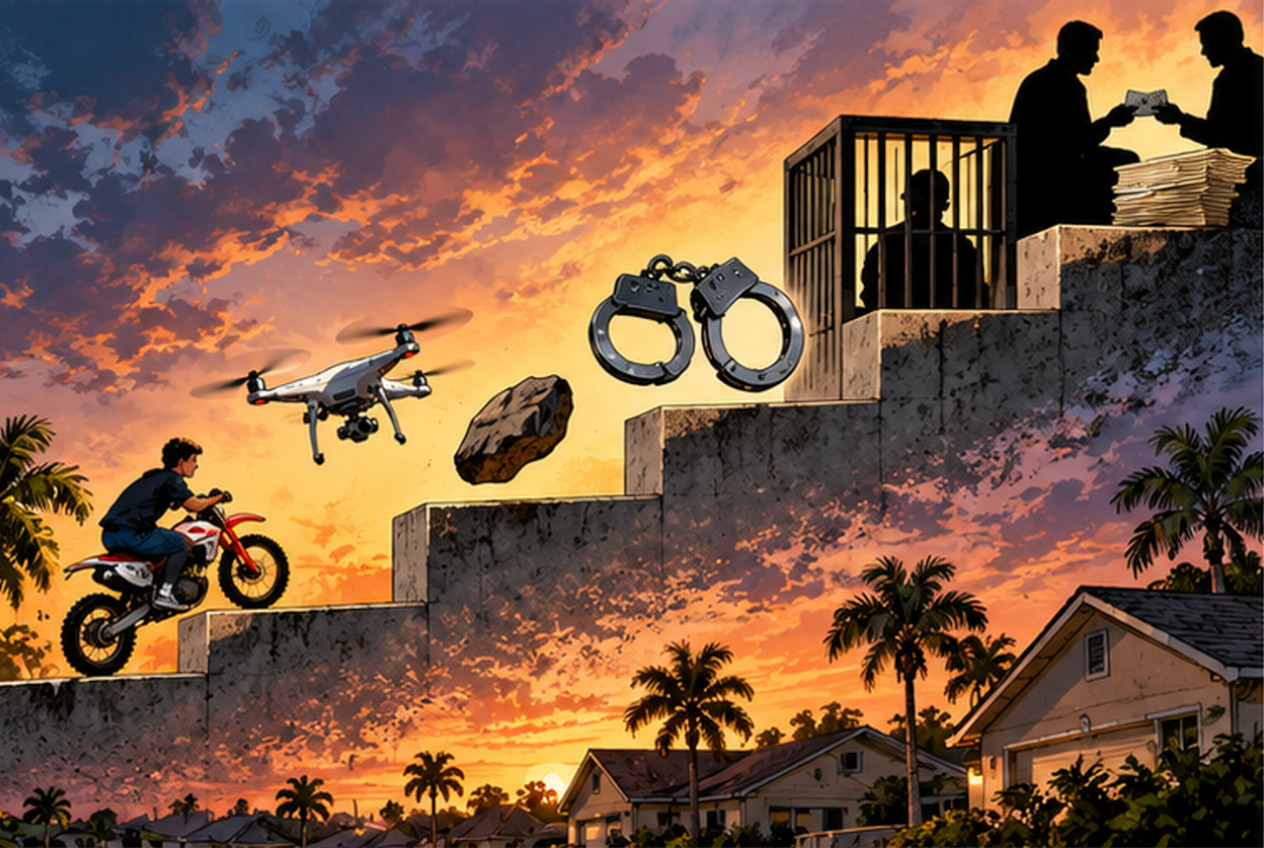
AI-generated conceptual illustration of the case timeline. It does not depict the actual people, location, detention facility or any real transfer of cash.
In Florida, asking can itself be a serious felony
Under Florida Statutes §777.04, a person can commit criminal solicitation by commanding, encouraging, hiring or requesting someone else to engage in conduct that would constitute a crime. The underlying crime does not have to be successfully carried out for a solicitation charge to exist.
Premeditated first-degree murder is classified as a capital felony under Florida Statutes §782.04. When the offense being solicited is a capital felony, §777.04 classifies the solicitation as a first-degree felony. Under Florida’s general sentencing statute, a first-degree felony can carry a prison term of up to 30 years, although the actual outcome in Butka’s case will depend on the prosecution, any conviction and the eventual sentencing process.
The drone is what makes the headline memorable. But it may not be the most important part of the story. The more revealing question is how a chain of ordinary neighborhood grievances kept escalating until prosecutors were looking at an alleged murder solicitation.
Editor’s Note
There is a point in some neighborhood disputes where the original problem almost stops mattering. It is no longer about the dirt bike, the drone or the speed of a vehicle. It becomes about who is going to win and who refuses to back down.
Seen from Japan, that part feels uncomfortably familiar. We have our own endless feuds over noise, parking, garbage collection and property boundaries. Most never become criminal cases, of course. But the psychology is recognizable: once someone decides, “I am going to teach that neighbor a lesson,” a very small problem can start consuming an absurd amount of time, money and judgment. In this Florida case, the disturbing part is not the technology hovering in the sky. It is how far human stubbornness is alleged to have traveled on the ground.
References
- WFTV — “Inmate allegedly offered $5,000 to kill witness in his criminal case” (September 18, 2026)
- Inside Lake — “Lake County Jail inmate accused of offering $5,000 to have witness killed” (September 18, 2026)
- FOX 35 Orlando — “Murder-for-hire: Lake County inmate accused of plot targeting witness” (September 18, 2026)
- WESH 2 — “Neighbors fighting over drone in Central Florida turns into murder-for-hire plot, docs show” (September 18, 2026)
- The Florida Senate — 2026 Florida Statutes §777.04, Attempts, solicitation, and conspiracy
- The Florida Senate — 2026 Florida Statutes §782.04, Murder
- The Florida Senate — 2026 Florida Statutes §775.082, Penalties
- The Florida Senate — 2026 Florida Statutes §934.50, Searches and seizure using a drone