
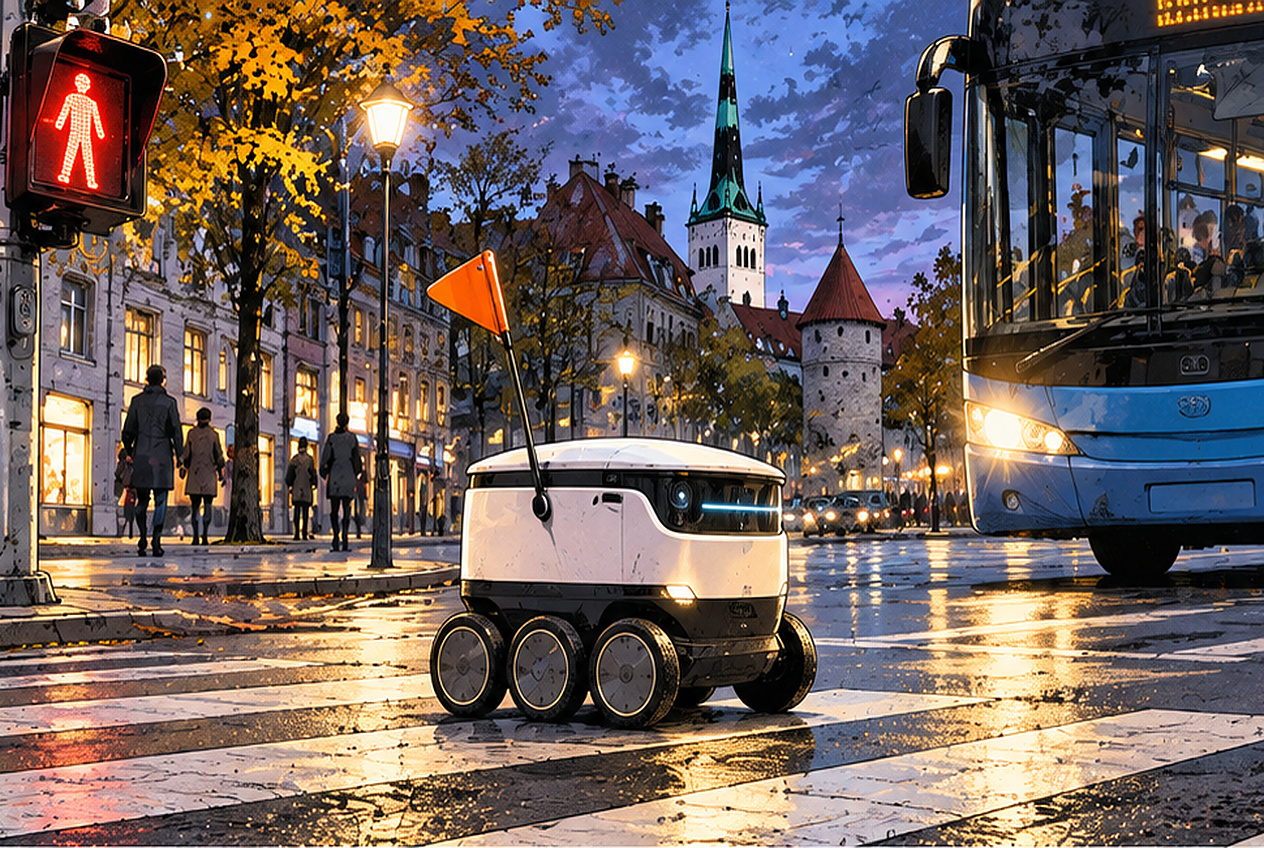
On October 26, 2026, at around 6 p.m., an unusual traffic accident unfolded in Tallinn, Estonia’s capital.
A small autonomous delivery robot entered a pedestrian crossing against a red light. A city bus driver braked sharply, sending standing passengers tumbling inside the vehicle. According to Tallinn’s public transport operator, as many as nine people were injured.
Bus-camera footage also showed the vehicle making contact with the robot and pushing it along the road.
Then came an even stranger detail: the robot reportedly drove away from the accident scene.
A delivery robot had apparently run a red light, caused a bus accident, and then fled. But a closer look at subsequent reports reveals that the word “fled” tells only one side of the story.
A Six-Wheeled Robot in the Path of a City Bus
The collision happened at the intersection of Luise and Tehnika streets, close to central Tallinn.
The machine was a six-wheeled delivery robot developed by Starship Technologies. It carried Bolt branding, associated with the local delivery service.
According to municipal transport operator Tallinna Linnatransport (TLT), the robot approached from Tehnika Street and entered the pedestrian crossing while the signal was red. The bus driver attempted to avoid a collision by braking suddenly.
Several standing passengers fell. Footage from the bus, reported by Estonian Public Broadcasting (ERR), showed the bus making contact with the robot and pushing it forward.
There is an important distinction in the injury figures. TLT reported up to nine injured passengers, but that is not necessarily the number of medically confirmed injuries. The company subsequently received a health-related complaint from a passenger.
The incident was therefore more than a harmless encounter between a small robot and a much larger vehicle.
Did the Robot Really Flee the Scene?
In its October 28 report, ERR quoted TLT representatives describing how the robot had driven away after the collision.
In a conventional traffic accident, leaving the scene without fulfilling the required duties could raise questions about a hit-and-run offense.
Starship Technologies, however, offered a different account.
Pepe Aaviksoo, the company’s head of operations, said the robot contacted a remote support team following the collision. The team moved it out of the roadway to a safer position near the curb.
According to Aaviksoo, the robot remained near the accident scene for approximately ten minutes.
There is another detail worth considering: the bus also left the immediate scene.
TLT said the driver asked passengers whether anyone needed an ambulance. Nobody requested one at that time. After speaking with the transport control center, the driver was instructed to continue the route, partly because remaining at the intersection during rush hour could obstruct traffic.
These were different actions taken under different circumstances. Neither account, by itself, establishes that all legal obligations were met.
Moving away from the point of impact is not necessarily the same as attempting to evade responsibility. Whether the robot’s movement was an appropriate safety response or an inadequate accident response cannot be settled from the publicly available accounts alone.
How Could a Robot Misread a Red Light?
Starship’s explanation points to several factors operating together rather than one simple mistake.
The intersection was dark. An illuminated advertisement stood behind the traffic lights, while pedestrian and vehicle signals appeared within the robot’s field of view.
Aaviksoo also said the robot’s light sensitivity was not functioning as expected. The company acknowledged a signal-reading error and indicated that improvements would primarily involve software.
But how dark was it when the collision happened?
To put the reported lighting conditions into context, we compared sunset times for Tallinn immediately before and after the accident.
| Date | Sunset (local time) |
|---|---|
| October 24, 2026 | Approximately 5:48 p.m. |
| October 26, 2026 | Approximately 4:43 p.m. |
The difference is approximately 65 minutes. Most of that change in clock time came from Estonia’s transition out of daylight saving time on October 25, when clocks were moved back one hour.
By the time the accident occurred at around 6 p.m. on October 26, more than an hour had passed since sunset.
This comparison does not establish that the daylight saving time change caused the collision. It does show why the same clock time could correspond to noticeably different lighting conditions just a few days apart.
What remains unknown is exactly how the robot interpreted the conflicting visual information. The company has not publicly established whether the advertisement itself was mistaken for a signal, whether multiple traffic lights were confused, or precisely how the light-sensitivity problem affected the decision.
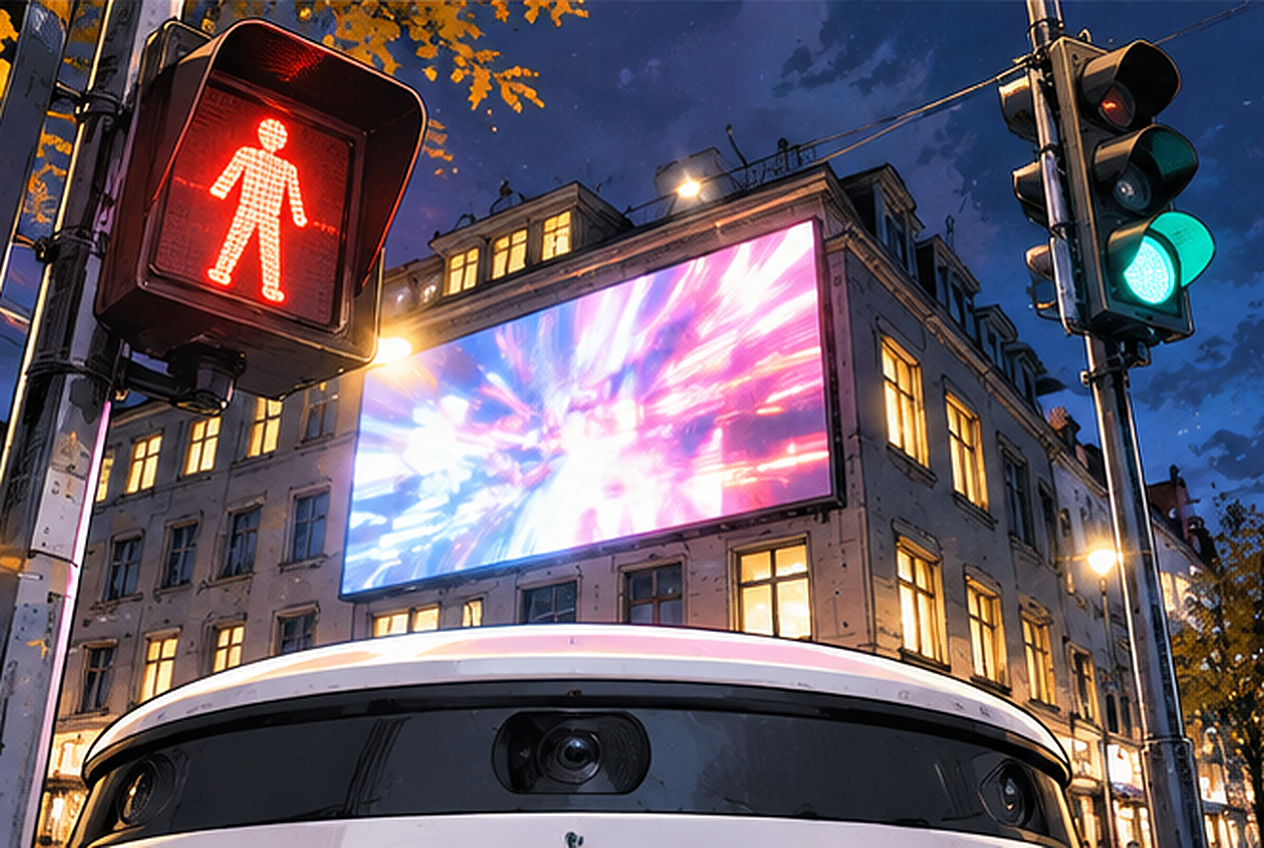
AI-generated conceptual illustration. It does not reproduce the actual intersection or the robot’s camera footage.
Estonia Already Had Traffic Rules for Delivery Robots
One of the most interesting aspects of this accident is that Estonia was not facing an entirely new legal problem.
The country introduced specific traffic rules for self-driving delivery robots in 2017.
Under Section 1514 of Estonia’s Road Traffic Act, a delivery robot must assess whether it can cross a roadway safely. It generally does not have priority over vehicles at pedestrian crossings, subject to exceptions such as vehicles turning into its crossing path.
Section 169(8) also addresses accidents involving delivery robots. The operator or user must ensure the robot stops and does not create additional danger. If an injury can be recognized through a camera or other means, the relevant person must notify the emergency response center and follow its instructions.
Moving a robot out of an active traffic lane may therefore be a necessary safety measure. But moving it to safety does not, on its own, prove that every accident-related obligation has been fulfilled.
There is another provision that makes this case particularly interesting.
Section 1512(7) allows traffic supervision authorities or courts to require records of a delivery robot’s movements, including its location, speed, control instructions and certain sensor-detected problems that prompted human intervention.
The law sets out a requirement to save and submit specified data when requested within six months of the robot’s use. It does not mean that every conceivable camera image or internal decision is necessarily available for reconstruction.
If relevant records from this incident are available, they could help establish when the robot stopped, when remote support intervened and where the machine moved afterward.
However, the actual incident logs and the final investigation findings have not been made publicly available in the reports reviewed for this article.
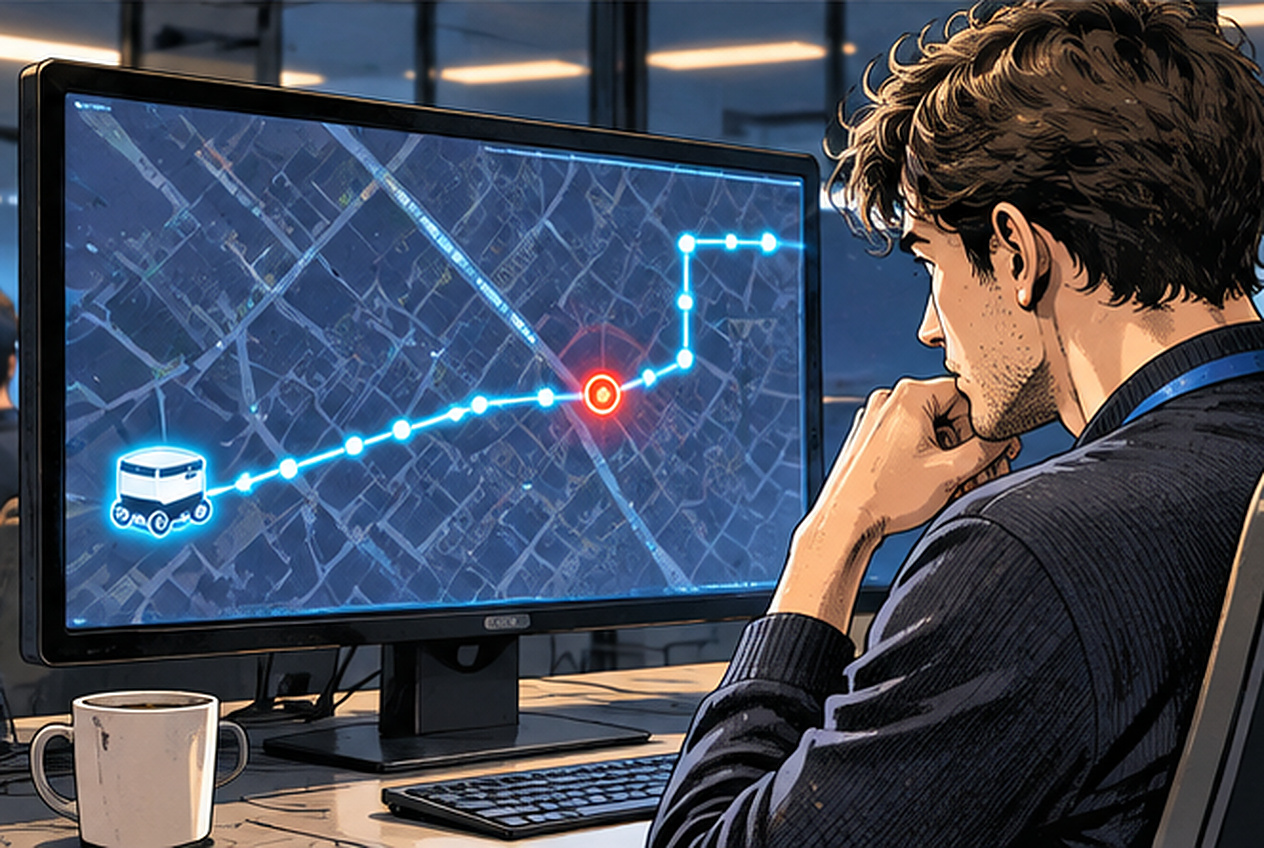
AI-generated illustration using fictional route data and a fictional monitoring interface. It is not a reproduction of Starship’s actual system or incident records.
More Than 4,000 Successful Crossings. Why Did This One Go Wrong?
Following the accident, Starship rerouted its delivery robots to avoid the intersection while the incident was investigated.
According to the company, its robots had previously crossed that same junction successfully more than 4,000 times.
At first glance, that sounds like a reassuring safety record. But it raises a more difficult question: what made this crossing different?
More than 4,000 successful crossings cannot be converted directly into a reliable accident probability. We do not know the complete number of hazardous encounters, the distribution of crossings by time of day, or how often similar lighting conditions occurred.
There is also a striking mismatch between the size of the machine and the scale of the consequences.
Under Estonia’s Road Traffic Act, the speed limit for a self-driving delivery robot is 6 km/h, equivalent to approximately 1.67 meters per second.
The robot’s actual speed at the moment of this collision has not been confirmed. Nevertheless, a slow-moving machine can create a dangerous situation if its movement forces a much larger vehicle to brake abruptly.
That brings us to another question: who compensates the bus passengers?
According to Lauri Potsepp of the Estonian Motor Insurance Bureau, passengers injured by a bus braking suddenly can claim compensation through the bus’s motor insurer, regardless of who ultimately caused the incident.
If the delivery robot or its operator is later found responsible, the insurer may seek reimbursement from the robot’s owner.
In other words, a small delivery robot’s mistake can produce consequences far beyond damage to the robot itself: injured passengers, insurance claims, traffic safety questions and a dispute over responsibility for autonomous systems.
Editor’s Note
What bothers me most is the claim that these robots had successfully crossed the same intersection more than 4,000 times. If a system can handle a junction thousands of times, what makes it suddenly misread the signals on one particular evening?
With a human driver, we might say someone was distracted. With a robot, that explanation is nowhere near enough. We need to know what the machine detected, how it made its decision and what safeguards failed.
And then there is the supposed escape. The robot may have been moved to safety rather than trying to flee. But somebody still has to recognize that an accident has occurred, secure the scene and explain what happened.
I have no objection to delivery robots becoming a normal part of city life. What I find strange is how quickly the conversation shifts from what the robot did to who should answer for it.
You can automate a delivery. You cannot simply automate away accountability.
References
- ERR, October 28, 2026 — “Passengers injured after collision between bus and delivery robot in Tallinn” — Original accident report, location, passenger injuries and bus-camera footage.
- ERR, October 29, 2026 (updated October 30) — “Starship plans software changes to improve delivery robots’ safety” — Starship’s explanation, remote intervention, insurance and comments from Estonia’s Transport Administration.
- ERR, October 28, 2026 — “Pakirobot põhjustas vigastatutega liiklusõnnetuse” (original-language Estonian report) — Starship’s statement, temporary route changes and the previously reported 4,000-plus crossings.
- Riigi Teataja, Estonia’s official legal database — Road Traffic Act (English translation, 2026 version) — Section 15, Sections 1512–1515, and Section 169(8).
- Time and Date — Sunrise and Sunset Times in Tallinn, October 2026 — Sunset-time comparison and local daylight conditions.
- Calendar Center — Tallinn Sunrise and Sunset Times, 2026 (Estonian-language astronomical calendar) — Additional reference for the late-October sunset-time comparison.