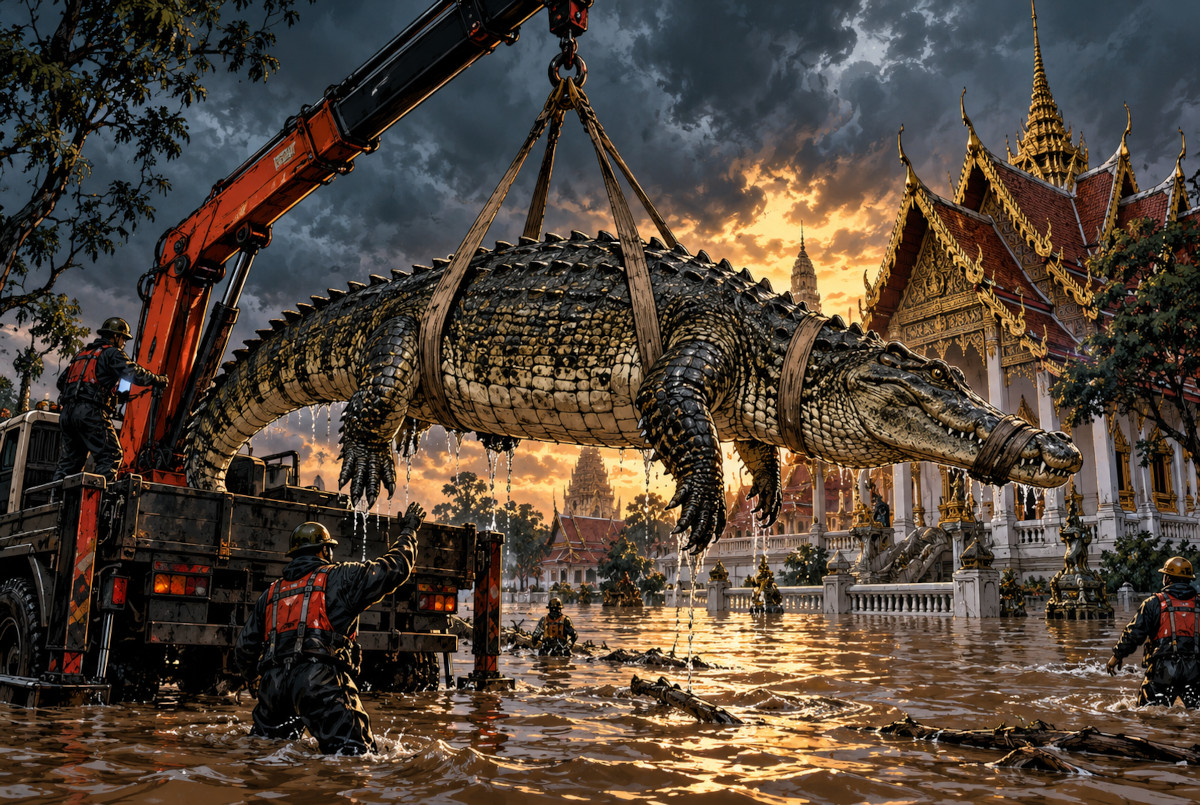
On September 27, 2026, floodwaters were rising around Wat Pho Thong in Prachin Buri Province, eastern Thailand. Among the things that suddenly needed evacuating was something no disaster response plan could make look ordinary: a 27-year-old crocodile more than four metres long and weighing over 400 kilograms.
The crocodile, named Nuea Thong, was still inside its enclosure when water around it reached roughly 1.3 metres. With floodwater continuing to rise, officials feared the animal could leave the enclosure and eventually reach the nearby Prachin Buri River. The important part of this story is that the crocodile never escaped. The evacuation happened before it could.
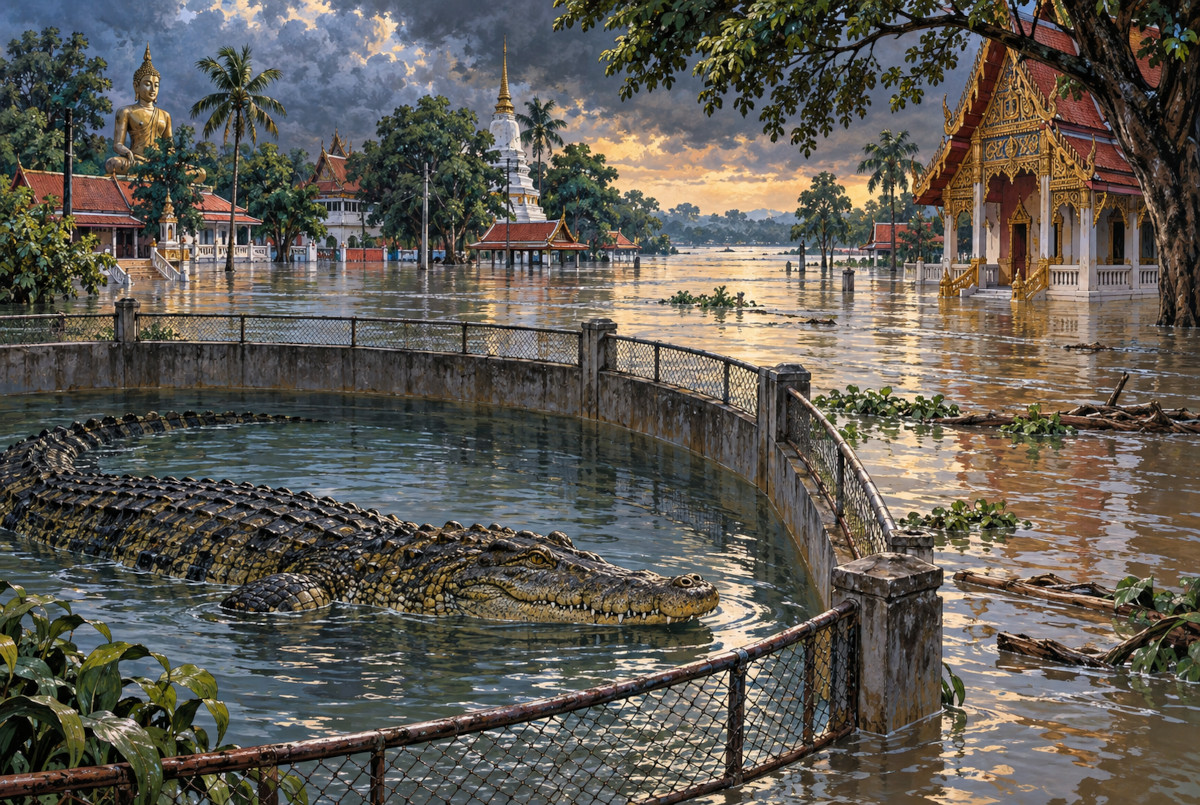
AI-generated explanatory illustration. It does not reproduce the actual layout of Wat Pho Thong, the real crocodile, or a news photograph from the scene.
The crocodile never escaped — that was the point
After the temple asked for help, Si Maha Phot district chief Juthamas Buaphuean coordinated the operation with the Department of Fisheries, Ruamkatanyu Foundation rescue volunteers and local residents. Nuea Thong’s jaws and legs were secured with ropes, and the animal was moved out toward the road.
A truck-mounted hydraulic crane then lifted the crocodile onto a transport vehicle. It was taken to a temporary holding site in another subdistrict, around 20 kilometres away, where flooding had not reached. This was not a story about authorities chasing a 400kg crocodile after it escaped. It was a story about preventing that story from happening in the first place.
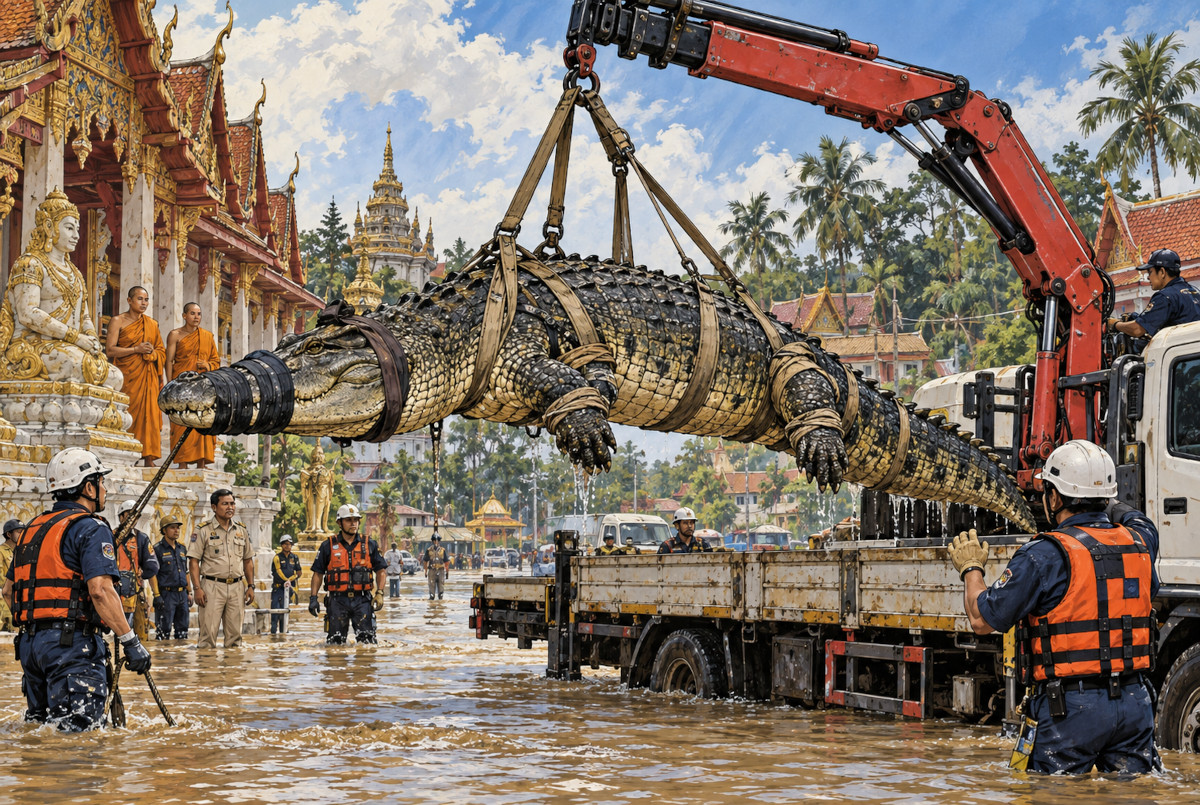
AI-generated explanatory illustration. It does not depict the actual rescue workers, crocodile or evacuation scene involved in the incident.
This was part of a real flood emergency
The visual is strange enough to become a curiosity on its own: a huge crocodile, a temple and a crane standing in floodwater. But the surrounding disaster was not trivial. On September 27, Thailand’s disaster authorities reported flooding across Prachin Buri Province affecting 4,106 households, with water levels still rising.
The Thai Meteorological Department had also warned of heavy rain across the eastern region. Local government reporting indicated that the Prachin Buri River could continue to rise. In other words, the problem was not simply that one crocodile enclosure had become wet. The surrounding landscape itself was gradually turning into one continuous body of water.
That distinction matters. A fence can separate an animal from dry ground under normal conditions. During a serious flood, however, the water on both sides can eventually become connected. Once the enclosure, temple grounds and surrounding waterways begin functioning as the same water system, waiting for a 400kg crocodile to escape before taking action would be the much stranger decision.
Why was a temple keeping a 400kg crocodile?
From a Japanese perspective, that may be the next obvious question. A crocodile large enough to require a crane is not something most people in Japan expect to find on a temple’s disaster-response checklist.
Thailand’s Department of Fisheries says the country is home to species including the Siamese crocodile and saltwater crocodile. They are protected wildlife, but breeding, trade and possession of certain crocodile species can be carried out under the relevant legal framework and permits. Crocodile farming is also treated as a regulated aquaculture activity, and provincial fisheries offices conduct checks related to crocodile possession and facilities.
Flooding is an obvious part of that management problem. Fisheries authorities have previously advised that crocodile enclosures need to be structurally secure enough to prevent animals from climbing, digging or escaping, particularly during natural disasters and floods.
There is one limit to what can be said about Nuea Thong itself. The reports reviewed for this article do not establish the crocodile’s species, the exact permit arrangements for this particular animal, or how long it had been kept at Wat Pho Thong. Being 27 years old does not automatically mean it had lived at the temple for 27 years, and its size alone is not enough to identify the species.
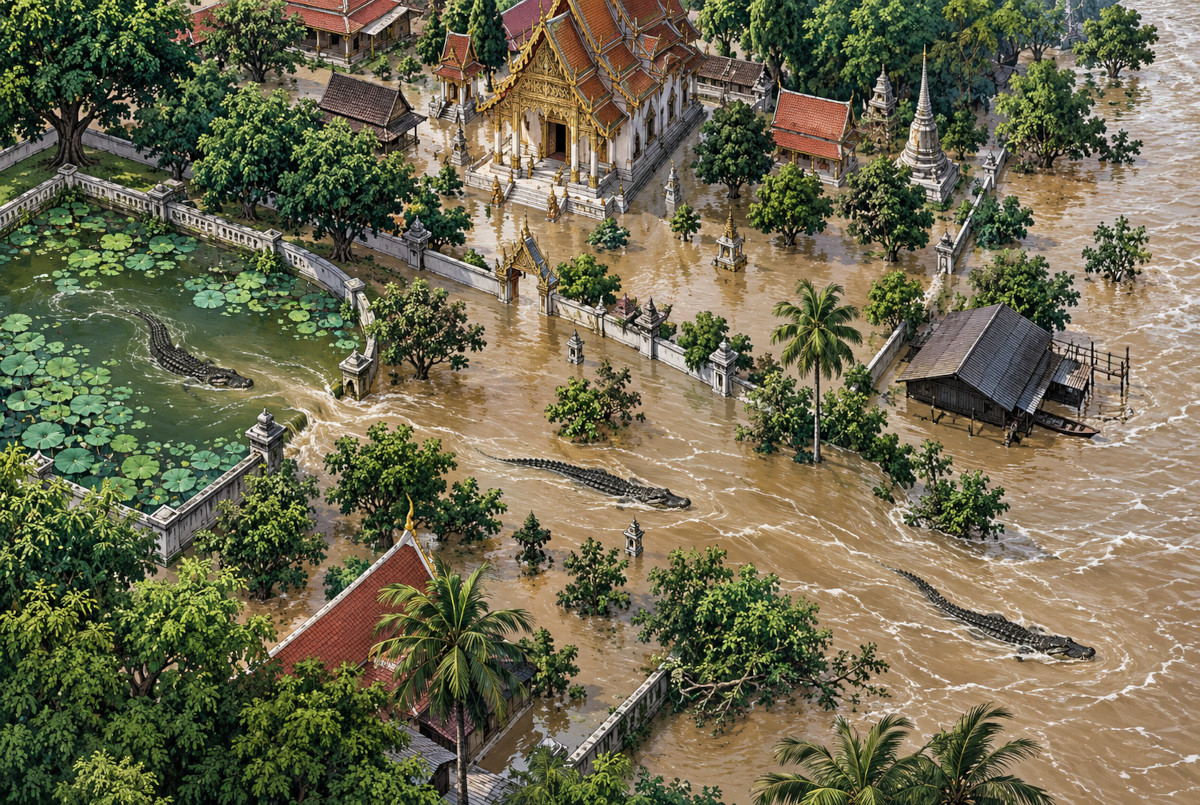
AI-generated schematic illustration. The multiple crocodile positions represent the possible movement of the same animal from the enclosure through floodwater toward the river; they do not indicate that several crocodiles were involved. The image does not reproduce the actual geography of the site.
It looked absurd. The response itself was not
Thailand produces its share of stories that can look chaotic or improvised from the outside, and a 400kg crocodile living at a temple during a major flood certainly has all the ingredients of a B-Side Earth headline.
But reducing this case to another example of things going wrong in Thailand would miss what actually happened. The temple asked for help before the animal escaped. District officials coordinated with fisheries authorities and rescue volunteers. The crocodile was moved roughly 20 kilometres away before it could enter a public waterway.
The image belongs in an old pulp magazine: a flooded Buddhist temple, a crane and a giant crocodile hanging in mid-air. Yet beneath that image was a fairly conventional piece of preventive disaster management. The scene was B-grade. The response was surprisingly sensible.
Editor’s Note
What caught my attention was not that the crocodile broke through a fence. It didn’t. Nobody accidentally let it loose either. The flood was gradually making the idea of a separate “crocodile pond” meaningless. Once the water outside rises high enough, even a perfectly obvious boundary on an ordinary day can stop functioning as a boundary at all.
Seen from Japan, there is still something wonderfully surreal about imagining a local disaster meeting where someone says, “Next item: we need to evacuate the temple’s 400-kilogram crocodile.” I suspect there would be a short silence in most Japanese municipal offices.
But this is also where the story turns against the easy stereotype. It would be tempting to look at Thailand, see the crocodile and the crane, and conclude that somebody had failed spectacularly. In this case, the opposite is closer to the truth. The temple called early, the authorities responded and the animal was moved before it became a public-safety problem. The picture looks like pure B-movie material. The actual response was closer to an A-grade precaution. That’s the part I find interesting.
References
- Thai Meteorological Department — Daily weather forecast for September 27, 2026
- Government Public Relations Department / Department of Disaster Prevention and Mitigation — Flood situation summary for September 27, 2026
- Government Public Relations Department — Report on the Prachin Buri flood situation and rising river levels
- Thailand Department of Fisheries — Crocodiles in Thailand: species, protection and regulatory framework
- Prachin Buri Provincial Fisheries Office — Inspection of crocodile holdings under the SP.15 possession permit system
- Nakhon Nayok Provincial Fisheries Office — Guidance on securing crocodile enclosures during storms and flooding
- The Nation Thailand — “400kg crocodile moved from flooded Prachinburi temple”
- Amarin TV — Report on the evacuation of Nuea Thong from the flooded temple