

“Welcome aboard.” A new employee heard some version of that on his first day in a Bangkok office. By that same afternoon, he was gone—and more than ฿400,000 worth of his employer’s valuables were allegedly gone with him.
On October 5, 2026, a 37-year-old Thai man allegedly stole valuables from his female employer’s private room at an office on Yaowarat Road, Bangkok’s historic Chinatown district. The employer reported the case to Chakkrawat Police Station the following day.
The strange part is not simply that an employee allegedly stole from an employer. It is that this was his first day.
Interviewed on October 1, at work on October 5
According to the report, the employer advertised the job online and interviewed the applicant on October 1. She later said she noticed nothing particularly concerning during the recruitment process.
October 5 was his first day at work. At around 2 p.m., he allegedly took valuables worth more than ฿400,000 from the employer’s private room on the second floor and left the premises. CCTV footage reportedly captured him, and the employer later offered a ฿20,000 reward for information leading to his arrest. As of the October 7 report, he had not been detained.
There is one detail worth keeping straight: the report does not say that ฿400,000 in cash was stolen. The specific items have not been disclosed. What has been reported is that the missing valuables were worth more than ฿400,000. The business name and the position for which the man was hired were also not made public.

AI-generated illustration. It does not depict the actual people, building or location involved in the incident.
It is tempting to blame “mai pen rai.” The facts are less convenient.
Seen from Japan, Thailand is sometimes lazily reduced to the phrase mai pen rai—roughly, “no worries” or “never mind”—as shorthand for an easygoing national character. A story about an online hire allegedly stealing from his employer on day one almost invites that stereotype.
But once you look at the system behind the story, the easy explanation starts to fall apart.
Thailand does have a formal criminal-record checking system that can be used when applying for jobs. In fact, the Royal Thai Police’s Criminal Records Division launched an online criminal-history checking service on July 15, 2026, less than three months before this incident.
Thailand’s Government Public Relations Department specifically described employment applications as one of the purposes for which people may need criminal-record documents. Applicants can submit a request online, verify their identity through the ThaiD app or the laser code on a national ID card, pay electronically, and receive the result by email.
What we do not know is whether this employer asked the new hire to provide such a check. Nothing in the available report establishes that. It would therefore be a leap to say that the theft happened because the employer “failed to do a background check.”
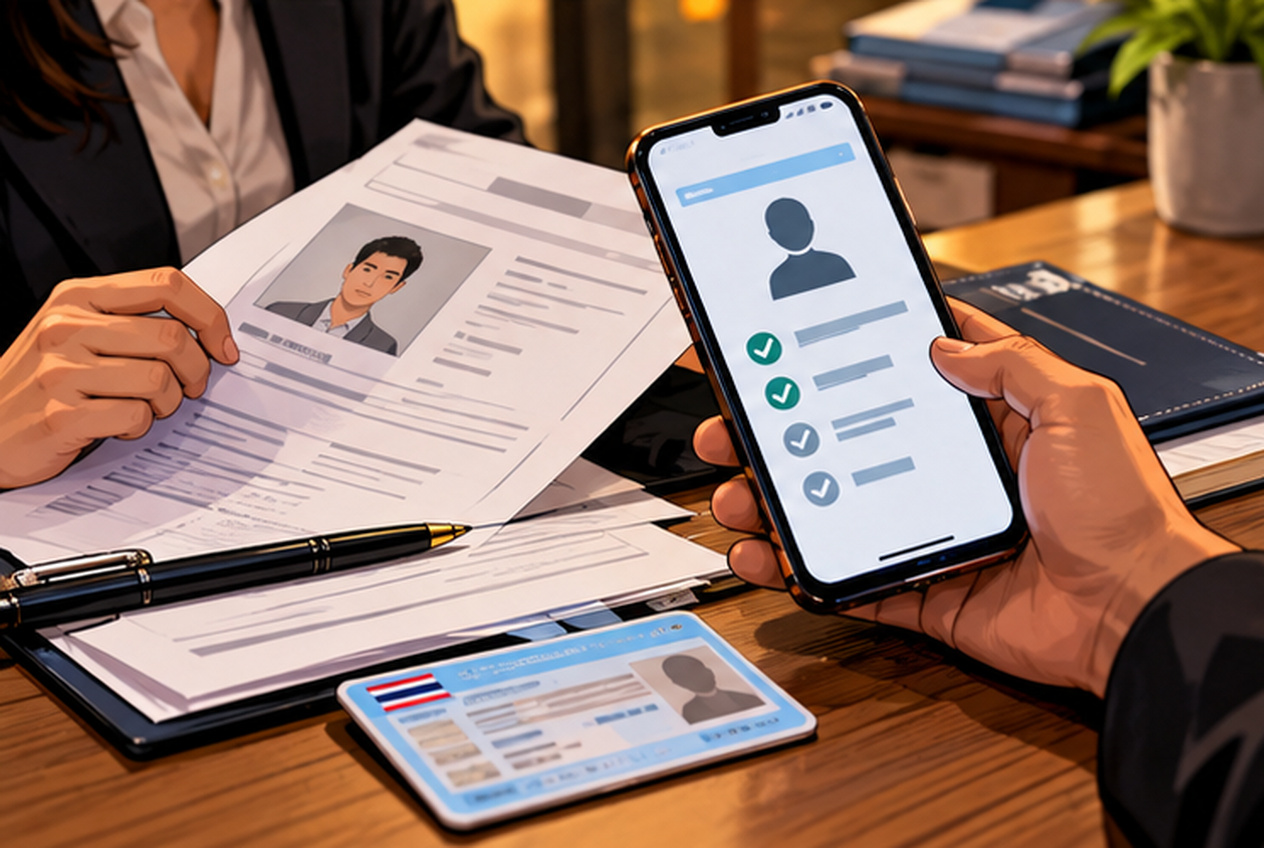
AI-generated explanatory illustration. It does not reproduce the actual ThaiD interface, a real Thai ID card, or any real applicant.
A criminal record is not something an employer can simply rummage through
Thailand’s Personal Data Protection Act, or PDPA, treats criminal-history information as sensitive personal data, alongside categories such as health and biometric information.
So the answer is not simply: “Employers should check everybody’s criminal history and be done with it.” Access to and processing of that information is legally restricted, and the official online service itself is built around identity verification.
There is another problem with the background-check theory anyway. Even if a person produces a clean record, a clean record cannot predict what that person will do tomorrow. A background check is a security measure, not a crystal ball.
The real question: how did a first-day hire reach the private room?
This is where the B-side of the story becomes more interesting.
How did someone who had only just started working there end up in a position to reach more than ฿400,000 worth of property inside his employer’s private room by 2 p.m. on day one?
That question cannot yet be answered from the public reporting. We do not know whether his duties required him to go upstairs. We do not know whether the private room was locked. We do not know whether he entered without permission, had been shown the room, or simply found an opportunity.

AI-generated illustration. It does not depict the actual scene, people or stolen property. The specific stolen items have not been disclosed; the cash, watch and jewelry shown here are fictional visual examples only.
That also means this case is not evidence that “Thai companies have poor security.” One incident cannot support a claim that broad.
What it does highlight is a more universal problem: hiring checks and workplace access are two different layers of security. Knowing who a new employee is does not answer the separate question of which rooms, keys, documents, devices or valuables that person should be able to reach on day one.
That issue is hardly unique to Thailand. A small business, family-run shop or office in Japan—or almost anywhere else—can face exactly the same gap between “we hired this person” and “we should trust this person with unrestricted access.”
Thai law is not particularly “mai pen rai” about employee theft either
Section 335 of Thailand’s Penal Code includes theft of property belonging to, or in the possession of, an employer among the circumstances that can make theft an aggravated offence. Where the provision applies, the stated penalty is imprisonment for one to five years and a fine of ฿20,000 to ฿100,000.
That does not mean Section 335 has already been established as the charge in this case. The final legal classification can depend on the facts, including possession and control of the property, and the available report does not give enough detail to settle that question.
On the surface, this looks like the sort of odd crime story that can be filed away under “only in Thailand.” Dig a little deeper, though, and that description becomes too easy.
Thailand had a criminal-record checking system. It had just made that system easier to use online. Yet no screening system can close the separate gap between hiring somebody and deciding what that person can access after walking through the door.
Editor’s Note
My first reaction was exactly the lazy one: “Thailand again. Very mai pen rai.” Then I checked how the system actually works, and that version of the story became a lot less satisfying.
Thailand has a criminal-record check. It even moved the process online in 2026. That part was more structured than I had assumed.
What still bothers me is something much more basic: this was day one, and by around 2 p.m. the alleged theft had already involved the employer’s private room. We still do not know how he got there, so blaming the employer would be unfair.
But I keep coming back to one thing. “Having a good eye for people” sounds reassuring. A system in which someone can be trusted and still cannot easily steal anything is stronger.
That is not a Thailand problem. Plenty of small businesses in Japan probably run on exactly the same fragile assumption: we hired you, therefore we trust you.
If every thief looked suspicious during the job interview, hiring would be a much easier business.
References
- The Thaiger, “Bangkok employer offers reward for arrest of new hire who stole 400k baht” (October 7, 2026)
- Government Public Relations Department of Thailand, announcement on the launch of the online criminal-record checking service (July 15, 2026, Thai)
- Department of Disaster Prevention and Mitigation, Ministry of Interior — PDPA privacy information and sensitive personal data (Thai)
- ThaiLawOnline, “Penal Code s.335: Aggravated theft” — unofficial English translation of the Thai Penal Code