
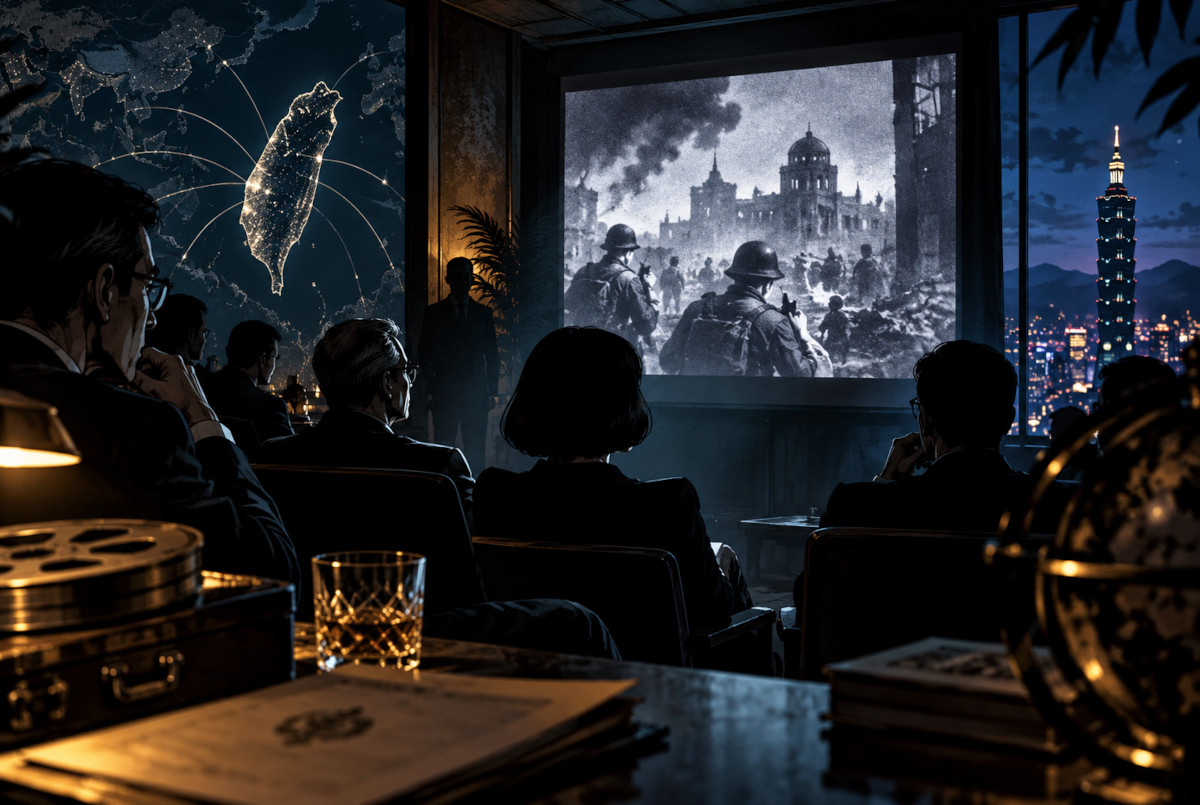
On September 3, 2026, Russian officials in Taipei held a closed-door film screening for roughly 20 Taiwanese guests. The film was an old Soviet documentary about the defeat of Japan at the end of World War II. On paper, it sounds like a tiny cultural event.
Taiwan’s government did not treat it that way. The island’s National Security Council said it was closely monitoring Chinese-Russian cooperation in what Taiwan describes as “cognitive warfare.” The strange part is the mismatch: a screening for only about 20 people triggered attention at the level of national security.
The date itself was not random. In Russia, September 3 is officially commemorated as the “Day of Victory over Militarist Japan and the End of World War II,” a designation written into federal law in 2023. The Taipei event was therefore tied to a much larger Russian historical narrative about the end of the war in Asia.
But the audience matters just as much as the date. Reuters reported that the event was invitation-only and that journalists were denied entry. Taiwan’s foreign ministry said around 20 people from academic circles had been invited, while one attendee said the group also included former journalists, business figures and other public-facing people. Seen another way, they were not simply 20 viewers. They were potentially 20 information nodes.
Why such a small screening attracted so much attention
It is difficult to dismiss the event as just another cultural screening because of the combination of host, format and audience. Russia’s representative office in Taipei—effectively its de facto diplomatic mission in Taiwan—has generally maintained a relatively low profile. Yet this event was private, invitation-only and aimed not at a mass audience, but at people capable of carrying ideas beyond the room.
That does not prove the screening was an influence operation. There is no public evidence that every guest was expected to promote a particular message. But if spreading a narrative were part of the goal, targeting a small number of people with public reach could be more efficient than trying to reach thousands of random viewers at once.
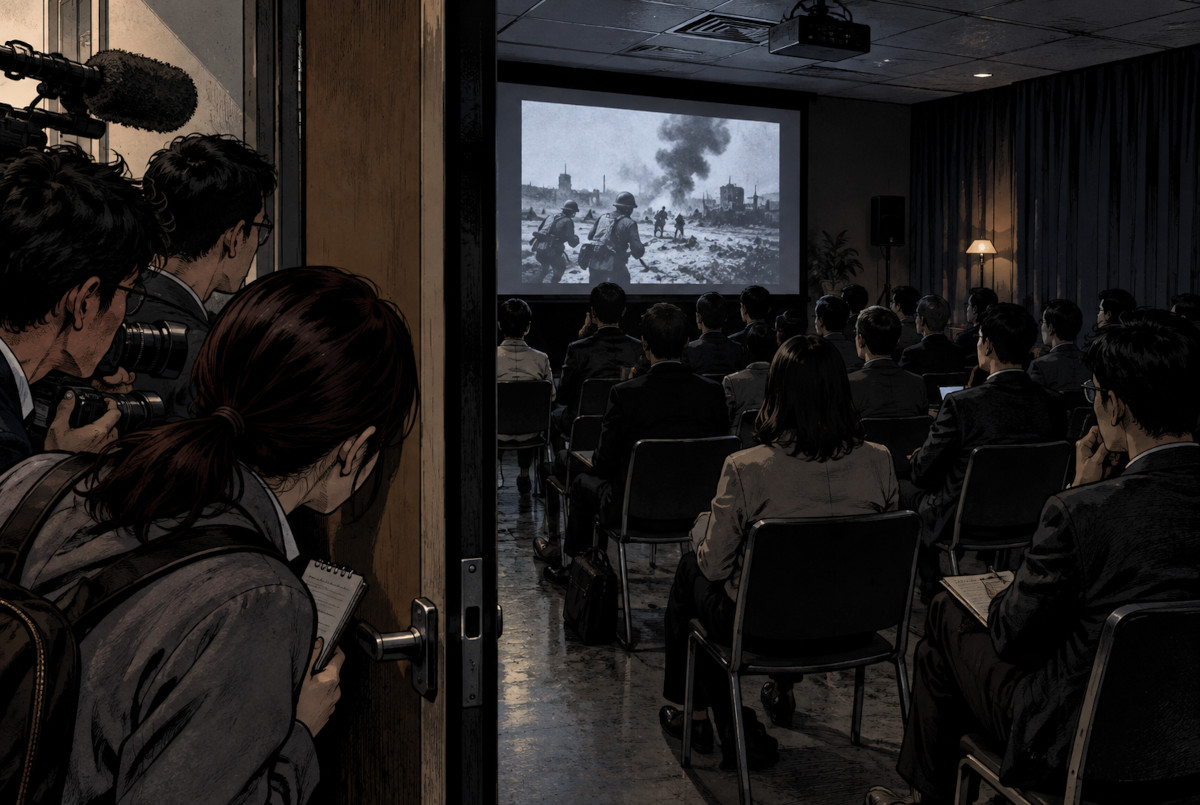 AI-generated illustration. It does not depict the actual venue, attendees or footage shown at the event.
Taiwanese outlet Watchout later added another layer. Based on interviews with people who attended the event, it reported that a Taiwanese participant spoke about historical memory after the screening, and that a Russian representative responded positively, encouraging intellectuals to explain and promote their understanding of the past.
That account is based on participant testimony, not on a publicly released recording or transcript, so it should be treated carefully. Still, if accurate, it suggests the organizers may have wanted the message to travel beyond the screening room rather than remain a one-off cultural event.
Was this really just an 81-year-old film?
The film itself is more complicated than the phrase “an 81-year-old Soviet documentary” suggests. The Russian CSDF Museum lists a 1945 full-length documentary titled Razgrom Yaponii, which can be translated as The Defeat of Japan. The archive also states that a new edited version was released in 1985 under the title Razgrom militaristskoy Yaponii, or The Defeat of Militarist Japan.
In other words, there was already more than one historical version of the same documentary material. Old footage is not a fossil. It can be recut, reframed and given a different political meaning decades later.
Watchout reported that the copy shown in Taipei used Traditional Chinese subtitles and differed in some respects from a publicly available online version. According to its comparison, several portions of Russian narration were absent, and footage showing the flag of the Republic of China appeared in the online version but was not seen in the screening copy.
There is no confirmed evidence explaining why those differences existed, who made them, or whether the changes were politically motivated. But if the Taipei copy had been specifically altered for a modern Taiwanese audience, then this was not simply an old film being dusted off. It was historical footage being repackaged for a contemporary political environment.
 AI-generated conceptual illustration. It does not reproduce the actual film, the screening copy, or the real editing process.
Were China and Russia actually coordinating this event?
This is where the story can easily become too neat. There is no public evidence that Beijing ordered Moscow’s representatives in Taipei to hold the screening. China’s foreign ministry told Reuters that it was not aware of the event.
At the same time, the overlap in political language is real and publicly documented. Chinese officials in 2026 repeatedly accused Japan of accelerating “remilitarization.” In a July meeting with Russian Foreign Minister Sergey Lavrov, Chinese Foreign Minister Wang Yi said China and Russia should strengthen strategic coordination and oppose Japanese rearmament. Russia expressed a similar position.
So the strongest conclusion is not that Beijing secretly directed this particular screening. It is that China and Russia already share a broadly compatible narrative about Japan’s military trajectory and the political meaning of World War II.
That distinction matters. Influence operations do not always require a single visible command center. Governments can reinforce one another’s narratives simply because their political interests and historical messaging already point in the same direction.
Why Taiwan could not simply shut the event down
Taiwan’s response also reveals a democratic dilemma. Article 11 of the Constitution of the Republic of China guarantees freedom of speech, teaching, writing and publication. Reuters reported that there was no police presence outside the screening and no attempt to stop it. Taiwan’s foreign ministry also said that it respects the lawful conduct of normal exchanges.
Taiwan does have the Anti-Infiltration Act, passed in 2019 to address certain forms of covert political influence by hostile foreign forces. But there has been no finding that this film screening itself violated that law.
That leaves democratic governments in an uncomfortable position. A suspicious event is not automatically an illegal one. The same openness that protects free expression can also create space for foreign actors to circulate political narratives. That is not a flaw unique to Taiwan. It is part of the price—and the difficulty—of maintaining an open society.
 AI-generated conceptual illustration. It does not depict any specific government action, individual or organization.
The odd part is not that “only 20 people came”
Based on the evidence available so far, there is no basis for calling the screening illegal, and there is no proof that China directly organized it. Those limits matter.
But the combination is still unusual: a private event, a carefully selected audience, participant testimony suggesting an interest in further dissemination, and a film that may have appeared in a version different from the one publicly available online.
The important question is therefore not simply what the film said. It is who was shown the film, how the material was presented, and where the message might travel afterward.
History does not stop being politically useful because it is old. Once archival footage is selected, edited and connected to a modern argument, it can become part of present-day politics again.
 AI-generated conceptual illustration. It does not depict the actual attendees or venue and does not imply that a documented operational planning meeting took place.
Editor’s Note
What bothers me about this story is how easy it would be to dismiss it with one sentence: “Only 20 people watched an old movie.” That may be exactly the wrong way to look at it.
Influence does not always begin with a huge audience. Sometimes it begins with people who already have an audience of their own. And the material does not even have to be fake. In this case, the raw material is real history, real war footage and real historical grievances. That is what makes it more interesting—and more uncomfortable.
From a Japanese perspective, there is another strange layer here. A war that ended more than 80 years ago is still politically active. Change the subtitles, change the edit, change the audience, connect it to today’s security debate—and suddenly the past is back at work again. That mix of something extremely old being used in an extremely modern information environment feels very much like the B-side of the world.
References
- Reuters: Why a Russian screening of an 81-year-old Soviet-era film to a tiny audience has alarmed Taiwan
- Central News Agency (Taiwan): Reuters report on the Russian Soviet-film screening in Taipei and Taiwan’s concerns
- Watchout: Follow-up reporting on invited attendees, participant testimony and differences in the screening copy
- Office of the President, Republic of China (Taiwan): Constitution of the Republic of China (Taiwan), Article 11
- CSDF Museum: Razgrom Yaponii (1945) and the 1985 re-edited version
- Ministry of Foreign Affairs of the People’s Republic of China: Wang Yi Meets with Russian Foreign Minister Sergey Lavrov, July 28, 2026
- Russian State Historical Archive of the Far East: September 3 commemoration of victory over militarist Japan and the end of World War II
- Representative Office in Taipei for the Moscow-Taipei Coordination Commission on Economic and Cultural Cooperation