

Late on October 10, 2026, a most unusual incident unfolded in Cologne, western Germany.
A red-and-gold humanoid robot, approximately 120 centimeters (3 feet 11 inches) tall, allegedly approached a 16-year-old girl from behind, touched her buttocks, and made inappropriate thrusting movements.
Police began investigating the robot’s 16-year-old owner and his 19-year-old companion. The two were suspected of filming the incident, livestreaming it on social media, and providing commentary as it happened.
Then came the part that made this case especially unusual: police confiscated not only two mobile phones, but the humanoid robot itself.
The central question is not simply what the robot did. Who, or what, determined its movements? And what can investigators learn by examining the machine itself?
The article’s featured image is an AI-generated illustration, not a photograph of the actual robot or police evidence room.
What Happened on the Streets of Cologne?
According to a statement issued by Cologne Police on October 12, the incident took place near the intersection of Palmstraße and Hohenzollernring, in the city’s central nightlife district.
Between approximately 11:45 p.m. on October 10 and midnight on October 11, the 16-year-old girl was standing outside a fast-food restaurant with two friends, aged 17 and 18. The humanoid robot allegedly approached her from behind and made inappropriate physical contact.
Officers responding to the incident later located the people involved near Magnusstraße and Hohenzollernring, a short distance away. The robot was found inside the trunk of a Volkswagen, where its teenage owner had placed it.
Cologne Police described the investigation using the German phrase Beleidigung auf sexueller Grundlage, meaning a suspected insult of a sexual nature.
As of October 16, 2026, the public information reviewed for this article had not established exactly how the robot was operated or whether either suspect would ultimately be held criminally responsible.
Why Did Police Seize the Robot Itself?
Section 94 of Germany’s Code of Criminal Procedure allows objects that may be relevant as evidence to be secured during an investigation. Seizing the robot therefore does not mean that investigators consider the machine itself a criminal offender.
Instead, the central technical question is how the robot’s movements were generated.
Speaking to the Associated Press, a Cologne police spokesperson explained that investigators were examining whether the robot had been programmed in advance or controlled in real time.
That distinction opens up several possibilities. We can separate them into four broad categories, each presenting a different question for investigators.
| Possible Control Method | What Investigators Would Need to Establish |
|---|---|
| Real-time remote control | Who issued the commands, and when? |
| Playback of a preprogrammed movement | Who created the sequence, and who triggered it? |
| Autonomous behavior | What decisions or control processes produced the movement? |
| Malfunction | Could a technical fault explain what happened? |
This table is an independent breakdown of possible control mechanisms based on publicly available information. It does not claim that Cologne Police have examined each scenario individually or established that any one of them occurred.
A robot that automatically maintains its balance is not necessarily a robot that independently decides whom to approach or what actions to perform.

AI-generated illustration of external commands and internal robot control. It does not establish how the robot in Cologne was operated.
Records from a smartphone, settings stored inside the robot, and available video footage could potentially help investigators connect the machine’s movements to human instructions. Whether the seized robot actually stores usable command logs or movement histories, however, remains unknown.
A 120-Centimeter Robot: Can Its Model Be Identified?
Some media reports have suggested that the robot belongs to the R1 series produced by the Chinese robotics company Unitree Robotics. Cologne Police, however, did not identify a manufacturer or model in their official statement.
Unitree’s published specifications provide an interesting comparison. Both the R1 AIR and the standard R1 stand 123 centimeters tall, remarkably close to the police description of approximately 120 centimeters.
But the similarities in height conceal some important mechanical differences.
| Official Specification | R1 AIR | R1 |
|---|---|---|
| Height | 123 cm | 123 cm |
| Weight | Approx. 27 kg | Approx. 29 kg |
| Total degrees of freedom | 20 | 26 |
| Waist degrees of freedom | None specified | 2 |
| Manufacturer-listed price | US$4,900 | US$5,900 |
Source: Unitree Robotics’ published R1 specifications. Listed prices exclude taxes and shipping.
In robotics, a degree of freedom refers to an independently controllable direction of movement. The standard R1 has two degrees of freedom at the waist, whereas the R1 AIR has no independently specified waist degrees of freedom.
That difference matters when interpreting video footage. Even without a separate moving waist joint, a humanoid robot can lean its upper body forward by coordinating movements of its hips and knees.
In other words, seeing a robot bend or move its torso does not, by itself, tell us which R1 model it is.
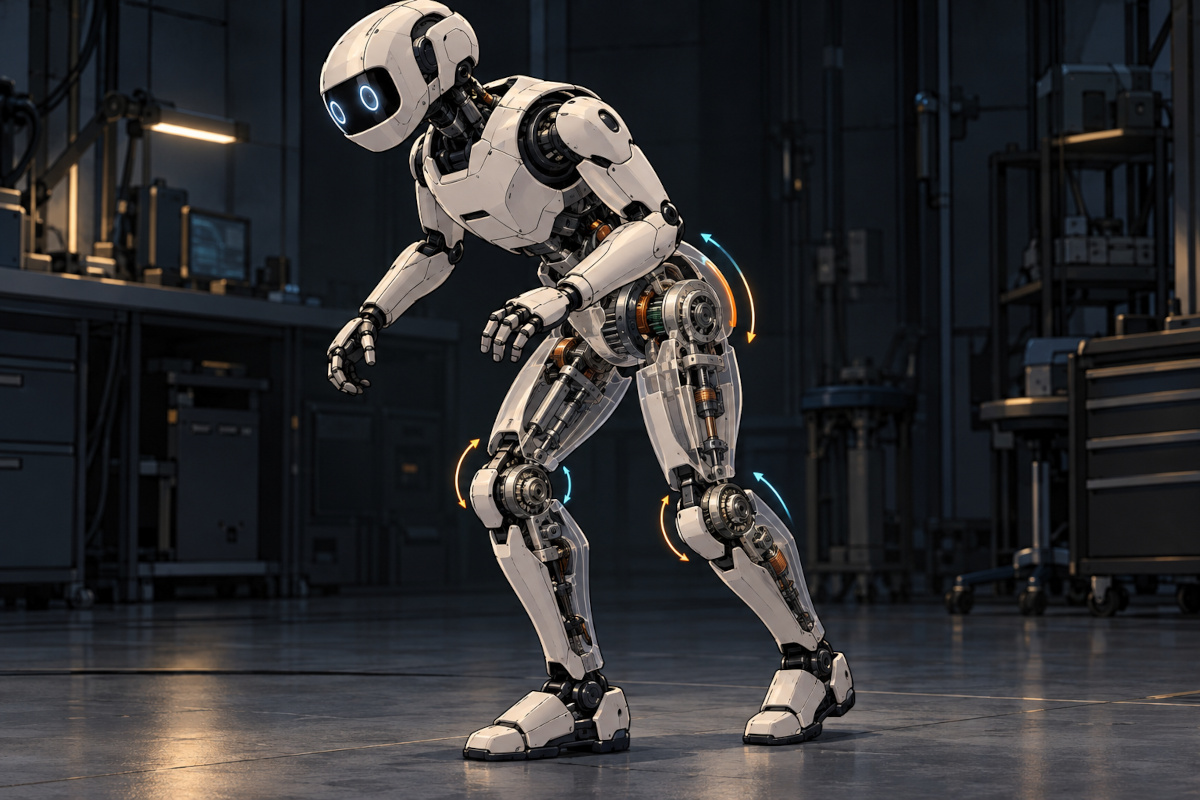
AI-generated conceptual illustration of humanoid joint mechanics. It is not an accurate reproduction of the internal structure of a specific Unitree model.
The manufacturer’s figures are useful for understanding the technology, not for identifying the seized machine. Neither its precise model nor the price actually paid for it has been confirmed by the official police statement.
Was It Really Just an Accidental Collision?
The question of intent became more complicated after a public response from one of the people associated with the livestream.
According to a report published by German public broadcaster ZDF on October 14, a streamer denied the allegations in videos posted on social media, including TikTok. He claimed that the robot had been avoiding a passerby and accidentally collided with the girl.
ZDF also reported that videos from earlier outings showed the robot making similarly inappropriate movements.
Ralf Beck, a specialist in control and automation engineering at Düsseldorf University of Applied Sciences, told ZDF that movements of the kind shown in the footage were unlikely to occur without human programming or instructions.
According to his explanation, even when a robot has learned or stored a sequence of movements, executing that sequence would normally require a trigger, such as a command issued through an app or remote controller.
That is an expert assessment of the technology, not a forensic finding about the particular robot seized in Cologne.
Whether the initial contact was accidental, whether subsequent movements were deliberately commanded, and who was responsible are separate questions. Video footage alone may not answer all of them.
That is precisely why evidence from the robot and its associated devices could matter.
Why Did Police Investigate an “Insult” Rather Than Sexual Harassment?
There is another unusual detail in the official record: the legal terminology.
Germany’s Criminal Code contains separate provisions for sexual harassment and insult.
Section 184i addresses sexual harassment involving physical contact of a sexual nature. Section 185 deals with insult.
Yet Cologne Police initially described their investigation as involving a suspected Beleidigung auf sexueller Grundlage, or an insult of a sexual nature. That expression is not the name of a separate criminal statute; it describes the suspected conduct under investigation.
In an October 14 analysis published by German legal news outlet beck-aktuell, criminal law specialists considered how existing laws might apply when physical contact is made through a robot rather than directly by a human being.
They explained that contact through an object does not necessarily prevent the physical-contact requirement of Section 184i from being satisfied. Whether the relevant offenses can be established would still depend on the circumstances, including the nature of the contact and the intent of those involved.
The alleged livestream also raises a distinct issue. If the incident was deliberately broadcast in a way that publicly humiliated the girl, that could affect its legal assessment. But recording or livestreaming an event does not automatically establish every element of a criminal offense.
Using a robot does not automatically put an act outside criminal law. Equally, owning the robot does not automatically make someone guilty of a crime.
What responsibility could fall on the 16-year-old owner or his 19-year-old companion? And how does German law distinguish a human-controlled machine from one acting with greater autonomy?
Those questions deserve a closer examination of their own. Part Two will explore the relevant provisions of German criminal law and the limits of liability when machines act on human instructions—or appear to act without them.
Editor’s Note
What first caught my attention was the idea of police taking the robot itself into evidence. For a moment, it almost sounds as though the machine had been arrested.
Of course, that’s not what happened. The robot is a piece of equipment. The real question is whether someone chose its movements, programmed them in advance, or allowed a particular sequence to run.
And that’s the part that bothers me. Technology can create a convenient distance between an action and the person responsible for it. Put a screen, a controller, and a mechanical body between someone and the consequences, and responsibility can start to look strangely blurred.
Add the allegation that the incident was livestreamed, and the problem becomes even harder to ignore. Robots will continue to get better at moving through our world. The people using them should not be allowed to become harder to hold accountable in the process.
References
- Cologne Police (Polizei Köln): Official statement POL-K: 261012-2-K, October 12, 2026 (German; original-language source)
- German Code of Criminal Procedure (StPO), Section 94: Securing and Seizing Evidence (official German legal text)
- German Criminal Code (StGB), Section 184i: Sexual Harassment (official German legal text)
- German Criminal Code (StGB), Section 185: Insult (official German legal text)
- Unitree Robotics: Official R1 Series Specifications (English)
- ZDFheute: Robot Harassment Allegation and the Question of Responsibility, October 14, 2026 (German)
- beck-aktuell: “The Robot Is Not the Perpetrator, but a Tool” — Legal Analysis, October 14, 2026 (German)
- Associated Press: Police Seize Robot in Cologne and Investigate Its Control, October 2026 (English)