
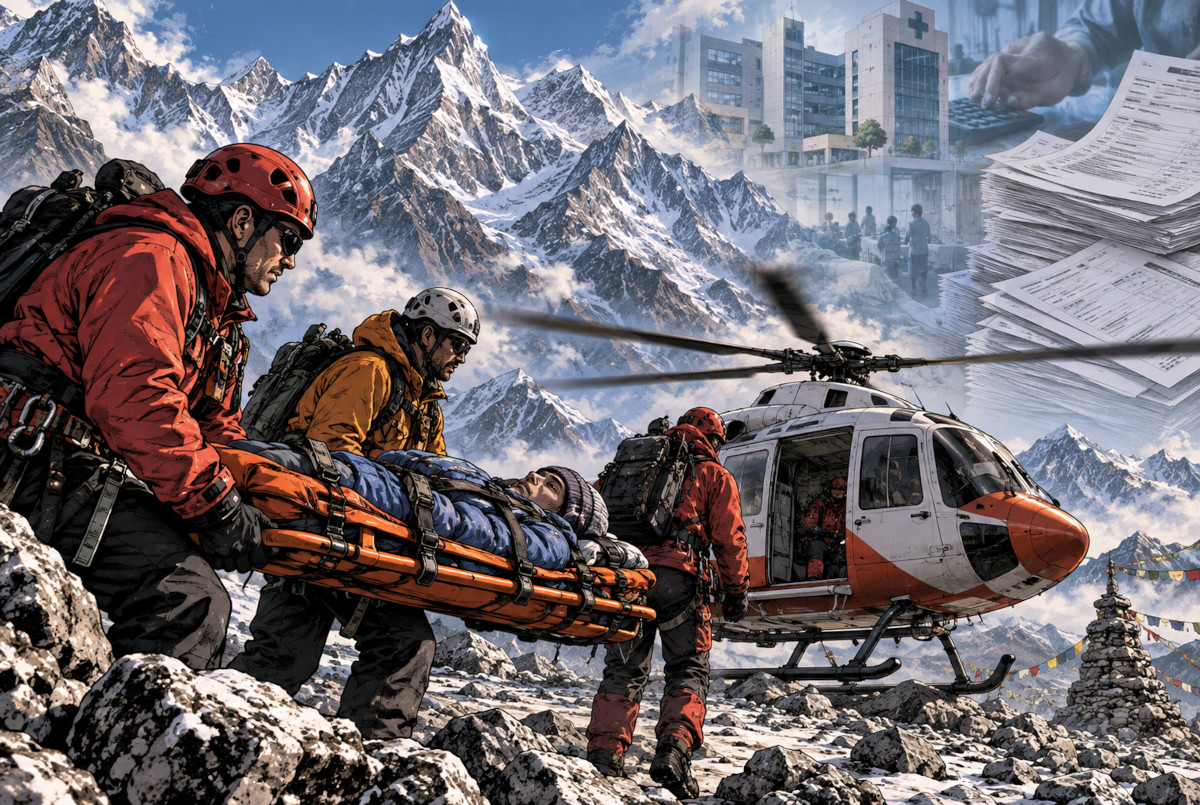
In the Himalayas, a helicopter evacuation can be the difference between life and death. A trekker develops severe altitude sickness or suffers an injury in a remote mountain region, and a rescue helicopter gets them to medical care within hours. There is nothing strange about that. It is exactly what mountain rescue is supposed to do.
But in Nepal, investigators say that lifesaving system was also exploited as a way to extract money from overseas insurance companies.
On January 25, 2026, Nepal Police’s Central Investigation Bureau (CIB) arrested six people linked to rescue and travel businesses as part of an investigation into alleged organized fraud involving foreign trekkers. The investigation later expanded across trekking businesses, rescue operators, aviation, hospitals and other intermediaries. On March 22, cases were filed against 32 defendants. A 33rd defendant was formally charged in April, and by June all 33 were under a second-stage money-laundering investigation.
These are criminal allegations, not convictions. But the structure described in the investigation is striking enough without exaggeration.
 AI-generated illustration. It does not depict the actual people, companies, aircraft or location involved in the case.
Why a Lifeline Was So Easy to Exploit
Nepal’s high mountain regions have limited road access and medical infrastructure. When altitude sickness or a serious injury strikes, helicopter evacuation is not a luxury. It can genuinely save a life.
That necessity also creates a verification problem. An insurance company thousands of miles away may have little practical way to determine whether a patient in a remote Himalayan valley really required an immediate helicopter evacuation.
According to the CIB investigation and court filings reported by Nepali media, foreign tourists were allegedly presented as rescue patients while passenger and cargo manifests were altered or fabricated. Hospital admission records, medical documents and invoices were also alleged to have been manipulated in support of insurance claims.
One of the most revealing allegations involved multiple tourists sharing a single helicopter flight while insurers were billed as though separate rescue operations had taken place.
In one case documented by investigators, four tourists travelled on the same helicopter, on the same day and under the same manifest. Yet the resulting rescue claims reportedly totalled $31,100, with another $11,890 billed for hospital treatment.
The helicopter flew once. On paper, however, the rescue seemed to multiply. Apparently, the paperwork was better at cloning itself than the aircraft.
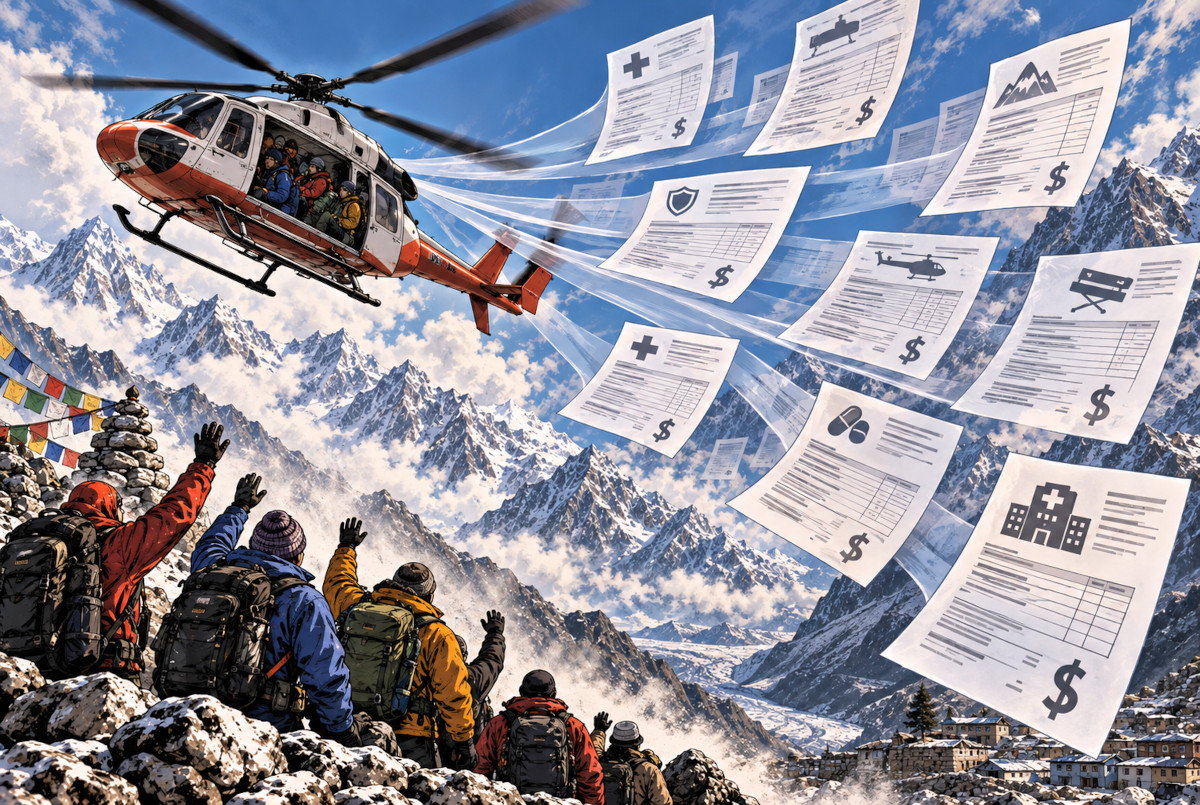 AI-generated illustration explaining the alleged billing structure. It does not depict an actual flight, patient, company or insurance document from the case.
When Rescue Becomes More Profitable Than Not Rescuing
The more disturbing part of the case is that the alleged scheme did not depend on one company acting alone.
The investigation described a chain in which trekking businesses could refer tourists to rescue operators, helicopters could carry them out of the mountains, hospitals could receive the patients, and insurance claims could then be prepared for companies overseas. Statements reported from the investigation also described hospitals paying commissions to trekking and rescue businesses from insurance-related income.
That changes the incentive. Rescue is no longer valuable only because someone needs help. It can become valuable because each additional rescue creates revenue for several businesses at once.
If a trekker walks back under their own power, there may be little additional income. If the same person becomes a “rescue case,” however, a helicopter flight, assistance fees, medical examinations and hospital charges can all follow.
That does not mean legitimate helicopter rescues should be treated with suspicion. Nepal’s mountains produce real emergencies every year. The problem arises when the people deciding, arranging or benefiting from an evacuation are all financially rewarded when that evacuation happens.
This Was Supposed to Have Been Fixed in 2018
Another reason this case matters is that Nepal had already confronted similar accusations years earlier.
In 2018, unnecessary helicopter evacuations and inflated insurance claims became an international issue. Nepal’s government investigated the problem and introduced the Tourist Search, Rescue, Medication and Monitoring Guidelines, 2018.
The guidelines created a framework for monitoring rescue activity. Air services and helicopter companies were required to provide details of rescue flights, flight duration and costs after each season. Those records could be checked against Civil Aviation Authority data. Hospitals were required to provide information about rescued tourists and treatment costs, while the monitoring system also covered insurance claims and amounts paid. The government committee was given authority to set maximum rescue-flight fares based on factors including flight time, distance and altitude.
In other words, officials already knew which parts of the system needed watching.
Yet in 2026, a major criminal case involving remarkably similar incentives surfaced again. Writing a rule and changing the financial logic behind an industry are not necessarily the same thing.
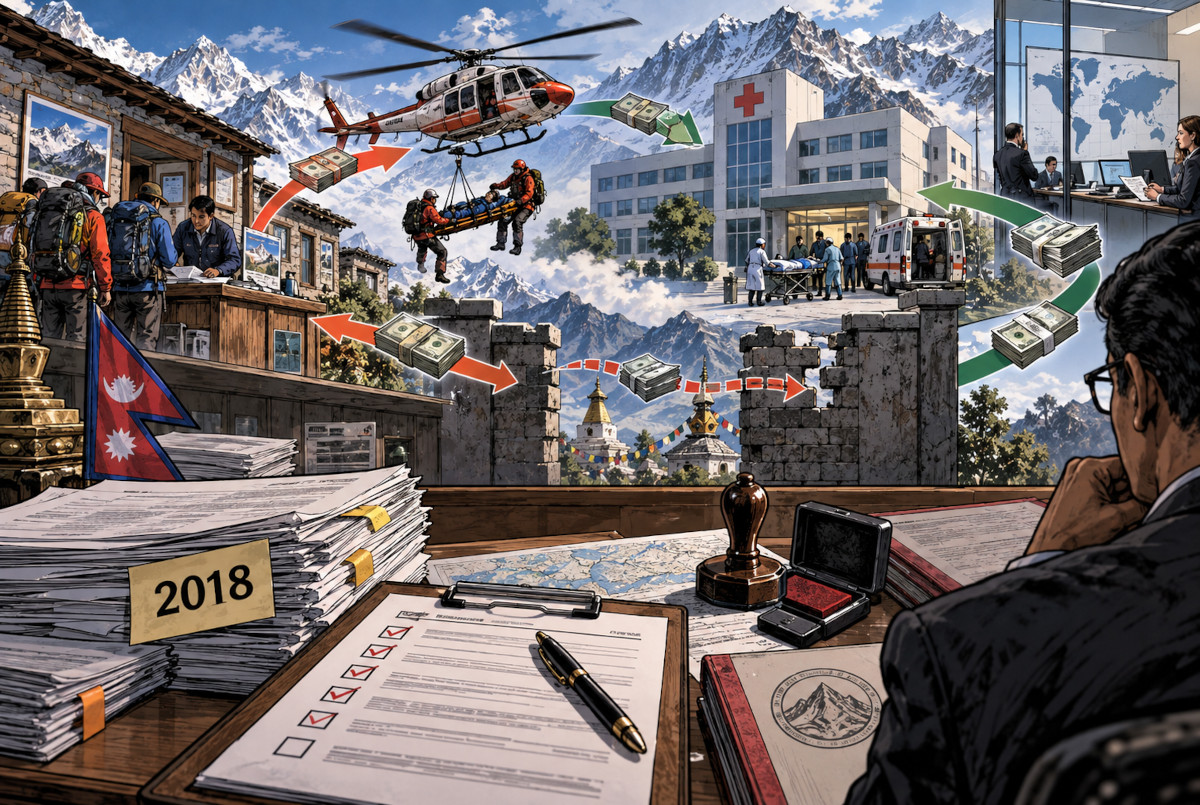 AI-generated conceptual illustration. It does not reproduce actual government documents, companies, people or financial records from the investigation.
The Story About Deliberately Making Tourists Sick Is Different
As the case spread internationally, an even more sensational allegation began circulating: that tourists had deliberately been made ill so they could be turned into rescue patients.
That claim needs to be separated from the documented criminal case.
On April 3, 2026, Nepal Police’s CIB issued a public notice addressing unverified reporting about the investigation. The bureau said that claims that harmful substances had been deliberately mixed into tourists’ food to make them sick had not been established by its investigation.
The allegations involving falsified records, inflated rescue claims and other irregularities are the subject of criminal proceedings. The more dramatic “tourists were poisoned for insurance money” story should not be treated as established fact.
The case is strange enough without adding something the investigators themselves have not verified.
The Real B-Side: The Incentive Matters More Than the Villain
It would be easy to reduce this story to a familiar headline: greedy operators allegedly cheated insurance companies.
But that misses the more interesting part.
If only a rescue operator benefits from unnecessary evacuations, a hospital might act as a check. If only a hospital benefits, a trekking company or aviation operator might question what is happening. But when several links in the same chain can make money from the same rescue, the people who should function as brakes can all end up facing the accelerator.
The distance between the trekker in the mountains, the hospital in Kathmandu and an insurer abroad makes verification difficult. That distance is not just geographic. It is also informational: one side must often rely on records produced by businesses operating inside the same local commercial ecosystem.
This happened in the Himalayas, but the underlying problem is not uniquely Nepali. Whenever the people who determine whether a service is necessary are closely connected to the people who earn more money when that service is provided, incentives deserve scrutiny.
Editor’s Note
I have no problem with people making money. Provide a useful service, do the work, take the risk and earn a profit. That is business.
But something flips when “we make money because we save people” becomes “we make more money if there are more people to save.” That is the part of this story that bothers me.
Seen from Japan, mountain-rescue stories usually produce a fairly simple first reaction: thank goodness they got the person down safely. I do not normally look at a rescue helicopter and immediately wonder how many invoices can be generated after it lands. The idea that the rescue itself could become a revenue event is what makes this story feel so upside down.
And Nepal had already confronted the problem in 2018. Records were supposed to be reported. Costs were supposed to be checked. Oversight rules were written. Yet years later, allegations built around a similar financial structure surfaced again.
Greed, apparently, is quite good at finding the side road around a “No Entry” sign.
The Himalayas have avalanches, altitude sickness and brutal weather. But sometimes the most uncomfortable danger is much more ordinary: someone looking at another person’s emergency and seeing a sales opportunity.
References
- Nepal Police, Central Investigation Bureau (CIB) — Arrest of six people in connection with alleged fake rescue operations in the mountaineering and trekking sector
- Nepal Police, Central Investigation Bureau (CIB) — Public Notice Concerning Unverified Media Reports and Misinformation Pertaining to Tourist Fake Rescue Investigations (April 3, 2026)
- Ministry of Culture, Tourism and Civil Aviation, Government of Nepal — Tourist Search, Rescue, Medication and Monitoring Guidelines, 2018 (English translation)
- Setopati — Case filed against 32 over fake rescue scam targeting mountaineers (March 22, 2026)
- Setopati — Case filed against Rajendra Bahadur Singh over fake rescue scam (April 22, 2026)
- Setopati — CIB launches money laundering probe into 33 defendants in fake rescue case (June 9, 2026)
- The Kathmandu Post — Inside Nepal’s fake rescue racket (March 27, 2026)
- Associated Press — Nepal travel executives arrested for scamming millions with fake mountain rescues (January 2026)