
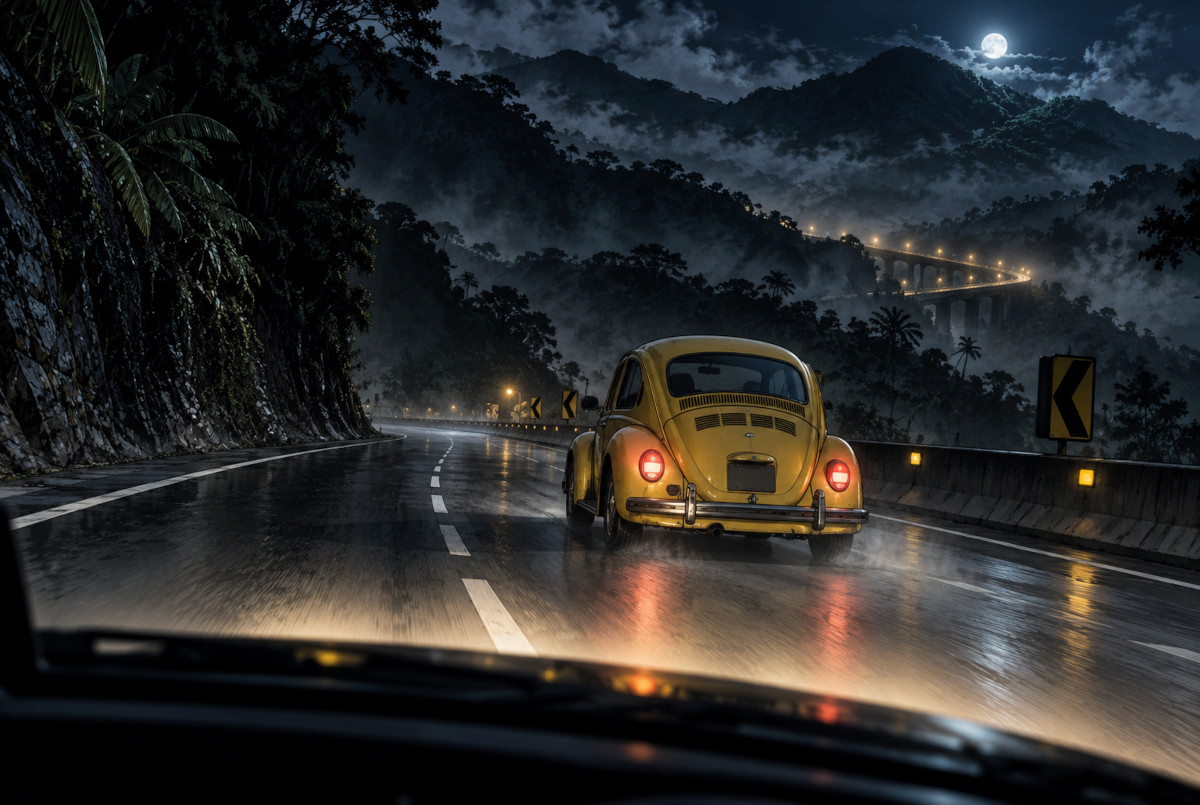
You are driving along a highway at night when a yellow Volkswagen Beetle appears ahead. It is moving strangely slowly, so you pass it. A few minutes later, the same yellow Beetle is in front of you again.
You overtake it once more. It comes back again. And when you finally pull alongside it, there is nobody in the driver’s seat.
This is the Malaysian urban legend commonly known as Volkswagen Kuning—literally, the “Yellow Volkswagen.” Today it is closely associated with the Kuala Lumpur–Karak Highway, one of Malaysia’s best-known mountain expressways. But once you start digging into the story, things become less tidy. There is no clearly documented first witness, no confirmed date when the legend began, and no verified accident that can be identified as its origin. Even stranger, older online accounts suggest that the ghost car may not always have belonged to Karak at all.
By 2010, even the location of the legend was already getting blurry
Old Malaysian online discussions show that stories about haunted highways were already circulating widely by at least 2010. The Yellow Volkswagen appears among tales of ghostly passengers, mysterious vehicles and other roadside encounters connected with major highways.
But the geography is not consistent. Some older discussions show uncertainty over whether the yellow Beetle belonged to the Karak Highway or to the Jelapang area near Ipoh in Perak. A Malaysian paranormal blog called Puaka Karak, in a post dated October 19, 2010, specifically placed the car around the Jelapang highway rather than Karak.
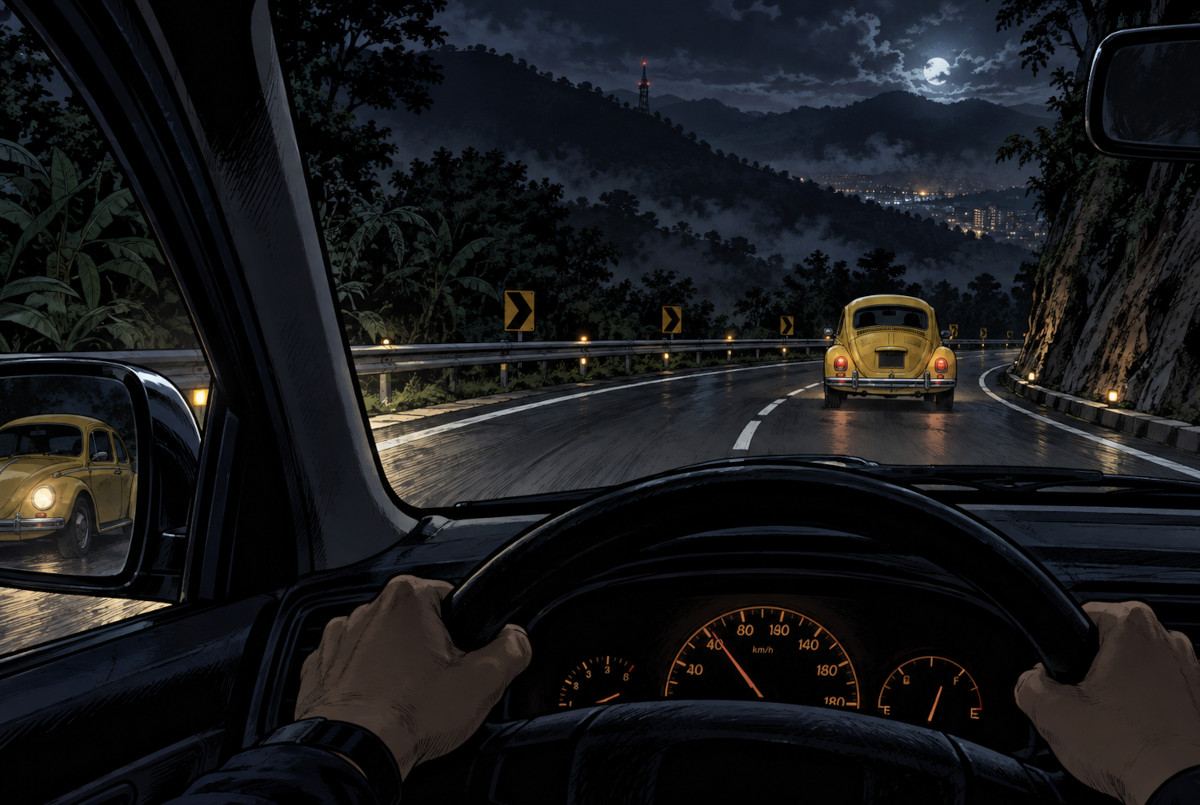 AI-generated illustration. It does not depict an actual sighting or a specific real-world location.
The same body of folklore also contains elaborate origin stories: claims that the car had appeared since 1956, or that the spirit of a murdered husband had somehow become attached to the vehicle. None of those stories, however, could be matched to police records or contemporary reporting.
That means the Yellow Volkswagen may not have begun as one clearly identifiable “Karak incident” at all. Perhaps a story originally told about another road migrated to Karak. Perhaps several similar stories developed independently and later merged. At this point, the evidence does not allow a firm answer—and that uncertainty is arguably more interesting than a neat ghost-story origin.
The highway does have a very real history of tragedy
What is documented is that the Kuala Lumpur–Karak Highway has seen serious accidents. On February 28, 1990, a major collision involving 12 vehicles occurred around KM31.
According to a later historical account published by the Royal Malaysia Police (PDRM), an express bus developed brake problems while descending a hill, went out of control and struck several vehicles. Eleven members of Malaysia’s Federal Reserve Unit (FRU), a public-order unit of the national police, and four civilians were killed. The official police total is 15 deaths.
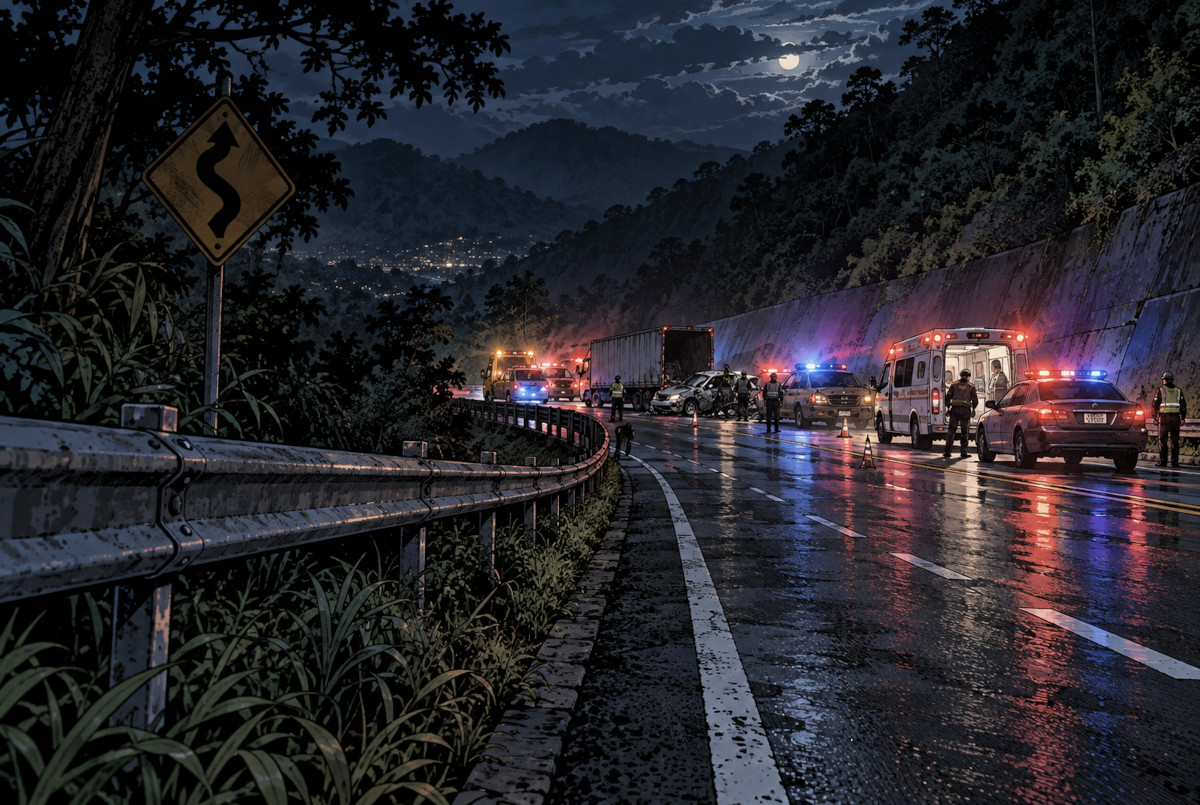 AI-generated illustration. It does not recreate the actual 1990 accident scene, victims, vehicles or personnel.
There is an important detail here. A figure of 17 deaths has also circulated online and appears in older retellings. The Royal Malaysia Police account, however, gives 15: eleven FRU personnel and four civilians.
Just as importantly, there is no verified evidence that this 1990 crash created the Yellow Volkswagen legend. Connecting a real tragedy directly to a ghost story simply because both involve the same highway would be too convenient. What can reasonably be said is that a road with a history of fatal crashes may gradually acquire a reputation as a place where “things happen,” making it easier for unrelated folklore to attach itself to the location.
Why a yellow Beetle?
The choice of car is not as random as it might seem. Volkswagen’s own historical records state that Beetle assembly began in Malaysia and Singapore in 1968. Volkswagen Malaysia has also noted that many Malaysians grew up seeing the Beetle in their neighbourhoods, where its rounded shape earned it the nickname kereta kura—roughly, “turtle car.”
So the Beetle was not some exotic prop imported from a foreign horror film. It was a recognizable part of Malaysia’s motoring landscape.
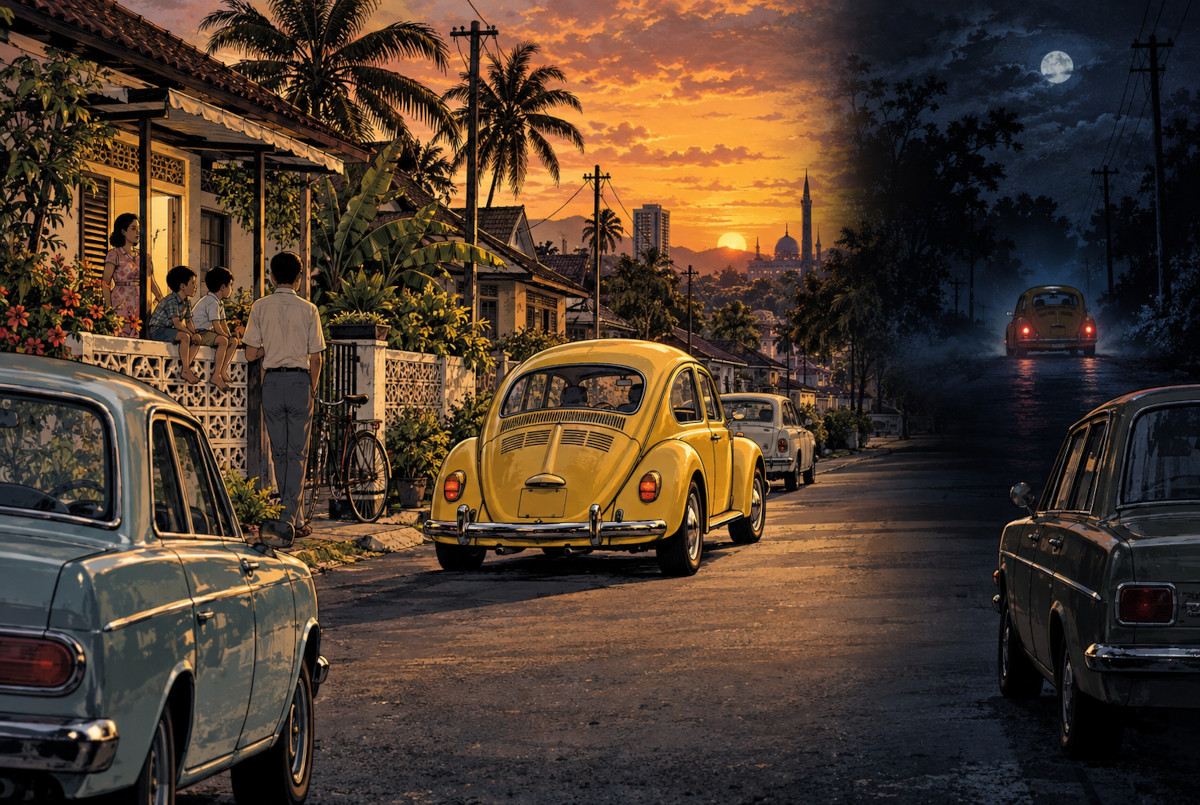 AI-generated historical illustration. It is not an archival photograph and does not depict specific real people or vehicles.
There is also a storytelling advantage. Even in darkness, a Beetle has an unusually recognizable silhouette: the curved roof, short body and distinctive rear profile. Add bright yellow paint, and the audience immediately understands why a driver might think, “That is the same car I passed five minutes ago.”
This part is interpretation rather than documented history, but it makes sense from the mechanics of folklore. A good ghost car does not need to be fast. It needs to be memorable.
Highways are remarkably good machines for producing strange stories
None of this proves that people who reported unusual encounters were simply hallucinating. That would be another unsupported leap. What research does show is that long periods of monotonous driving can reduce vigilance and increase fatigue.
Studies published in Accident Analysis & Prevention have found that monotonous road environments can contribute to vigilance decline, and that drivers may not always accurately judge how alert they really are after prolonged driving.
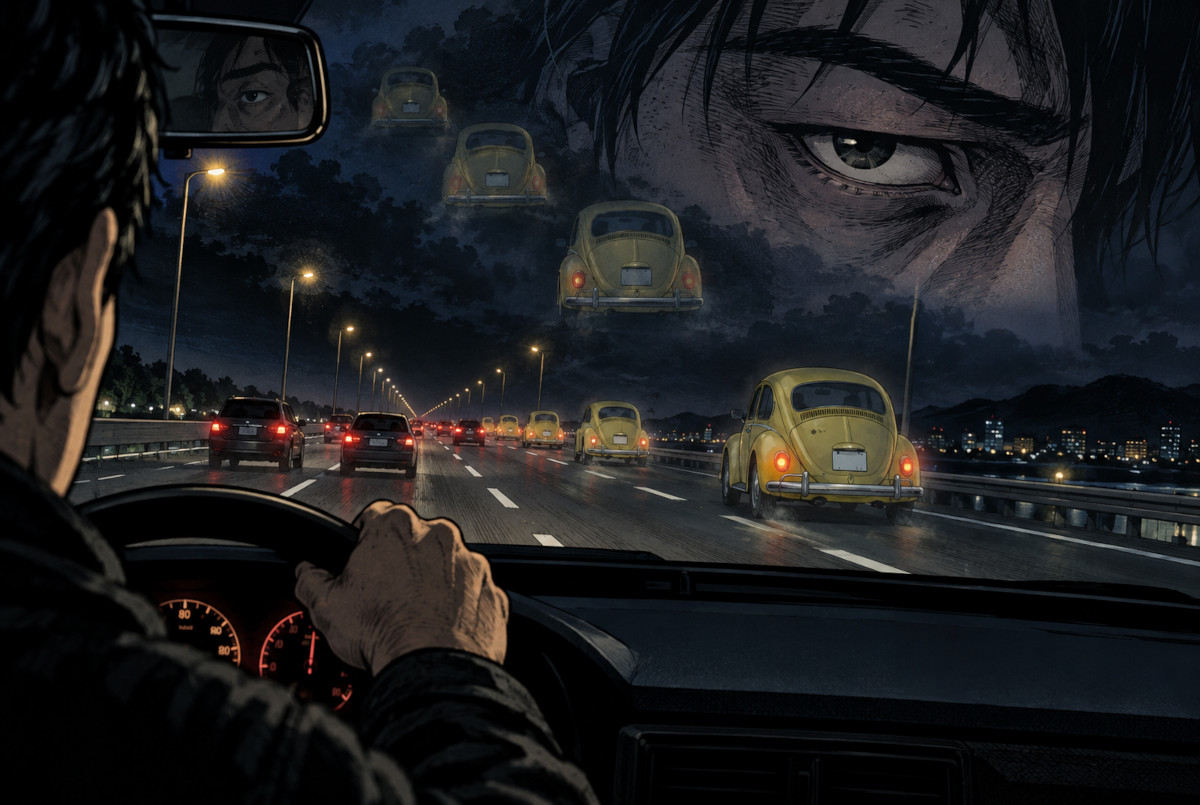 AI-generated conceptual illustration. It represents fatigue, repetition and memory; it does not imply that tired drivers literally hallucinate ghosts.
Darkness, repetition, long stretches of road, similar vehicles, uncertain distance and a tired brain can all create small moments of doubt: “Didn’t I already pass that car?” Once a famous local story already exists, an ordinary moment of confusion has a ready-made narrative waiting for it.
That still does not mean every Yellow Volkswagen account can be dismissed as an optical mistake. The science only supports the narrower point that highways contain many of the conditions that can produce unusual perceptions, uncertain memories and stories that become stronger in the retelling.
Eventually, the ghost car became part of pop culture
Over time, the story became firmly identified with Karak. On September 22, 2016, the Malaysian horror film Volkswagen Kuning, inspired by the familiar road legend, opened in cinemas. Malaysian entertainment outlet mStar described the story as one widely known among people travelling on the Karak Highway.
Then, on October 31, 2019, Malaysian automotive site paultan.org reported that Volkswagen Malaysia itself had released a Halloween video playing on the legend of the driverless yellow Beetle.
At that point, the folklore had completed an interesting journey. Whether or not the story originally belonged to Karak, its cultural address had become clear: the Yellow Volkswagen was now one of the Karak Highway’s signature legends.
And that may be the strangest part of the whole thing. Look far enough back and Jelapang appears. Retellings alter locations, dates and death tolls. A local road story becomes a movie. Then the manufacturer of the supposedly haunted car joins the joke.
The ghost Beetle supposedly keeps returning to the road ahead. The legend itself seems to behave in much the same way—changing roads, changing eras, and repeatedly turning up in front of the next generation.
Editor’s Note
I am less interested in proving whether a driverless Beetle literally travelled the Karak Highway than in the fact that the story itself refuses to stay parked. Once you start digging, even the question “Was this always a Karak legend?” becomes surprisingly slippery.
From Japan, we have plenty of road ghosts, haunted tunnels and stories tied to fatal bends in the mountains, so the basic mechanism feels familiar. What makes this Malaysian example especially good is the car. Not a faceless black sedan. Not some supernatural carriage. A very specific, slightly cheerful-looking yellow Beetle.
Then the story migrates, attaches itself to real accident history, becomes a film, and eventually gets acknowledged by Volkswagen itself. At some point the more interesting question is no longer whether the ghost car exists. It is why the story has survived so well.
You pass it, leave it behind, and somehow it is waiting ahead again. That is almost a perfect description of an urban legend.
References
- Royal Malaysia Police (PDRM), “#InfoPeristiwa: Tragedi Lebuh Raya Karak Korbankan 11 Anggota FRU” — official retrospective on the February 28, 1990 Karak Highway crash.
- Volkswagen Newsroom, “VW Beetle, the real miracle” — Volkswagen’s historical account noting Beetle assembly in Malaysia and Singapore from 1968.
- Volkswagen Malaysia, “The many different names of the world’s favourite Bug” — including the Malaysian nickname kereta kura.
- mStar, “Volkswagen Kuning Rungkai Kisah Misteri Popular” — coverage of the 2016 film inspired by the Karak Highway legend.
- paultan.org, “The legend of the Yellow Beetle on the Karak Highway” — 2019 coverage of the legend and Volkswagen Malaysia’s Halloween video.
- Puaka Karak, “Misteri Volkswagen Kuning” — a 2010 Malaysian paranormal-blog version placing the Yellow Volkswagen around Jelapang.
- CariDotMy, older Malaysian forum discussions on Karak Highway and highway folklore. Forum URLs and thread structures have changed over time; these discussions are used only as evidence of how the folklore circulated, not as verification that the supernatural events occurred.
- Thiffault, P. & Bergeron, J. “Monotony of road environment and driver fatigue: a simulator study.” Accident Analysis & Prevention, 2003.
- Schmidt, E. A. et al. “Drivers’ misjudgement of vigilance state during prolonged monotonous daytime driving.” Accident Analysis & Prevention, 2009.