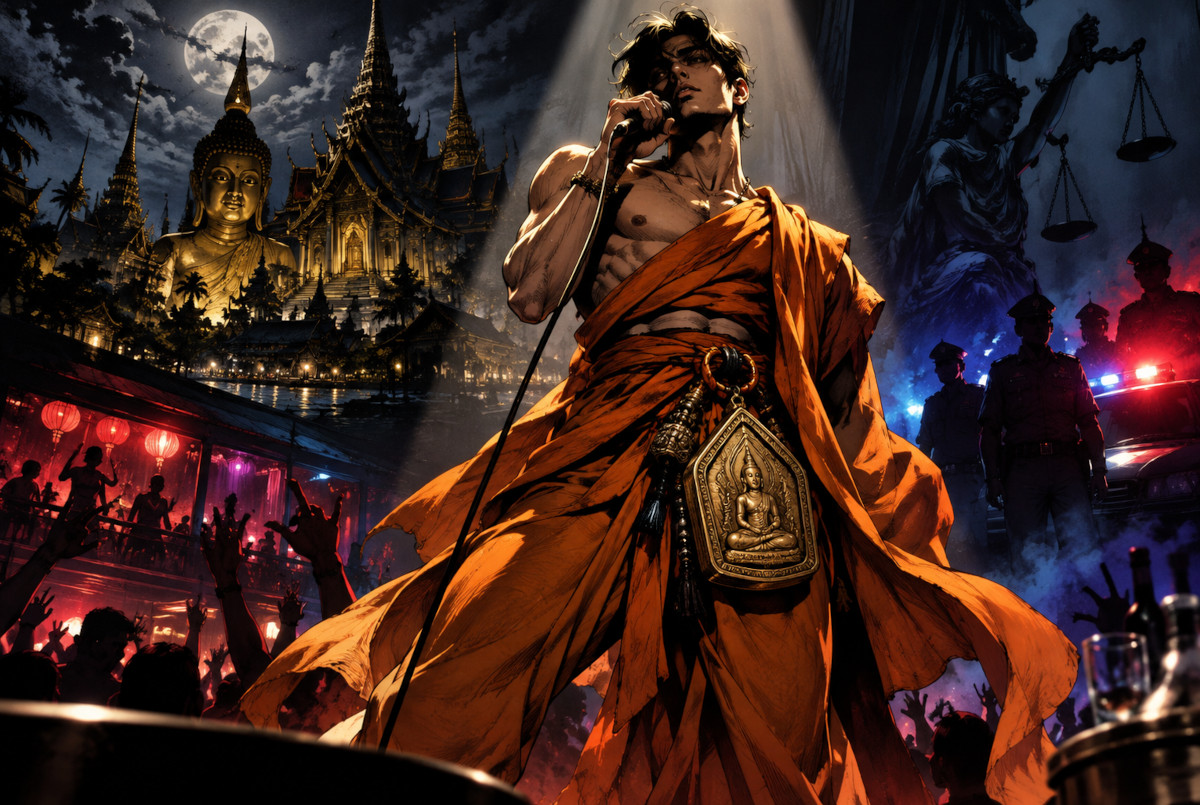
On September 13, 2026, a video from an entertainment venue in Lampang Province, northern Thailand, began circulating online. A male singer appeared onstage draped in orange cloth resembling a Buddhist monk’s robe, with a huge phallic-shaped prop hanging from his waist.
At first glance, it had all the ingredients of a bizarre viral clip destined to disappear into the internet within a day or two. Instead, the Lampang Provincial Office of Buddhism filed a complaint with police that same day, saying the performance could potentially fall under Section 206 of Thailand’s Penal Code, concerning acts that insult religion, and Section 208, concerning the unlawful impersonation of monks or other religious clergy.
On September 16, the singer and representatives of the venue went to a temple to apologize. The provincial Buddhist authorities, however, said the legal process would continue.
There is one important distinction. As of September 18, 2026, the major reports reviewed for this article did not show that the singer had been formally convicted—or even that Sections 206 or 208 had definitively been applied. At this stage, this is a police complaint and an ongoing legal matter, not a settled criminal judgment.
And then there is the object hanging from his waist. It was not simply an oversized dirty joke. It was modeled after a real Thai amulet known as the Palad Khik. That changes the story considerably. What looks obscene to an outsider can exist, in another context, as part of a long-standing protective amulet tradition.
AI-generated illustration. It does not depict the actual people, venue or location involved in the incident.
The phallic object was not just a crude joke
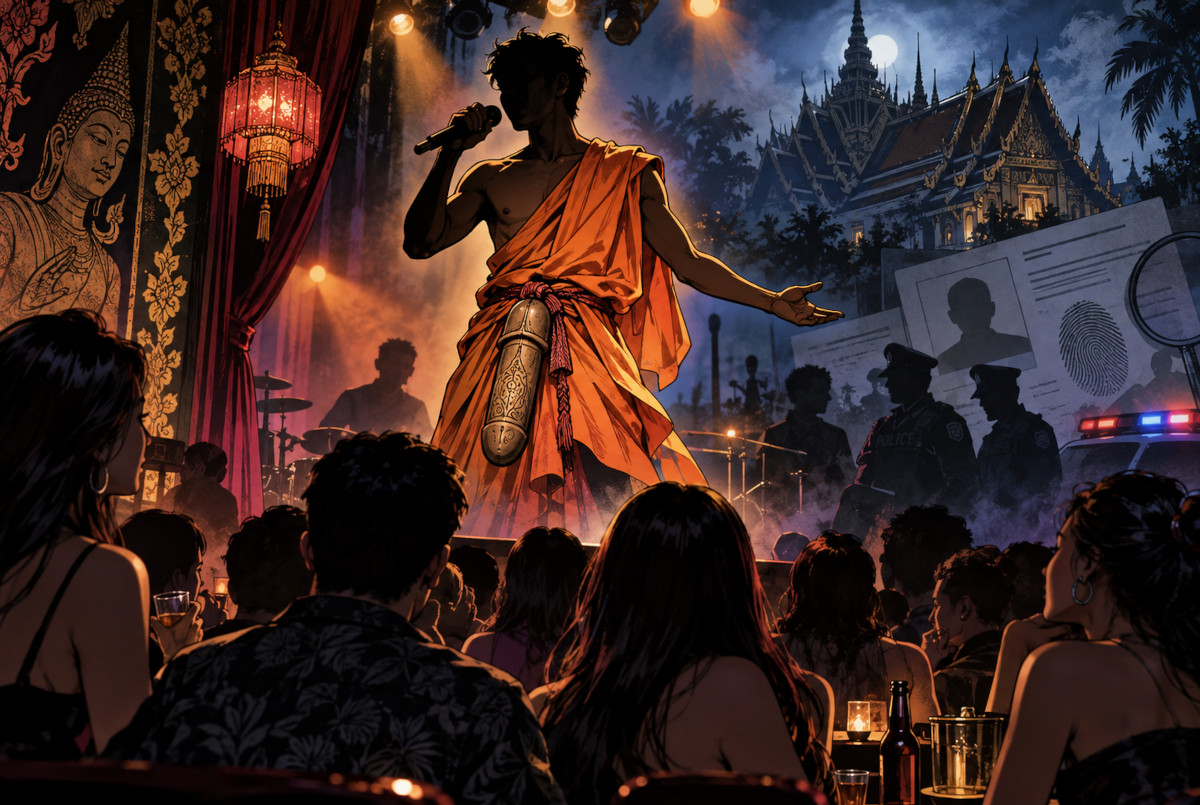
According to Thai reports, the object used onstage was not an actual sacred amulet. It was described as a large bolster or cushion resembling a Palad Khik.
That distinction matters. The Palad Khik is a genuine phallic amulet found in Thai society, and academic research traces its background through several overlapping traditions. Scholars have discussed influences from Brahmanic Shaivism, older Tai spirit beliefs and the way those practices later became integrated into Thai Buddhist society.
In other words, the shape itself is not automatically treated as obscene or anti-religious. In its traditional context, the Palad Khik belongs to a much broader world of protective and auspicious amulets.
The controversy was created by context: a Palad Khik-shaped prop, monk-like clothing, a nightlife stage and a parody aimed at a highly sensitive religious subject.

AI-generated cultural illustration. It does not reproduce a specific real amulet, temple, market or individual.
Dressing like a monk is not automatically the whole legal issue
It is easy to understand why Buddhist authorities objected. Monks occupy a highly visible and socially respected position in Thailand, and using monk-like imagery as part of a sexualized or mocking nightclub performance was always likely to provoke criticism.
Legally, however, the case is more complicated.
Section 206 of the Thai Penal Code concerns acts directed at an object or place of religious reverence in a manner that insults the religion. Section 208 deals with someone unlawfully wearing clothing or using signs associated with a Buddhist monk, novice, ascetic or cleric in order to make other people believe that the person actually holds that religious status.
That final element is important. Previous Thai litigation over Section 208 has examined whether there was a specific intention to make others believe the defendant was genuinely a monk or religious cleric. In one case involving Samana Dao Din, a court acquitted the defendant after considering differences in clothing, practice and whether ordinary people would actually mistake him for a conventional Buddhist monk.
That creates the strange legal question at the center of the Lampang case. If a man is performing at a nightlife venue with a microphone and an enormous Palad Khik-shaped cushion hanging from his waist, were members of the audience really being led to believe that he was an actual monk?
That does not answer the case. It does show why social outrage and criminal liability are not necessarily the same thing. Something can be widely condemned as disrespectful without every element of a particular criminal statute automatically being satisfied.
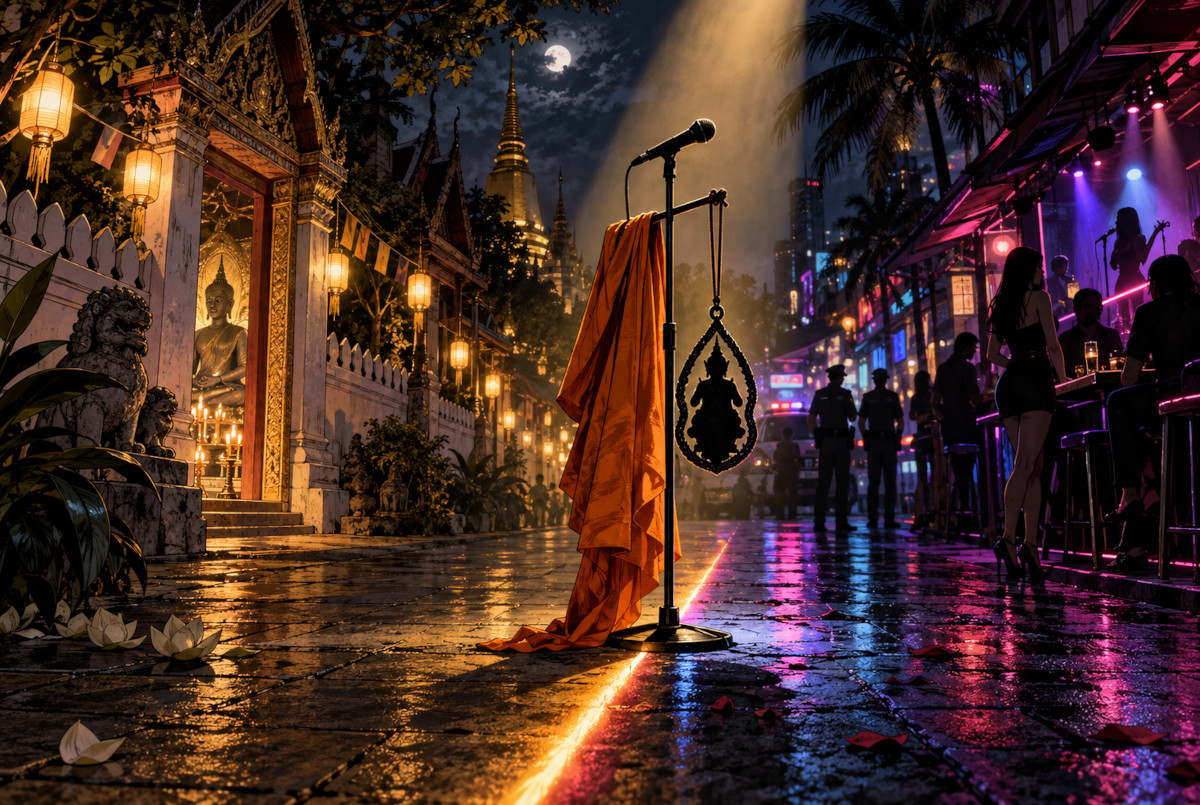
AI-generated conceptual illustration. It does not recreate the actual venue, people, police investigation or any specific religious site.
The timing made the performance even more combustible
The singer was reportedly performing Sek Loso’s song “Om Phra Ma Phut” (อมพระมาพูด), and Thai media described the act as appearing to parody a former monk who was already at the center of a major news story.
So this was not simply someone deciding to wear orange cloth for a random nightclub gag. The performance appears to have been drawing humor from an active controversy involving the Buddhist clergy.
That context helps explain why the reaction escalated so quickly. A viral joke was colliding with a moment when public attention was already focused on scandals involving monks and Buddhist institutions.
From a Japanese perspective, this is where the case becomes especially interesting. In Japan, an offensive parody of a Buddhist priest might produce criticism, complaints or demands for an apology, but the immediate possibility of a government Buddhist office taking the matter to police can feel unusual.
That does not mean Thailand is simply “more religious” or less tolerant of humor. What the case shows more precisely is that religious status, public institutions and criminal law remain connected in ways that may not be obvious to visitors who mainly experience Thailand through tourism, nightlife and popular culture.
The real dividing line is not the shape—it is the context
The oddest part of the story is that the same basic phallic form can exist comfortably within Thailand’s amulet culture, yet become highly controversial when moved into another setting.
A Palad Khik can exist as an amulet. A giant Palad Khik-shaped cushion combined with monk-like clothing and religious parody on a nightclub stage can trigger a police complaint.
The difference cannot be explained by shape alone. It depends on setting, intention, religious symbolism, social expectations and the exact wording of the law.
That is the real B-side of this story. It is not simply about a singer making a crude joke.
It is about what happens when a symbol that is acceptable in one religious and folk-cultural context is transformed into comedy in another—and where a society decides to draw the line.
Seen from outside Thailand, the boundary can look inconsistent. Seen more closely, however, the incident reveals a complicated coexistence of Buddhism, folk belief, popular entertainment, administrative authority and criminal law. The giant prop was merely the object that made all of those layers suddenly visible at once.
[p2_meter b2=”9″ seo=”9″ adsense=”A” index=”INDEX”]
Editor’s Note
It would be easy to file this under “another weird story from Thailand” and move on. That would also miss almost everything interesting about it.
The strange part is not simply that a singer went onstage with a giant phallic prop. Thailand already has a cultural tradition in which a phallic object can function as an amulet. What caught my attention was the moment the same imagery was combined with something resembling a monk’s robe—and suddenly a joke became a police matter.
From Japan, that shift feels abrupt. Thailand can look remarkably relaxed from the outside: street food, nightlife, spirit houses, amulets and religion all occupying the same streets. Then you touch a particular religious boundary and the atmosphere changes very quickly.
And even then, the law adds another twist. Socially, many people may consider the performance obviously offensive. Legally, Section 208 still raises the question of whether anyone was actually supposed to believe the performer was a real monk. That gap between “everyone thinks this crossed a line” and “does the statute actually fit?” is exactly the kind of gap B-Side Earth exists to look at.
References
- Thai Rath, September 13, 2026 — Thai-language report on the Lampang Provincial Office of Buddhism filing a police complaint and citing possible violations of Penal Code Sections 206 and 208.
- Thai Rath English, September 16, 2026 — Report on the singer and venue representatives apologizing at a temple and the provincial Buddhist authorities stating that legal proceedings would continue.
- Khaosod, September 13, 2026 — Thai-language report describing the monk-like costume, Palad Khik-shaped bolster, the song performed and the apparent parody of a former monk then in the news.
- ThaiDeka — Thai Penal Code, Section 206 — Current Thai statutory text concerning acts against objects or places of religious reverence that constitute an insult to religion.
- Government of Thailand legal database — Thai Penal Code, Section 208 — Current Thai statutory text covering unlawful use of religious dress or symbols with the purpose of making others believe the person is a monk, novice, ascetic or cleric.
- Thai Lawyers for Human Rights — Samana Dao Din case — Summary of a 2023 judgment examining the specific intent required under Section 208 and whether the defendant could reasonably be mistaken for a Buddhist monk.
- “The Origin of the Palad Khik,” Journal of MCU Ubon Review (2022) — Academic study examining the amulet’s relationship to Shaivism, traditional Tai spirit beliefs and Thai Buddhist society.
- Kasetsart Journal of Social Sciences (2022) — Research on the relationship between Buddhist and animist amulets in contemporary Thailand and the broader process of religious syncretism.