Bathing in blessed water to wash away bad luck does not sound especially alarming. In Thailand, where religious practice, local custom and folk belief can overlap in everyday life, rituals of protection or purification are hardly unusual.
But on February 12, 2026, women went to Thailand’s Central Investigation Bureau (CIB) with allegations involving an undertaker in Ang Thong Province, central Thailand. They said they had undergone bathing rituals intended to remove คุณไสย (khun sai), a Thai term commonly associated with harmful magic, sorcery or “black magic,” and that sexual acts had occurred during those rituals without their consent.
On March 2, the man was arrested in Song District, Phrae Province, on seven arrest warrants issued by the Criminal Court. As investigators and local authorities examined the case, another issue emerged beside it: an infant cemetery located within the grounds of the temple where he had worked.
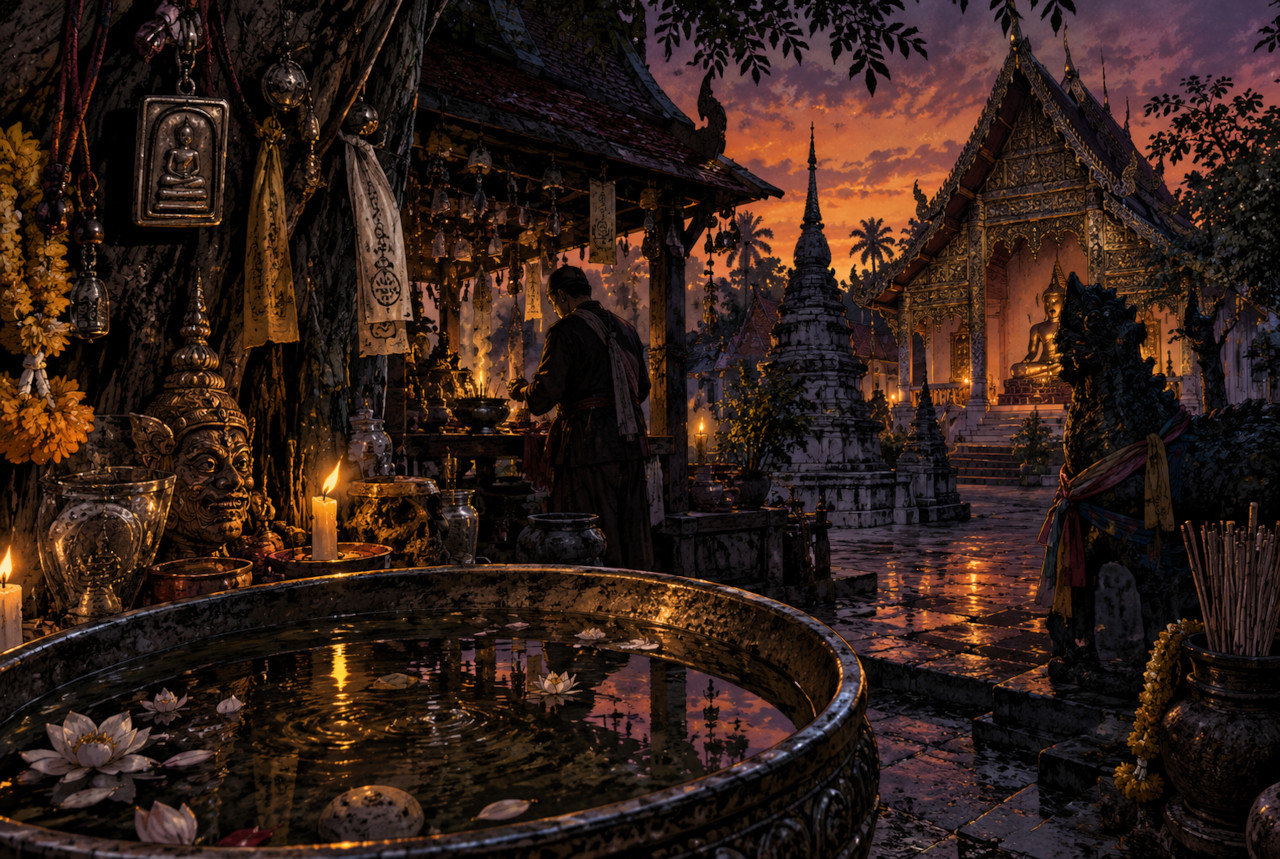
 AI-generated explanatory illustration. It does not depict the actual temple, crime scene or people involved in the case.
It began with a sick husband and a search for help
According to local reporting, one of the women whose account first drew major attention was a 44-year-old teacher. Her husband had suffered from a chronic illness for roughly one to two years, and conventional treatment had not brought the improvement she hoped for. Around March 2025, while under considerable stress, she learned about the man through social media.
He worked as a sap-pa-roe (สัปเหร่อ), a traditional Thai undertaker or funeral attendant. The role is not exactly equivalent to an employee of a modern funeral company. Depending on the community and tradition, a sap-pa-roe may handle bodies, cremation and burial while also inheriting older funeral rituals and beliefs connected with spirits, charms or occult protection.
The woman said the bathing ritual, promoted as a way to remove harmful magic or misfortune, cost about 200 baht per session. She also said she had heard claims that senior police or military figures were among the man’s followers. Whether those claims were true was itself something police said needed checking, but for someone already seeking help, they could add another layer of credibility.
The women later told investigators that during rituals in a place described in Thai reports as the “Dok Kaeo room” within the temple grounds, they were subjected to sexual touching and other acts involving ritual objects. These details come from the complainants’ accounts. They should not be confused with facts already established by a final court judgment.
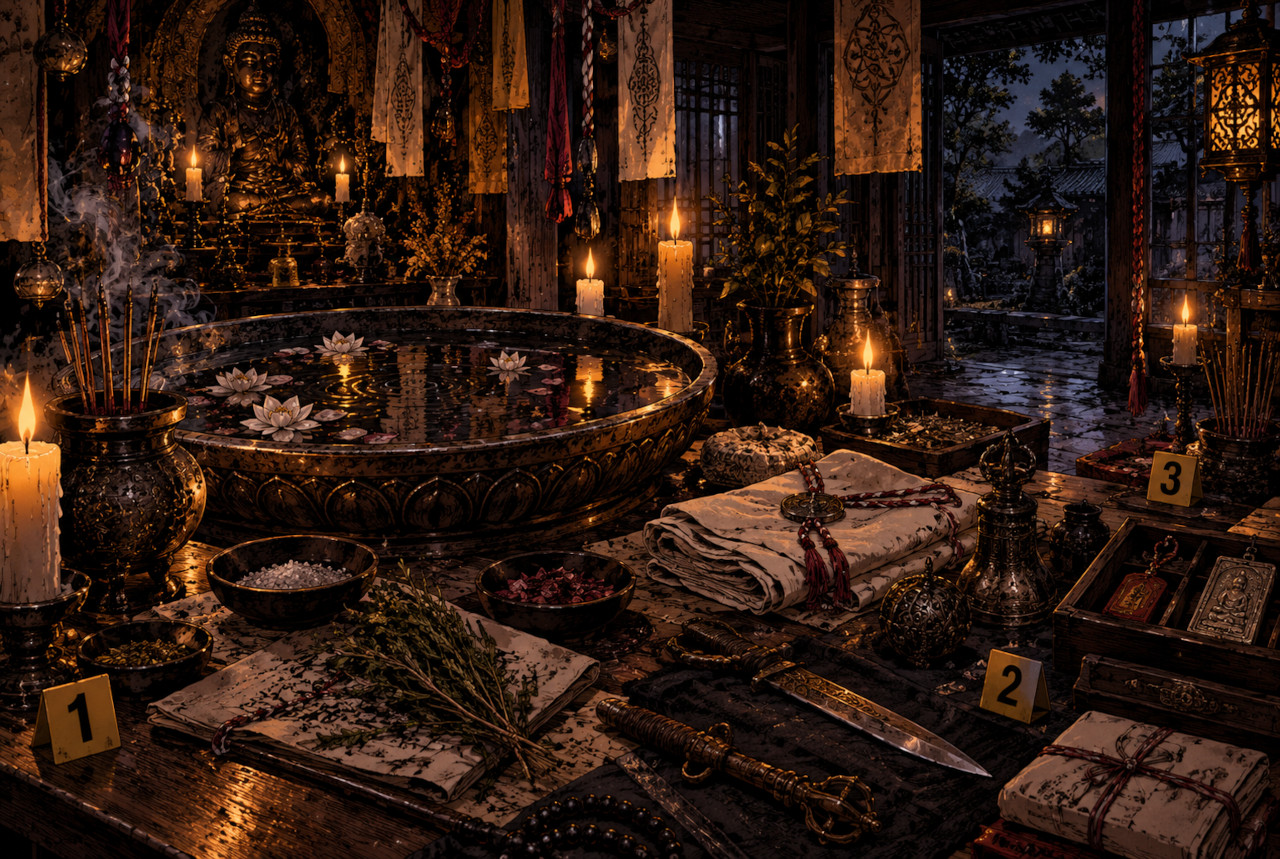 AI-generated explanatory illustration. It does not reproduce the actual crime scene, seized items or evidence arrangement.
Seven warrants — but the suspect disputed coercion
Investigators gathered complaints and sought arrest warrants from the court. On March 2, the undertaker was arrested while staying at a property connected to an associate in northern Thailand. Police also seized items said to have been associated with the rituals, including a ritual knife and other objects.
Thai PBS reported on March 4 that the investigation involved seven alleged offenses occurring on separate occasions. The allegations included indecent or sexual acts, conduct involving force or coercion, and the alleged use of objects. Investigators asked the Criminal Court to continue holding the suspect and opposed bail, citing concerns that he might flee or interfere with evidence.
The man, however, did not accept the accusations in the same terms. According to police accounts reported by Thai media, he acknowledged some of the physical acts but argued that the women had consented and that he had not threatened or forced them.
What can be stated firmly is narrower: multiple women filed complaints, investigators opened cases, the Criminal Court issued seven arrest warrants, and the man was arrested. In the reliable public reporting reviewed for this article through September 18, 2026, B-Side Earth could not confirm a final criminal conviction in the case.
Then another issue surfaced: an infant cemetery
The investigation became even stranger when attention turned to infant remains buried elsewhere within the temple grounds.
On February 16, relatives seeking the return of children who had been buried there took part in an exhumation. At least two sets of infant remains were recovered. Authorities and those involved then discussed forensic testing, including DNA comparison, to establish identities before remains were returned to families.
Thai PBS also reported claims that more than 100 infant burials may have existed at the site. That number needs careful handling. It does not mean police suddenly discovered more than 100 unidentified bodies in a mass grave, nor does it establish that every burial had the same circumstances.
What was directly reported from the February 16 excavation was the recovery of two sets of remains. One additional set sought by a family could not be located at that time.
 AI-generated explanatory illustration. It does not depict the actual infant cemetery, human remains or the real temple involved in the investigation.
Why were infants buried inside temple grounds?
Calling it simply a “mysterious baby cemetery” would make the story more dramatic, but also less accurate.
To explain the cultural background, Thai PBS cited academic research from Mahachulalongkornrajavidyalaya University on funeral customs in Lampang Province in northern Thailand. The study documented traditional roles of undertakers and beliefs surrounding deaths regarded as unusual or spiritually dangerous, including cases in which a pregnant woman and her unborn child died together.
In such traditions, funeral attendants could be responsible not only for practical treatment of the dead but also for rituals believed to separate the living from the dead or protect participants from spiritual danger.
There is an important limitation here: the academic study concerned Lampang Province, not Ang Thong, where this case occurred. It does not prove that the same customs were practiced in exactly the same way at this temple. It is useful as cultural background showing that funeral work, folk belief and occult knowledge have overlapped in some Thai communities.
The undertaker’s wife said her husband had performed this kind of funeral-related work for 40 to 50 years. She maintained that the infants had been buried at families’ requests and denied that the bodies had been kept for sale or other improper purposes.
The temple’s abbot and local authorities, however, said they had not previously known about the cemetery. The district chief subsequently ordered a halt to rituals and burials involving infant remains while officials investigated whether the site and its operation complied with Thailand’s laws governing cemeteries and cremation facilities.
This is not simply a story about “scary Buddhism”
This distinction matters, especially for readers who know Thailand mainly through temples, monks and Theravada Buddhism.
Theravada Buddhism is central to Thai religious life, but everyday belief can also include spirit worship, protective amulets, astrology, fortune-telling and local ritual traditions. These practices may coexist around Buddhist communities without all of them being formal Buddhist doctrine.
The “black magic cleansing” bath at the center of this criminal case should not be described as a standard Theravada Buddhist ritual. The sources reviewed for this article do not support that conclusion. A senior CIB official also said during the early investigation that the allegations concerned the conduct of an individual rather than religion itself.
From a Japanese perspective, there is something familiar here. Japan has Buddhist temples, Shinto purification, fortune-telling, lucky directions, grave-related beliefs and commercial spiritual services. Nobody would sensibly label all of those things simply “Japanese Buddhism.” Thailand deserves the same distinction.
But the case still raises an uncomfortable question. When a temple setting, a traditional funeral role, an old ritual and claims of influential followers all reinforce one another, an unusual request can begin to feel legitimate simply because it arrives wrapped in authority.
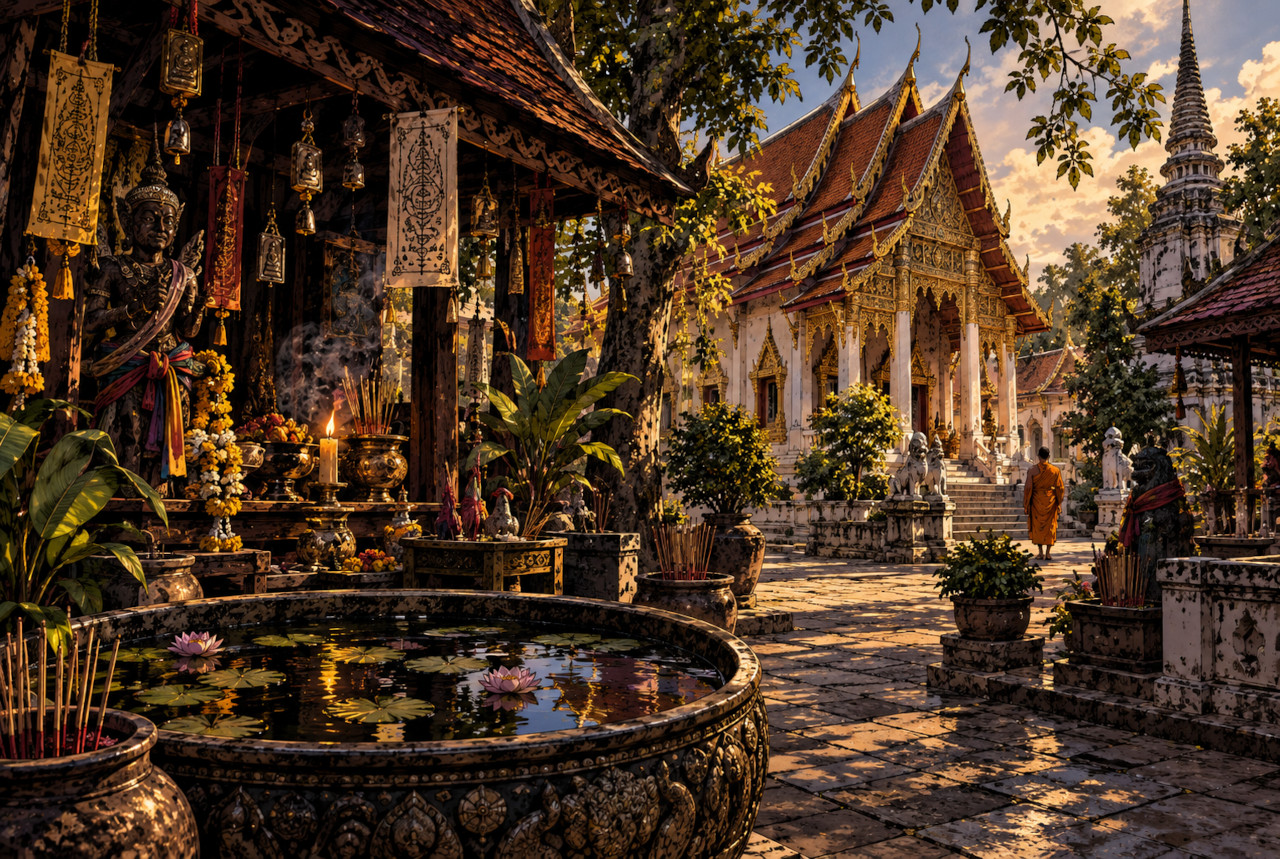
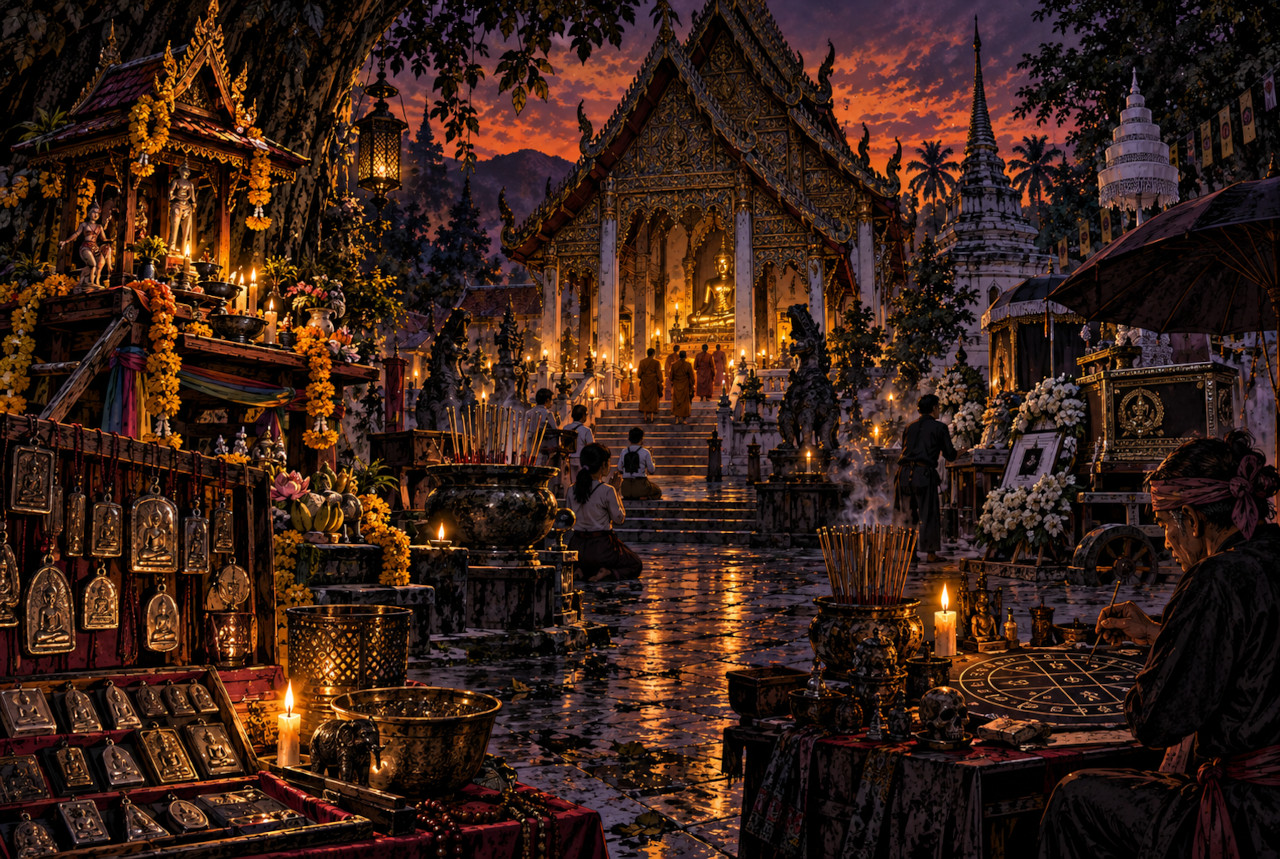 AI-generated cultural illustration. It does not depict a real temple and does not imply that all Thai temples combine these beliefs or practices.
The unsettling part may not be the black magic at all
Black magic. Blessed water. Ritual knives. An infant cemetery. Put those words together and the story sounds like something designed for a low-budget occult horror film.
But the more revealing part of the case is far less supernatural.
A person is worried about an illness or family problem. Social media introduces someone said to possess unusual knowledge. The temple setting supplies familiarity and legitimacy. A traditional occupational role adds authority. Stories about powerful followers make that authority feel even stronger.
Then comes the difficult part: if that person says, “This is necessary to remove what is harming you,” at what point does a vulnerable client feel able to say no?
Faith does not automatically create abuse. But when personal desperation meets someone claiming exceptional power and authority, belief can become something that is exploited.
That is the real B-side of this case. The unusual rituals attract attention, but the deeper story is about how trust can be constructed around a person until actions that would normally trigger suspicion begin to look legitimate.
Editor’s Note
When I visit temples in Thailand, one thing that always strikes me is how naturally faith sits inside ordinary life. From Japan, that can feel both familiar and much more visible at the same time. I do not find that strange in itself. In fact, it is one of the things that makes Thailand interesting.
What bothers me about this case is something else. Put someone inside temple grounds, give him a traditional funeral role, say that he knows old rituals, then add stories that senior officials also trust him. Suddenly, people may stop judging each request on its own merits. The setting starts doing part of the persuading.
And “removing black magic” is especially convenient because success or failure is almost impossible to measure objectively. When people are frightened, sick, grieving or desperate, that uncertainty creates room for someone else to define what is “necessary.” To me, that mechanism is more unsettling than the black magic itself.
References
- Thai PBS News, March 4, 2026 — court detention request, seven arrest warrants and details of the criminal investigation
- Thai PBS News, February 16, 2026 — two sets of infant remains recovered from the cemetery inside the temple grounds
- Thai PBS News, February 17, 2026 — relatives, temple officials and local authorities discuss the infant cemetery and its history
- Thai PBS News — Wiset Chai Chan District orders a halt to rituals and burials involving infant remains while legality is investigated
- Thai PBS News — background on Thai undertakers, funeral beliefs and traditional rituals cited in relation to the cemetery
- News1, February 12, 2026 — two women bring their allegations concerning the cleansing rituals to the Central Investigation Bureau
- Mahachulalongkornrajavidyalaya University — research on undertakers, beliefs and funeral rituals in Bo Haeo Subdistrict Municipality, Lampang Province