

On July 16, 2025, Istanbul police carried out a cybercrime operation targeting companies behind mobile fortune-telling services. Sertaç Taşdelen, founder of the Faladdin and Binnaz platforms, was taken into custody that day and ordered into pretrial detention by a judge on July 17.
The investigation went well beyond whether fortune-telling itself was suspicious. Authorities imposed seizure measures on bank and electronic-money assets, vehicles, vessels, and company interests. Istanbul police said that two vehicles, two vessels, and assets connected to two companies were valued at roughly TRY 107.5 million.
The central allegation was more serious: prosecutors suspected that revenue generated through fortune-telling services had been presented as legitimate corporate income and then laundered through financial transactions.
But calling this a case of “someone getting arrested for using AI to tell fortunes” would be misleading. AI itself was not the stated reason for the arrest. What makes the case unusual is that a modern mobile app ended up at the intersection of a century-old Turkish law, cybercrime provisions, and money-laundering rules.
 AI-generated explanatory illustration. It does not reproduce an actual legal document, app screen, or crime scene.
A 1925 Law Meets a Smartphone Fortune-Telling App
One of the laws cited in the investigation was Law No. 677, enacted in 1925 during the early years of the Turkish Republic. The law is best known for regulating religious lodges, shrines, and certain religious titles, but its language also covers practices including fortune-telling, magic, charms, and claims of revealing hidden or future events.
In other words, fortune-telling in Turkey does not exist in the same fully unregulated entertainment space that many foreign readers might assume.
And the authorities had not suddenly discovered Faladdin in 2025. On January 9, 2024, Turkey’s Advertising Board had already ordered advertising to stop over promotions connected with fortune-tellers, mediums, astrologers, and related services. Binnaz was also named in the board’s decisions.
So from the authorities’ point of view, this was not a case of a harmless app being unexpectedly targeted out of nowhere.
 AI-generated illustration for legal context. It does not depict an actual court, official legal document, or app interface.
But “Illegal Fortune-Telling Equals Criminal Proceeds” Is Not the Whole Story
This is where the case becomes much more interesting.
Article 282 of the Turkish Penal Code, which covers laundering assets derived from crime, generally requires the underlying or “predicate” offense to carry a minimum prison sentence of at least six months. Yet the relevant provision under Law No. 677 carries a sentence of not less than three months.
Read literally, that creates an awkward gap. A fortune-telling offense under Law No. 677 does not automatically appear to meet Article 282’s six-month threshold on its own.
That makes another provision cited by police especially important: Article 245/A, covering prohibited devices and computer programs. The provision applies to certain devices, programs, passwords, or security codes specifically designed or adapted for committing cyber-related crimes, and carries a prison sentence of one to three years.
That penalty range does clear Article 282’s six-month threshold.
Local reporting on the September 2025 indictment says prosecutors treated revenue allegedly generated through fortune-telling activities and the use of prohibited devices or programs as part of the money-laundering case.
But one major question remains. Faladdin was a widely distributed consumer app. The public material available does not clearly explain which part of the app or its operation prosecutors believed satisfied Article 245/A’s requirement for software designed for criminal use.
Filling that gap with assumptions would turn legal analysis into fan fiction. The unanswered connection is precisely what makes the case worth watching.
 AI-generated conceptual illustration. The cities and transfer routes shown do not represent actual recipients, accounts, or transaction destinations in the case.
Does Paying Taxes Make Questionable Revenue Legitimate?
Another striking part of the prosecution’s case concerns how the money was treated after it was earned.
According to reporting on the indictment, prosecutors argued that revenue from the disputed activities was recorded as ordinary company income and taxed in a way that made it appear legitimate. They also pointed to transfers to overseas accounts and transactions involving crypto-asset service providers.
This principle extends far beyond fortune-telling. Registering a company, issuing invoices, and paying tax do not automatically legalize the activity that generated the money in the first place. If a court first establishes that the underlying income came from a qualifying criminal offense, steps taken to disguise or transfer that money can create a separate money-laundering issue.
But that brings the case straight back to the same question: what exactly qualifies as the underlying criminal offense here? That is not a minor technical detail. It is central to the entire legal theory.
He Denies the Charges — and the App Is Still Online
Taşdelen has denied wrongdoing. In statements reported after his arrest, he described himself as a technology entrepreneur whose companies developed applications using AI, and argued that he was neither a fortune-teller nor involved in illegal money laundering.
In September 2025, prosecutors filed an indictment seeking a sentence of three to seven years under Article 282. At the first hearing on December 2, the court ordered his release from detention under judicial supervision, including a requirement not to leave his residence.
That means Taşdelen should not be described as a convicted criminal. As of September 21, 2026, the reliable public sources reviewed for this article did not show a final conviction in the case.
There is another odd twist. The Faladdin-branded app itself has not disappeared. It remains available on Google Play, where it shows more than 10 million downloads. The app description claims more than 25 million users. Google Play currently lists the developer as Estonia-based Truemium OÜ, and the app was updated on September 17, 2026.
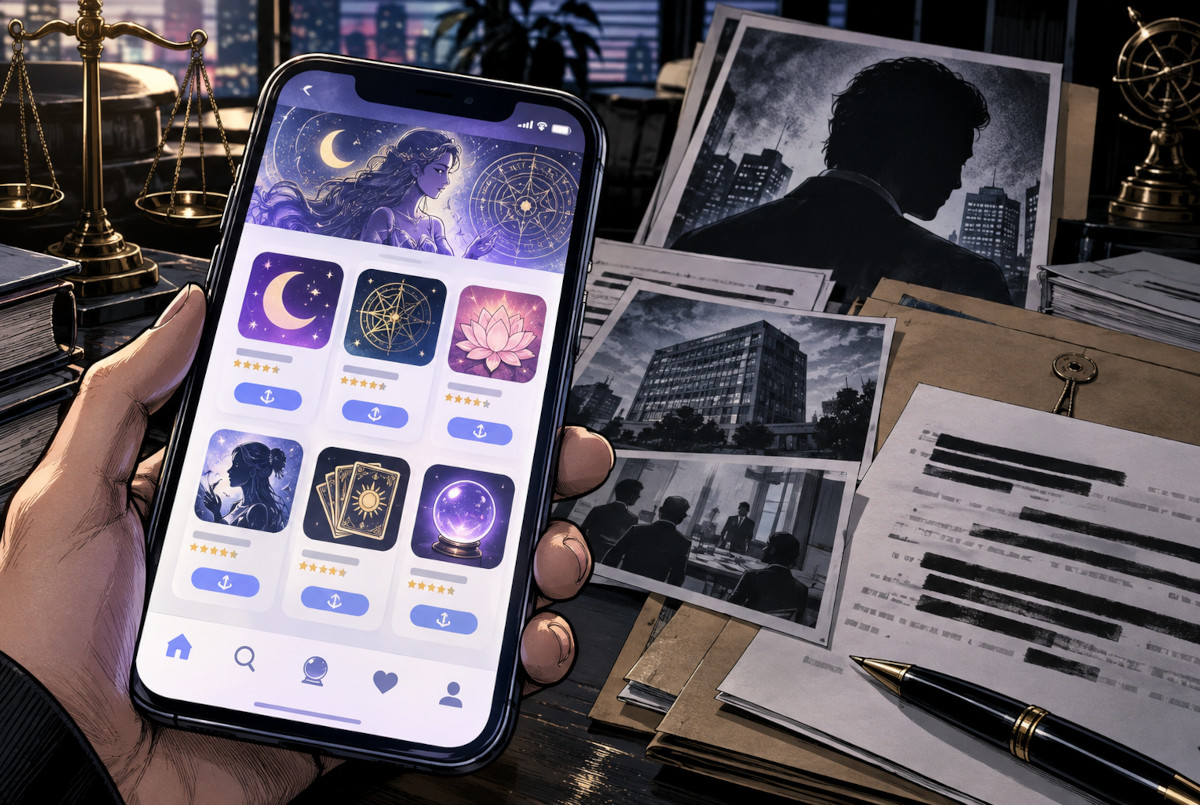 AI-generated explanatory illustration. It does not reproduce the real Faladdin store page, actual investigation files, or any person involved in the case.
Why the Same Story Would Look Different in Japan
From a Japanese perspective, the starting point is noticeably different. Fortune-telling itself is not broadly prohibited in Japan in the way Turkey’s Law No. 677 can restrict fortune-telling practices.
Japanese consumer law focuses more heavily on how a customer is persuaded to pay. For example, contracts may be subject to cancellation when a seller uses supposed spiritual or supernatural knowledge to intensify fear of serious harm and claims that entering into a contract is necessary to avoid it.
So in Japan, the legal question is more likely to become, “What was the customer told, how was fear used, and how was payment obtained?” rather than simply, “Was a fortune told?”
That contrast matters. It would be easy to reduce the Faladdin story to a headline such as “AI fortune-telling gets you arrested in Turkey.” But the real structure is stranger: a century-old fortune-telling restriction, a modern cybercrime provision, and criminal-proceeds law all ended up colliding around one mobile app.
That is the real B-side of the story.
Editor’s Note
What bothers me here is not whether fortune-telling “works.” That is almost beside the point. The more interesting question is whether putting something inside a company, adding an app, payment processing, invoices, and tax filings somehow turns it into an ordinary technology business. The authorities’ answer was basically: not necessarily, if the underlying activity is illegal.
Fair enough. But then I want the other half of the explanation. What exactly turns a mainstream app-store fortune-telling product into the kind of “prohibited program” contemplated by Article 245/A? That is the part I want to see argued clearly in court.
“AI fortune-telling founder arrested!” is the kind of headline an old-school tabloid could print in five minutes. B-Side Earth should be digging one layer below that. In this case, the weirdest part is not the fortune-telling. It is the legal bridge built underneath it.
References
- Istanbul Provincial Police Department — Cybercrime Branch press statement, July 16, 2025
- Grand National Assembly of Turkey (TBMM) — original text of Law No. 677
- Turkish Ministry of Justice — Turkish Penal Code, including Articles 245/A and 282
- Turkish Ministry of Trade, Advertising Board — decisions from Meeting No. 341, January 9, 2024, including Faladdin and Binnaz
- DHA — Sertaç Taşdelen ordered into detention, July 17, 2025
- DHA — indictment seeks up to seven years in prison for Sertaç Taşdelen, September 24, 2025
- Dünya — release under judicial supervision at the first hearing, December 2, 2025
- Rest of World — reporting on Faladdin’s AI-assisted fortune-telling system and business model, May 26, 2020
- Google Play — Faladdin app listing
- Consumer Affairs Agency of Japan — consumer contract rules concerning solicitation based on spiritual or supernatural claims