
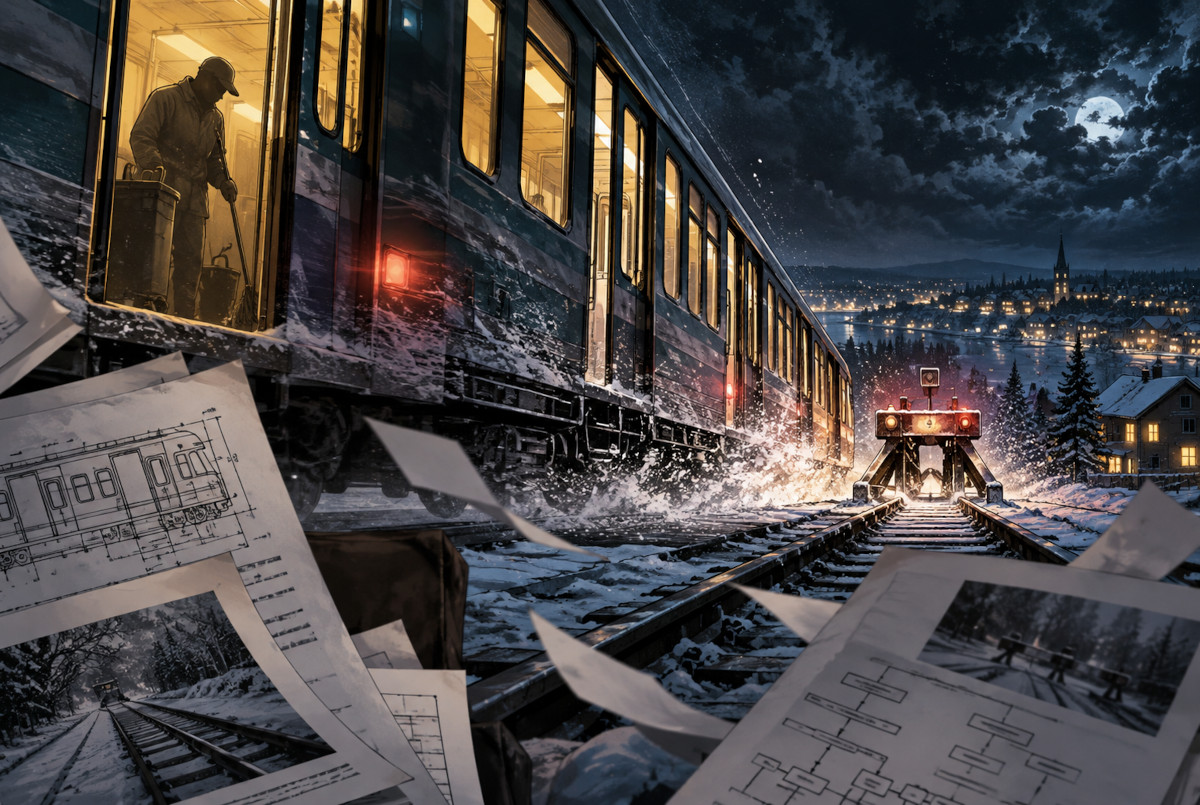
At around 2:23 a.m. on January 15, 2013, a commuter train sitting at the Neglinge depot outside Stockholm, Sweden, suddenly began to move. It accelerated toward the terminus at Saltsjöbaden, roughly 1.7 kilometers (1.1 miles) away.
The train consisted of two C10/C11 two-car units, four cars in total. In the Swedish Accident Investigation Authority’s accident analysis, the train was treated as weighing roughly 90 metric tons. It reached around 80 km/h (50 mph) before crashing through the buffer stop and continuing toward a residential building about 30 meters (100 feet) beyond the end of the track.
There was only one person aboard: a woman who had been cleaning the train. She was seriously injured. No one in the building was reported injured.
Within hours, however, the accident acquired a much more sensational explanation. Reports around the world said that a cleaner had stolen an empty train, driven it at high speed and crashed it into a house.
Three days later, that story began to collapse.
The story that went around the world: “A cleaner stole a train”
Immediately after the crash, the cleaner was suspected of deliberately taking the train. Early information from operator Arriva and Stockholm’s public transport side suggested that the train could not simply have started moving by accident. The obvious narrative followed: someone must have driven it.
That was not merely an internet rumor invented by strangers online. Early news reports were based on information coming from the organizations involved and the authorities investigating the crash. The cleaner was treated as a criminal suspect, and international coverage quickly turned the accident into an extraordinary story about an unauthorized joyride.
Japan received the same version. On January 16, AFPBB News published an article whose Japanese headline translated roughly as: “Cleaner steals unmanned train, goes on rampage and crashes into a house in Sweden.”
But on January 18, the Swedish Prosecution Authority removed the woman from suspicion. Technical findings had revealed several serious safety deficiencies involving the train and the way it had been stabled, and investigators had found nothing indicating that she had intentionally driven it away.
The supposed “train thief” was no longer the central criminal suspect. The investigation was turning toward the conditions that had allowed the train to move at all.
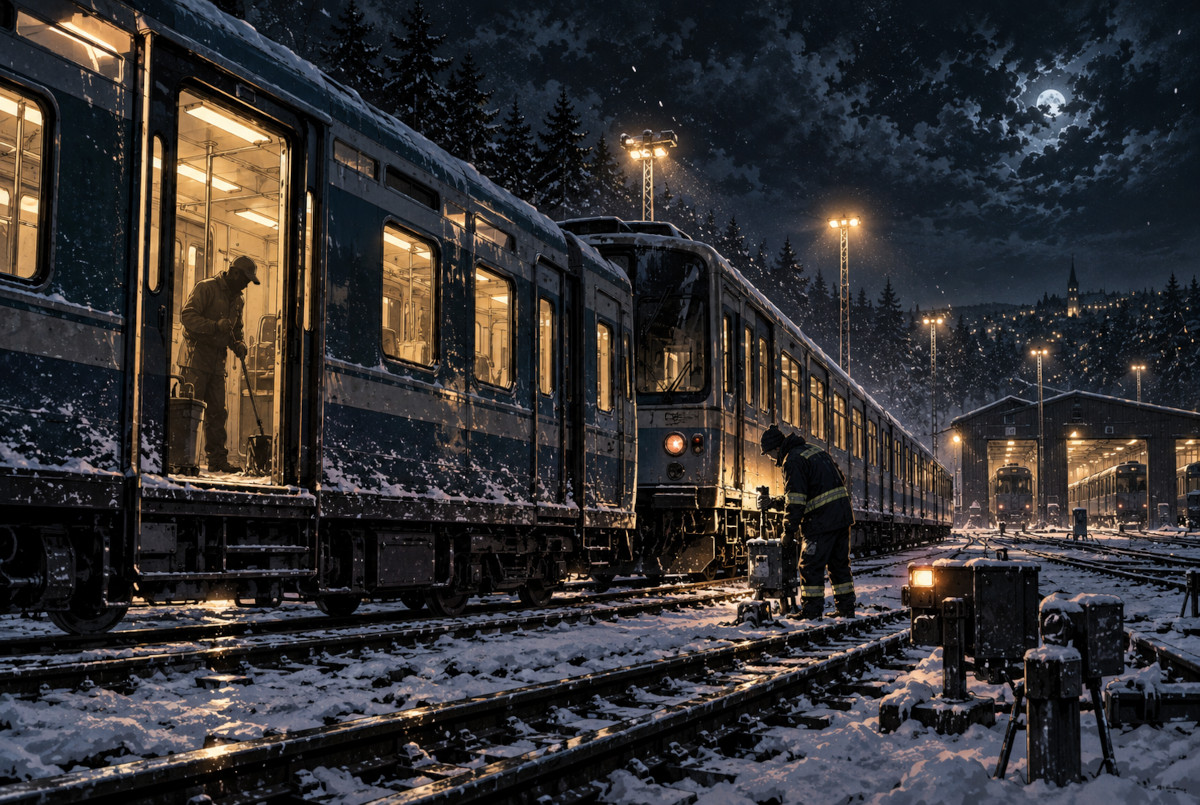 AI-generated explanatory illustration. It does not reproduce the actual Neglinge depot, accident train or people involved.
The final trigger was something completely ordinary: closing the doors
In May 2014, the Swedish Accident Investigation Authority (SHK) published its final report, RJ 2014:03. What it described was much stranger — and more serious — than a cleaner experimenting with a train and losing control.
The night was below freezing. One concern at the depot was that brake blocks could freeze against the wheels while trains were parked. Neglinge had equipment designed to allow trains to be stabled with their brakes released under controlled conditions, but the system serving Track 3 was not working. The fault had already been reported in December and had still not been resolved on the night of the accident.
A railway worker therefore used an alternative method to keep the train in an unbraked state. The cab was activated, the deadman system was held down, and the controls were left in an unusual configuration. By the end of the procedure, the traction controller was in the full-power position. The passenger doors, however, were open, which prevented traction from being applied.
The worker believed the train could not simply begin moving in that condition.
SHK later tested the system. The result exposed the crucial weakness.
With the cab configured as it was that night, operating the central door-closing control was enough for traction power to engage and the train to start moving.
Closing those doors was not some reckless attempt to operate the train. It was part of the cleaner’s normal end-of-job routine. SHK concluded that the ordinary door-closing operation was the final trigger that set the train in motion.
Importantly, SHK did not identify a technical failure in the train itself that independently caused it to run away. The problem was the combination of the failed depot brake-release equipment, the improvised response to that failure, and the hazardous configuration in which the cab had been left.
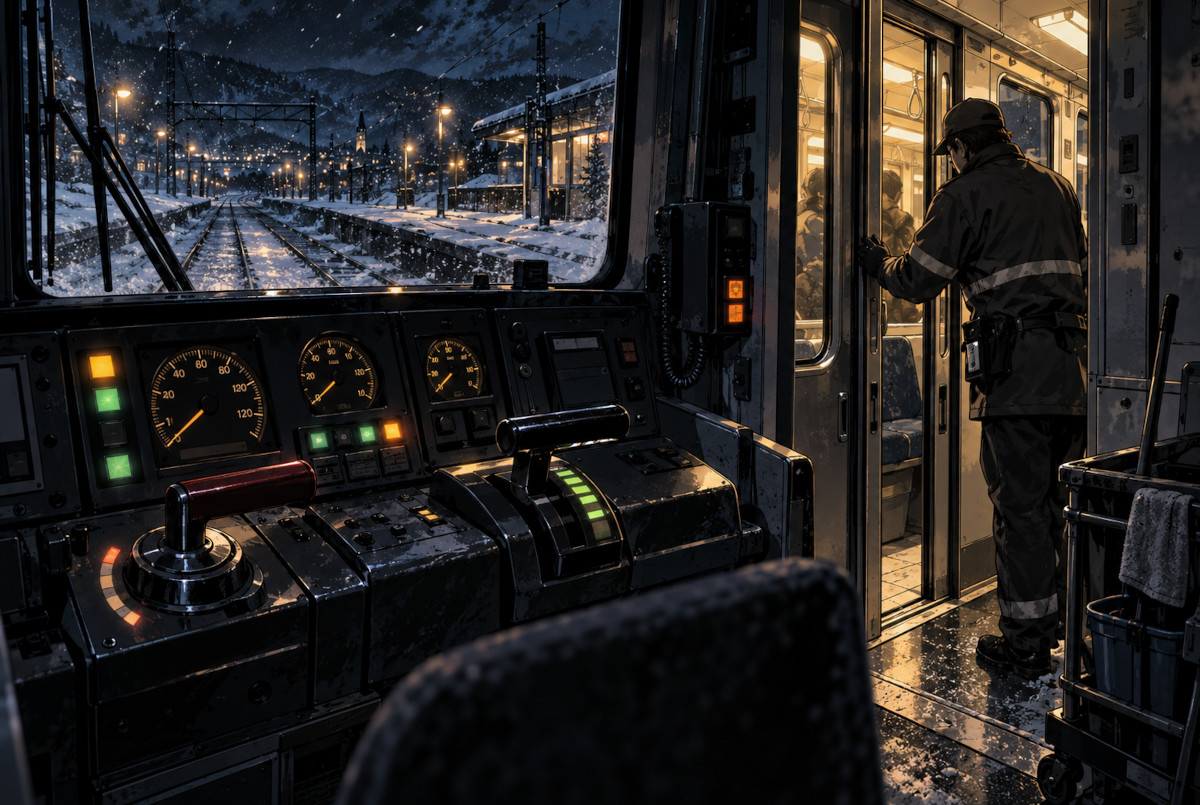 AI-generated illustration explaining the accident sequence. It does not reproduce the actual C10/C11 cab or provide an exact operating procedure.
Nearly 90 tons of train, 80 km/h, and another safety barrier missing
Once the doors closed, the train began moving out of Neglinge toward Saltsjöbaden.
There was still another opportunity for the runaway to be contained. The points leading away from the depot could have sent the train away from the main route. Instead, they were positioned so that the train could continue toward Saltsjöbaden.
SHK found that this was connected partly to preparations for the following morning’s first service and partly to differing interpretations between the operator and infrastructure side over what the points’ normal position should be.
In other words, this was not a one-error accident.
The depot brake-release equipment was out of service. An improvised procedure was being used. The cab had been left in an abnormal state. Closing the doors allowed traction to engage. And the points provided a route straight onto the line.
Several separate holes in the safety system happened to line up.
The train traveled roughly 1.7 kilometers in about one minute and forty seconds, accelerating to around 80 km/h. The normal maximum speed on the section was 60 km/h. It passed the end of the line, broke through the buffer stop and entered the residential building beyond it.
The cleaner had not been trained to drive the train, and her training did not include the location and use of the emergency braking controls. SHK considered her inability to stop the train understandable under the circumstances.
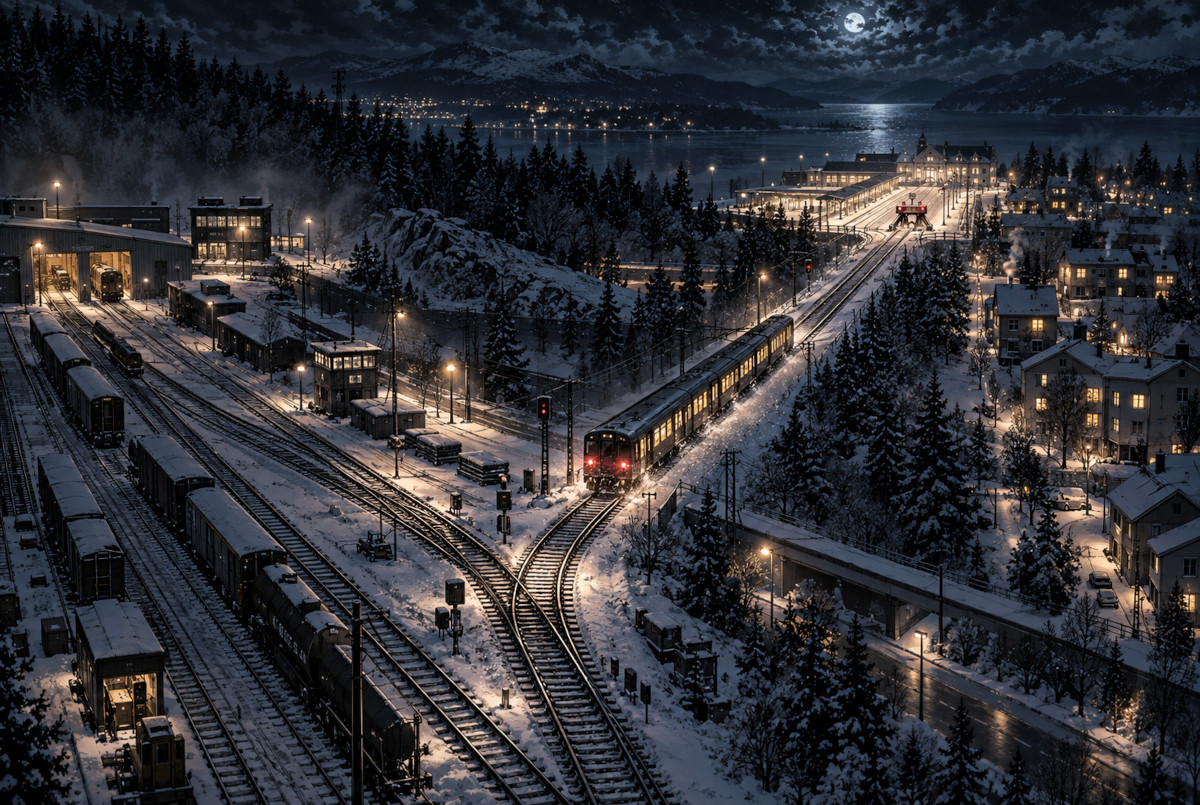 AI-generated schematic interpretation of the runaway route. It does not reproduce the actual track layout, rolling stock or geography.
The broken equipment had been a problem for more than a month
There is one detail buried in the official investigation that feels almost tailor-made for the B-side of the story.
The faulty brake-release equipment had been reported on December 7, 2012. It remained unavailable for weeks. Yet after the accident, when another repair request was made, an electrician replaced a fuse in the transformer and the system returned to operation.
That does not mean the entire accident can be reduced to “someone forgot to change a fuse.” The report describes confusion over responsibilities and failures in how the defect was handled. Complex accidents rarely have one cartoonishly simple villain.
Still, a problem that had remained in the background for more than a month was restored to service after the crash through a comparatively simple repair. That detail says a great deal about how mundane maintenance issues can become part of a much larger safety failure.
The theft allegation disappeared. The old headline did not.
Arriva later apologized for having identified the cleaner so quickly. Speaking to Swedish broadcaster SVT, an Arriva representative acknowledged that the initial version had effectively become accepted as a general truth before the facts had been established.
The investigation subsequently moved into occupational-safety territory. In 2017, Arriva received a corporate fine of SEK 500,000 over workplace-safety failures connected with the crash. The cleaner, who had been seriously injured, was awarded SEK 20,000 in compensation.
Yet the first version of the story never completely disappeared.
As of September 2026, the Japanese AFPBB News article published on January 16, 2013 can still be found online under its original headline describing a cleaner who “stole” an unmanned train and crashed it into a house.
That does not make AFP uniquely responsible for what happened. The report reflected information circulating at the time. The more interesting problem is what happens afterward.
A dramatic first report can remain searchable for years, while the correction, the accident report and the boring but crucial safety findings sink much deeper into the archive.
Seen from Japan, this case is especially revealing because that old Japanese-language story remains an easy way to encounter the accident. Someone discovering it today could reasonably walk away believing that a cleaner simply stole a Swedish train for reasons unknown — unless they keep digging.
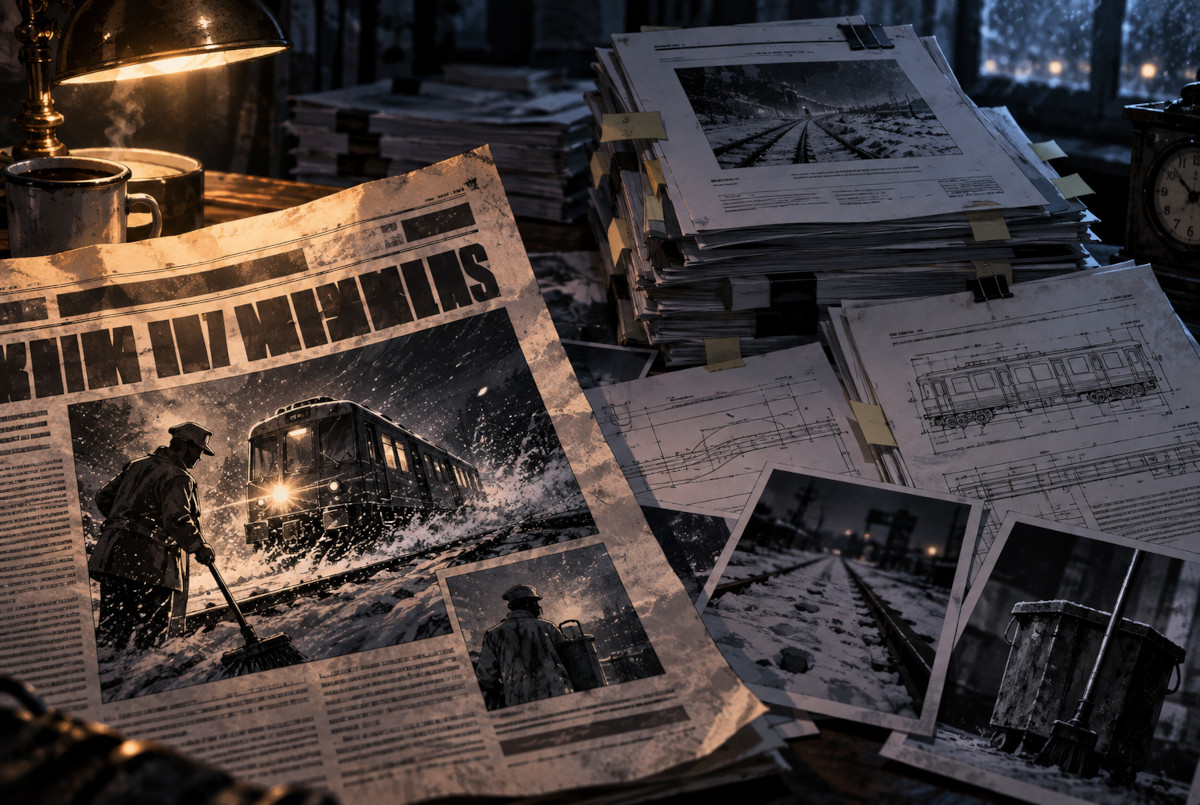 AI-generated illustration representing the gap between early reporting and later findings. It does not reproduce any real newspaper page, official report or news photograph.
The real story was stranger than the “weird news” version
From a railway-safety perspective, the most unusual part of this accident is not that a cleaner supposedly stole a train.
It is that several layers that should have prevented an uncontrolled departure disappeared one after another, until an ordinary cleaning task became capable of starting a train.
The media story developed in a strangely similar way. A simple explanation — “the cleaner stole it” — moved faster than the slower technical investigation that eventually showed how complicated the accident really was.
The runaway train stopped after less than two minutes.
The story that the cleaner stole it has been running for more than thirteen years.
Editor’s Note
If I had seen only the first headline in 2013, I probably would have thought exactly what millions of other people thought: “Wait — a cleaner stole a train and somehow got it up to 80 km/h?” It is the kind of headline that practically files itself into the weird-news drawer of your brain.
What bothers me is what happened next. We tend to think the internet constantly replaces old information with newer and better information. It often does the opposite. The loudest first version can survive indefinitely while the correction is buried several search results — or several languages — away.
And in this case, the cleaner was never the strangest part of the story. The failed equipment, the workaround, the cab configuration, the points and the safety-management failures all happened to line up until something that sounds absurd — “close the doors and the train starts moving” — became possible.
That is why old weird-news stories are worth revisiting. Sometimes the original headline is only the A-side. Ask, “So what happened after that?” and the B-side can be much more interesting — and much more important.
References
- Swedish Accident Investigation Authority (SHK), “Accident on the Saltsjöbanan commuter train, Stockholm” — Official investigation page for the January 15, 2013 accident.
- Swedish Accident Investigation Authority (SHK), Final Report RJ 2014:03 — Swedish-language final report covering the accident sequence, rolling stock, control system, safety management and causes.
- Swedish Prosecution Authority, “Städerska inte längre misstänkt för tågkrasch” — January 18, 2013 official statement removing the cleaner from suspicion and noting serious safety deficiencies. Swedish-language source.
- Swedish Prosecution Authority, “Tågkraschen vid Saltsjöbanan i Stockholm” — January 21, 2013 update stating that the case would be investigated as a suspected workplace-safety offense. Swedish-language source.
- SVT Nyheter, “Det blev liksom en allmän sanning i början” — Reporting on the early identification of the cleaner and the subsequent apologies from Arriva and SL.
- SVT Nyheter, “Utredning klar: Därför skenade tåget” — May 5, 2014 coverage of the SHK findings and the role of the door-closing operation.
- SVT Nyheter, “Arriva får böta halv miljon för tågkraschen” — February 2017 report on the SEK 500,000 corporate fine and compensation to the injured cleaner.
- AFPBB News, “清掃員が無人列車を盗み暴走、住宅に突っ込む スウェーデン” — Japanese-language AFP report published January 16, 2013, preserving the initial “stolen train” version of the story.