

On June 8, 2026, just days before the FIFA World Cup opened, Mexico City appeared to be experiencing an unusual kind of wildlife boom.
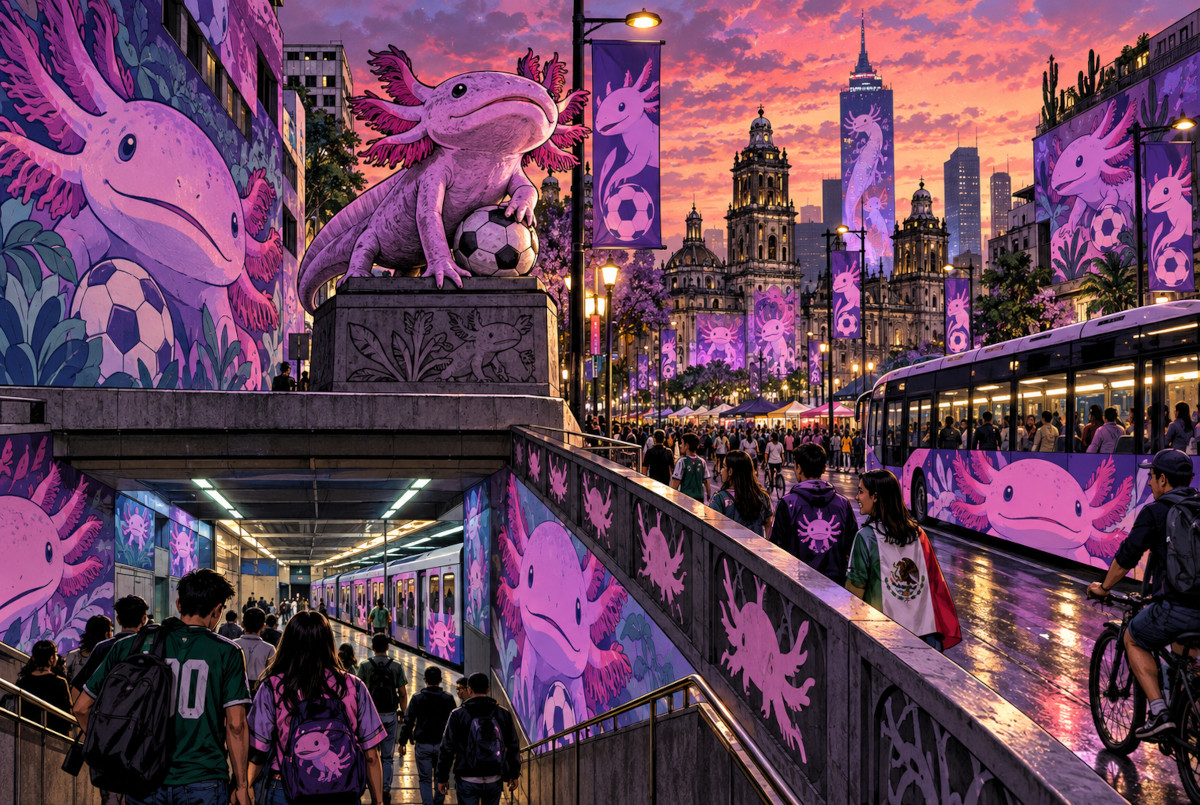
The animal was the axolotl (Ambystoma mexicanum), the salamander native to the lakes and canals of the Valley of Mexico. They were not crawling through the streets, of course. Instead, brightly colored purple and pink axolotls were turning up on murals, public art, transit vehicles, sculptures and merchandise across the city.
At almost the same time, researchers looking for actual wild axolotls in the canals of Xochimilco were confronting the opposite situation: their survey nets were coming up empty.
In the city, axolotls seemed to be multiplying everywhere. In the wild, researchers caught none. Yet when they tested the water, the animals’ DNA was still there. That contradiction is the strange reality now surrounding one of Mexico City’s most famous native animals.
No, the axolotl is not an official World Cup mascot
First, one easy misunderstanding needs clearing up. The axolotl is not an official mascot of the 2026 FIFA World Cup. Mexico’s official tournament mascot is Zayu, a jaguar.
Mexico City, however, embraced the axolotl so enthusiastically that Reuters described it as an “unofficial mascot.” The spread of axolotl imagery became noticeable enough to inspire the term ajolotización — roughly, “axolotlization” — along with internet memes imagining gigantic axolotls taking over the city.
In other words, FIFA did not suddenly decide to promote salamanders. Mexico City took an animal that was already one of its strongest local symbols and turned the volume up dramatically as the World Cup approached.
AI-generated explanatory illustration. It does not reproduce any actual mural, transit vehicle or specific city scene.
From 6,000 per square kilometer to just 36
The numbers from the wild tell a much darker story.
According to the National Autonomous University of Mexico (UNAM), a 1998 survey estimated roughly 6,000 axolotls per square kilometer in Xochimilco. By 2014, that figure had fallen to just 36 per square kilometer.
That distinction matters. The often-repeated claim that “only 36 axolotls remain in the wild” is wrong. The figure refers to population density, not the total number of surviving animals.
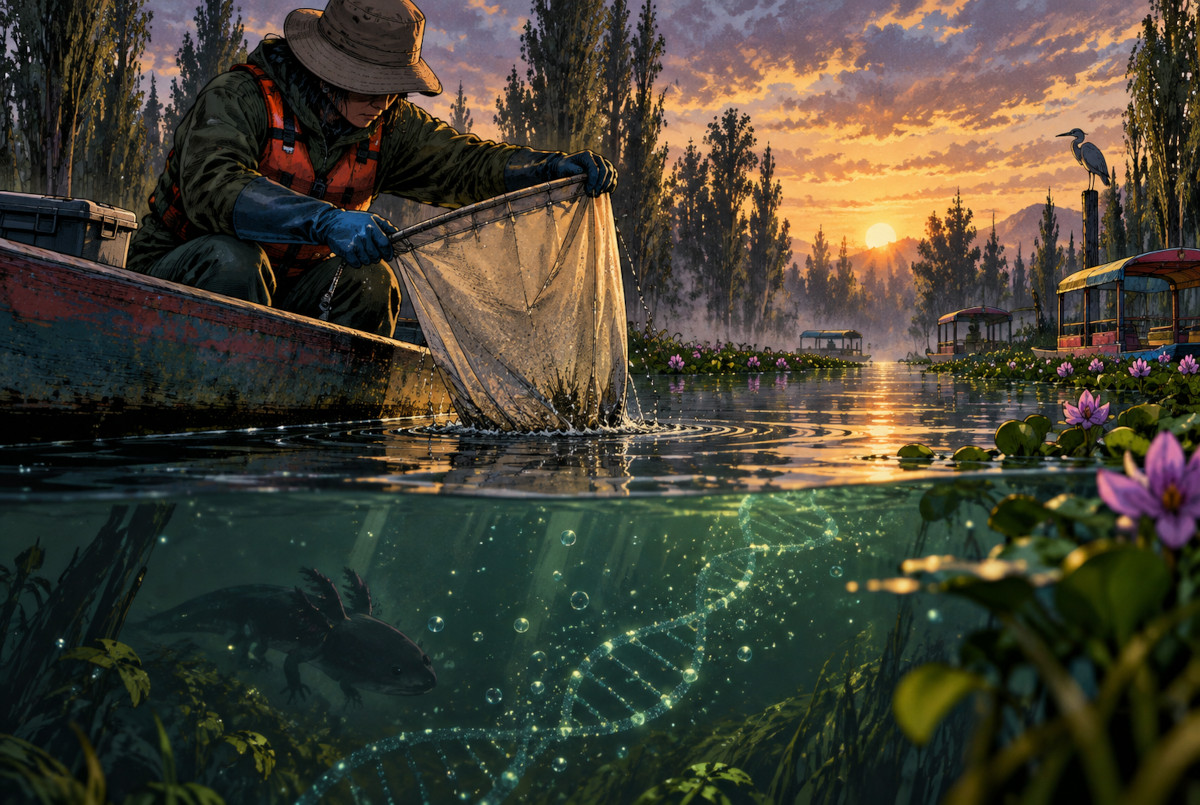
A new census began in 2024. Researchers again used traditional nets, but no wild axolotls were captured. As of a June 28, 2026 UNAM update, the new census results were still being processed.
So this does not mean the wild population has fallen to zero. It means the animals have become so difficult to detect that conventional net surveys are no longer finding them, even though other evidence shows they remain present.
AI-generated research illustration. In the actual survey, no wild axolotls were caught in the nets, while environmental DNA confirmed their presence. The visible DNA motif and underwater animal are symbolic and were not directly photographed or observed this way.
The nets found nothing, but the water left a clue
This is where environmental DNA, or eDNA, becomes important.
Animals constantly leave tiny traces of genetic material behind through skin cells, mucus, waste and other biological material. By sampling water and analyzing those traces, researchers can detect the presence of a species without physically catching or seeing an individual animal.
In the recent Xochimilco survey, traditional nets failed to capture an axolotl, but eDNA testing showed that axolotls were still present. Researcher Vania Mendoza also told Reuters that the team had evidence the animals were still there despite the lack of physical captures.
But the eDNA findings released so far do not provide a new, definitive population density. That leaves the situation in an uncomfortable middle ground. The species has not disappeared from Xochimilco, but the full size of the remaining wild population is still unresolved.
The wild axolotl does not look like the pink one most people know
There is another twist for anyone who knows the axolotl mainly from pet shops, aquariums, cartoons or social media.
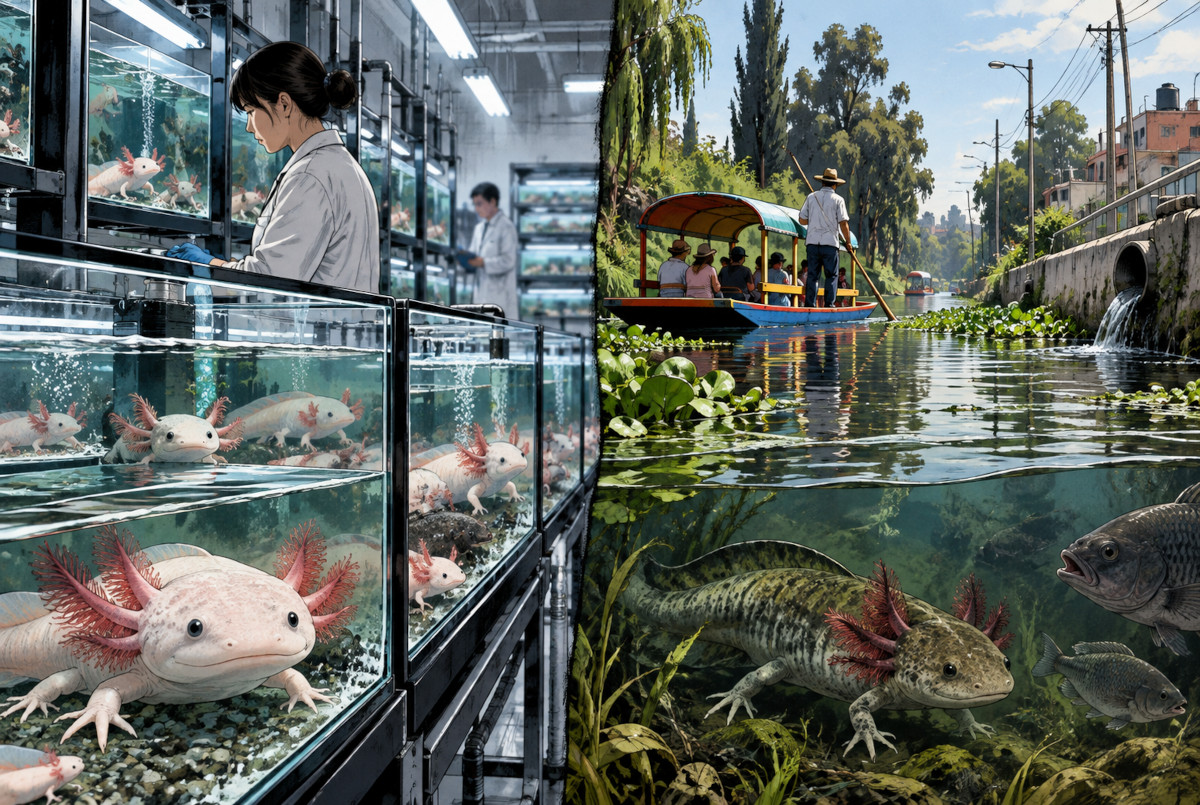
UNAM notes that wild axolotls are typically dark greenish-brown. That is very different from the pale-bodied, pink-gilled animals familiar in captivity — and even further removed from the bright purple versions decorating Mexico City.
In Japan, where the animal became famous under the pet-trade nickname uupaaruupaa, the pale form is especially familiar. Seen from Japan, that makes the contrast almost backwards: many people recognize the domesticated-looking version immediately, while the animal’s natural coloration may look unfamiliar.
The city, then, has been taken over mostly by a heavily stylized version of the animal. While the darker wild axolotl becomes increasingly difficult to find, its colorful urban alter ego is thriving spectacularly. It is almost too neat a metaphor.
Saving a cute animal is not as simple as breeding more of it
The decline of the wild axolotl is not caused by one problem. Urbanization, water pollution, shrinking habitat and invasive species all play a role.
Carp and tilapia are among the invasive fish considered a serious threat in Xochimilco. They prey on axolotls and also compete with native wildlife for food, shelter and breeding space. UNAM researcher Luis Zambrano has also pointed to poorly treated wastewater, pressure on the traditional chinampa farming system, land conversion and heavy tourism as additional stresses on the wetland ecosystem.
Chinampas are the historic raised-field farms that form part of Xochimilco’s canal landscape. Their survival is not merely a cultural issue. Researchers increasingly treat working chinampas and restored canals as part of the ecological infrastructure needed to keep wild axolotls alive.
That is why producing thousands of axolotls in aquariums does not solve the problem by itself. The challenge is not simply to create more animals. It is to preserve a place where they can survive without an aquarium around them.
AI-generated comparative illustration. It does not reproduce a specific research facility or canal. The wild axolotl shown on the right is symbolic and is not an animal photographed during the recent survey.
So was the government just decorating the city with axolotls?
That interpretation would be too simple as well.
Reuters reported criticism from scientists and residents who felt that the axolotl’s cultural and commercial popularity was racing ahead of meaningful conservation. Mexico City’s government did not respond to Reuters for that report. But five days earlier, on June 3, the city had publicly announced conservation measures that included a public conservation research facility, restoration work involving 30 chinampa areas, an axolotl sanctuary in the Xochimilco Ecological Park, and measures intended to reduce wastewater entering the ecosystem.
Then, on July 22, the Metropolitan Autonomous University (UAM) announced that its Centro de Investigaciones Biológicas y Acuícolas de Cuemanco, or CIBAC, was preparing to release around 800 axolotls into Lake Huetzalin in the Xochimilco Ecological Park. The project followed more than three years of monitoring water quality, food availability and habitat conditions, with the release planned for around the end of 2026.
The researcher leading the project said that even a 10 to 20 percent survival rate would represent an important result because surviving animals could reproduce and help rebuild a wild population. That figure says a great deal about the difference between keeping an axolotl alive in captivity and re-establishing one in the wild.
So the story is not simply that officials printed cute axolotls while doing nothing else. The reality is messier. Real conservation work is underway, but during the World Cup buildup the commercial and visual “axolotlization” of the city became far more visible than the slow, difficult work of rebuilding an ecosystem.
UAM researchers have also warned that popularity can cut both ways. Greater public interest may help conservation, but excessive commercialization, misinformation, irresponsible pet ownership and illegal trade can create new problems of their own.
Editor’s Note
The part that sticks with me is that the symbolic axolotl seems to be doing much better than the real one.
It is on trains. It is on walls. It is on merchandise. It lives comfortably in laboratories and aquariums around the world. Then researchers put a net into the place where the animal actually evolved, pull it back up, and find nothing. Only after testing the water do they get the message: yes, the axolotls are still here somewhere.
From a Japanese perspective, there is another layer to the irony. Most people in Japan first met this animal as the cute, pale “uupaaruupaa” from pet shops and television. The dark wild animal — the one whose habitat actually needs saving — is almost the less familiar version.
And yet blaming the city government alone would also be too easy. There are research projects, habitat restoration programs, sanctuaries and reintroduction plans. That may be the strangest part of all. Everyone loves the axolotl. What is much harder is maintaining the muddy, complicated wetland that allows a wild axolotl to exist.
Turning an endangered animal into a lovable character is easy. Saving the place underneath the character is the hard part.
References
- Reuters — “In Mexico City, axolotl salamanders are everywhere before the World Cup — except in the wild” (June 8, 2026)
- National Autonomous University of Mexico (UNAM) — Spanish-language release on the 2026 Environmental Merit Award, Xochimilco restoration and the latest axolotl census (June 28, 2026)
- National Autonomous University of Mexico (UNAM) — Spanish-language release on the new Xochimilco axolotl census (2024)
- Metropolitan Autonomous University (UAM) — Spanish-language release: “The axolotl’s popularity does not guarantee its conservation” (July 22, 2026)
- Government of Mexico City — Spanish-language announcement on Xochimilco improvements and axolotl conservation measures (June 3, 2026)
- FIFA — Official FIFA World Cup 2026 Mascots
- Conservation International — “Axolotls are on the brink. Can we bring them back?” (August 12, 2025)