
On February 6, 2026, something peculiar happened during a Lao Development Lottery draw. The officially certified six-digit winning number was 837430. But viewers watching Lao National Television saw a different number on screen: 387430.
At first glance, this sounds like an ordinary broadcast mistake: one digit in the wrong place, an apology, end of story. But by the time the broadcaster acknowledged the error on February 7, the problem had apparently traveled much further. A lottery buyer named PaNoy Bouttavong said the incorrectly displayed number had been recognized by the lottery app as a six-digit winner, the prize money was transferred to a bank account, and the transaction was reversed roughly 30 minutes later.
The lottery result itself was not changed
There is an important distinction here. According to the broadcaster’s explanation, the draw was not rerun and the official winning number was not changed after the fact. The central lottery committee had already recorded and certified 837430 as the correct result.
The error was the number shown on television: 387430. On the surface, then, this was a broadcast display error.
But that leaves a much more interesting question. According to Bouttavong’s account, her number was also treated as a six-digit winner in the lottery app, and the payout process went far enough for money to reach a bank account. The official result was apparently correct from the beginning, yet a different number was still accepted somewhere in the digital process as a winning ticket.
If the problem had existed only on the television screen, it should have stopped there. Did the broadcast display and the lottery app receive the same incorrect data? Was the wrong number entered separately into different systems? Or was there another step between certification and payment that failed to reject it? The publicly available explanations do not reveal the technical path.
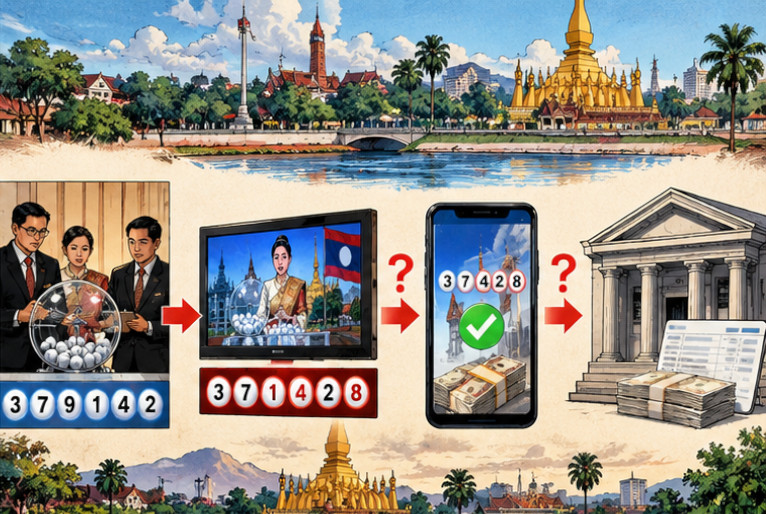 AI-generated conceptual illustration. It does not depict the actual system architecture, television broadcast, lottery app or people involved, and the numbers shown in the image are not the actual winning numbers.
Was the prize really theirs for only 30 minutes?
The Laotian Times reported that Bouttavong said the money remained in the account for about 30 minutes before the transaction was reversed. Banque Pour Le Commerce Exterieur Lao Public, better known as BCEL, later said it had acted on instructions from the lottery distributor after the broadcast error was confirmed and had processed the transaction according to agreed procedures.
A six-digit Lao Development Lottery prize for a 1,000-kip purchase has been reported at 400 million kip. At early-February 2026 exchange rates, that is roughly US$18,700.
That figure needs one important qualification. Public reporting does not independently establish how much Bouttavong actually paid for the ticket or whether the exact amount reversed from her account was 400 million kip. What can be separated more safely is the reported transaction sequence—six-digit win, payment, reversal—from the standard prize figure associated with a 1,000-kip purchase.
Then came the second question: why can this be reversed so quickly?
The story did not remain a lottery story for long. On Lao social media, people began asking a broader question: if money connected to a lottery mistake could apparently be reversed within a short period, why do victims of online scams or mistaken transfers often struggle far longer to recover their money?
The Laotian Times reported that one video discussing the issue received more than 500,000 views, while another related video exceeded 800,000. BCEL responded only to the lottery case, explaining that it was acting as the payment service provider for the lottery agent and following the agent’s instructions. BCEL itself is a publicly listed bank in which the Lao government holds a 60 percent stake.
Of course, the situations are not technically or legally identical. Correcting a transaction within a lottery payment arrangement is different from trying to retrieve money that has already been transferred to a third party, especially in a fraud case.
From a Japanese perspective, that distinction is familiar. Major Japanese banks also warn that a completed transfer cannot necessarily be pulled back instantly; a recall may require formal procedures and the recipient’s consent. Even so, the contrast is hard to ignore from the customer’s point of view: when an institution needs a mistaken payment corrected, the system can look remarkably fast; when an ordinary person has sent money to the wrong place, it can feel painfully slow.
 AI-generated explanatory illustration. It does not depict an actual BCEL branch, customer, bank employee or transaction screen.
This had happened before—in 2022
Dig a little deeper and the 2026 incident starts to feel uncomfortably familiar.
On January 14, 2022, another Lao Development Lottery broadcast on Lao National Television Channel 1 displayed the six-digit number 331496. The official result published shortly afterward, however, was 337496.
There was also a real buyer holding 331496. Thai regional news outlet MGR Online reported that she had purchased the number for 1,000 kip. Had the television display been correct, the ticket would have been worth 400 million kip.
In 2022, the “winning ticket” existed mainly on the television screen. In 2026, according to the buyer’s account, the mistake went further: the app recognized a win and the payment process reached a bank account. That escalation is what makes the newer case more than just another television typo.
What remains unexplained is the most interesting part. Public information does not show exactly how the incorrect television number related to the app’s apparent winning-number data, or where responsibility for checking the result shifted from one system to another. Calling it merely an “on-screen typo” feels incomplete when the wrong number apparently managed to walk all the way into the payment process.
 AI-generated symbolic illustration. It does not reproduce the actual lottery equipment, mobile app, location or people involved in the incident.
Editor’s Note
A wrong digit on television? Fine. People make mistakes. But once the same wrong number is apparently being congratulated by an app and money is moving toward a bank account, I stop thinking of it as just a typo. If the correct result had already been certified, where was the checkpoint that was supposed to say, “Hold on, that number isn’t the winner”?
And then there is that 30-minute reversal. Yes, a lottery payment correction and a scam victim trying to recover money are very different cases. I get that. But I also understand why people in Laos immediately asked the uncomfortable question: if the system can move this quickly when the institution needs money back, why does it often look so much slower when an ordinary customer is the one in trouble?
The strangest part of this story is not that somebody typed or displayed the wrong number. It is how far that wrong number appears to have traveled. Four years earlier, the phantom prize lived on a TV screen. This time, it apparently made it all the way to the bank. Technology is supposed to make systems more reliable. It should not simply make the illusion of winning more convincing.
References
- Laotian Times — “Lottery Error Triggers Broader Debate Over Scam Cases and Banking Safeguards in Laos” (February 12, 2026)
- Banque Pour Le Commerce Exterieur Lao Public (BCEL) — Share Structure
- ExchangeRates.org.uk — US Dollar Exchange Rates for February 6, 2026
- Sumitomo Mitsui Banking Corporation — Procedures for Recalling or Amending a Bank Transfer (Japanese)
- MGR Online — Thai-language report on the January 2022 Lao lottery display error (January 16, 2022)
- MThai — Officially reported Lao lottery result for January 14, 2022: 337496