
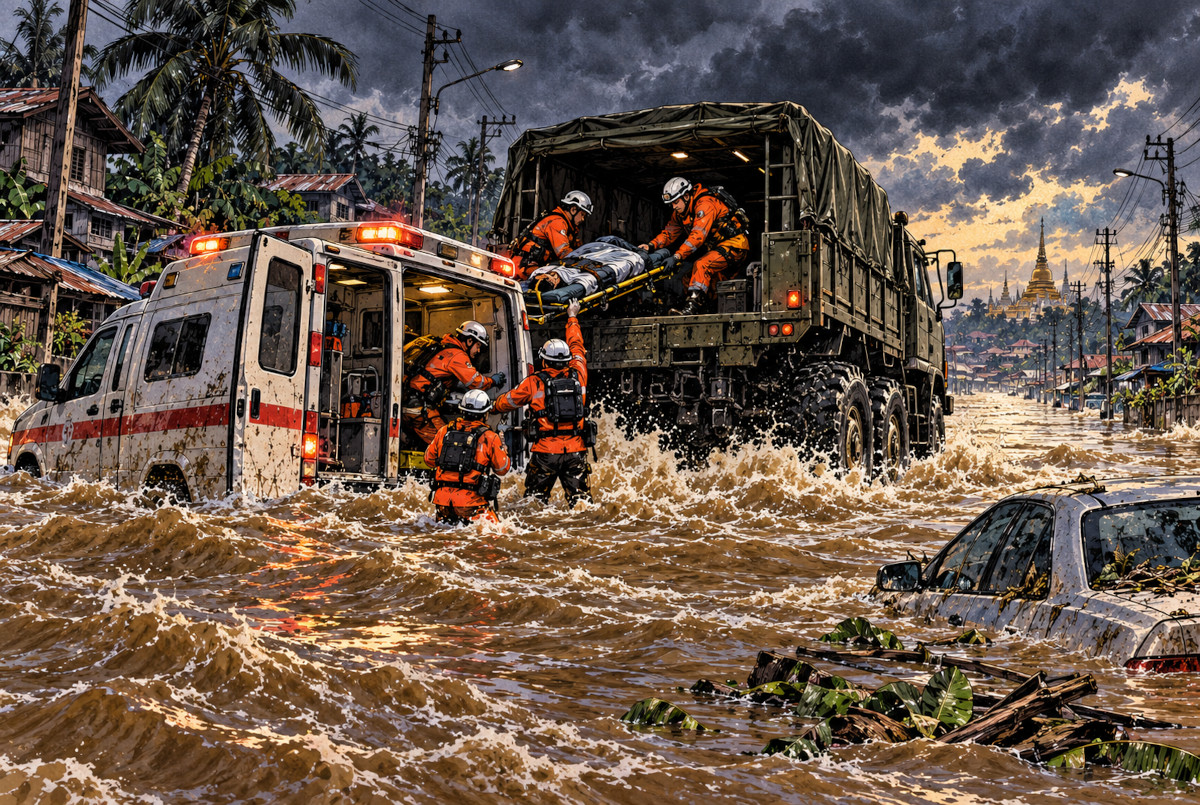
In late September 2026, days of heavy rain left large parts of Bangkok flooded. Cars sat stranded in brown water, streets became channels, and once again the city was confronted with the familiar problem of moving people through neighborhoods that had effectively stopped functioning as roads.
But this time, one detail stood out. Some of the vehicles sent in to help could no longer get through either.
Standard six-wheel trucks used by the Bangkok Metropolitan Administration (BMA) became unusable in some of the deepest-flooded areas. Ambulances also ran into trouble. In response, doctors and emergency personnel had to travel as far as an ambulance could safely go, then transfer to high-clearance GMC trucks for the final leg into flooded residential districts.
When Even a Six-Wheel Truck Is Not Enough
On September 28, Bangkok Deputy Governor Tavida Kamolvej described vehicle access as one of the biggest obstacles facing relief teams.
BMA’s Public Works Department had nearly 70 six-wheel trucks available for moving personnel and supplies. That figure needs to be handled carefully. It does not necessarily mean that all 70 trucks broke down.
The Active reported Tavida as saying that BMA had nearly 70 six-wheel vehicles, but that they could not be used in some areas because the water was simply too deep.
There is an interesting discrepancy in the reporting. THE STANDARD summarized the same briefing more strongly, saying that more than 70 six-wheel vehicles and seven ambulances suffered engine shutdowns in high floodwater. The Active, however, described the figure of roughly 70 as the size of the available fleet and said those trucks could not operate in some locations.
For this article, B-Side Earth takes the more conservative interpretation. Dramatic numbers are useful for headlines. They are less useful when the underlying wording does not fully support them.
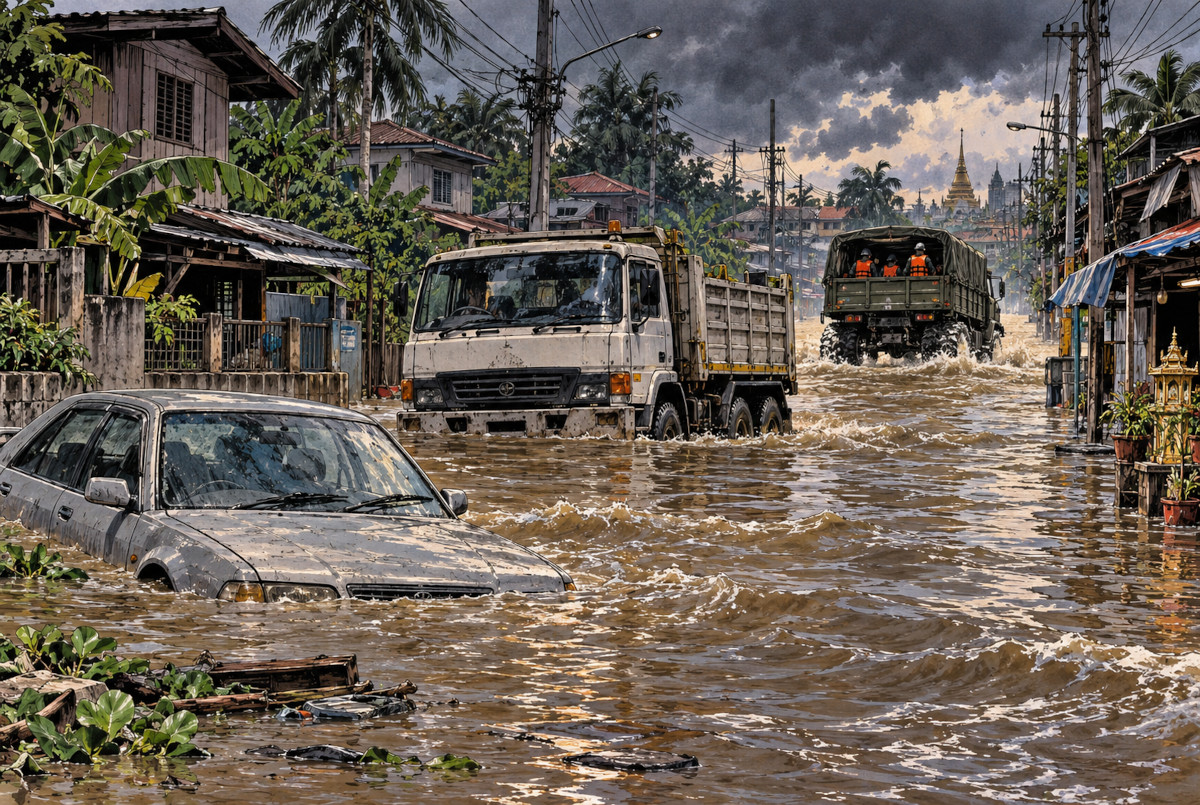 AI-generated explanatory illustration. It conceptually compares an ordinary car, a standard six-wheel truck, and a high-clearance rescue vehicle. It does not recreate the actual location, vehicles, or people involved.
The point is not whether a truck has six wheels. Flood capability depends on ground clearance, air-intake height, drivetrain layout, electrical systems and the depth and current of the water itself.
Two extra wheels do not make floodwater negotiate.
Reporting from the Bang Kapi area described some neighborhoods with water approaching or exceeding a meter in the hardest-hit spots. At that depth, the problem is no longer simply whether a passenger car can make it through. Ordinary heavy vehicles can also reach their operational limits.
Seven Ambulances Had Problems — So the Medics Went On Without Them
The more serious problem involved emergency medical vehicles. According to Tavida, around seven ambulances operated by BMA’s Erawan emergency medical service had developed problems after entering flooded areas.
The available reports do not establish the exact mechanical failure of every ambulance, so it would be misleading to claim that all seven suffered identical engine damage. What is clear is that ambulances could not continue all the way into some of the deepest-flooded neighborhoods.
That is where the high-clearance GMC trucks came in.
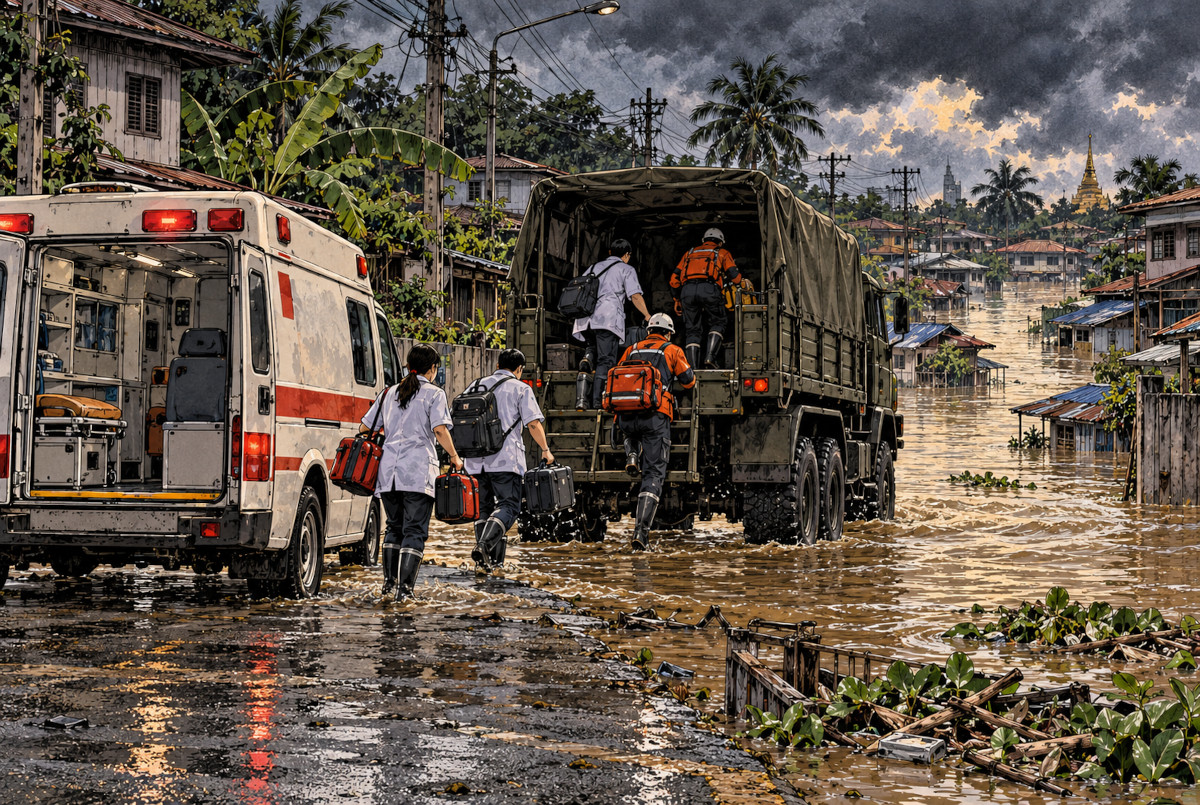 AI-generated explanatory illustration based on the vehicle-transfer system described by Bangkok officials. It does not depict the actual personnel, vehicles, or location.
The procedure was unusual but straightforward. Ambulances drove as far as conditions allowed. At the point where they had to stop, doctors and other staff transferred to the taller trucks. Those vehicles then continued deeper into the flooded neighborhoods, brought residents out, and returned them to a point where conventional ambulances could take over again.
In other words, an ambulance could no longer complete the ambulance journey by itself.
For an ordinary transport network, changing vehicles halfway through a journey is an inconvenience. For bedridden patients, older residents or people with complicated medical needs, it becomes part of the emergency itself.
The Flood Broke the Emergency-Response “Last Mile”
The story is not simply that Bangkok needed a bigger truck. The Active and Matichon both reported that when ordinary six-wheel vehicles could no longer enter certain areas, BMA needed taller GMC-type vehicles with capabilities closer to those used by the military.
According to Tavida, roughly 10 GMC vehicles were available during the first stage of the response. More were then supplied by other agencies, including the military and Thailand’s Department of Disaster Prevention and Mitigation. Even after that, BMA said it still needed around 15 additional high-clearance vehicles.
That detail exposes the real B-side of the story.
Flood management is usually discussed in terms of drainage tunnels, pumps, canals and how quickly water can be removed. But even if all of those systems are working, emergency response still fails if medical teams cannot physically travel from the usable road network to the homes where patients are waiting.
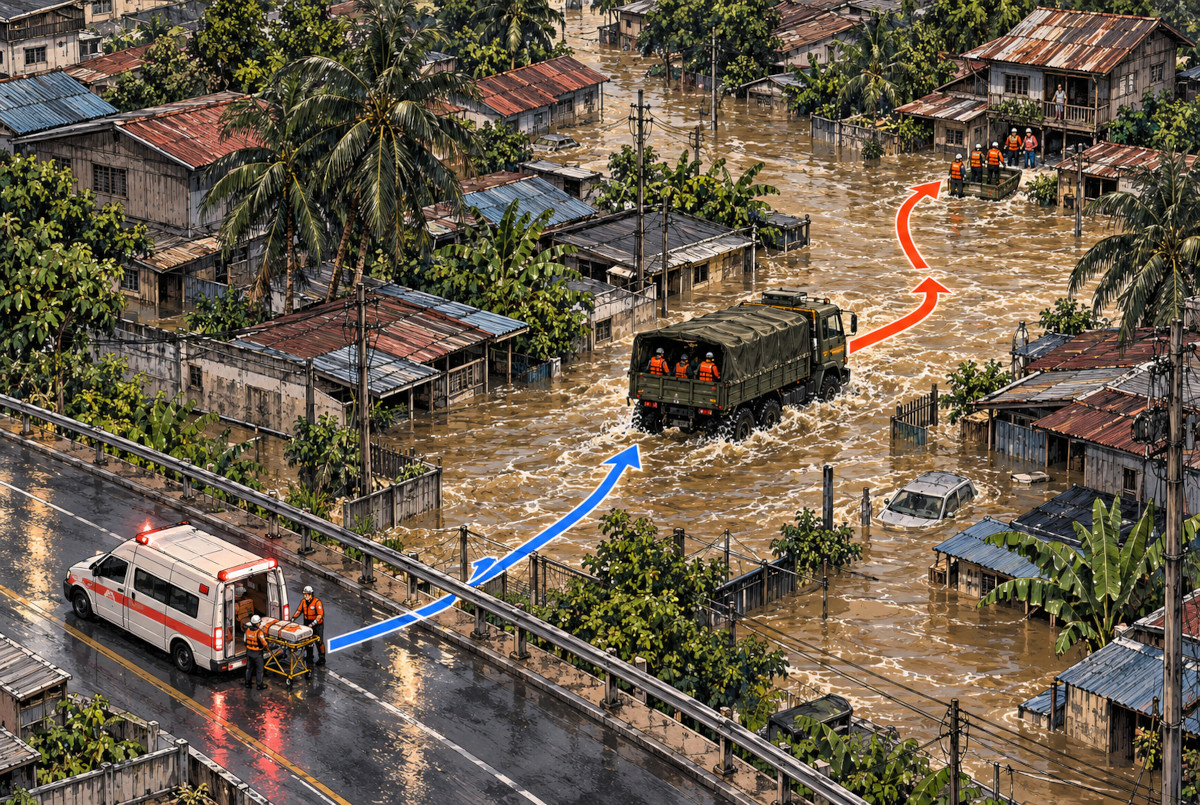 AI-generated conceptual diagram. The route, street layout and vehicle positions are fictional and are intended only to explain the emergency transport relay; they do not represent an actual map or rescue route.
It was not just vehicles that had been stopped by the water. Part of the city’s emergency-response network had effectively been cut in two.
The ambulance handled one side. The high-clearance truck handled the flooded side. The patient had to cross the gap between them.
That is the emergency-services version of a broken “last mile.”
Editor’s Note
Bangkok flood footage can become strangely easy to normalize from the outside. Seen from Japan, there is sometimes a temptation to look at another flooded Bangkok road and think, “Yes, Bangkok floods. We know.”
But this case bothered me for a different reason. Bangkok is not a city encountering serious flooding for the first time. Yet when the water became deep enough, ordinary six-wheel relief vehicles were no longer sufficient, ambulances could not complete the trip, and taller vehicles had to be pulled in from outside agencies.
Of course, extreme rainfall can overwhelm emergency systems in Japan or anywhere else. This is not a uniquely Thai failure. What interests me is the gap between having a rescue vehicle on paper and knowing exactly where that vehicle stops being useful in the real world.
A disaster plan that says “we have trucks” is only half a plan. The more important question is how much water those trucks can actually operate in, and what happens one meter beyond that limit.
Flooded streets are visually dramatic, but that is not really the B-side here. The stranger and more important part is that the rescue system itself had to change vehicles halfway to the patient.
References
- Bangkok Metropolitan Administration, Traffic and Transport Department — Bangkok Flood Situation portal (historical dashboard covering September 26–28, 2026; the page now redirects users to BMA’s newer flood-information service)
- Thai PBS / The Active — report on Bangkok flood impacts, emergency medical access, six-wheel trucks and GMC vehicle deployment (September 28, 2026)
- Matichon — report on Bangkok flood response, high-clearance vehicles and medical access to deep-flooded areas (September 28, 2026)
- THE STANDARD — report on Deputy Governor Tavida Kamolvej’s Bangkok flood briefing and emergency vehicle problems (September 28, 2026)