
What happens when someone says they saw you in a dream—and that dream becomes evidence that your family put a curse on them?
Some people would dismiss it immediately. Others might wonder whether the dream meant something. Belief in ghosts, omens and curses is deeply personal, and this story is not about mocking people for believing in things that cannot be seen.
But in October 2026, in Sop Moei district of Mae Hong Son province in northern Thailand, a dream reportedly moved beyond private belief and became the starting point for an attempt to push a family out of its village.
The pressure eventually expanded to seven households. More than 30 relatives were reportedly included in demands that the wider family leave, while more than 40 family members and relatives were said to have been affected by the dispute.
 AI-generated explanatory illustration. It does not depict the actual people, location, ethnic group or events involved in the case.
It began with a dream about a curse
According to Thai media reports, the dispute began with one young person, aged 20 or younger, who had been suffering from a chronic illness.
The young person reportedly told their parents that, in a dream, members of a local family—specifically the family’s grandparents and youngest aunt—had used black magic against them. The dream was also said to have linked the same family to other unexplained illnesses in the village.
There is an important distinction here. No medical or objective evidence has been reported showing that the family practiced magic or that anyone’s illness was caused by a curse. What is documented is an accusation rooted in a dream and the way some members of the community responded to it.
The allegation spread. Residents reportedly approached the village head, and the man who later sought outside help said members of the family were surrounded and pressured by villagers.
An oath over water—and a demand to leave
The dispute did not remain a ghost story or a private argument. Reports say the initial proposal was for two branches of the accused family—the grandparents’ household and the youngest aunt’s household—to drink “oath water” and then leave the village.
The idea of swearing an oath through water did not appear from nowhere. In 2024, Thai PBS reported another case in which monks and villagers drank oath water after money donated to a temple went missing. Thailand also has older historical traditions involving oath-taking with water, although those historical ceremonies should not be treated as identical to the village ritual reported in this case.
Then the pressure expanded. According to local reports, the demand grew to cover seven households involving more than 30 descendants and relatives. The family also alleged that threats of serious harm were made if they refused to leave.
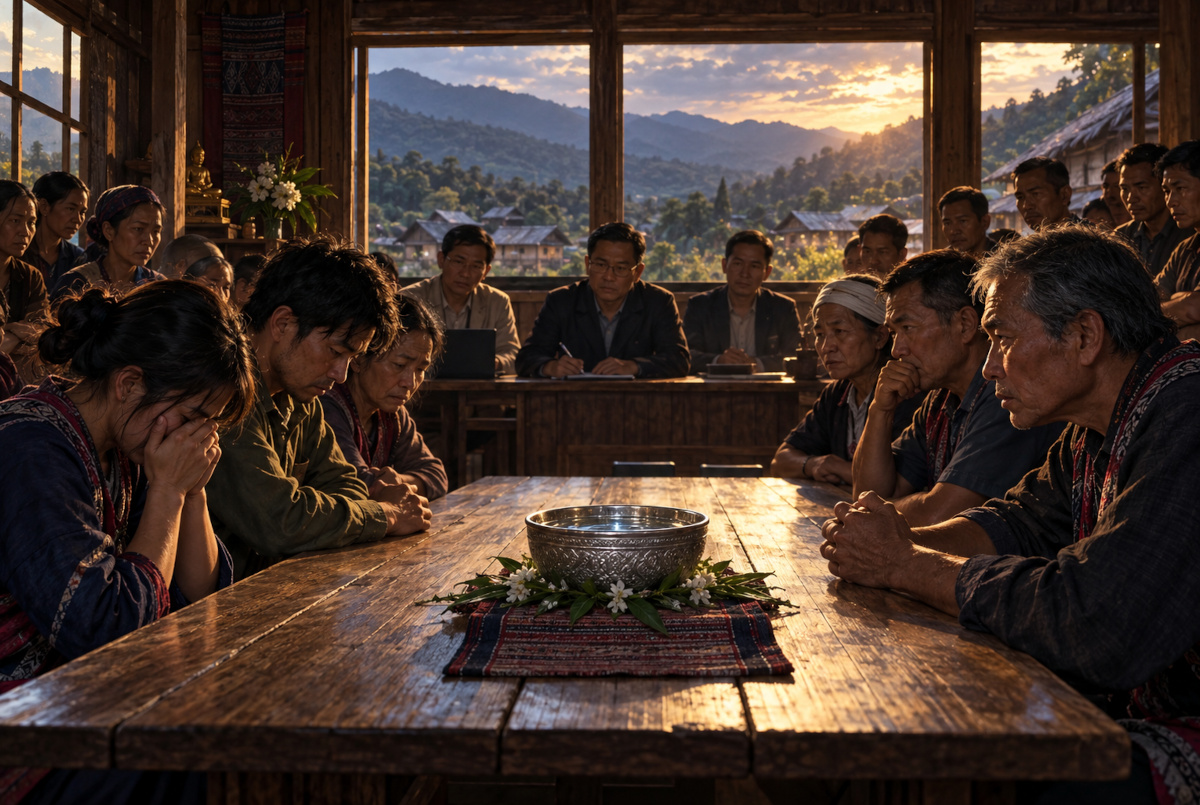 AI-generated explanatory illustration. It does not recreate the actual meeting, participants, clothing or specific form of the oath-water ritual.
Ten hours of mediation—and an agreement to dismantle homes
The family sought help from police and from the Damrongtham Center, a Ministry of Interior grievance and administrative complaint service.
Officials then took part in talks that reportedly ran from around 9 a.m. until 7 p.m.—more than 10 hours.
Yet the agreement reported afterward still leaned heavily toward the villagers’ demands. It reportedly called for members of the grandparents’ and aunt’s households to drink oath water on October 10, leave the village, not return, and even dismantle their homes. Four people were reported to have initially accepted the arrangement under pressure.
A strange dream is one thing. When the contents of that dream begin determining whether real people can keep living in their homes, the story is no longer merely supernatural folklore. It becomes a question of rights, authority and collective pressure.
The next day, the district chief said the expulsion was illegal
On October 7, 2026, the chief of Sop Moei district publicly addressed the dispute.
His position was clear: people cannot be declared guilty or expelled from a village simply because of personal belief or a dream, and such an expulsion would be unlawful. He said the seven households had a legitimate right to remain as long as they were living and working lawfully and were not causing unlawful harm to others.
Thailand’s Local Administration Act also defines the village head’s role around maintaining order and safety, promoting harmony and helping residents deal with government agencies. It does not describe an independent power to exile residents on the basis of supernatural accusations. Section 38 of Thailand’s 2017 Constitution separately protects freedom of travel and freedom to choose one’s residence, subject to restrictions imposed by law for specified purposes.
District officials were sent to the area to explain the situation, while police arranged additional monitoring, including plainclothes investigators. Even so, authorities said that belief connected with the village’s ancestors remained strong among many residents, and the conflict had not yet been fully resolved as of October 7.
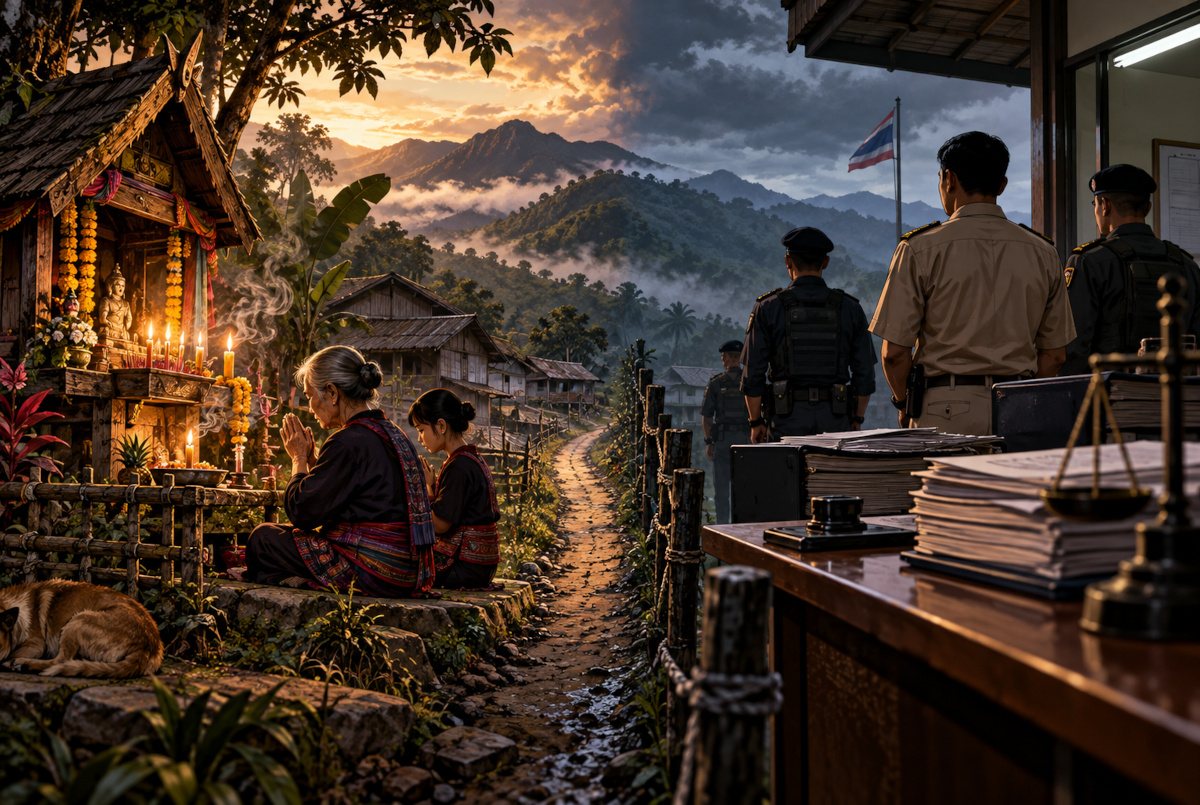 AI-generated symbolic illustration. It does not depict an actual shrine, police officers, government officials, ethnic clothing or location involved in the case.
In Thailand, occult belief is not simply a thing of the past
It would also be too easy to dismiss this as an isolated story about a supposedly “superstitious village.”
A 2023 NIDA Poll surveyed 1,310 Thai Buddhists aged 18 and older nationwide. A combined 53.47% said they believed strongly or to some degree in ghosts and mysterious supernatural phenomena. For saiyasat—a Thai term covering occult or magical practices—the combined figure was 38.64%.
Those numbers do not mean that 38.64% of Thai people would support accusing a family of black magic, nor did the survey represent every religious group in Thailand. They simply show that supernatural belief remains part of the cultural landscape for a substantial share of the Buddhist respondents surveyed.
And belief itself is not the real problem here. Japan has its own traditions involving exorcisms, omens, curses and dreams that are treated as meaningful by some people.
The harder question is where the freedom to believe ends and the power to punish another person begins. Someone may believe that a dream carries a warning. That is very different from allowing the dream to become evidence that another family should lose its home.
Editor’s Note
I don’t think every story about ghosts, curses or strange dreams should automatically be laughed away as nonsense. There are things people cannot easily explain, and sometimes a dream really does stay with you long after you wake up.
But that isn’t the part that bothers me here.
This apparently began with “I saw that family in my dream,” then grew into a shared accusation, and eventually reached the point of “tear down your home and leave.” By then, whether black magic exists is almost beside the point.
From a Japanese perspective, the part I keep coming back to is the 10-hour mediation. Officials were already involved, yet the first reported agreement still moved in the direction of making people leave. Then, the following day, the district chief effectively said: no, you cannot legally do that.
Maybe the most unsettling part of this story is not the curse. It is how quickly a private dream can begin to look like public “evidence” once enough people decide to believe the same accusation.
References
- Khaosod — Report on a Sop Moei family facing village expulsion after a young person’s dream led to black-magic accusations (October 6, 2026) [Thai]
- Khaosod — Sop Moei district chief says expelling seven households over a dream or personal belief is unlawful (October 7, 2026) [Thai]
- Amarin TV — Report on the Sop Moei family’s complaint over village expulsion linked to alleged black magic (October 6, 2026) [Thai]
- Department of Provincial Administration, Thailand — Local Administration Act B.E. 2457 (1914), Section 27 [Thai]
- Office of the Constitutional Court of Thailand — Constitution of the Kingdom of Thailand B.E. 2560 (2017), Section 38
- NIDA Poll — “Are You a Mutelu Believer?” nationwide survey on supernatural beliefs among Thai Buddhists (2023)
- Thai PBS — Monks and villagers drink oath water after nearly 300,000 baht in temple donations went missing (May 1, 2024) [Thai]
- Fine Arts Department / Bangkok National Museum — Historical article on Thailand’s royal oath-taking-with-water ceremony [Thai]