
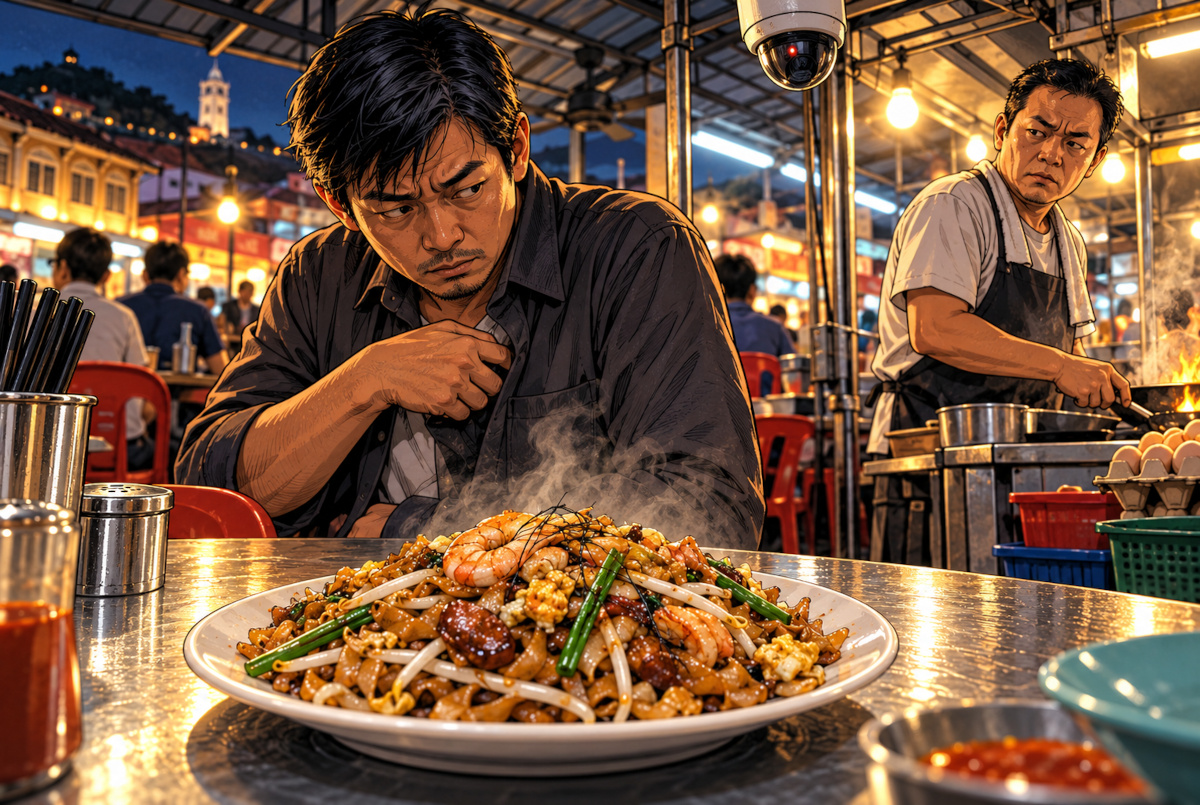
A customer complains that there is hair in his food and refuses to pay. On its own, that sounds like an unpleasant but fairly ordinary restaurant dispute.
What happened at a restaurant along Persiaran Gurney in George Town, Penang, on October 4, 2026, was stranger. Local reports place the incident in the 5 p.m. hour. A man described in local media as a foreign national complained that he had found hair in his char kway teow and left with a woman accompanying him without paying a bill of about RM30.
But the detail that bothered the restaurant manager was not simply that there was hair in the food. The hairs appeared to be dry.
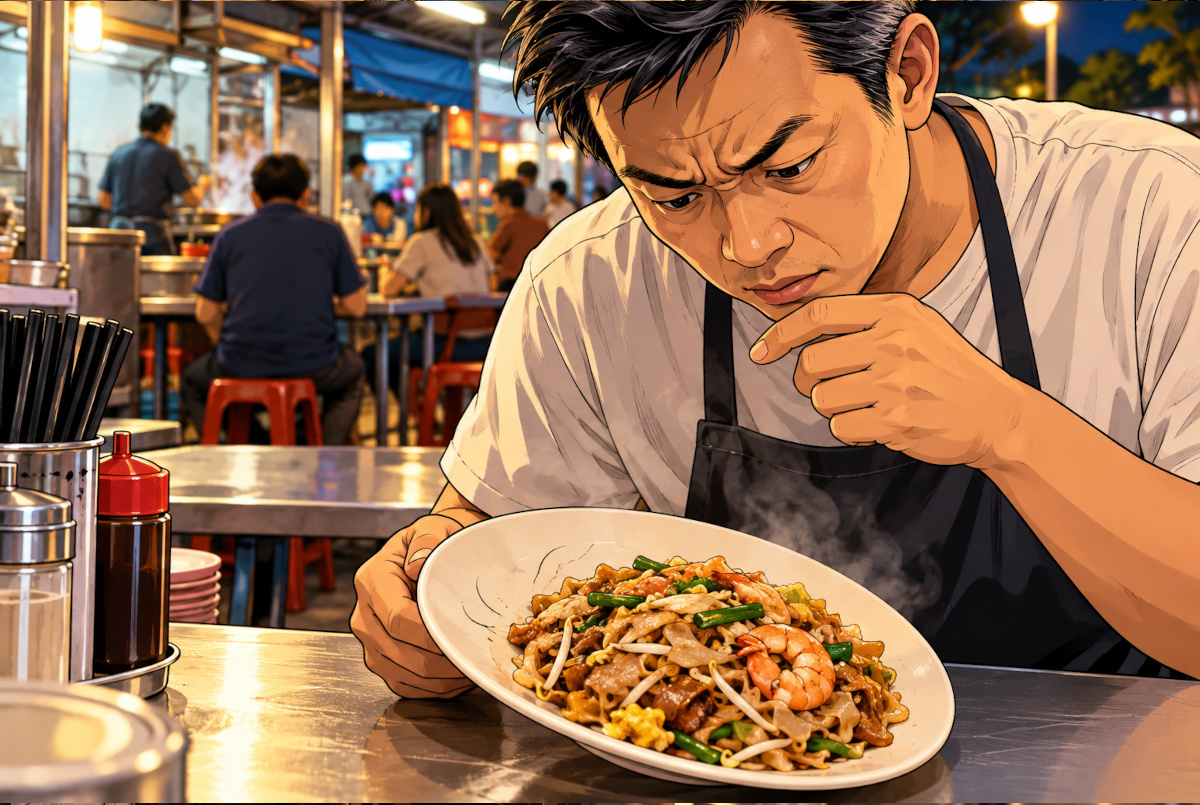
AI-generated illustration. It does not depict the actual restaurant or people involved, and the number and appearance of the hairs are not intended as an exact reconstruction.
Six or seven short hairs — and something did not look right
According to local reports, the man and his female companion had initially wanted to order fried chicken. When they were told it was sold out, they ordered char kway teow, an egg and a drink instead. The total came to about RM30.
Char kway teow is one of Penang’s best-known hawker dishes: flat rice noodles stir-fried over high heat, typically with ingredients such as egg, bean sprouts and prawns.
The man later complained that there was hair in the noodles. The restaurant manager, identified in reports only as Cheng, examined the plate and said he found six or seven very short strands.
That was when he noticed something odd. The hairs were short and did not look like eyelashes. More importantly, Cheng told local media that they appeared dry despite supposedly having come from a freshly stir-fried plate of noodles.
The manager went back to the CCTV
While staff were still examining the food, the man and the woman reportedly got up to leave. When Cheng reminded them that the bill had not been paid, the man refused to pay on the grounds that the food had been contaminated. The pair then left, according to the restaurant’s account.
Still unconvinced, Cheng later reviewed the restaurant’s CCTV footage.
He said the recording appeared to show the man repeatedly putting a hand inside his clothing and then moving that hand toward the plate. The restaurant believes the man may have been removing hair from his chest area and placing it into the food.
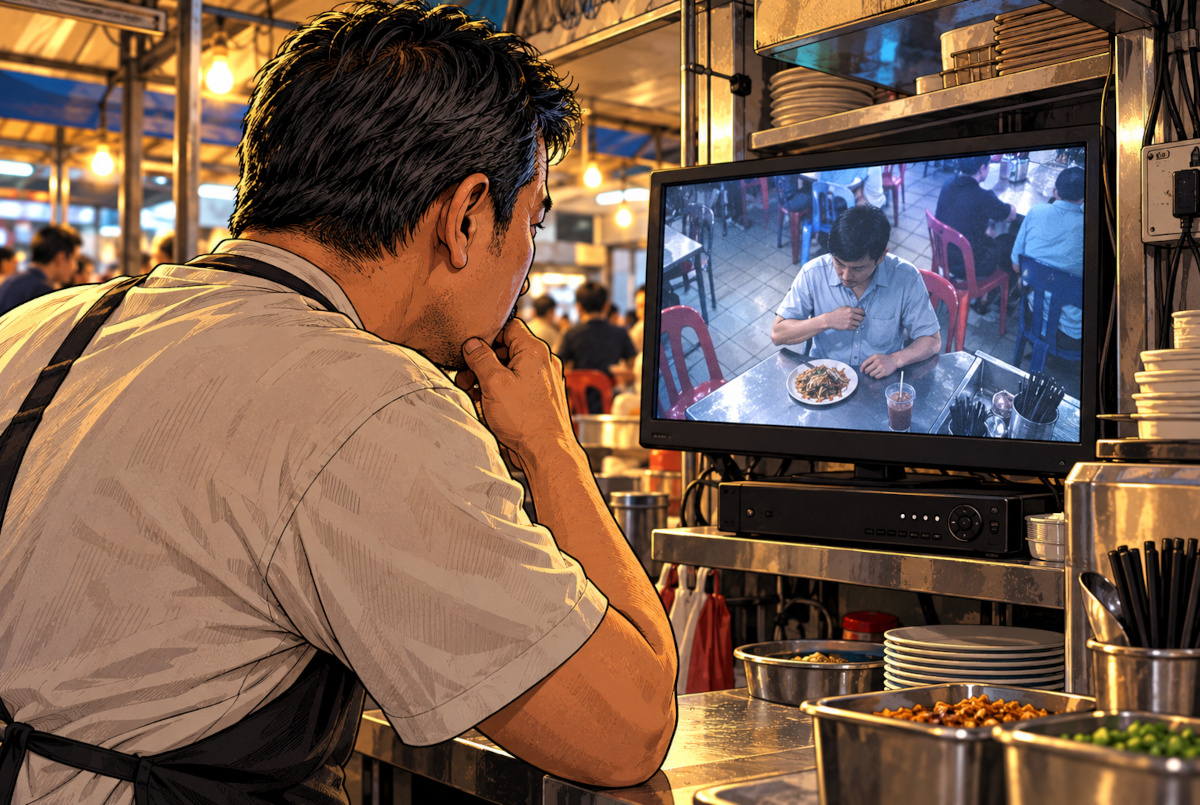
AI-generated illustration. The monitor image, restaurant and people are fictional and do not reproduce the actual CCTV footage or individuals involved.
There is an important distinction here. No police or forensic authority has been reported as confirming that the man actually pulled out six or seven chest hairs and planted them in the dish. The number refers to the short strands the manager said he found on the plate. The CCTV evidence described in reports concerns the man’s repeated movements inside his clothing and toward the food.
So, based on the information currently available, this remains an allegation raised by the restaurant after reviewing its CCTV footage, not a formally established finding.
“The hair was dry” is a clue, not proof
Cheng’s reasoning is easy to understand. If the hairs had been mixed into a hot, oily plate of char kway teow during cooking, it would seem unusual for several of them to remain noticeably dry.
But dry hair by itself does not scientifically prove that a customer planted it. It does not eliminate every possibility of contamination after cooking or during service.
That is what makes this incident more interesting than the headline alone suggests. The real turning point was not the hair itself. It was a small physical inconsistency that prompted the manager to go back and review what had happened before the complaint was made.
All this over an RM30 meal?
Cheng said he later shared the CCTV footage with other restaurant operators as a warning about the pair.
In the major reports reviewed by B-Side Earth as of October 8, the man’s nationality and identity had not been made public, nor had the nature of his relationship with the woman accompanying him. The reports also did not establish that police had identified or arrested him, or officially determined that he had planted chest hair in the meal.
That means it would be premature to describe him as a convicted fraudster or to state as fact that he deliberately planted chest hair to avoid paying.
Still, if the restaurant’s account is accurate, the scale of the alleged scheme is what makes the whole thing particularly strange. This was not an attempt to escape a luxury restaurant bill running into thousands of ringgit. The order — char kway teow, an egg and a drink — cost about RM30.
Different country, same basic human question: was all that effort really worth avoiding such a small bill? And in a restaurant with CCTV, fooling the person standing in front of you may no longer be enough.
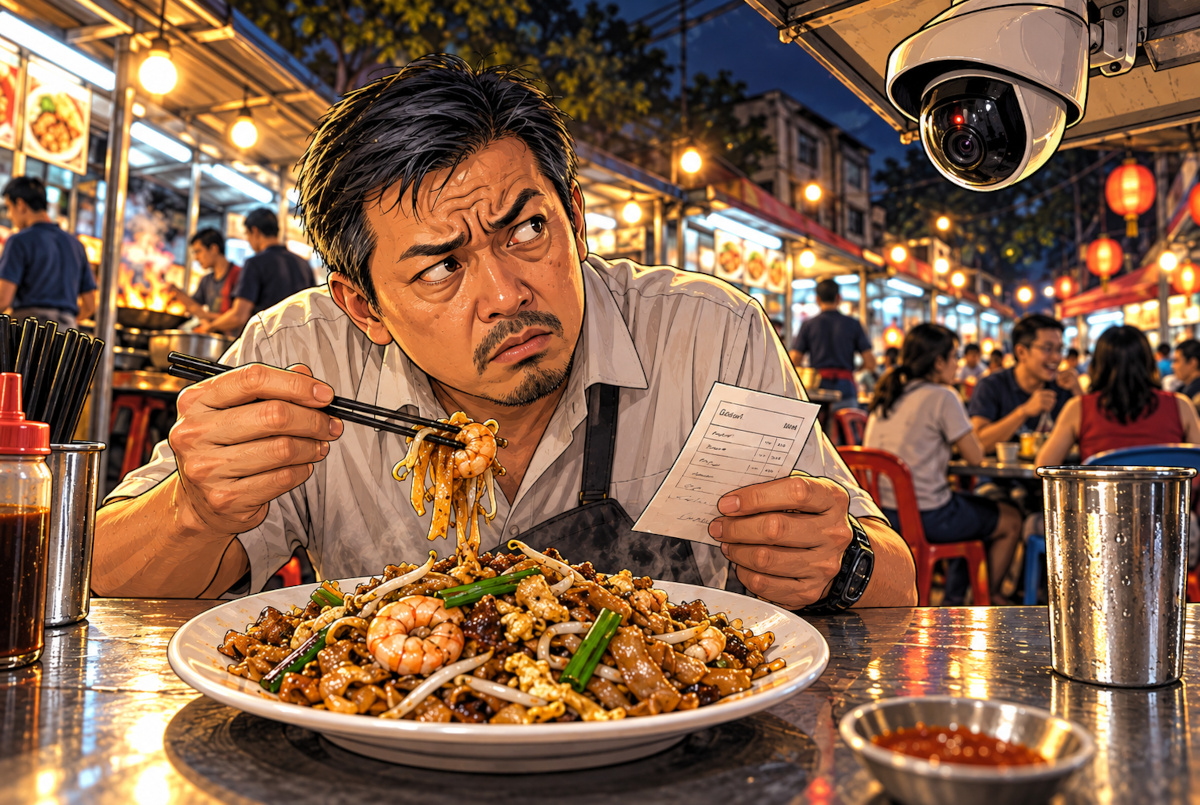
AI-generated symbolic illustration. It does not reproduce the actual customer, restaurant, bill, CCTV system or incident location.
Editor’s Note
What catches my attention here is not really the question of whether the hairs were chest hairs. It is the manager noticing something as small as, “Why are these hairs dry?”
From a Japanese perspective, the basic situation is familiar enough. Restaurants in Japan also deal with complaints about hair, insects or other foreign objects in food. In the past, a dispute like this could easily become one person’s word against another’s. Now there may be a camera quietly recording what happened before anyone complained.
If the restaurant’s account is accurate, there is also something wonderfully inefficient about the alleged plan. To save RM30, a person would have had to keep reaching inside his shirt, put something into the food, make a complaint and then hope nobody checked the footage. At some point, simply paying the bill starts to look like the easier option.
That mismatch is what feels most “B-side” to me. The petty scheme is old-fashioned; the evidence trail is completely modern. Countries change, cuisines change, but small human calculations can look remarkably similar.
References
- The Star — “Foreign couple accused of planting chest hair in food to avoid bill” (October 6, 2026)
- Malay Mail — “Chest a minute! Diner allegedly plucks out body hair and plants it in char kway teow to dodge RM30 bill in Penang” (October 6, 2026)
- Oriental Daily — Chinese-language report on the allegation that a diner planted chest hair in char kway teow and refused to pay RM30 (October 6, 2026)
- PenangToday — “Penang Diner Allegedly Plucks Chest Hair Into Char Kway Teow To Dodge RM30 Bill” (October 7, 2026)
- Penang Global Tourism — “Penang Street Food” (official English guide to Penang street food, including char koay teow)