
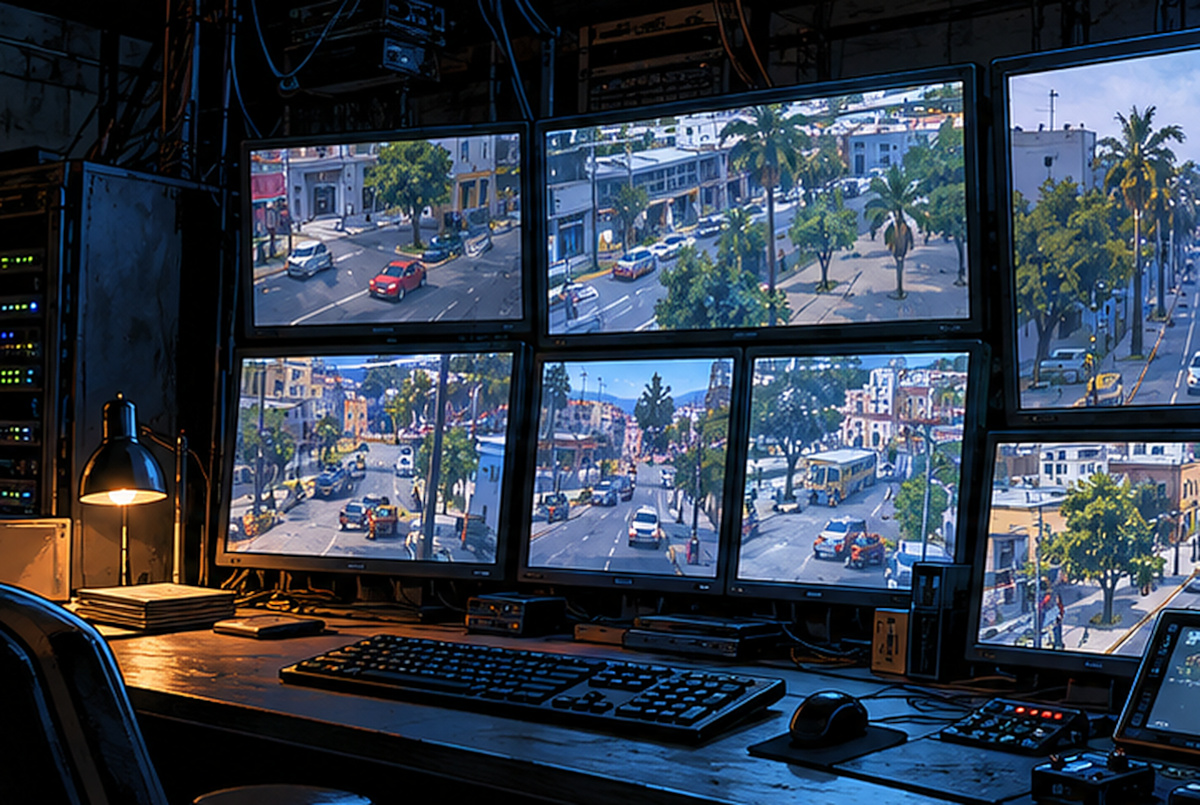
On October 8, 2026, security forces in the Mexican state of Tabasco uncovered something unusual: a clandestine surveillance center associated with approximately 120 cameras spread across several neighborhoods.
The discovery came during four searches in Centro, the municipality that includes Villahermosa, the state capital. Federal and state authorities reported seizing drugs, weapons, technical equipment, and a building used as a covert surveillance center.
But the number was what caught our attention. Around 120 cameras, scattered across different neighborhoods, apparently forming part of an unauthorized surveillance operation.
Security cameras are supposed to help keep an eye on the streets. But who was watching through these cameras? And how much of a city could 120 of them actually monitor?
The featured image is an AI-generated illustration, not a photograph of the facility seized by authorities.
The Official Report Does Not Say All 120 Cameras Were Seized
The first surprise comes from reading the original government statement rather than relying on the headline.
On October 9, Mexico’s Gabinete de Seguridad (Security Cabinet) published a summary of operations conducted the previous day. Its entry for Tabasco described four searches in Centro, during which authorities seized drugs, weapons, technological equipment, and a building used as a clandestine surveillance center.
The Spanish statement described the facility as being equipped with approximately 120 cameras in various neighborhoods.
It used the phrase centro de vigilancia clandestino. Here, clandestino means secret or unauthorized. It does not establish that the facility was physically underground.
Crucially, the statement does not say that all 120 cameras were removed or seized. Nor does it say that each of the four searched locations was itself a surveillance center.
The report does not identify who installed or operated the network, which camera models were used, or exactly where the devices were positioned. It also does not establish whether anyone was arrested in connection with operating this particular surveillance center.
There is another geographical detail worth remembering. Centro is a municipality, not merely a downtown district. According to Mexico’s National Institute of Statistics and Geography (INEGI), its population was 683,607 in the 2020 census.
Without knowing which neighborhoods contained the cameras, there is no reliable way to reconstruct the network’s actual geographical coverage.
Tabasco Had Already Been Removing Hundreds of Unauthorized Cameras
The October discovery becomes more interesting when placed alongside the state’s earlier records.
Tabasco had already been conducting an operation called Halcón Ciego, or “Blind Falcon,” aimed at locating and removing unauthorized surveillance devices. Authorities have referred to suspicious installations as cámaras parásitas—literally, “parasitic cameras.”
The state’s 2025 annual government report and subsequent official announcements show that this was not an isolated problem.
| Period | Findings in official records |
|---|---|
| Mar–Sep 2025 | 410 surveillance cameras and 14 pan-tilt-zoom (PTZ) cameras removed; 424 in total |
| Apr 13–16, 2026 | 50 suspected unauthorized cameras seized |
| May 29–31, 2026 | 53 cameras removed in Centro municipality |
| Oct 8, 2026 | A clandestine surveillance center associated with approximately 120 cameras uncovered |
Note: The 2025 figure covers several municipalities. The October 2026 figure describes cameras associated with a surveillance center, not a confirmed number of cameras removed. These figures have different meanings and should not simply be added together. Possible overlap between networks has not been established.
The 2025 government report lists more than cameras. Authorities also reported dismantling 13 digital video recorders (DVRs), nine internet modems, and five repeater antennas.
That distinction matters.
The authorities were dealing with more than individual cameras mounted on streets. Their records also describe recording and communications equipment—the components that can turn separate cameras into a larger monitoring system.
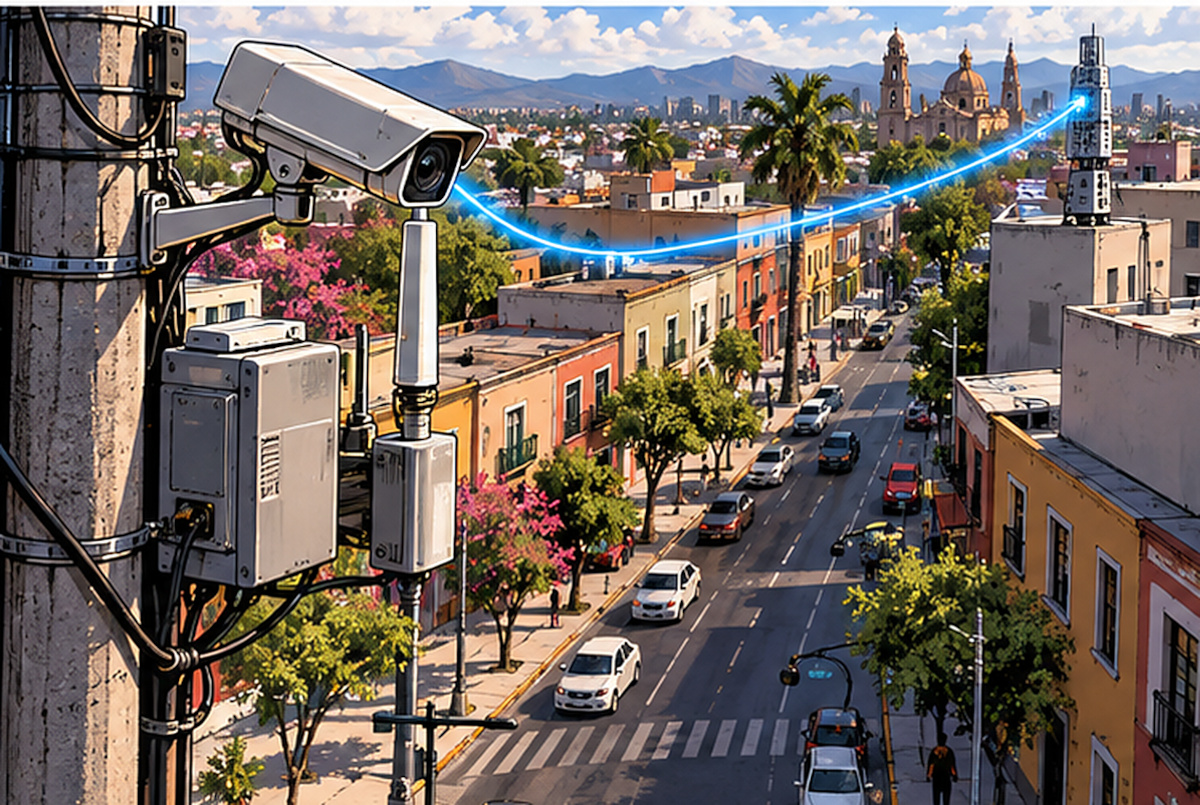
AI-generated conceptual illustration. It does not show the actual camera locations, equipment arrangement, or communications method used in the Tabasco case.
In a June 2025 announcement, the Tabasco government stated that cameras removed under the Blind Falcon operation were allegedly being used by criminal suspects to monitor the presence and movements of security forces.
That provides a possible explanation for why such equipment might be installed. It does not prove that the network uncovered in October 2026 had the same operators or purpose.
And it raises a question the October announcement cannot answer: after so many cameras had already been removed, why was another large network still operating?
Was some older equipment left in place? Had cameras been reinstalled? Or was this an entirely separate network? The published information does not allow us to choose among those explanations.
Could 120 Cameras Really Watch an Entire City?
The number sounds enormous. But the usefulness of a surveillance camera depends on what someone needs to see.
Detecting that a person is present is not the same as identifying that person.
Axis Communications explains this distinction using the DORI model—Detection, Observation, Recognition, and Identification—based on the guidelines in IEC 62676-4:2014.
Under this model, detecting a person requires a reference pixel density of 25 pixels per meter. Identifying an individual requires 250 pixels per meter, ten times as much detail.
To illustrate what that difference means, consider a hypothetical fixed camera with a horizontal resolution of 1,920 pixels and a 90-degree horizontal field of view.
| Viewing objective | Reference pixel density | Approximate theoretical distance |
|---|---|---|
| Detect that a person is present | 25 px/m | 38 m (125 ft) |
| Identify an individual | 250 px/m | 3.8 m (12.5 ft) |
Calculation: With a 90-degree horizontal field of view, the visible width at distance d is approximately 2d. Pixel density is therefore 1,920 ÷ (2 × d). These figures are simplified geometric estimates, not measurements of the cameras seized or associated with this case. Real-world results depend on optics, lighting, compression, subject movement, viewing angle, and other factors. DORI guidelines are not performance guarantees.

AI-generated technical illustration. The colored zones are conceptual and are not drawn to scale. They do not represent the specifications or actual coverage of cameras involved in the incident.
This helps explain why camera count alone can be misleading.
A network of 120 cameras does not automatically provide detailed visual coverage of an entire city. Buildings, viewing angles, installation locations, and the cameras’ technical specifications would all affect what could actually be seen.
But identifying faces may not be the only possible objective. Monitoring whether vehicles or people pass through particular locations could be useful even when the images are too distant for reliable identification.
What about recording all those feeds?
Suppose all 120 cameras were continuously recording at an average bitrate of 2 Mbps per camera. The resulting video data would amount to approximately 2.6 TB per day—or roughly 78 TB over 30 days.
That is a substantial amount of data. Yet the calculation is only hypothetical. The authorities have not publicly established whether the October facility recorded every feed, merely displayed live images, or retained footage for any particular length of time.
The missing technical details are precisely why 120 cameras should not be treated as a complete description of the network’s capabilities.
Meanwhile, the State Was Planning a 5,000-Camera Network of Its Own
There is another layer to this story.
In November 2025, the Tabasco government announced Escudo Olmeca (“Olmec Shield”), an ambitious expansion of its official security monitoring infrastructure.
The plan called for upgrading the existing command system to a C5 center and expanding the public surveillance network from approximately 1,000 cameras to 5,000. Fiber-optic communications, drones, GPS-equipped patrol vehicles, and automatic license-plate readers were also part of the proposal.
The 5,000-camera figure was a project target—not proof that every camera had been installed and was operational by October 2026.
In other words, the authorities were developing a much larger official monitoring network while also dismantling unauthorized networks in the same state.
The central question is not simply how many cameras exist. It is who controls them, which locations they monitor, and what the information is being used for.
And the campaign against unauthorized cameras had already produced a complication of its own. Earlier in 2026, security forces removed cameras belonging to a church whose representatives denied any connection to criminal activity. The cameras were subsequently reinstalled.
That incident raises a different question: how do authorities distinguish equipment used for unlawful surveillance from legitimate cameras installed to protect ordinary people?
We will examine that problem in the concluding installment.
Editor’s Note
Say “120 surveillance cameras” and it’s easy to picture a movie-style control room: walls of monitors, blinking lights, perhaps someone watching every passing car. I can picture it myself. But the actual layout of the facility hasn’t been made public. Turning that mental image into a description of what the police found would be crossing the line between reporting and fiction.
What bothers me more is the history. Authorities had already removed hundreds of cameras. They clearly knew unauthorized monitoring was a problem. Yet another network associated with roughly 120 cameras was discovered.
Does removing the hardware solve the underlying problem, or does it simply create a need to find the next installation?
There’s something unsettling about the phrase “security camera.” It sounds reassuring—until you realize the important question is who has access to the footage.
References
- Government of Mexico, Security Cabinet: Summary of Security Operations Conducted on October 8, 2026 (published October 9, 2026; original in Spanish)
- Government of Tabasco: First Constitutional Government Report 2025, including results of Operation Halcón Ciego (PDF; original in Spanish)
- Government of Tabasco: Removal of 93 Unauthorized Cameras Under Operation Halcón Ciego (June 29, 2025; original in Spanish)
- Government of Tabasco: Security Operations and Seizure of 50 Unauthorized Cameras, April 13–16, 2026 (published April 17; original in Spanish)
- Government of Tabasco: Removal of 53 Unauthorized Cameras in Centro, May 29–31, 2026 (published June 1; original in Spanish)
- Government of Tabasco: Announcement of the Escudo Olmeca C5 Surveillance and Command System (November 3, 2025; original in Spanish)
- National Institute of Statistics and Geography (INEGI): Tabasco Sociodemographic Overview, 2020 Census (PDF; original in Spanish)
- Axis Communications: Pixel Density Based on IEC 62676-4:2014 (English-language white paper, April 2026)
- XEVT: Surveillance Cameras Removed from a Presbyterian Church Were Reinstalled (June 18, 2026; local reporting in Spanish)