
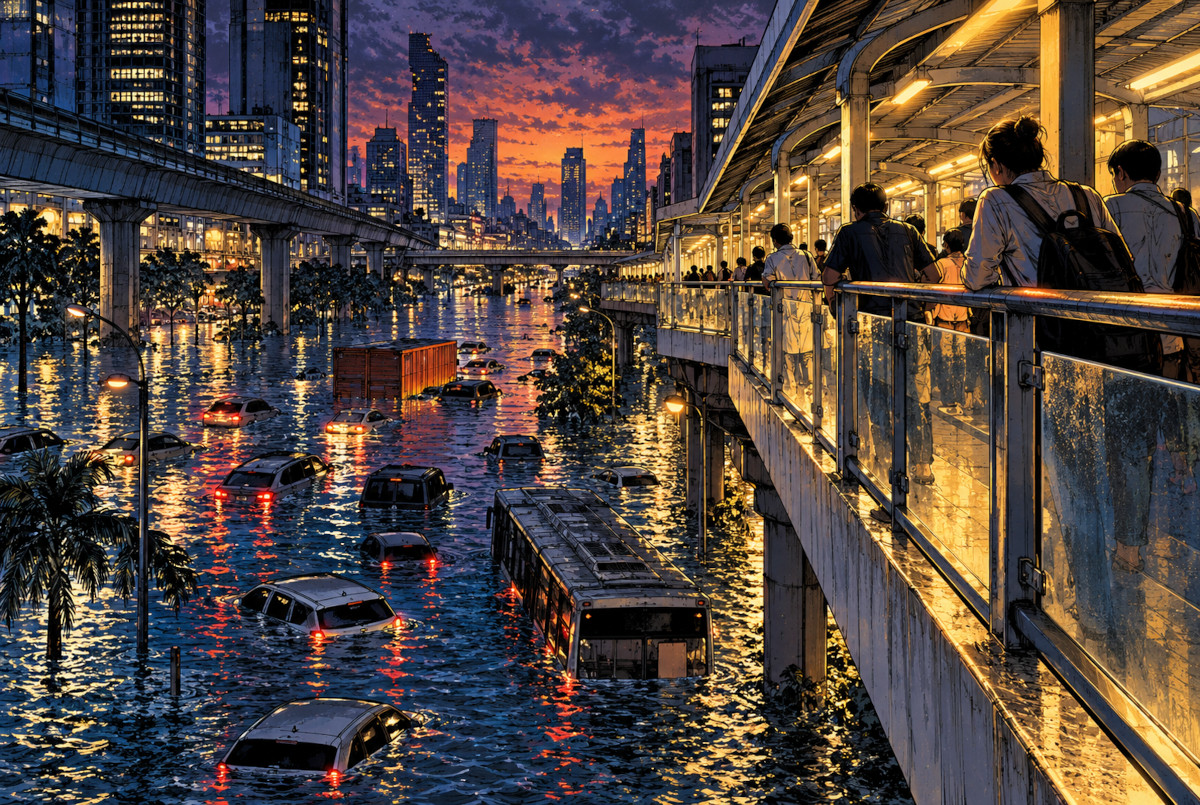
On September 27, 2026, parts of Bang Kapi in eastern Bangkok were still under deep floodwater. Around the Happy Land intersection, cars and buses sat stranded while roads that normally carried heavy city traffic had effectively become waterways.
But the stranger scene was above the street. Residents had carried bags of clothes, valuables and basic supplies onto an elevated pedestrian skywalk. Some were no longer simply passing through it. They were using it as a place to stay — and, for at least one family, a place to spend the night.
A Family Moved From Street Level to the Skywalk
According to Thairath, flooding around Happy Land reached roughly waist height in some places on September 27, leaving numerous vehicles stranded. Mongkol Phosoi, a 40-year-old food-shop owner, said he had been moving goods to higher ground when the water began rising faster than expected.
At first, he believed it was another heavy Bangkok downpour that would eventually drain away. About an hour later, the situation had changed. Traffic had stalled, the water kept rising, and he and his family packed clothes, valuables and other essentials into bags before moving onto the Bang Kapi skywalk opposite his shop.
This was not simply a few minutes of shelter from the rain. Mongkol said he had been staying on the skywalk with three other people and spent the night there with his family. He believed two motorcycles left at his shop were probably underwater and said they might have to remain on the elevated walkway for another two or three days.
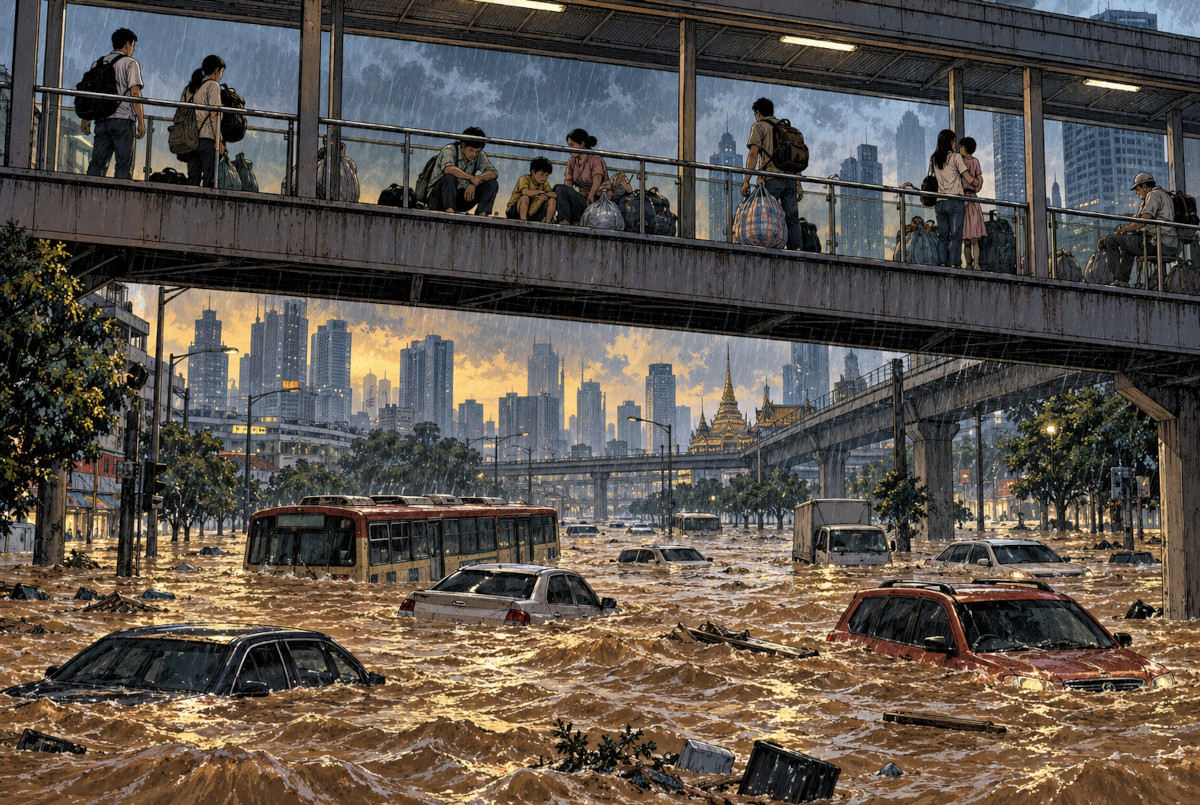 AI-generated illustration. It does not depict the actual people, vehicles or location involved in the flood.
When the Street Failed, the City Moved Up One Level
A Bangkok skywalk is built for pedestrian movement: crossing major roads, connecting buildings and keeping people away from traffic below. During this flood, that role changed. A passageway became a refuge, and then temporarily became living space.
That is what makes the scene more revealing than another headline about a flooded road. Once street-level movement became impossible in parts of Bang Kapi, the elevated structure remained one of the few immediately usable spaces above the water.
The normal logic of the city had been rearranged: roads were no longer for traffic, ground-level space was no longer reliably habitable, and a pedestrian walkway became a place to wait, rest and sleep.
That is the B-side of this story. Bangkok did not simply flood. For a brief period, everyday life became vertical.
It Began With the Assumption That the Water Would Go Away
One detail in Mongkol’s account is especially revealing. He initially thought the rain was nothing unusual. That reaction is understandable in a city where temporary street flooding is familiar enough that residents may expect the water to drain after the storm passes.
This time, however, the scale was different. From September 24 through 26, Bangkok was hit by prolonged heavy rainfall, with cumulative totals approaching 300 millimeters — nearly 12 inches — over roughly 48 hours in the hardest-hit parts of the city. Major waterways including Khlong Saen Saep, or Saen Saep Canal, were already at critically high levels.
That matters because Bangkok cannot simply pump water away into nowhere. Streets and smaller drainage channels ultimately need somewhere to send it. When the main receiving canals are already high, removing water from surrounding low-lying districts becomes much harder.
The Bangkok Metropolitan Administration’s own drainage-planning documents have long identified this problem around Bang Kapi. They note that during heavy rain, high water levels in Saen Saep Canal can make it difficult to drain nearby areas efficiently, one reason the city has pursued additional drainage-tunnel infrastructure.
On September 27, traffic police reported floodwater of around 1.3 meters, or more than four feet, around Bang Kapi intersection and warned motorists not to attempt to drive through it. This was no longer a case of a few inconvenient puddles waiting for a pump.
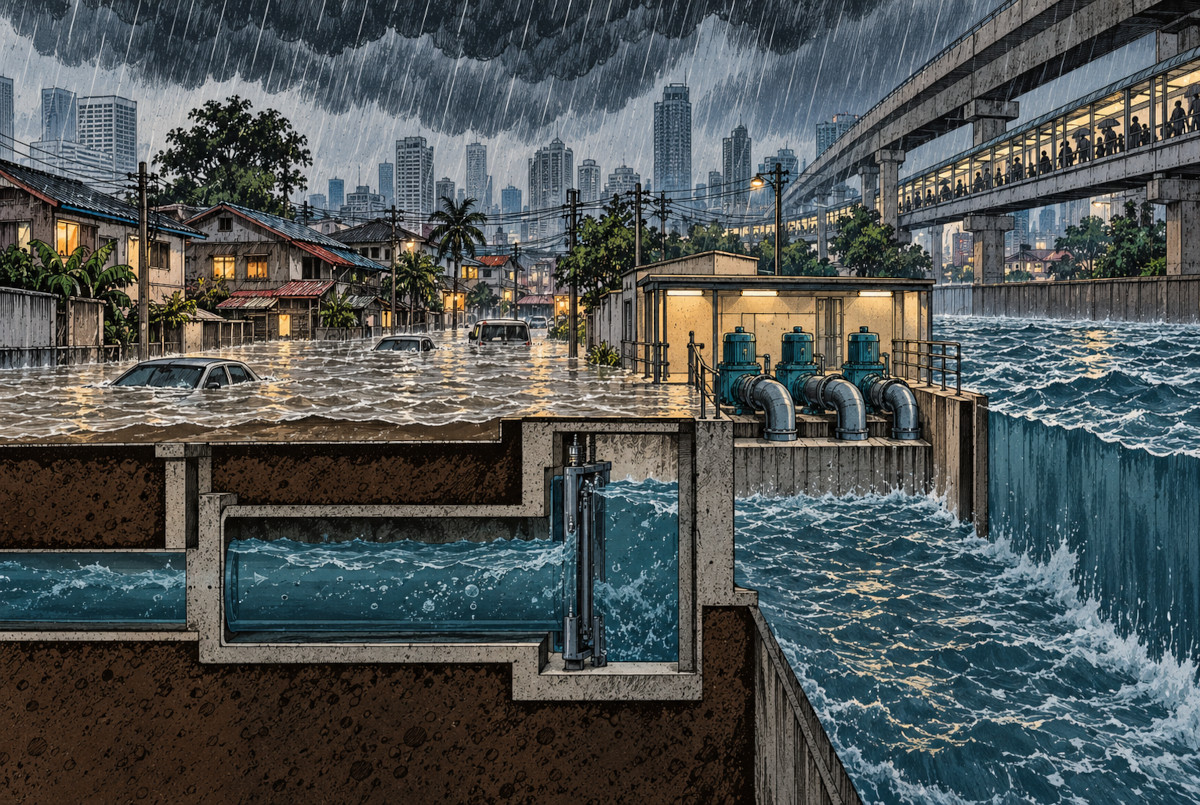 AI-generated conceptual illustration. It is not an engineering diagram and does not reproduce the exact terrain, drainage facilities or infrastructure of Bang Kapi.
More Than 4,000 Households Were Hit in Nearby Khlong Chan
The situation at the nearby Khlong Chan Flats should not be confused with the Happy Land skywalk case, but it shows how serious the flooding had become across the same part of Bangkok.
The Active, a Thai PBS outlet, reported that the housing complex consisted of roughly 30 residential buildings and more than 4,000 households. Floodwater exceeded one meter in some locations. Access became extremely difficult, and some residents had to move through chest-deep water or rely on rescue boats.
Power and water supplies were disrupted in parts of the complex. At Building 5, residents reportedly drew water from rooftop storage tanks for cooking and for the needs of children and elderly residents.
By September 28, residents were also calling for a more systematic coordination point for aid. At the same time, Bangkok authorities, housing agencies, emergency responders and private relief organizations were providing drainage work and assistance in affected areas.
So the accurate version is not that “the authorities did nothing.” The more interesting problem is that the scale of the flooding and the drainage constraints created places where organized assistance could not keep pace with immediate needs, leaving residents to improvise in the meantime.
The Night “It Will Drain Soon” Stopped Being a Safe Assumption
Mongkol’s experience suggests that at least some residents initially relied on a familiar assumption: the rain was heavy, the road would flood, and eventually the water would go down.
There is no solid basis for claiming that Bangkok officials made the same assumption. What the city did acknowledge was the extraordinary cumulative rainfall and the difficulty of draining neighborhoods while major canals remained full.
Below, vehicles sat in floodwater. Above them, people were trying to sleep on a pedestrian walkway. That contrast says more about the scale of this flood than another photograph of a submerged street ever could.
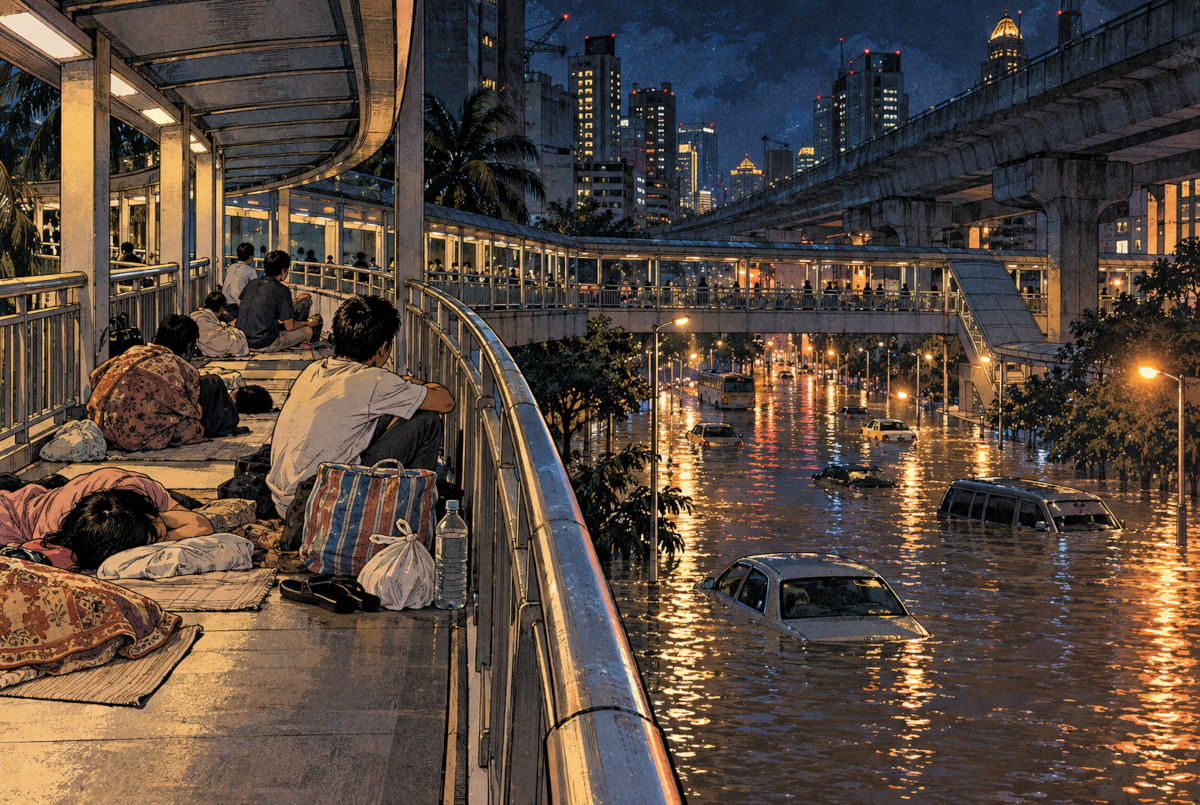 AI-generated illustration. It does not reproduce actual flood victims, news photographs or the exact location of the incident.
Editor’s Note
Seen from Japan, there is an easy temptation to look at a scene like this and say, “Couldn’t someone have planned for this a little earlier?” Thailand’s ability to improvise and somehow keep things moving can be refreshing at times and maddening at others. But this particular flood does not fit neatly into a simple “Thailand being Thailand” explanation.
What sticks with me is something stranger. Bangkok has shopping malls, elevated railways, pedestrian skywalks and all the machinery of a modern megacity. Yet after several days of extreme rain, one of the most dependable places for one family turned out to be the walkway simply because it was higher than the road.
In other words, a modern piece of urban infrastructure ended up serving one of humanity’s oldest emergency rules: get to higher ground.
And the skywalk was not useless — quite the opposite. It gave people somewhere safer to go. That is why I do not see this as a cheap story about Thailand somehow “failing.” When a city’s infrastructure starts being used for purposes nobody normally thinks about, its weaknesses and its unexpected strengths become visible at the same time.
If everything below is underwater, you sleep above it. The logic is perfectly sound. Seeing that logic actually play out in the middle of Bangkok, though, still makes you think: this really went a long way beyond an ordinary flooded street.
References
- Bang Kapi District Office, Bangkok Metropolitan Administration — “Bangkok Permanent Secretary Inspects Flood Situation in Bang Kapi and Orders Accelerated Water Management” (September 27, 2026, Thai)
- Bangkok Metropolitan Administration, Department of Drainage — Saen Saep Canal Drainage Tunnel Extension Project Information (Thai)
- Thairath — “Bang Kapi Still Heavily Flooded, Water Waist-High in Some Areas Residents Flee to Skywalk” (September 27, 2026)
- INN News — “Bangkok Flooding Remains Severe at Multiple Locations; Motorists Advised to Avoid Affected Routes” (September 27, 2026, Thai)
- The Active / Thai PBS — “Bangkok Sees Nearly 300 mm of Rain in 48 Hours as Major Canals Reach Critical Levels” (September 26, 2026, Thai)
- The Active / Thai PBS — “More Than 4,000 Khlong Chan Households Hit as Floodwater Exceeds One Meter” (September 27, 2026, Thai)
- The Active / Thai PBS — “Khlong Chan Flats Flood Crisis Still Lacks a Central Coordination Point” (September 28, 2026, Thai)