
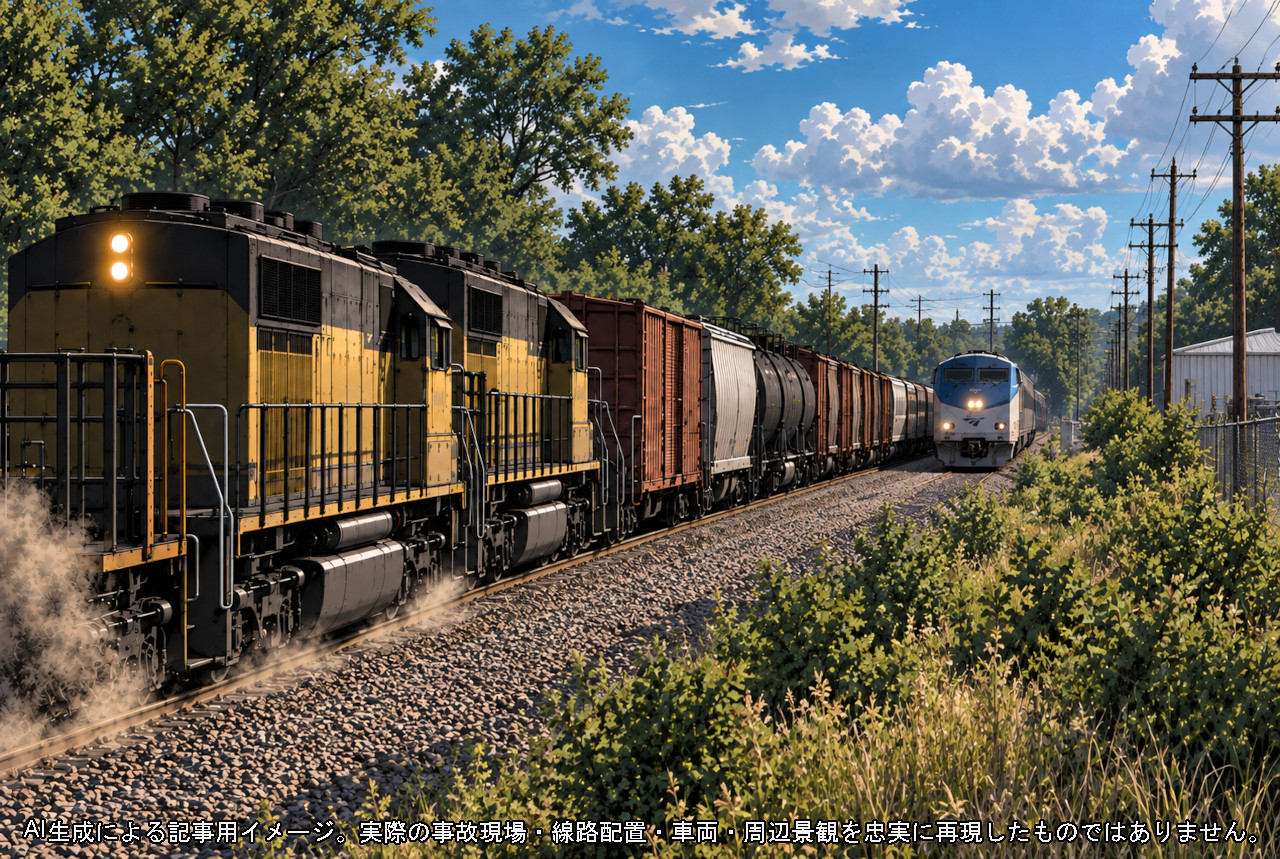
On February 22, 2026, at about 11:00 a.m. near Memphis, Tennessee, an Illinois Central Railroad Company (IC) freight train struck a stationary Amtrak passenger train on the same track.
The freight train consisted of two locomotives and 82 railcars. The Amtrak train had one locomotive and seven passenger cars, carrying 118 passengers and seven Amtrak employees. During a switching operation, the freight train was shoving north at about 10 mph when it struck the Amtrak locomotive.
So far, that sounds like a relatively low-speed railroad collision. But the National Transportation Safety Board’s preliminary investigation contains a much stranger second act.
The IC crew told investigators that they interpreted the resistance from the first collision as resistance caused by an air-brake problem. They pulled forward, reversed again, and about three minutes after the first impact, struck the same Amtrak locomotive a second time.
Two Amtrak employees and two passengers suffered minor injuries. Fortunately, the accident did not become a major disaster. But it left an obvious question behind: how does a train hit another train once, then come back and hit it again?
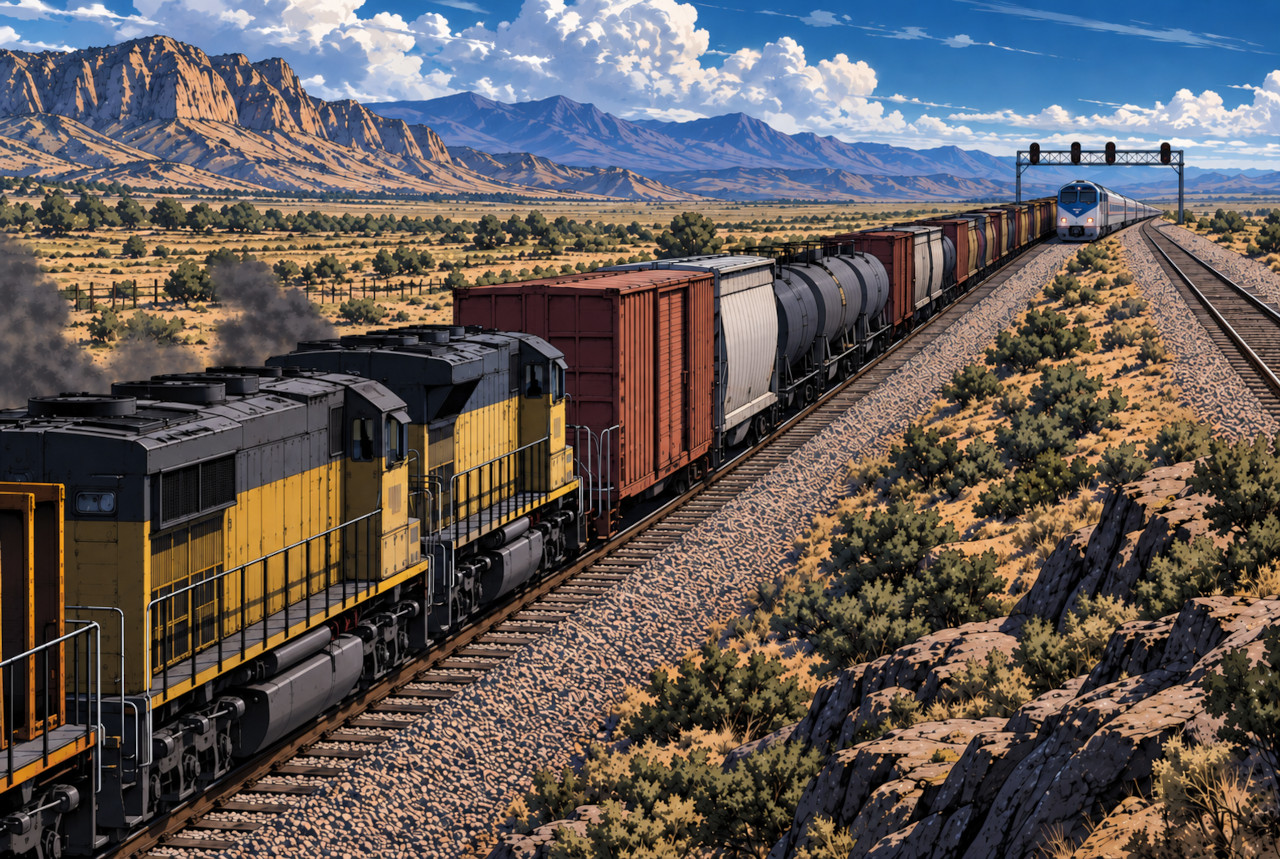
AI-generated explanatory illustration. It does not reproduce the actual accident site, track layout, equipment, or signal indications.
Why Were 82 Railcars Being Shoved in the First Place?
From a Japanese perspective, this is the first detail that immediately feels unusual: why were two locomotives at one end of an 82-car train pushing the cars instead of leading them?
In U.S. railroad terminology, this is a shoving movement—a train or group of railcars is pushed from the locomotive end rather than pulled. As the NTSB notes, shoving movements are common during switching operations.
Before the accident, the IC crew had set out 21 railcars on Main Track 1, entered an intermodal yard, and picked up another 61 cars. The train then reversed north and coupled back onto the 21 cars, creating the 82-car consist.
The conductor directed the coupling from the ground. After the coupling was completed, the crew continued shoving north so that the locomotives could eventually reach the conductor and pick him up. Before that happened, however, the opposite end of the 82-car train reached the stopped Amtrak train.
In other words, the fact that 82 railcars were being shoved was not, by itself, proof that something improper was taking place. Federal regulation 49 CFR §218.99 sets rules for shoving and pushing movements, including point protection requirements and specific provisions for certain movements on main track or signaled sidings when conditions such as dispatcher authorization are met.
That does not mean the IC movement has already been found compliant with every applicable rule. The NTSB has confirmed that the crew obtained dispatcher permission for the switching operation, but the preliminary information is not enough to determine whether every condition of any applicable exception was satisfied. That remains part of the investigation.
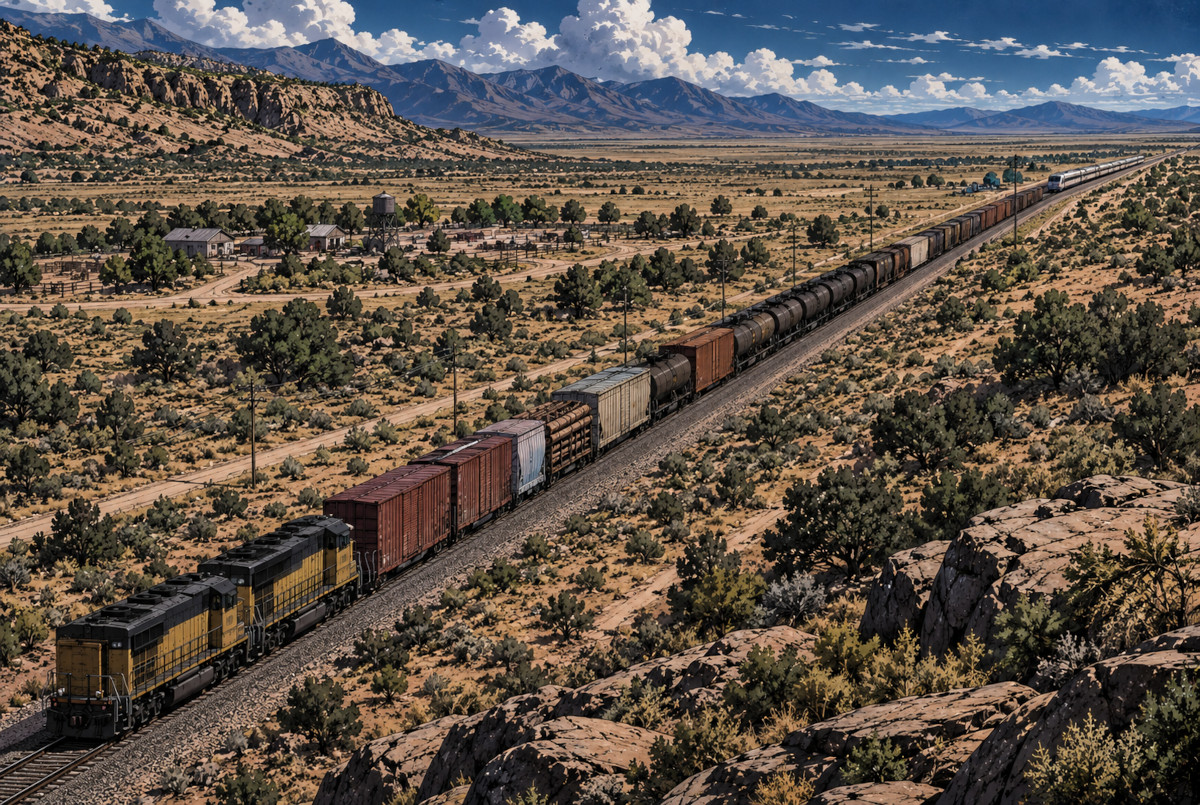
AI-generated structural illustration. It does not reproduce the actual accident site or the NTSB accident diagram.
Did Amtrak Run Past a Stop Signal?
Another detail is easy to misunderstand. According to the NTSB, shortly before the collision, the Amtrak train passed a restricting signal and entered the block where the IC train was performing its switching work.
Read casually, that can sound like Amtrak simply ran a red signal. That is not what “Restricting” means.
Under U.S. federal rules, restricted speed requires a crew to operate at a speed that allows the train to stop within one-half the range of vision, while not exceeding 20 mph.
The basic idea is not “the track is clear.” It is closer to: “There may be a train, obstruction, or other problem ahead, so proceed only as fast as you can safely stop for what you can see.”
In this case, the Amtrak crew saw the IC train ahead and stopped their train. Based on the NTSB’s preliminary information, there is no basis for reducing the accident to a simple claim that “Amtrak ignored the signal.”
If PTC Was Installed, Why Could the Trains Still Collide?
For railfans, this may be the next obvious question. The track in the accident area was equipped with Positive Train Control, or PTC.
PTC is a family of systems intended to prevent train-to-train collisions, overspeed derailments, unauthorized entry into established work zones, and movement through improperly lined switches.
So why could a freight train still reach a stationary Amtrak train?
This is where the accident itself and the general capabilities of PTC must be kept separate. The NTSB preliminary information does not state what mode the IC train’s onboard PTC equipment was operating in, whether it issued a warning, or whether any enforcement occurred. The following is therefore an explanation of PTC and restricted-speed operation in general—not a finding that PTC caused or failed to prevent this particular accident.
In restricted-speed operation, PTC can enforce a railroad’s maximum restricted-speed limit—often 15 or 20 mph depending on the railroad and operating rules. But keeping a train below that ceiling is not the same thing as guaranteeing that it will stop short of every object ahead.
In other words, PTC should not automatically be imagined as a system that always “sees a train ahead and stops before reaching it” under every operating condition.
On September 3, 2026, the Federal Railroad Administration issued Safety Advisory 2026-01 specifically addressing restricted-speed operations. FRA emphasized that crews cannot simply rely on the maximum speed permitted in PTC Restricted Mode. They must still account for visibility, train length and weight, braking characteristics, grades, curves, and other conditions to ensure the train can stop within the required distance.
Restricted speed is not simply a number below 20 mph. The real requirement is whether the train can stop for what is visible ahead.
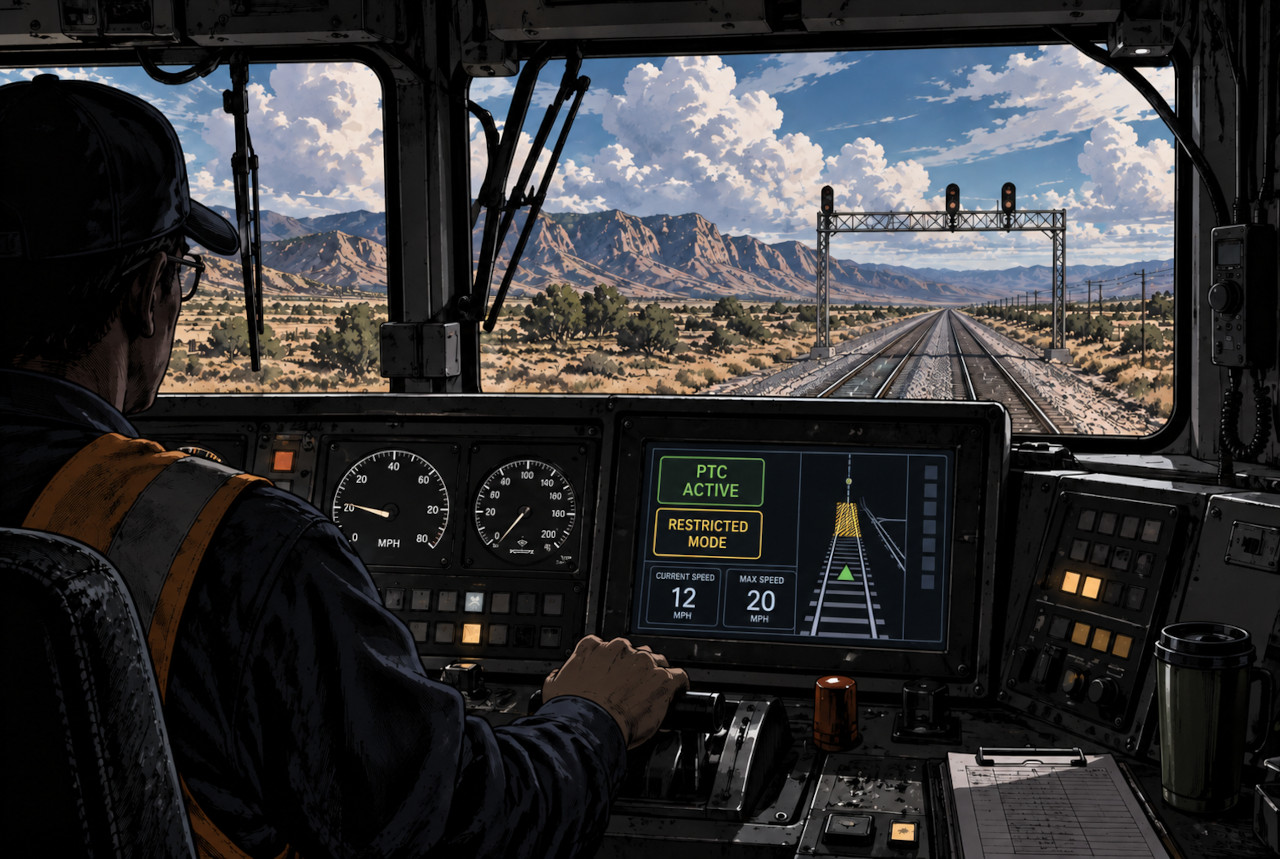
AI-generated conceptual illustration. It does not reproduce an actual locomotive cab or PTC interface, and the speeds, display information, and signal indications shown are not accident data.
The Biggest Unanswered Question: Why Was the First Impact Misread?
Once the operating system is unpacked, several details that initially look impossible become less mysterious. Shoving movements are real and common. Restricting does not mean the same thing as a stop signal. And PTC is not an all-seeing automatic barrier against every low-speed contact.
But one question remains difficult to explain.
Why did the crew interpret the first collision with another train as resistance associated with an air-brake problem?
A long freight train is a complicated mechanical system. The locomotives can be a considerable distance from the opposite end of the consist, and the engineer experiences forces through couplers, slack action, train weight, grade, brake-pipe behavior, and the movement of dozens of individual cars.
That does not mean any of those factors caused the misinterpretation in this accident. At present, the public preliminary information does not tell us.
Answering that question will require much more detail: event-recorder data, PTC records, brake inputs, radio and dispatcher communications, train weight and configuration, track profile, and the crew’s own observations.
As of September 20, 2026, the NTSB investigation remains ongoing and the probable cause has not been determined. The investigation docket has not yet been released either. Claims that the accident was simply an engineer error, a PTC failure, or a dispatcher mistake therefore go beyond what has been established so far.
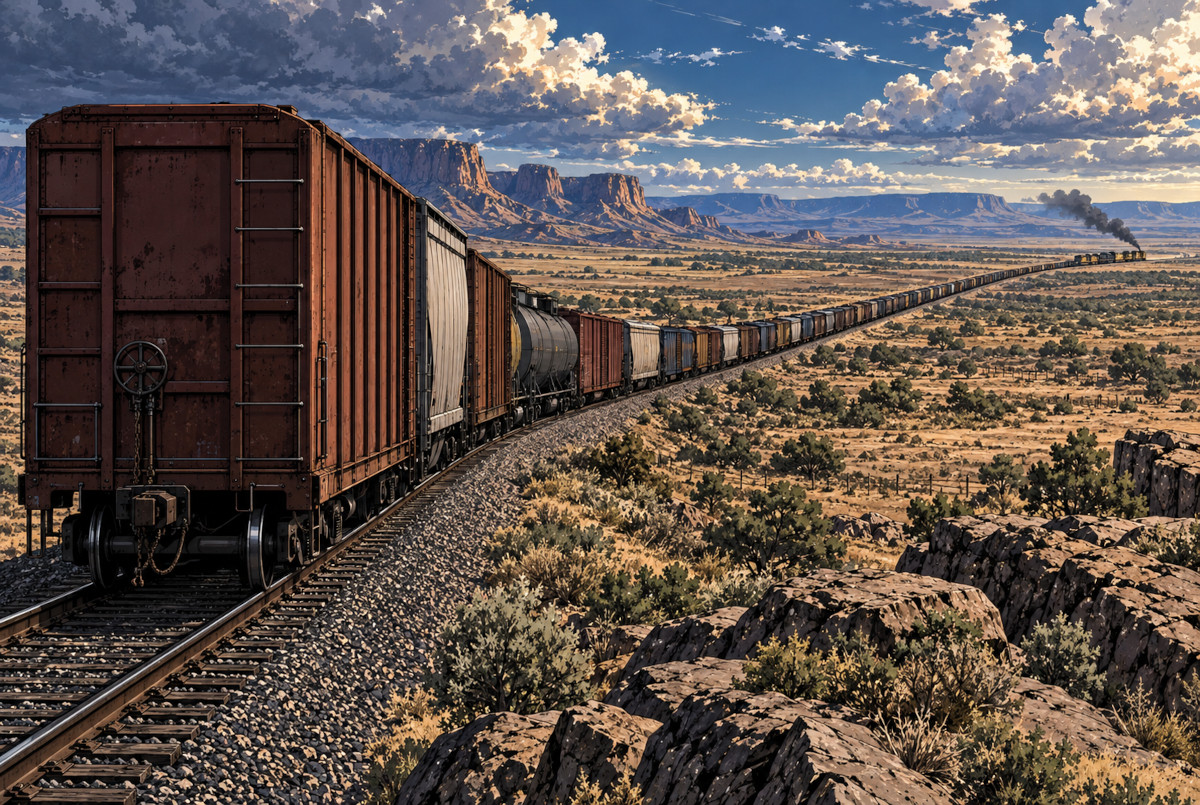
AI-generated explanatory illustration. It does not reproduce the actual accident location or accident train.
The B-Side of the Accident Is the Railroad System Behind It
“The same Amtrak train was hit twice within about three minutes” sounds like the kind of headline that could have appeared in an old pulp magazine.
But once the story is unpacked, the more interesting part is not the headline. It is the operating system underneath it: long freight consists being shoved during switching, a Restricting indication that permits movement under strict conditions, and PTC that still leaves an important part of restricted-speed operation in human hands.
To understand why this accident is so strange, you have to understand how U.S. railroads actually move trains.
And after all of that, the most intriguing point is still the one the preliminary report cannot answer: what did that first impact actually feel like from the locomotive, and why was it interpreted as something other than a collision?
For that, speculation is less useful than waiting for the NTSB investigation to go further.
Editor’s Note
When I first read the preliminary report, my reaction was pretty simple: “You hit the train once—how do you end up hitting it again?” But the deeper I went, the less this looked like a cheap “idiot accident” story.
The part that caught me most was PTC. Seen from Japan, it is tempting to hear “advanced train-control system” and assume that if another train is sitting ahead, the system must simply stop you before you reach it. But restricted-speed operation is more complicated than that. Technology may enforce a ceiling, while the crew still has to judge what can actually be seen and how quickly a very long, very heavy train can stop.
That is where this story becomes more interesting than the bizarre headline. The system has rules. It has signals. It has PTC. It has dispatchers. And yet an 82-car train can still produce a situation where the physical sensation of the first impact apparently gets interpreted as something else.
That gap between technology, procedure, and what a crew actually feels through a long train—that is the part I want to see explained when the NTSB eventually releases its full findings.
References
- National Transportation Safety Board (NTSB), “Amtrak and Illinois Central Railroad Company Train Collision” — Preliminary information on the February 22, 2026 collision, train consists, two impacts, shoving movement, Restricting signal, and investigation status.
- NTSB Investigation Docket RRD26FR007 — As of September 20, 2026, the investigation docket had not been released.
- Federal Railroad Administration (FRA), “Safety Advisory 2026-01; Restricted Speed” — September 3, 2026 safety advisory addressing restricted-speed operations and PTC Restricted Mode.
- Federal Railroad Administration, “Restricted Speed Enforcement for Positive Train Control Systems” — Technical report on restricted-speed operation and Positive Train Control.
- 49 CFR §218.99, “Shoving or pushing movements” — Federal requirements governing point protection and certain shoving or pushing movements.
- 49 CFR §236.812, “Speed, restricted” — Federal definition of restricted speed.
- 49 CFR §236.1005, “Requirements for Positive Train Control systems” — Federal requirements governing PTC system functions.