
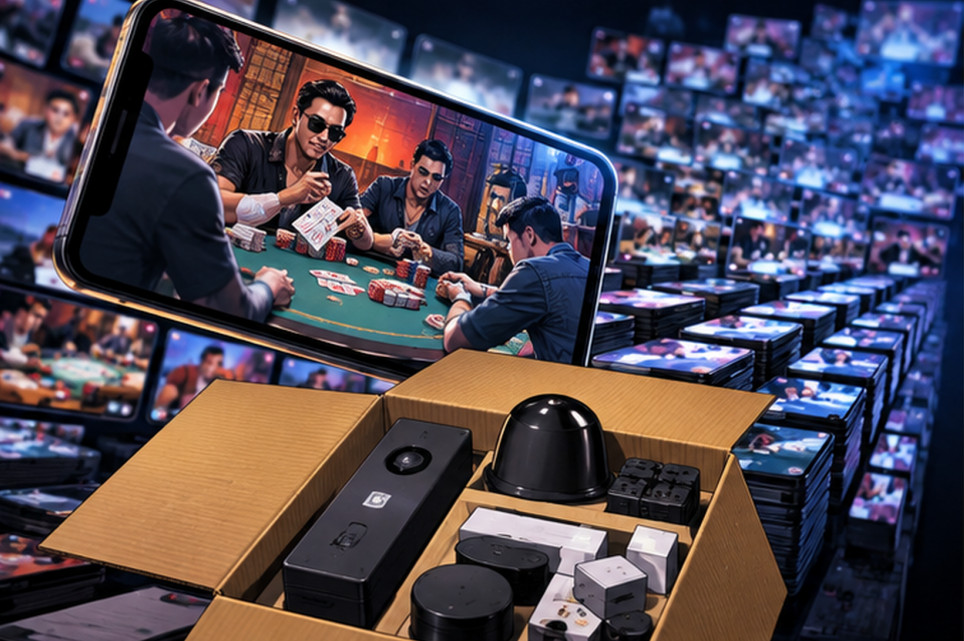
On September 28, 2026, Vietnam’s Ministry of Public Security and Hải Phòng City Police announced an unusual case: a group of eight people had allegedly built what looked less like a gambling operation and more like a small video-production business.
The group staged gambling scenes, assigned roles, wrote scripts and uploaded the resulting clips to Facebook. Police say they posted nearly 800 videos.
But the gambling itself was not really the product. Embedded in the videos were advertisements for devices promoted as tools for cheating at gambling.
The gambling was staged. The sales pitch was real.
Eight People, Assigned Roles and a Fake Gambling Table
According to Vietnamese authorities, the operation was led by Phạm Huy Tuyền, born in 1987. Police say Tuyền and seven others discussed the concept, divided up roles and filmed staged scenes involving card games and xóc đĩa.
Xóc đĩa is a traditional Vietnamese betting game involving small two-sided pieces shaken beneath a covered dish. The exact rules are not important here. Visually, however, it provides everything a fake underground gambling video needs: a table, money, suspense and a group of people reacting to a hidden result.
Local reporting says some performers appeared with visible tattoos and adopted a “giang hồ” persona—a tough, underworld-style image commonly associated in Vietnamese popular culture with gangsters or street enforcers.
 AI-generated illustration. It does not depict the actual people or location involved in the case.
Nearly 800 Videos Functioned Like a Giant Shopping Channel
Police said the videos promoted items including contact lenses, modified playing cards, wallet-type card accessories, vibration devices and electronic gambling equipment. Authorities said the group obtained the products through social media.
There is no need to explain how any of those devices were supposed to work. The important point is that they were marketed as products capable of giving gamblers an unfair advantage.
According to a September 29 report by Vietnamese newspaper Tiền Phong, prices varied widely, from about VND 100,000 to VND 15–16 million depending on the item. The group allegedly operated multiple personal accounts and Facebook fan pages to attract potential buyers.
One distinction matters: this was not primarily reported as a scheme to make money from video-platform advertising. The videos themselves were marketing tools. Contact details were inserted into the content so viewers interested in the devices could become customers.
In other words, the clips were not the merchandise.
All 800 of them were salespeople.
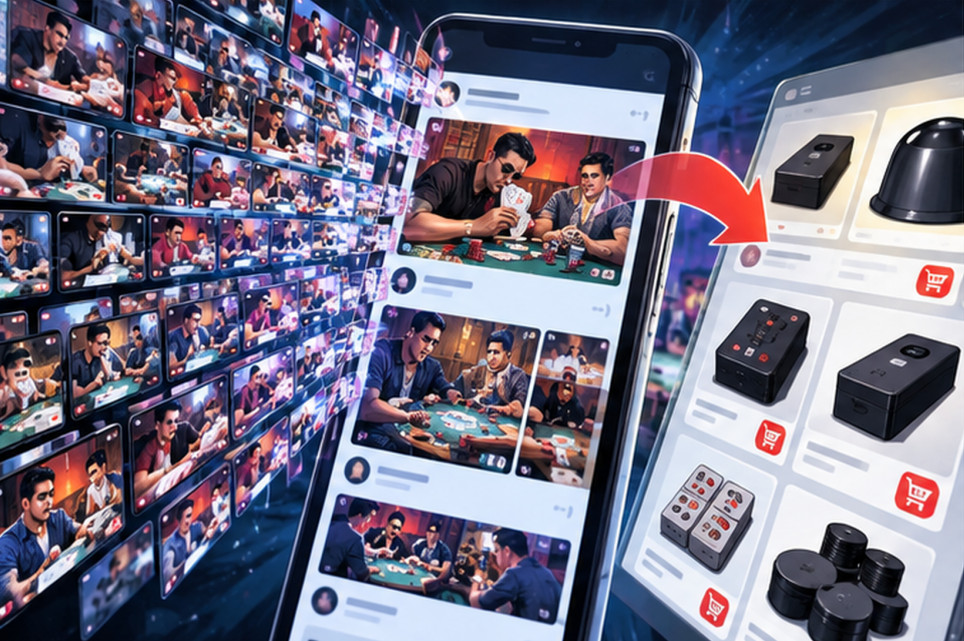 AI-generated illustration. It does not reproduce any real Facebook interface, product listing or video from the case.
Even the Facebook Page Names Were Part of the Performance
The scale was not the only strange part of the operation.
Tiền Phong reported that Tuyền operated pages with names such as “Giang hồ bịp,” roughly suggesting a world of gambling cheats and underworld characters, and “Tình người trên chiếu bạc,” which can loosely be rendered as “Humanity at the Gambling Table.” Other members allegedly ran pages advertising “trusted” cheating equipment and high-tech gambling gear.
Then there is one name that stands out particularly strongly when this story is viewed from Japan.
One Facebook page was called “Đồ bịp 7D nhập khẩu Nhật Bản”—roughly, “7D cheating gear imported from Japan.”
There is no evidence in the police announcement confirming that the products were actually made in Japan or imported from Japan. Authorities only said the equipment had been purchased through social media.
From a Japanese perspective, that makes the wording especially curious. “Japan” may have been used as a quality or technology signal, but that interpretation remains speculation. What can be confirmed is simply that the claim appeared in the name of the page.
Why Make Nearly 800 Videos Just to Sell Products?
This is where the case becomes more interesting than a simple story about illegal gambling-related merchandise.
If someone posts a photograph of a suspicious device and says, “This will help you cheat at gambling,” the obvious problem is credibility. The buyer already knows the market is shady.
A staged gambling video solves a different problem. Instead of merely showing the product, it creates a world in which the product appears to belong: money on the table, tough-looking players, apparent wins and losses, and characters who seem familiar with an underground gambling scene.
That does not prove the devices worked. It creates something arguably more useful to a seller: a believable setting in which the devices appear legitimate.
And the group allegedly did not make five videos, or twenty, but nearly 800 across multiple pages. Police said some reached millions of views.
Seen this way, the operation resembles an old-fashioned dubious mail-order business that evolved into the social-media era and acquired its own ongoing video series.
Before selling the product, it sold the world in which the product supposedly made sense.
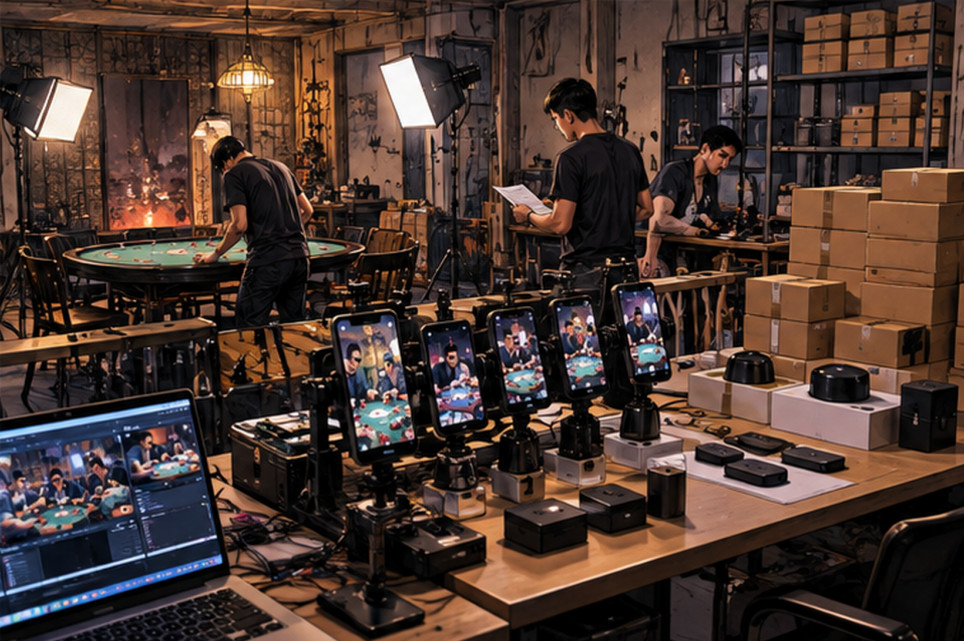 AI-generated illustration. It does not depict the actual studio, suspects, seized goods or equipment involved in the investigation.
The Case Was About More Than Pretending to Gamble
Hải Phòng police detained the eight people on September 19, 2026, and authorities publicly described the case on September 28.
The investigation concerned an alleged offense described by authorities as the illegal provision or use of information on computer and telecommunications networks.
On September 29, Tiền Phong reported that investigators had formally initiated criminal proceedings against all eight as accused persons in the case—a procedural step known in Vietnamese as khởi tố bị can. It should not be confused with a final judgment or conviction.
The authorities’ concern therefore went beyond the simple fact that people had pretended to gamble on camera. Police focused on the broader online system: staged depictions of illegal or underworld behavior, distributed at scale and used to attract customers for gambling-cheat products.
Vietnam’s Ministry of Public Security also warned against posting and spreading content that glorifies violence, illegal behavior or gangster-style lifestyles merely to gain views, engagement or profit.
Editor’s Note
The number that gets me is not eight. It is 800.
If you make three or four videos to sell some questionable gadget, I can at least understand the logic. But nearly 800? At that point you need scripts, performers, locations, shooting, editing, uploads and multiple social-media pages. You are no longer just running a shady shop. You have accidentally built a small media company.
There is another contradiction I like about this story. The alleged business was selling products designed to help customers deceive other people. Yet before anyone would buy those products, the sellers first had to convince the customers that they could be trusted.
To sell tools for cheating, you first have to look like an honest cheating-equipment dealer.
And then there is that “imported from Japan” page name.
Seen from Japan, it is hard not to stop there for a second. Was the equipment genuinely Japanese? Authorities have not established that. Did attaching “Japan” to the name simply make the products sound more technical, precise or trustworthy? Maybe—but that would be speculation.
What this case does show rather neatly is that some forms of crime are not becoming sophisticated because the hardware is brilliant.
The marketing department is simply getting much better.
References
- Vietnam Ministry of Public Security — “Crackdown on groups illegally posting and sharing information in cyberspace” (September 28, 2026, Vietnamese)
- Hải Phòng City Police — “Eight people detained over staged gambling videos used to sell cheating products on Facebook” (September 28, 2026, Vietnamese)
- Tiền Phong — “Criminal Police Department issues warning after busting group that staged gambling-cheat videos” (September 29, 2026, Vietnamese)
- VnExpress — “Eight arrested after staging 800 clips to sell gambling-cheat devices” (September 28, 2026, Vietnamese)
- Tuổi Trẻ — “Eight detained after staging and posting nearly 800 gambling videos to advertise cheating equipment” (September 28, 2026, Vietnamese)