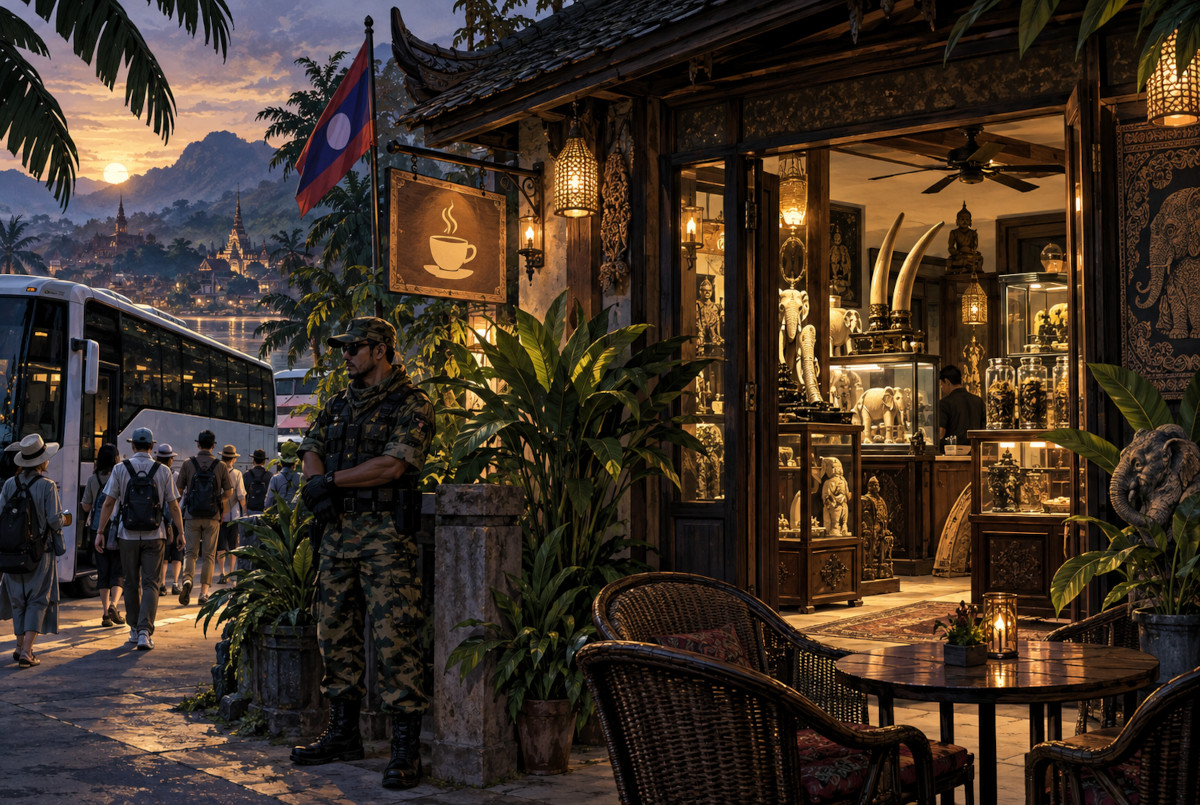
On September 17, 2026, officials in Luang Prabang, one of Laos’s best-known tourist cities, met to deal with a rather unusual problem: souvenir shops.
Authorities said they had inspected 15 premises suspected of involvement in illegal wildlife-product sales, closed two shops and detained foreign suspects. They also moved against businesses that admitted only selected foreign tour groups, calling for legal shops to be accessible to ordinary customers and for tighter scrutiny of businesses linked to so-called “zero-yuan” or “zero-dollar” tours.
But trace the story backward, and it leads to a wonderfully strange clue: a reporter walked up to a place called a coffee shop and was told there was no coffee.
The armed guard who said, “No coffee”
In June 2025, a Mongabay reporter visited Kin Liao Coffee, a roadside business near Kuang Si Falls outside Luang Prabang.
At the entrance stood an armed security guard in camouflage. His message to the reporter was simple: “No coffee, no coffee.”
That line is almost too perfect, so it is worth being precise. Mongabay did not establish that Kin Liao Coffee never serves coffee. What the reporting confirms is that, on the day of the visit, the reporter was told there was none.
The more important question was what the business appeared to be selling instead. According to an investigation by the Global Initiative Against Transnational Organized Crime (GI-TOC), the venue had been used as a stop for Chinese package-tour groups and was linked to the sale of rhino horn, ivory, bear bile and other wildlife products. Receipts seen by investigators were issued under the name “Kinliao Coffee.”
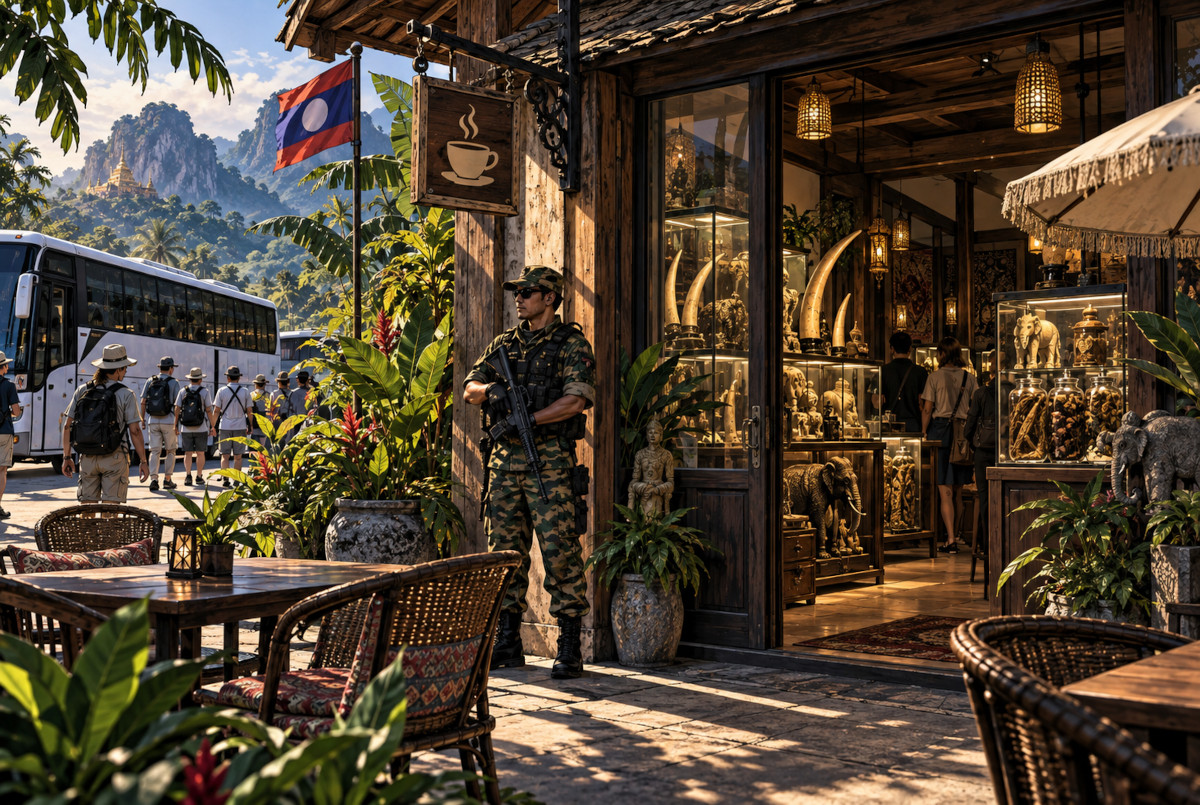
AI-generated illustration. It does not depict the actual Kin Liao Coffee, its guards, or the real location documented in the investigation.
Café, museum, jewelry store — the sign outside may be the least important part
A 2025 investigation by Mongabay and GI-TOC identified at least 18 large-scale venues, with as many as 21 locations documented across Luang Prabang and the capital, Vientiane.
The businesses presented themselves in various ways: cultural centers, museums, jewelry stores, restaurants and coffee shops. Investigators reported products including ivory, rhino horn, tiger parts, pangolin products and bear-derived products. Some venues were difficult for ordinary visitors to enter and appeared to cater primarily to pre-arranged Chinese-language tour groups.
By July 2026, investigators working on the issue told Mongabay they had identified as many as 35 suspected locations — 22 in Luang Prabang and 13 in Vientiane. That number needs a qualification. Mongabay did not independently verify all of the newly identified shops, and Lao authorities said they had not confirmed that the network had expanded to 35 locations.
The unusual part is not simply that illegal goods were allegedly being sold. It is that these were not tiny back-alley stalls. Some looked like substantial tourist facilities designed to receive busloads of visitors.
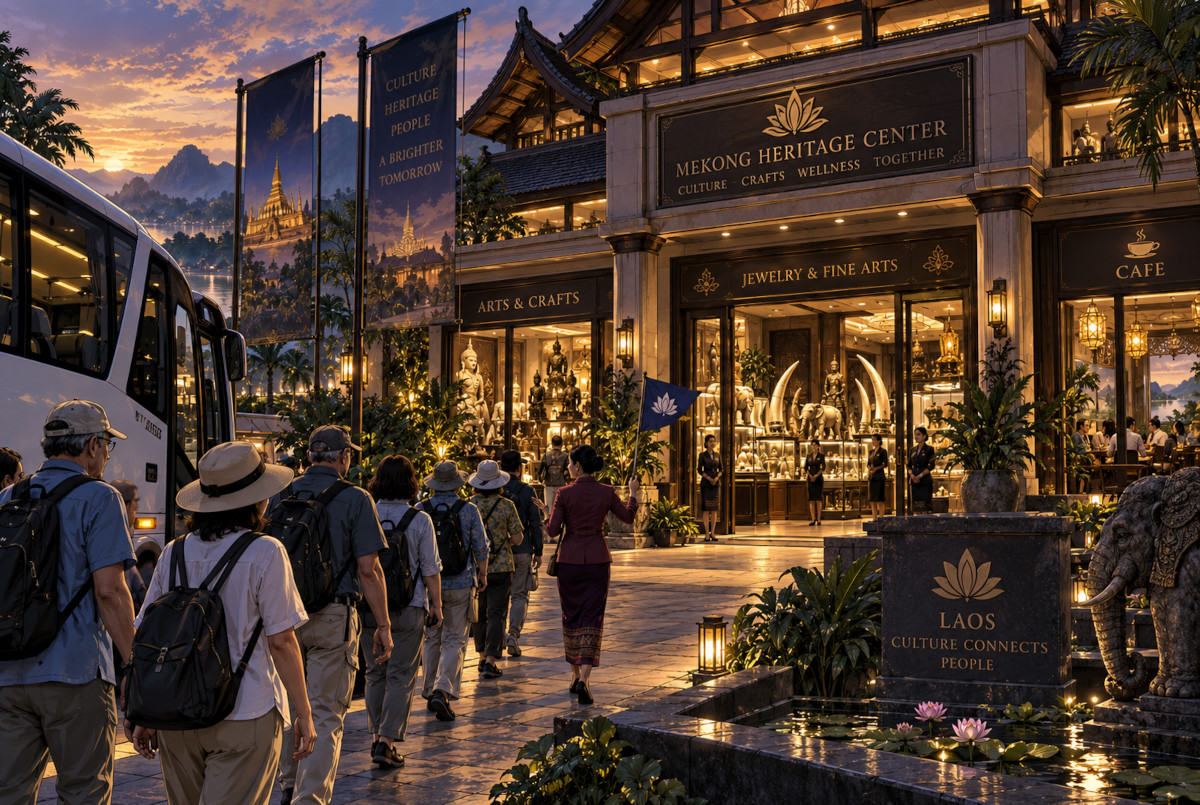
AI-generated explanatory illustration. It does not depict an actual tour operator, shop or group of travelers involved in the investigation.
A very cheap tour has to make money somewhere
The business model resembles what is commonly called a “zero-dollar tour” or “zero-yuan tour”: the package price is kept extremely low, while operators recover revenue through commissions and purchases at designated shopping stops.
GI-TOC’s investigation found that Chinese tourists in Laos were being taken to such venues under the language of cultural experiences and organized sightseeing, while the sale of expensive wildlife products helped support the commercial model behind the tours.
From the traveler’s point of view, the deal can look attractive: a surprisingly cheap trip to Laos. Once on the ground, however, the itinerary may include a series of carefully selected shopping stops where high-priced products are promoted aggressively.
A September 17, 2026 Lao government statement also pointed to broader business practices under investigation, including the use of Lao nationals to register businesses associated with foreign operators and cross-border digital payments such as WeChat Pay. By that stage, authorities were no longer treating the issue as merely a collection of suspicious souvenir shops. Tourism, payment systems and cross-border commerce had become part of the same enforcement picture.
The railway moved tourists — and another economy grew beside them
For anyone following tourism in Laos, the rapid growth in arrivals from China cannot be separated from the China-Laos Railway.
Cross-border passenger service linking China with Luang Prabang and Vientiane began in April 2023. GI-TOC reported that the number of Chinese visitors to Laos rose from roughly 45,000 in 2022 to more than 1 million in 2024.
That does not mean the railway created the illegal wildlife trade. The railway is major transport infrastructure that has made travel faster and easier for ordinary visitors as well. But when a new transport link suddenly moves far larger numbers of people, businesses — legal and illegal — have an incentive to position themselves along that flow.
On the A-side, the story is international rail, easier travel and a UNESCO-listed city. On the B-side, investigators found another tourism circuit growing alongside it — one that funneled visitors toward shops selling prohibited wildlife products.

AI-generated explanatory illustration. It does not reproduce a specific railway station, train photograph or shop, and it does not imply that the China-Laos Railway itself is involved in illegal wildlife trade.
In 2026, the Lao government stepped up enforcement
The situation moved significantly in September 2026. On September 11, the Lao Wildlife Enforcement Network (LAO-WEN), working with authorities in Luang Prabang, inspected premises in the city and seized 17 suspected wildlife-related items weighing a total of 28.03 kilograms.
According to the official statement, the seized material included items suspected to be rhino horn, carved elephant ivory, wildlife gallbladders and traditional medicines suspected of containing wildlife-derived ingredients. A foreign male suspect was detained for investigation, while the seized items were sent for technical examination.
On September 17, authorities announced action involving the 15 premises described earlier and the closure of two shops. The following day, tourism and environmental authorities held a national meeting on the relationship between zero-dollar tours and illegal wildlife trade.
The government said tourism businesses must not allow their premises or commercial networks to facilitate the illegal possession, sale, transport or consumption of wildlife products. Depending on the offence, measures could include licence suspension or revocation, administrative penalties, fines or criminal prosecution.
Chinese authorities were also warning travelers. On September 17, 2026, the Chinese Embassy in Laos advised tourists to be cautious about low-cost package tours and specifically warned against buying or carrying pangolins, rhino horn, ivory and other wildlife products.
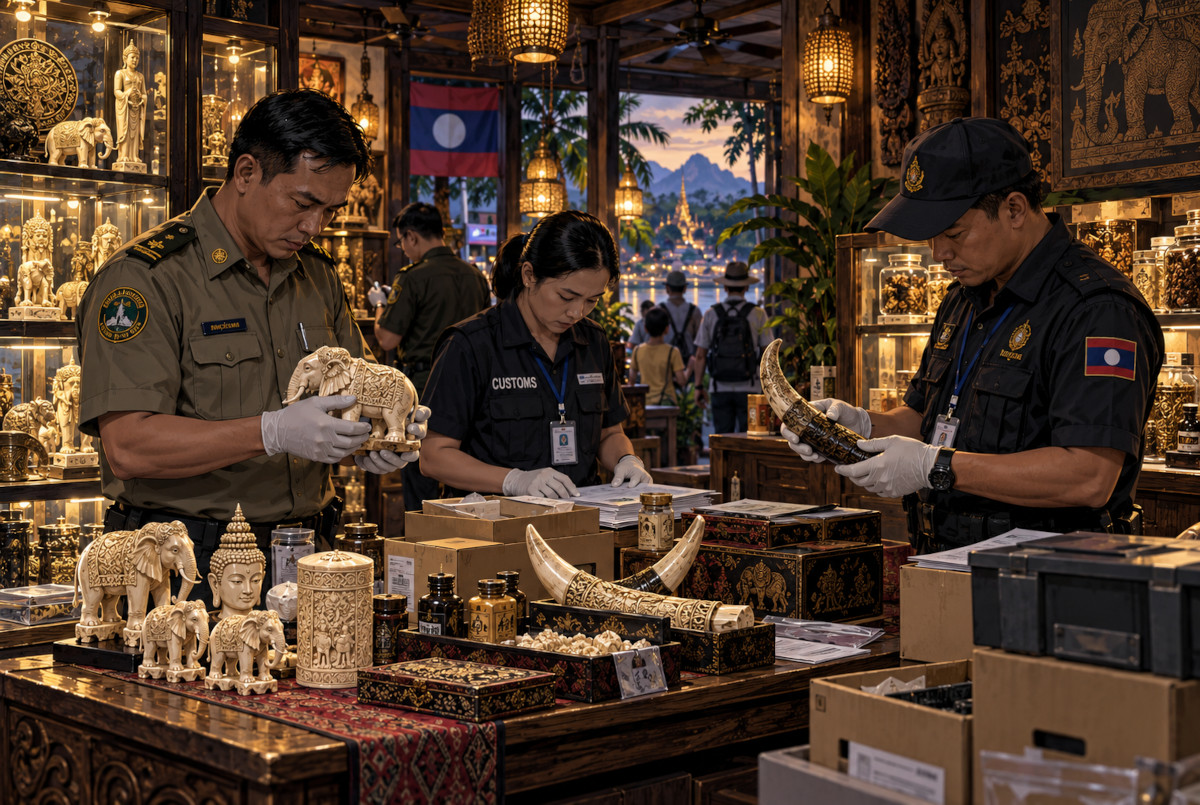
AI-generated illustration. It does not depict the actual September 2026 search, officials, suspects or seized evidence.
Being a tour customer does not automatically make a shop legitimate
There is another uncomfortable layer to the story. Chinese travelers can themselves be targets of misleading sales tactics and coercive shopping arrangements. But once someone purchases prohibited wildlife products, the fact that a tour guide brought them to the shop does not necessarily make the legal problem disappear.
Package tourism naturally creates a sense of trust. A shop is included in the itinerary. A large bus is parked outside. A guide walks everyone through the same door. The building may look professional, guarded and well established. It is easy to assume that somewhere along the line, somebody must have checked that everything is legitimate.
The Laos case shows why that assumption can fail.
A café, a cultural center, a jewelry store — the label on the building may tell you surprisingly little about what is being sold behind the next door.
Editor’s Note
If you travel to Laos, visit a World Heritage city, stop at Kuang Si Falls and then get taken to a “coffee shop,” the normal expectation is fairly modest: coffee. Instead, a reporter reaches the door and gets “No coffee,” while the investigation points to rhino horn and ivory inside. Even by the standards of Japan’s old-school, slightly dubious package-tour era, that is a remarkable change of itinerary.
But the part that bothers me most is not the punch line. It is the scale. A “secret” trade normally makes me imagine a back room, an alley or somebody quietly opening a suitcase. Here, buses were reportedly delivering tour groups to substantial commercial facilities. That is much stranger.
The railway is not the villain, and neither are Chinese tourists as a group. Better transport created a much larger flow of legitimate travelers. Then somebody figured out how to build another commercial route alongside that flow.
“No coffee” is funny for about five seconds. What sits behind it is not. The front entrance is tourism; just behind it, another economy is operating. That is exactly the kind of place where B-Side Earth tends to look.
References
- Department of Forestry, Lao PDR: “Lao PDR Intensifies Crackdown on Transnational Wildlife Crime Linked to Souvenir Shops in Luang Prabang” (September 17, 2026)
- Department of Forestry, Lao PDR: “LAO-WEN and Luang Prabang Authorities Seize Suspected Wildlife Products and Initiate Legal Proceedings” (September 11, 2026)
- Department of Forestry, Lao PDR: “Tourism and Environmental Authorities Join Forces to Combat Zero-Dollar Tours and Illegal Wildlife Trade” (September 18, 2026)
- Embassy of the People’s Republic of China in Laos: Travel Safety Reminder for the Mid-Autumn Festival and National Day Holidays (September 17, 2026; Chinese-language notice)
- Global Initiative Against Transnational Organized Crime: “Railroad to Extinction — How a Rail Link with China Supercharged an Illegal Wildlife Tourism Industry in Laos” (July 22, 2025)
- Mongabay: “Large-scale illegal wildlife shops in Laos found scamming Chinese tourists” (July 22, 2025)
- Mongabay: “Laos’s illegal wildlife shops keep growing despite enforcement, investigators find” (July 15, 2026)