
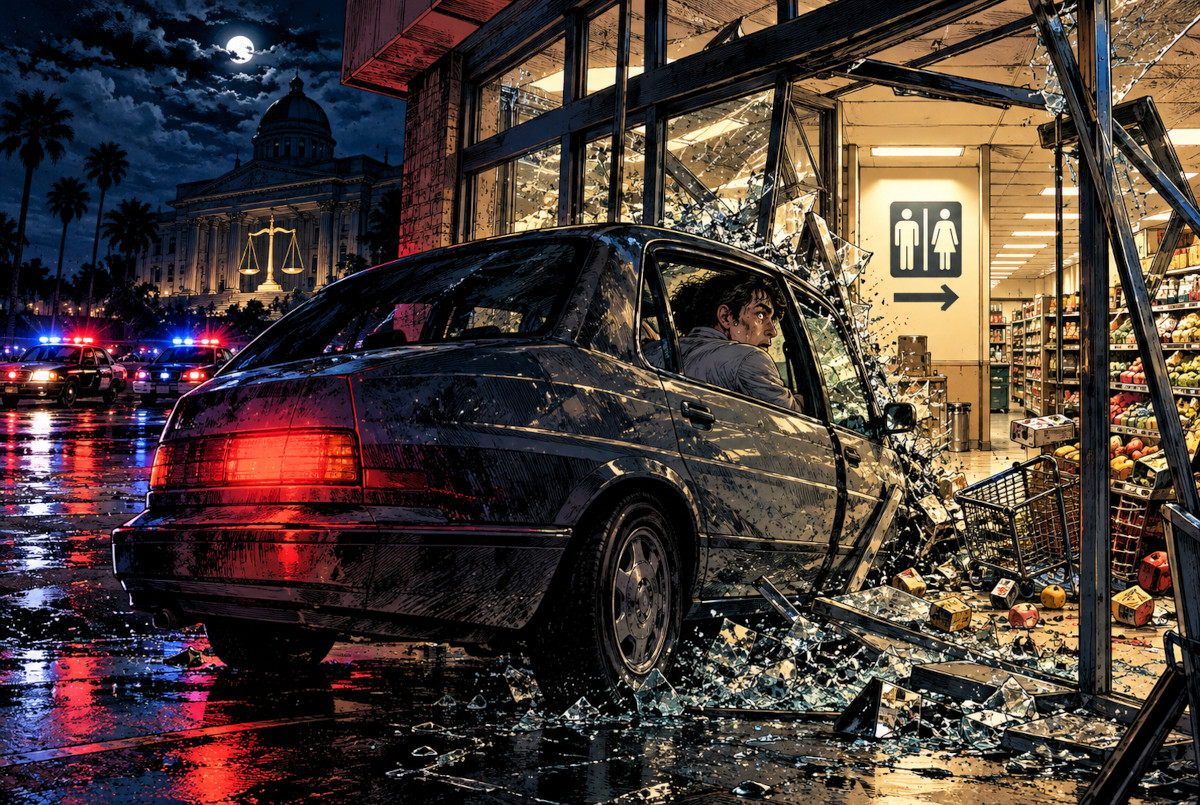
At 4:28 a.m. on September 27, 2026, a Chevrolet crashed through the entrance of a closed Kroger supermarket in Rosenberg, Texas, southwest of Houston.
This was not described by police as a case of confusing the accelerator with the brake. According to the Rosenberg Police Department, the 60-year-old driver intentionally accelerated into the store, damaging the pharmacy-side entrance.
Why?
Police said the driver needed to use the restroom and became upset when he found the doors locked.
The Store Was Still 90 Minutes From Opening
The Kroger at Brazos Town Crossing normally opens at 6 a.m. and closes at 11 p.m. The incident happened at 4:28 a.m., roughly an hour and a half before opening time.
According to police, the driver needed a restroom and was frustrated that the doors were locked. Rather than wait for the store to open or look elsewhere, he allegedly chose the locked entrance itself as the problem to solve—with his vehicle.
Police photos showed the vehicle well inside the store after smashing through the glass entrance. No one was injured. The building, however, was not completely empty simply because it was closed to customers; employees were reportedly working elsewhere inside at the time.
AI-generated illustration. It does not depict the actual store, vehicle, or scene involved in the incident.
There Was No Obvious Intoxication Explanation
For a story like this, an obvious assumption is that alcohol or drugs must have been involved. But Lt. Sebastian Muñoz of the Rosenberg Police Department told N+ Univision that the suspect showed no signs of being intoxicated or under the influence of drugs.
He also did not flee after the crash. He remained at the scene.
That leaves one of the strangest parts of the case intact. Based on the information released so far, this was not reported as an accidental crash, and police did not identify intoxication as an explanation. Yet the leap from “the door is locked” to “drive through the door” still happened.
The driver was identified in local reporting as James Mansell Lancaster Jr., 60, of Natchez, Mississippi. Publicly available reporting does not explain why he was in Rosenberg at that hour.
There Were Other Places Nearby
The story becomes even harder to explain when the surrounding area is taken into account.
Houston-area outlet Chron noted that a 24-hour 7-Eleven was located down the road. A SpringHill Suites hotel was across the way, and a nearby McDonald’s was scheduled to open at 5 a.m.
There is no evidence that Lancaster knew those alternatives were available. So it would be unfair to claim that he deliberately ignored an open convenience store in favor of crashing into Kroger. What can be said is that this was not an isolated location with no other businesses nearby.
That detail also points to a broader feature of the setting. This is the kind of American suburban commercial landscape built around large parking lots, arterial roads and driving from one business to another. The car explains how people move through the environment. It does not, of course, explain why anyone would use that car as a substitute for a key.
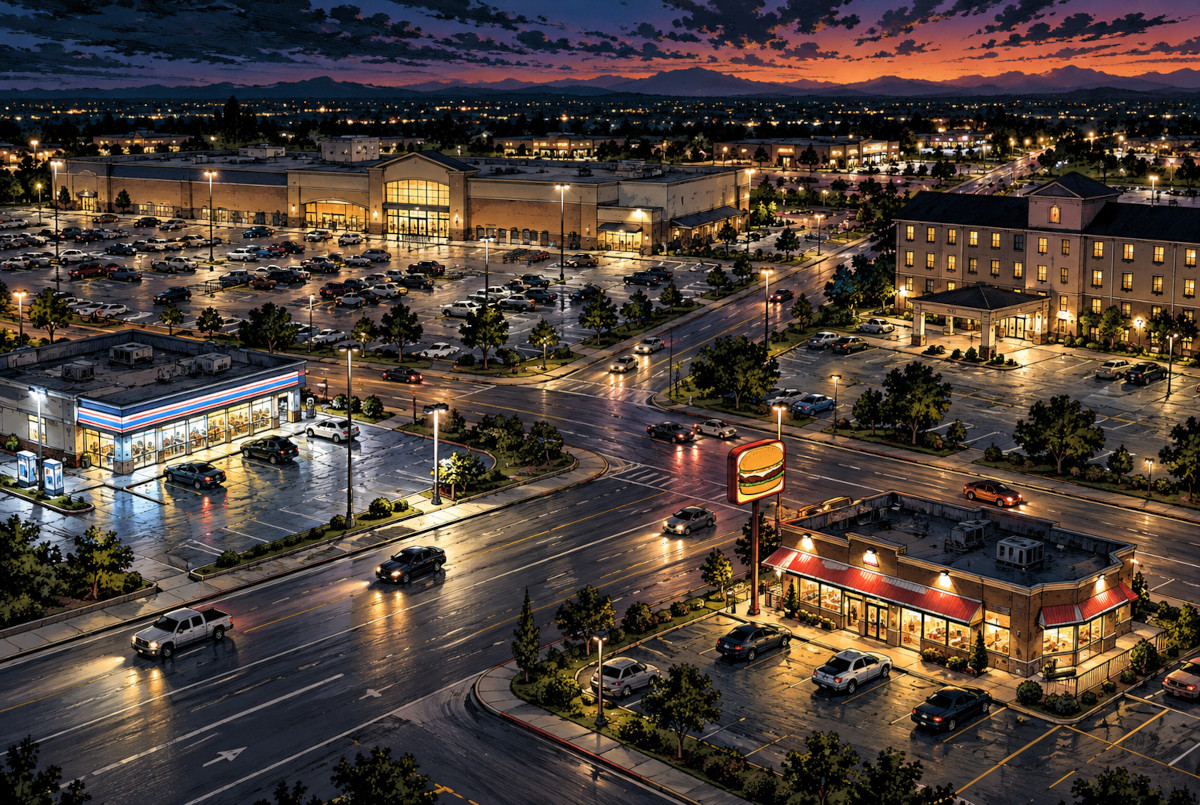
AI-generated explanatory illustration. It does not reproduce the actual map or business layout of Rosenberg, Texas.
A Restroom Emergency Became a Felony-Level Property Damage Case
Whatever the urgency of the original problem, the cost of the solution was on an entirely different scale.
Police estimated the property damage at about $50,000, according to reporting on the case. Lancaster was arrested on a criminal mischief charge.
Under Section 28.03 of the Texas Penal Code, criminal mischief covers intentionally or knowingly damaging or destroying someone else’s tangible property without the owner’s effective consent. When the amount of pecuniary loss is $30,000 or more but less than $150,000, the offense is classified as a third-degree felony.
Under Section 12.34, a person convicted of a third-degree felony in Texas can face two to ten years in prison and a fine of up to $10,000. That is the statutory range, not a prediction of what sentence Lancaster will receive, and a charge is not the same thing as a conviction.
A problem measured in minutes had turned into roughly $50,000 in property damage and a felony charge. Even by the standards of bad decisions, the exchange rate was spectacularly poor.
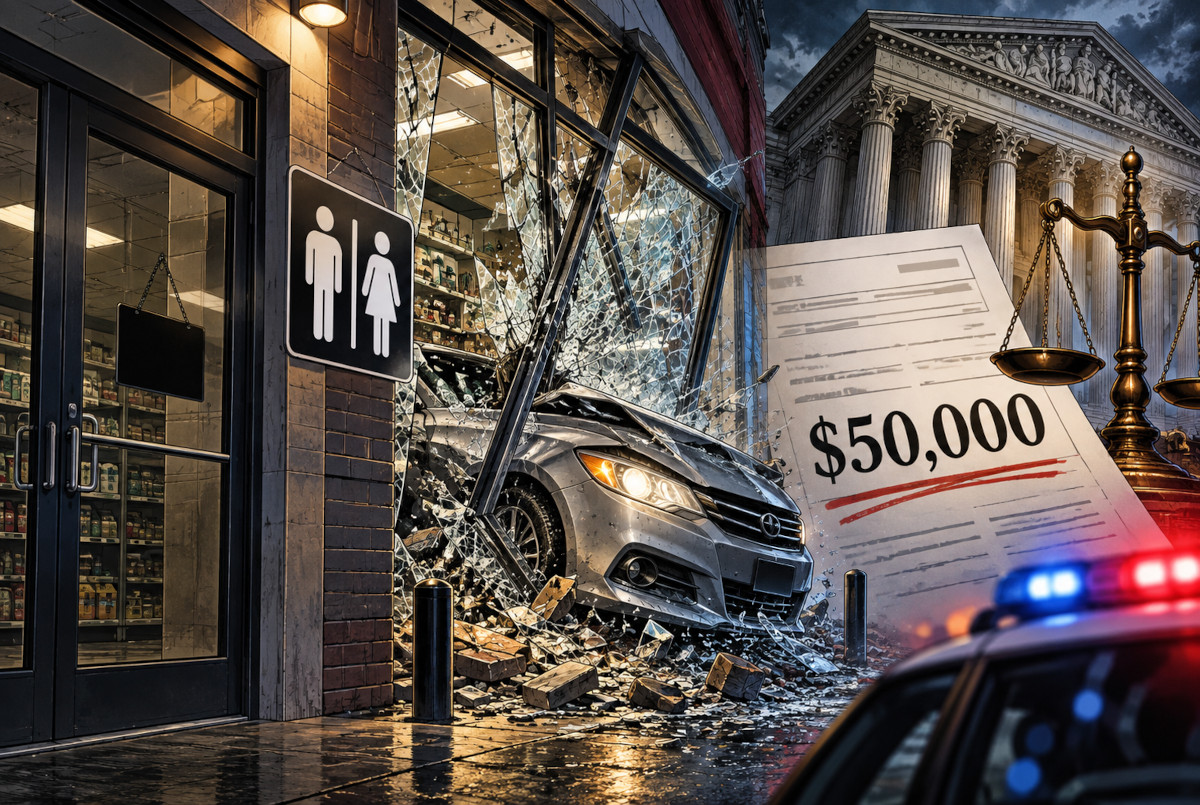
AI-generated explanatory illustration. It does not depict the actual scene, vehicle, police car or courthouse, and it does not imply that the suspect has been convicted.
Calling It “Only in America” Misses the Point
From overseas—Japan included—it would be easy to package this as another “only in America” story: enormous parking lots, big-box stores, a car for every trip, and then someone driving that car straight through the front doors.
But that explanation is too convenient. Rosenberg police themselves treated the decision as extraordinary, joking on social media that people should find a store that is actually open when they need to “do their business.” In other words, this was unusual in Texas too.
The suburban environment is still relevant. It helps explain why a car was immediately available and why nearby businesses were spread around a road-and-parking-lot landscape. But the environment is context, not a cause.
The real B-side of the story is the enormous gap between the original problem and the response to it: an ordinary physical need, a locked door, and then a decision wildly out of proportion to both.
And one oddly important question remains unanswered.
Did he ever actually make it to the restroom?
The reports reviewed for this article do not say.
Editor’s Note
Seen from Japan, what sticks with me is not that somebody desperately needed a restroom. Everybody has had that moment. It is the mental jump that followed.
The door is locked. Fine. But how does the next thought become, “Then I’ll open it with the car”?
My first instinct in Japan would probably be to look for a convenience store, gas station or any other business that was open. That does not mean Japanese people are somehow immune to ridiculous decisions, and I do not think this story says anything profound about “Americans” as a group.
In fact, the local police reaction makes the opposite point. They thought it was bizarre too.
What interests me is the combination of an ordinary human emergency and an environment where the car is already sitting there as the default tool for getting from A to B. Most people would simply drive to B. This time, somehow, the vehicle itself became the workaround.
A restroom problem turned into roughly $50,000 in damage because one locked door met one spectacularly disproportionate decision. That gap—the perfectly normal problem and the completely abnormal solution—is the B-side of this story.
References
- Rosenberg Police Department, “Suspect Intentionally Drives Through Grocery Store Entrance” (September 27, 2026)
- FOX 26 Houston, “Man arrested for crashing into Rosenberg store for bathroom” (September 27, 2026)
- Univision Houston, report on James Lancaster crashing into a Kroger after saying he needed to use the restroom (Spanish-language report, September 27, 2026)
- KPRC / Click2Houston, “Driver accused of ramming SUV through Rosenberg grocery store, upset because he needed to use the bathroom” (September 28, 2026)
- The New York Times, “A Driver Desperate to Use the Bathroom Plows Into a Kroger in Texas, the Police Say” (September 28, 2026)
- Kroger, Rosenberg Store (store location and hours)
- Texas Constitution and Statutes, Penal Code §28.03 — Criminal Mischief
- Texas Constitution and Statutes, Penal Code §12.34 — Third Degree Felony Punishment
- Chron, “Police: Driver smashes into Texas Kroger to use bathroom” (September 27, 2026; nearby businesses and local context)