In 2026, Taipei Zoo had an unusual run of animals getting outside their designated enclosures.
On May 18, a southern tamandua may have used a banana tree that snapped while she was climbing it as an accidental escape route. On July 4, a brown spider monkey jumped into the water and swam across. Then, on September 17, two chimpanzees got through doors that had not been properly secured.
The strange part is not simply that several animals escaped from the same zoo. It is that the “exit” was different almost every time. A tree, a body of water, and finally a human failure to lock a door. Put the incidents side by side, and this becomes more than a collection of quirky zoo stories.
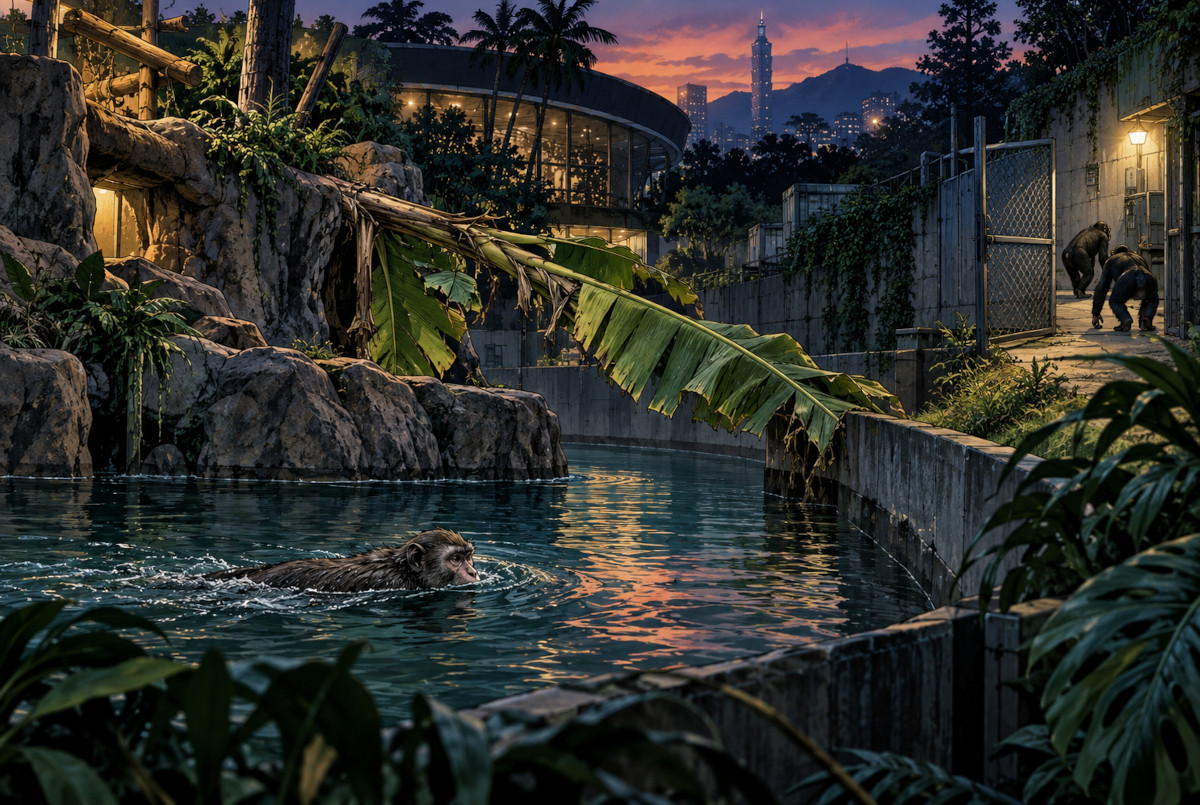
 AI-generated illustration. It conceptually combines the three major 2026 incidents and does not depict the actual layout, animals or news photographs from Taipei Zoo.
May 18: When a Banana Tree May Have Become a Bridge
The first major incident began on May 18, 2026, when a female southern tamandua named “Hei Niu” disappeared from her enclosure at Taipei Zoo.
Keepers realized she was missing the following morning and reviewed surveillance footage. According to the zoo, Hei Niu entered the outdoor habitat at about 6:15 p.m. on May 18. Roughly 40 minutes later, she was recorded near a planted area beside a visitor walkway before disappearing from view.
After inspecting the enclosure, zoo staff concluded that a banana tree may have snapped while Hei Niu was climbing it. The fallen plant could have created a temporary connection between the enclosure and an adjacent artificial rock structure, allowing her to get out.
That distinction matters. There is no evidence that Hei Niu deliberately engineered an escape using a banana tree. The zoo itself described the route as a likely reconstruction based on the condition of the enclosure.
Still, the result is hard to miss: vegetation intended to create a more natural habitat may also have become an unintended route beyond it.
Taipei Zoo deployed about 65 staff-days of search effort over May 19 and 20, along with automatic cameras and trapping equipment. Hei Niu remained missing for a week. Then, on May 25, zoo staff driving through the grounds unexpectedly spotted her calmly crossing an internal road.
She was recovered and taken for examination. Initial checks found no obvious injuries, only mild dehydration. The zoo also reported that she still had enough strength to struggle during capture and scratch a staff member’s hand.
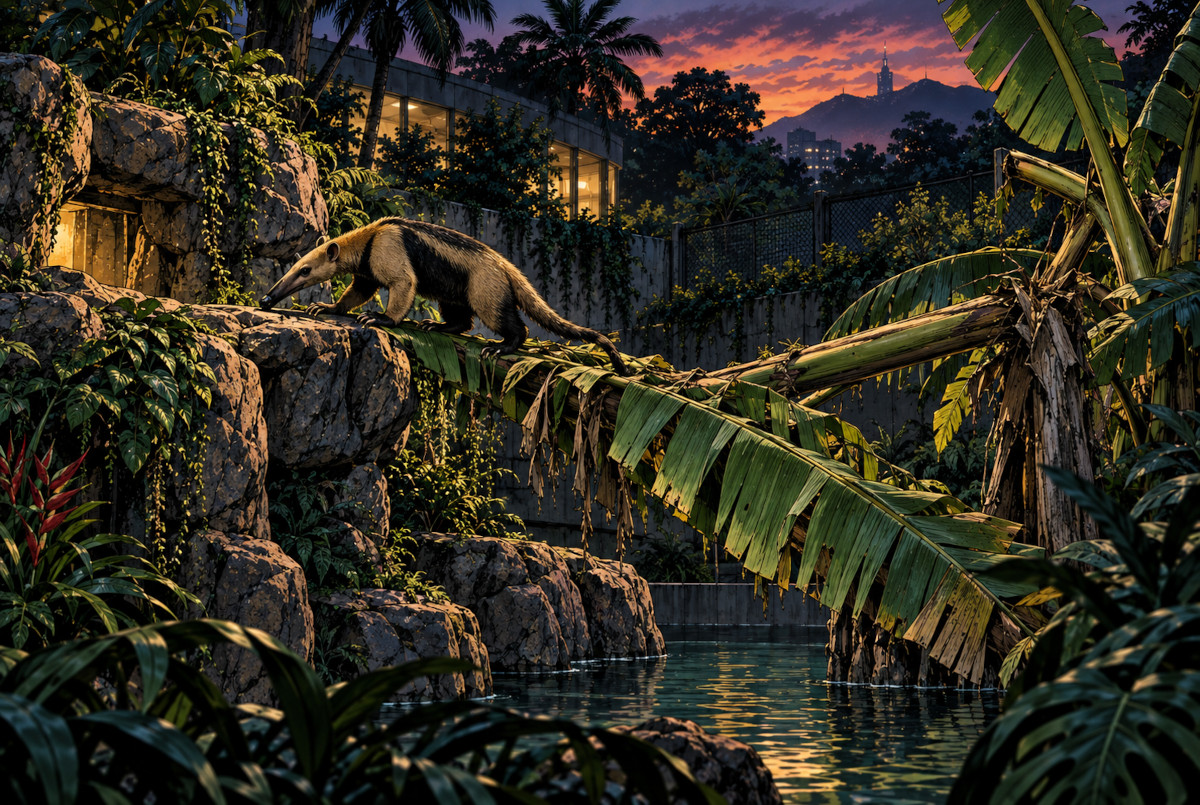 AI-generated illustration. It is intended to explain how such an escape route could have formed and does not reproduce the real enclosure, animal or incident photograph.
Two Days Later, Another Group of Monkeys Briefly Got Out
There is another detail buried in Taipei Zoo’s May 20 announcement.
While staff were still searching for Hei Niu, the zoo recorded a family group of black-capped squirrel monkeys temporarily leaving their outdoor enclosure to explore before returning by the same route on their own.
That makes the idea of “three escapes in 2026” slightly too neat. This article focuses on the three major incidents that attracted broader attention in May, July and September, but there was at least one additional episode of animals moving beyond their intended outdoor area during the same period.
July 4: The Spider Monkey That Swam
The next major incident came on July 4, 2026.
A brown spider monkey named Paco, then relatively low in the group’s social hierarchy, was involved in a chase with three other monkeys. According to the zoo, Paco became agitated, jumped into the water beside the enclosure, swam to the opposite side and moved toward a visitor pathway.
Zoo staff rejected the idea that he had been systematically bullied out of the group. They said the animals regularly engage in complicated social behavior—including chasing, play, food competition and rank disputes—and that Paco appeared to become nervous during the encounter.
He was recovered at around 11 a.m. from a tree in the children’s zoo area, roughly two hours after the incident began, and was found to be in good physical condition.
What makes the episode more interesting is an older Taipei Zoo article from 2019.
The zoo once described this group of young male brown spider monkeys using the Taiwanese expression “屁孩”—roughly the kind of term used for mischievous, troublesome kids or “little brats.” It was not a scientific label, but an intentionally playful description of a group known for energetic and disruptive social behavior.
The same zoo article described a giant anteater in the shared habitat entering the water to get away from them, while the brown spider monkeys, described as being afraid of water, stayed on the bank.
Seven years later, one of those brown spider monkeys jumped into the water, swam across it and got out.
That does not prove the water was designed as an absolute escape barrier. The zoo has not said that it believed the moat was impossible for a spider monkey to cross. But the incident is a useful reminder of something easily forgotten in animal management: observed behavior is not the same thing as a permanent rule.
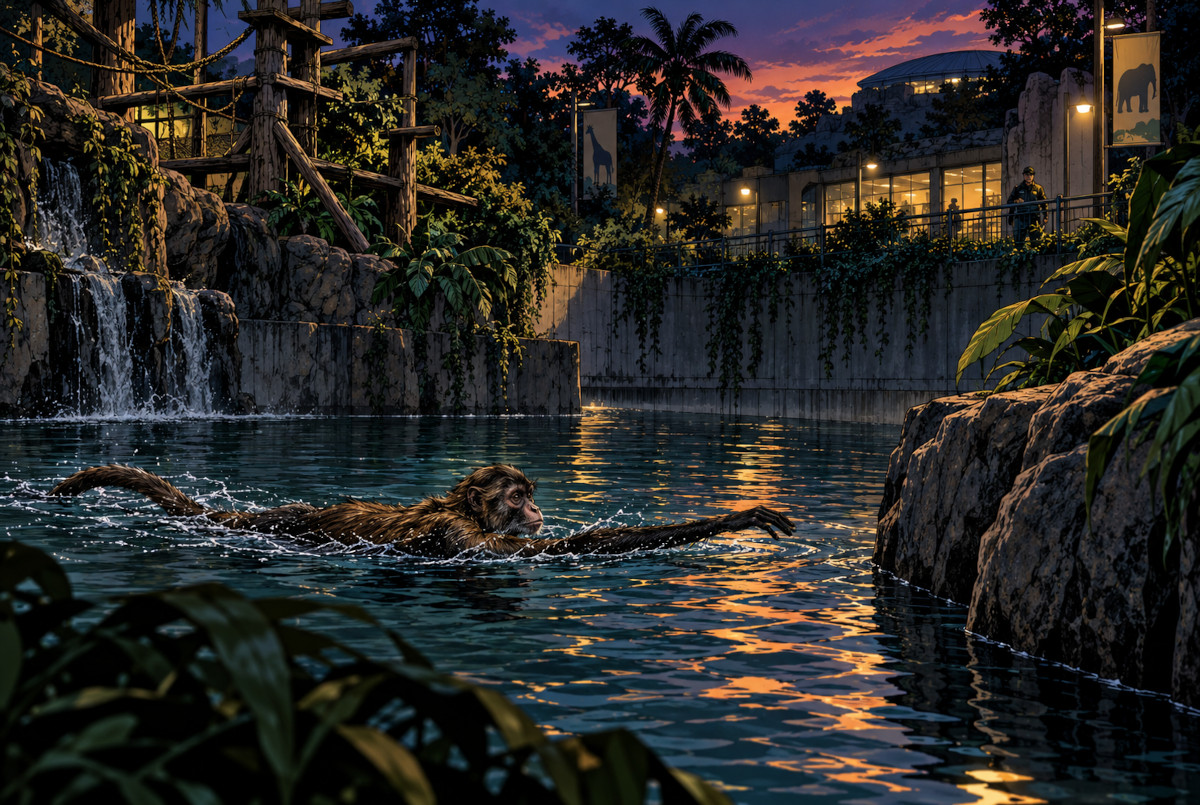 AI-generated illustration. It visualizes the unexpected swimming behavior and does not depict Paco, the actual enclosure or a real photograph of the incident.
September 17: This Time, Humans Left the Exit
Then came September 17, 2026, at around 4:55 p.m.
Two chimpanzees—44-year-old male “Xiao-Qiang” and 11-year-old “Wa-Zhi”—left their activity area in the zoo’s African Animal Area.
The following morning, Taipei Zoo explained what had gone wrong.
A door between the outdoor enclosure and a keeper passage had two locking mechanisms. Staff had secured one of them but failed to engage the main door bolt. The chimpanzees were therefore able to force the door open and enter the service corridor.
Farther ahead was another door used by outside maintenance workers because construction work was underway. That door had been closed, but it had not been locked. The chimpanzees got through that barrier as well.
This time there was little ambiguity about the cause. The zoo classified the incident as human error and said it would review its management procedures, staff training and inspection practices.
Once outside, the two chimpanzees behaved very differently.
Xiao-Qiang stayed near the chimpanzee facilities and moved toward the area occupied by a female chimpanzee group, eventually remaining on a roof. Wa-Zhi traveled farther, climbing onto a feeding structure in the giraffe area before moving toward the African lion enclosure and remaining in a tree.
Nearly 50 staff members were deployed in two teams. Wa-Zhi even pulled out the first tranquilizer dart fired at him; a second dart was needed before he was successfully sedated. Both chimpanzees were taken to the animal medical center and later showed no obvious abnormalities in their examinations.
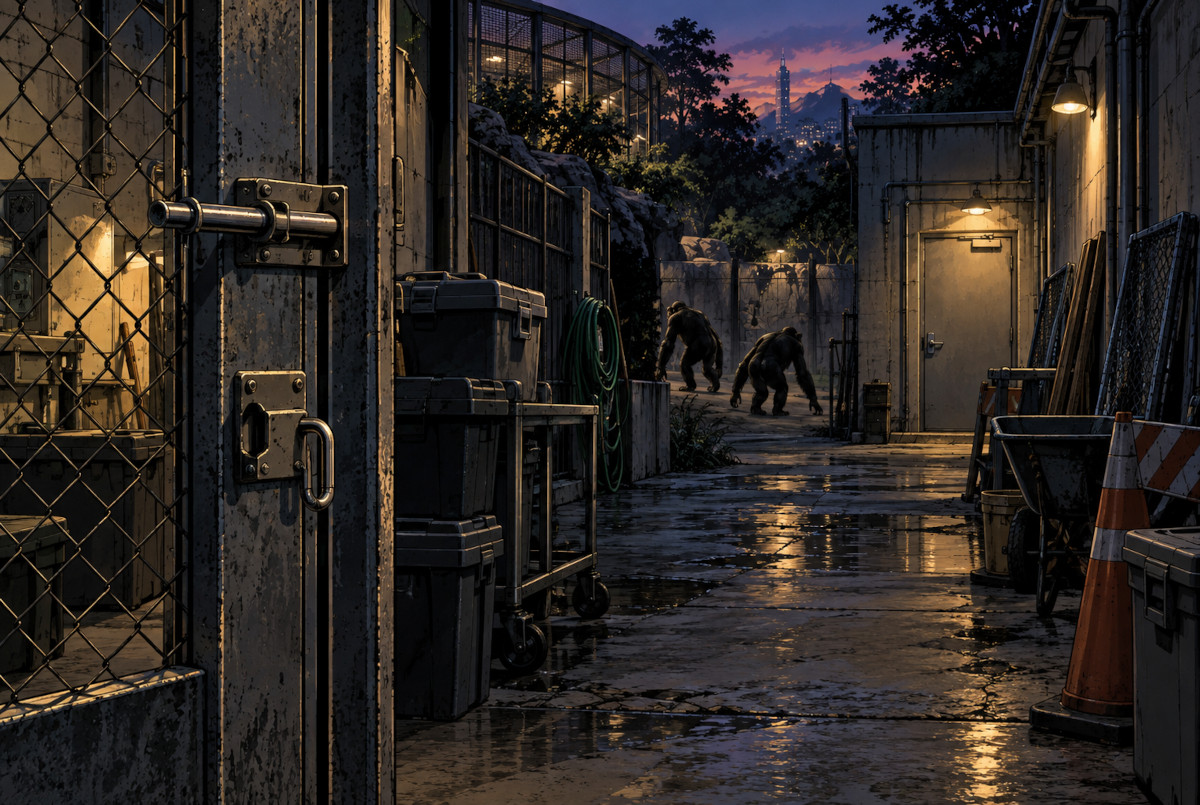 AI-generated illustration. It explains the two-stage locking failure and does not reproduce the real facility, staff members, chimpanzees or news photographs.
These Were Not Three Versions of the Same Escape
Placed side by side, the three major incidents do not point to one repeating mechanical defect.
In May, vegetation intended to create a more natural habitat may have accidentally provided a route out. In July, an animal behaved in a way that did not fit its previously observed pattern. In September, the containment system was undermined by incomplete locking procedures.
Those are three very different problems.
Modern zoos are not supposed to function like rows of old-fashioned iron cages. Trees, water, climbing structures and spaces for exploration are important parts of environmental enrichment and animal welfare.
But Taipei Zoo itself has acknowledged the trade-off. In 2023, a zoo spokesperson said that more open environments designed with animal welfare in mind also create the risk that animals may exploit blind spots humans did not anticipate.
There was already a clear example. In 2017, a female chimpanzee named Sally climbed out of her enclosure using a low-hanging branch. She later returned to the enclosure on her own, and the zoo carried out a new safety inspection.
The closer an enclosure gets to a natural environment, the less likely animals are to see its features the way humans do. A tree may look like landscaping to us and like a route to somewhere else to an animal. Water may look like a boundary—until it does not.
The September incident belongs in a different category. That was not an unpredictable consequence of naturalistic enclosure design. The zoo itself acknowledged that the doors were not properly secured.
A tamandua and a fallen tree, a spider monkey crossing the water, and finally a door humans failed to lock. The most interesting part of Taipei Zoo’s 2026 escape sequence is not that the animals were “too clever.” It is how many different human assumptions turned out to have limits.
Editor’s Note
What catches my attention here is that this was not the same mistake happening three times. There was no single broken fence that everybody somehow forgot to repair. One route involved a banana tree, another involved water, and the last one involved a door.
That is what makes the story more interesting than a simple collection of zoo escape headlines. Humans design an enclosure based on ideas such as “this animal probably will not cross here” or “this should be enough to keep that area separate.” The animals, of course, have never read the design manual.
A tree is something to climb. Water may be something to avoid—until there is a reason not to avoid it. And an unlocked door is simply an unlocked door.
The September case is the one I would separate from the others. A chimpanzee pushing on a door is not the real problem. Making sure that door is properly secured is a human job.
References
- Taipei Zoo, press release on southern tamandua “Hei Niu” and the banana-tree escape route (May 20, 2026)
- Taipei Zoo, press release announcing that southern tamandua “Hei Niu” had been found (May 25, 2026)
- Central News Agency, report on brown spider monkey Paco swimming out of the enclosure (July 4, 2026)
- Taipei Zoo, 2019 feature on the behavior of its male brown spider monkey group (July 19, 2019)
- Central News Agency, initial report on two chimpanzees escaping at Taipei Zoo (September 17, 2026)
- Central News Agency, follow-up report on the improperly secured doors and Taipei Zoo’s finding of human error (September 18, 2026)
- Taipei Zoo, press release on chimpanzee “Sally” leaving her enclosure via a low-hanging branch (September 10, 2017)
- Central News Agency, report on Taipei Zoo’s animal-escape prevention measures and emergency drills (March 29, 2023)