
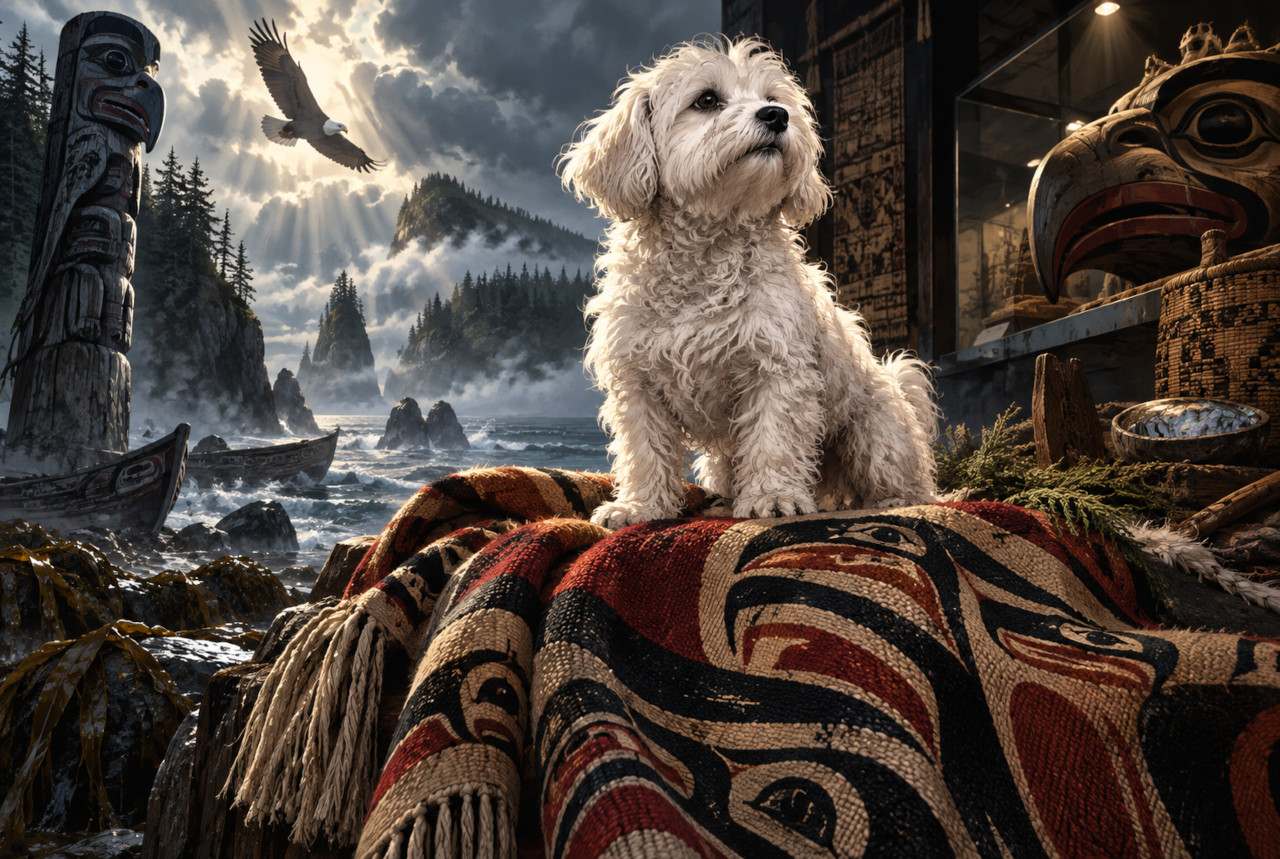
On September 8, 2026, the University of British Columbia announced that the only known surviving pelt of the extinct Coast Salish woolly dog would be placed on loan at UBC’s Museum of Anthropology. At first glance, it sounds like a small museum story: an unusual animal specimen returning to the region it came from after more than a century.
But the real story is stranger—and much bigger. This was not simply a fluffy dog that happened to shed useful hair. Coast Salish and Makah communities along the Pacific Northwest deliberately bred, managed, and sheared these dogs for fiber that could be spun and woven into blankets, robes, and clothing. In other words, the dog was part of a textile system. A living production system maintained for thousands of years began to decline rapidly during the 19th century.
The only known pelt has come back close to home
The pelt now on display comes from a dog named Mutton. In the mid-19th century, Mutton belonged to naturalist George Gibbs, who was involved in survey work along what became the Canada–U.S. border. The dog’s exact path into Gibbs’s possession remains unclear, but the pelt was sent to the Smithsonian Institution in 1859 and remained there for generations.
According to UBC, the pelt is on loan to the Museum of Anthropology from September 2026 through August 2027, following requests from members of Stó:lō communities. That distinction matters: this is not a permanent repatriation. It is more accurate to say that the pelt has returned close to its region of origin than to say it has permanently “come home.”
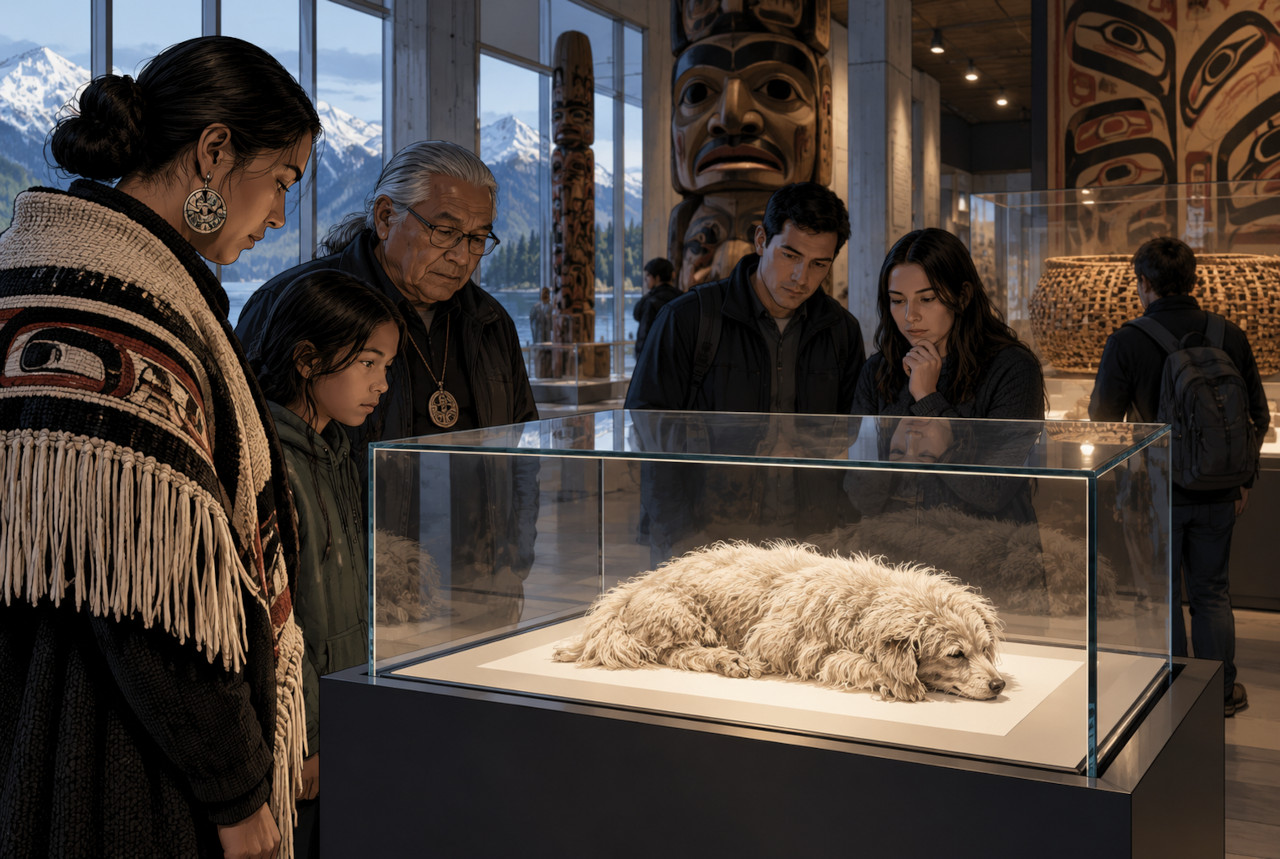 AI-generated interpretive illustration. It does not reproduce Mutton’s actual pelt, the real UBC exhibit, or any specific person.
The pelt matters not because it is visually spectacular, but because of what it confirms. Knowledge of woolly dogs survived through oral history and weaving traditions long after the dogs themselves disappeared. The specimen adds a physical layer to knowledge that communities had never entirely lost. In that sense, it is less a curiosity in a display case than evidence of a vanished technology of everyday life.
They did not just shear dogs—they built a textile system around them
In 1792, British explorer George Vancouver recorded seeing dogs in the region that had been shorn very close to the skin, comparing the practice to sheep shearing in England. That makes the practice more than a later legend. Modern scientific analysis has also confirmed that dog hair was actually used in historic Coast Salish blankets.
The key point is that this was not casual use of whatever fur happened to be available. Woolly dogs were managed to preserve desirable coat traits and were sometimes kept apart from other dogs, including in enclosures or on islands. Their fiber could be combined with materials such as mountain goat wool, then spun and woven into textiles. Weaving knowledge, labor, and the wealth associated with finished textiles were also closely tied to women in many communities.
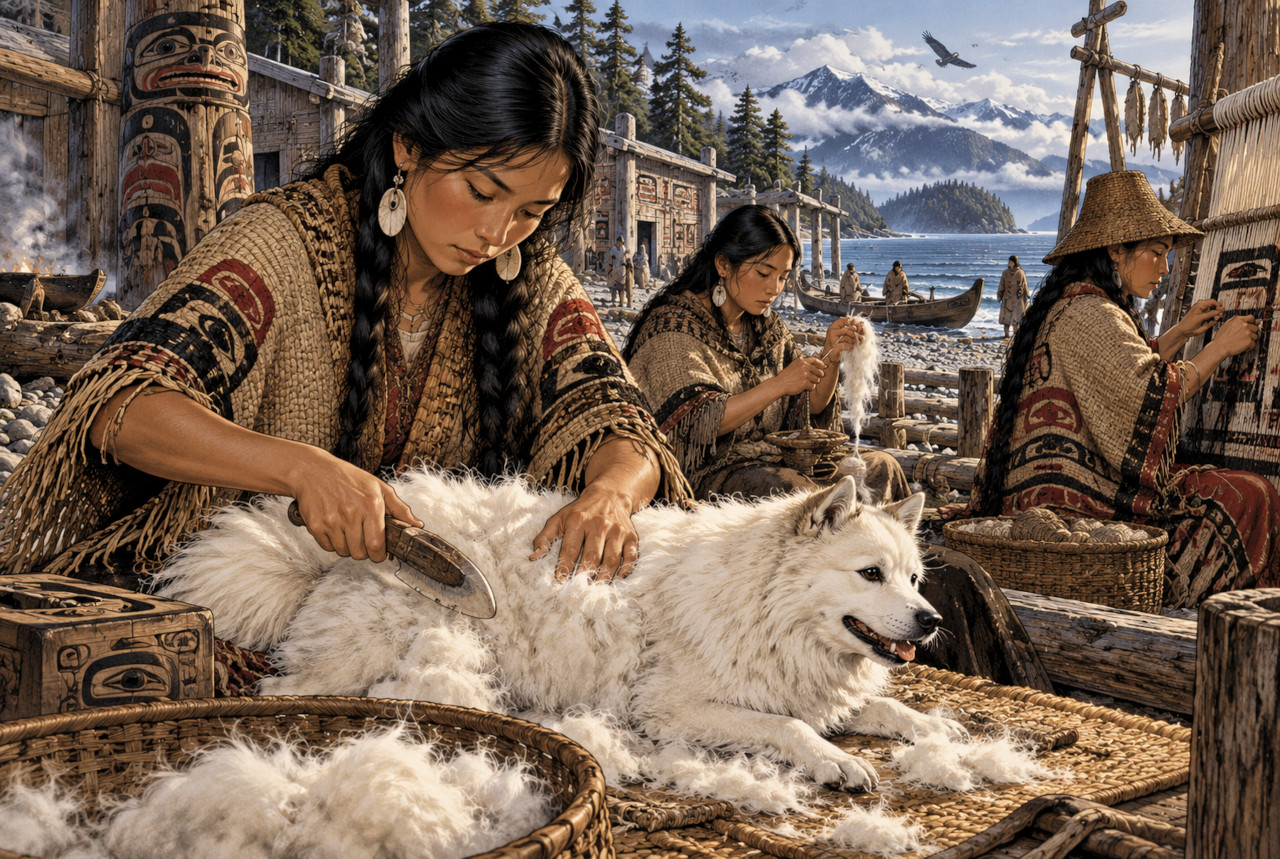 AI-generated historical interpretation. It does not reconstruct one specific village, date, person, garment, building, or artifact.
This is what makes the woolly dog more interesting than a simple story about an unusual breed. Breeding, population management, fiber harvesting, spinning, and weaving were all connected parts of one living textile system. Long before domestic sheep became common in the region, communities had already developed a sophisticated way to produce fiber from dogs. That complicates any simplistic image of Coast Salish societies as merely “hunter-gatherer” cultures.
Why did the woolly dog disappear? Cheap blankets are only part of the story
One common explanation is economic. During the 19th century, machine-made yarn and imported wool blankets became increasingly available. If factory-made textiles could be obtained more cheaply, maintaining a carefully controlled population of wool-producing dogs became less practical. That almost certainly mattered.
But genomic research published in 2023 points to a more complicated transition. Mutton’s DNA was estimated to be about 84 percent derived from pre-colonial North American dog ancestry, while roughly 16 percent reflected European dog ancestry. By the mid-19th century, the old lineage still remained strongly present—but admixture had already begun.
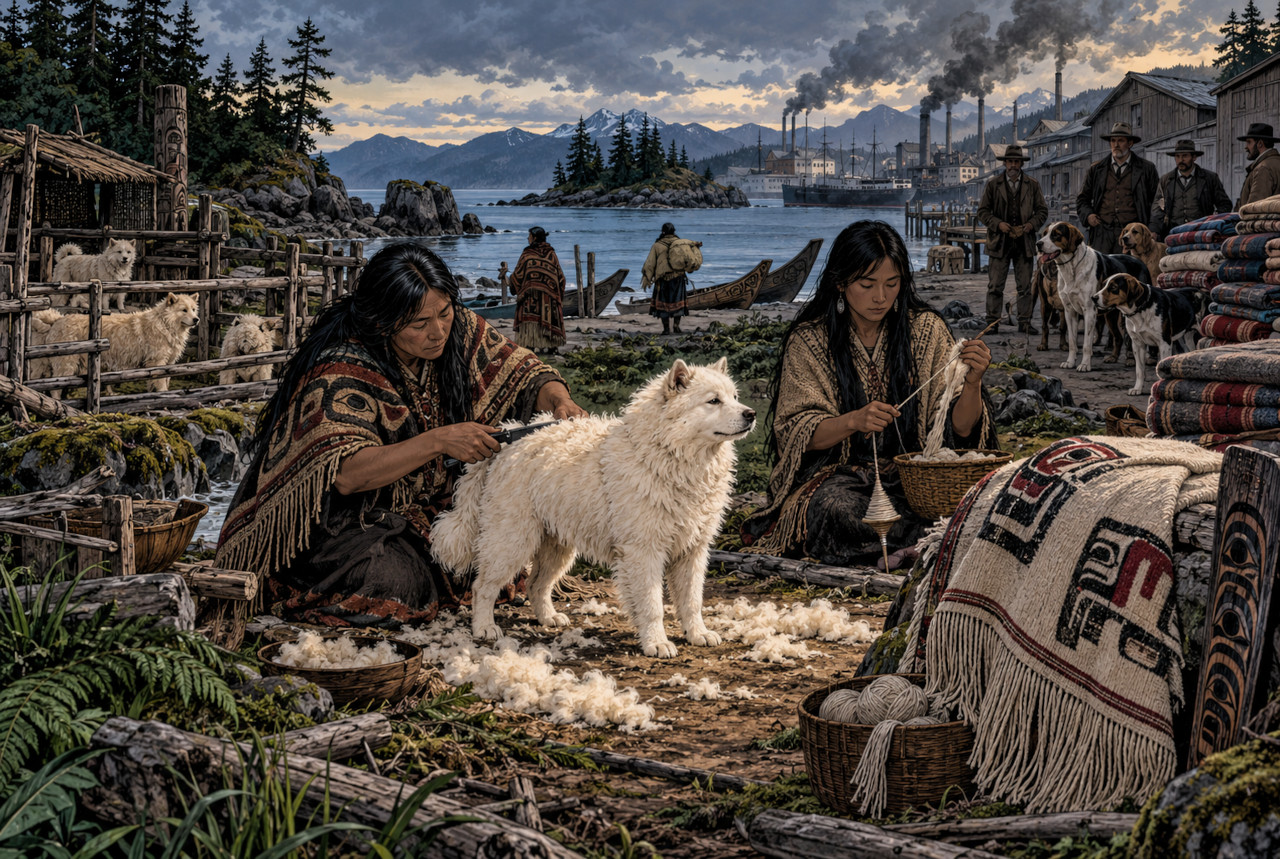 AI-generated conceptual illustration combining several historical pressures into one scene. It does not depict a single real event or location.
So the disappearance of the woolly dog is difficult to reduce to a neat story of “cheap blankets won.” Colonial expansion disrupted the social conditions that had supported controlled breeding, cultural transmission, and textile production, while introduced dogs increased the risk of genetic mixing. Epidemics, changes in land use and daily life, restrictions on Indigenous cultural practices, imported goods, and interbreeding all formed part of a larger shift. A system that had been maintained for thousands of years declined rapidly during the 19th century.
Seen from Japan, the strange part is not the dog—it is the system that vanished
From a Japanese perspective, this story has an oddly familiar edge. Japan has its own history of traditional crafts disappearing when cheaper industrial products replace local methods. But the woolly dog case goes a step further. Here, the raw material itself was alive—and its lineage had to be deliberately maintained.
In other words, this was not simply a workshop closing down. It was closer to losing the workshop, the craft system, and the biological source of the material at the same time. That is what makes the story feel unusually complete, and unusually unsettling.
The return of Mutton’s pelt is therefore about more than an extinct dog. It is also about reconstructing a knowledge system that was nearly erased. The evidence comes from more than one direction: Indigenous oral histories and weaving traditions on one side, genomic and material analysis on the other. The two do not cancel each other out. Together, they reveal the larger structure behind the story.
Editor’s Note
This one sticks with me. “People once sheared dogs for wool” is strange enough to get my attention, but that is not really the interesting part. The interesting part is that people built an entire production system around a living animal and kept it going for thousands of years. Breeding, fiber, weaving, knowledge, labor—everything was connected.
Then the outside world changed. Industrial goods arrived, colonial pressure reshaped local society, and a carefully maintained system became harder and harder to sustain. Seen from Japan, that feels strangely familiar. We have plenty of stories about local techniques losing out to cheaper mass production. But here, the “material” itself was a dog population. When the system collapsed, the animal lineage disappeared with it. That is the part that makes this more than a quirky historical footnote. It is a story about what modernization can erase before anyone realizes the whole structure was there.
References
- UBC News — “Only known woolly dog pelt returns close to home and for the first time to Canada”
- Science — “The history of Coast Salish ‘woolly dogs’ revealed by ancient genomics and Indigenous Knowledge”
- Smithsonian Research Online — Open-access version of the Science study
- Smithsonian National Museum of the American Indian Magazine — “A Woolly Tale: Salish Weavers Once Raised a Now-Extinct Dog for Its Hair”
- HistoryLink — “Coast Salish Woolly Dogs”
- Antiquity — “Proteomics and Coast Salish blankets: a tale of shaggy dogs?”