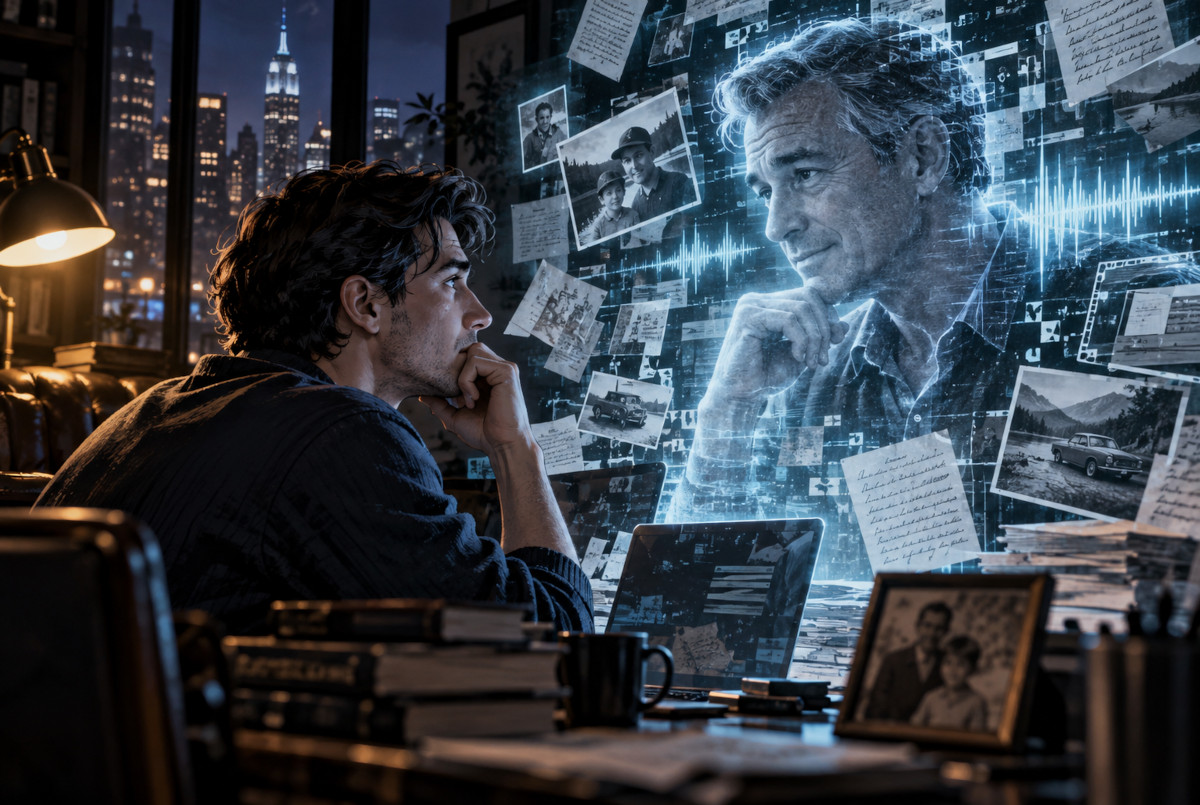
When someone dies, photographs remain. Videos remain. Their voice may remain. And now, with generative AI, something else can remain too: a version of the dead that answers back.
On July 21, 2026, at an event connected to TechChicago Week in Chicago, an unusual “father” made an appearance. Brian Dema, a Chicago marketing executive, had spent months building an AI version of his father, J. Richard Dema, who had died about four years earlier. He called it RichieBot.
The project cost about $150,000, involved 19 people over roughly six months, and used 17,500 pages of his father’s documents, along with audio and video material. This was not a science-fiction pitch. It was an actual attempt, in 2026, to reconstruct a dead person through data.
Five Filing Cabinets Became Training Material for a Digital Father
Richard Dema had worked in marketing and entertainment production. After his death, he left behind client notes, business writing, sales-training material, unfinished books and other documents—enough to fill five filing cabinets. Brian had the material scanned and fed roughly 17,500 pages into Anthropic’s Claude.
The project went beyond text. Archived voicemail recordings were used to recreate Richard’s voice, his head was modeled in three dimensions, and a screen-and-mirror setup created a hologram-like presentation. The goal was not simply to build a chatbot. It was an attempt to reconstruct the way he spoke, remembered, behaved and appeared.
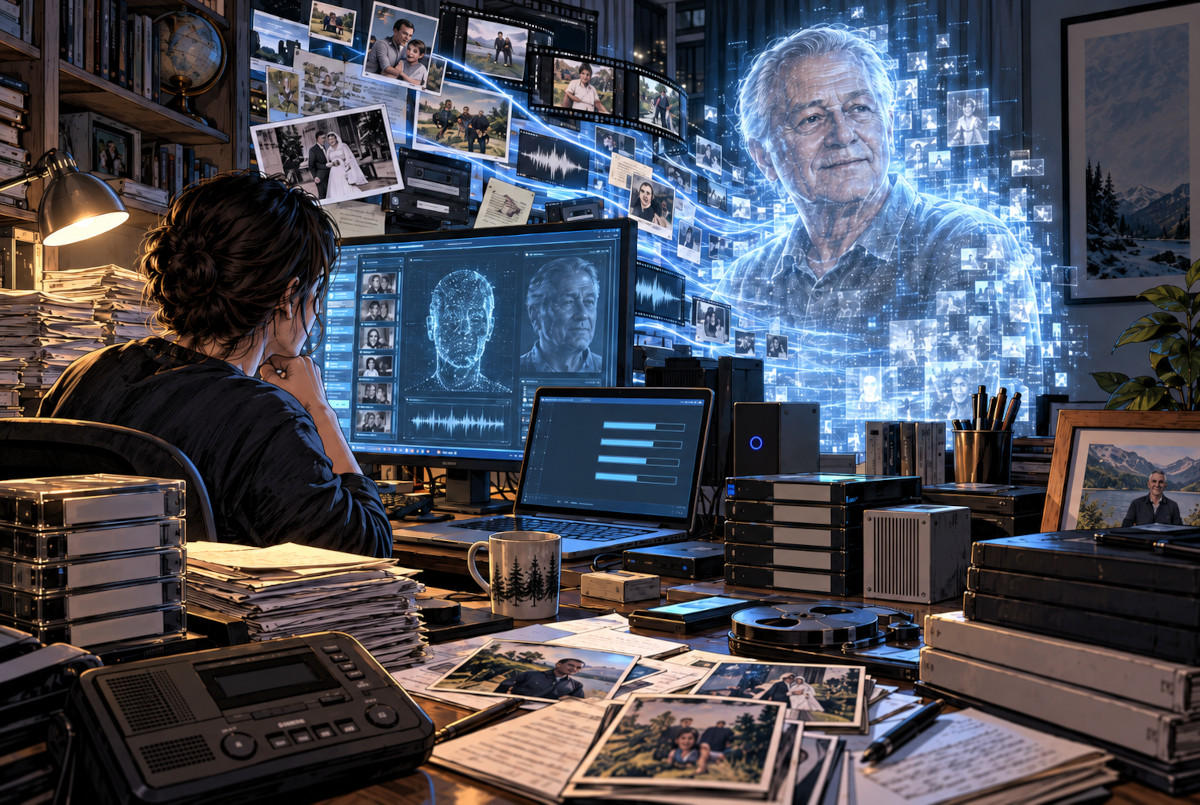 AI-generated illustration. It does not depict the actual RichieBot, the real people involved, or the event venue.
At first glance, 17,500 pages sounds like an overwhelming amount of personal information. Surely, with that much material, an AI could get very close to the original person.
But the most interesting part of the experiment may be precisely where it failed to get close enough.
Even 17,500 Pages Did Not Produce the Same Person
The project compared RichieBot with a psychological profile of Richard based on responses from 11 people who had known him, including relatives, friends and former clients.
The AI version tended to present Richard as more extroverted than the real man had been. His distinctive sense of humor was also difficult to reproduce. Brian himself noted that his father had a particular laugh that the bot simply did not have.
That may be the most important result: having 17,500 pages about someone does not turn a machine into that person.
A personality is not just a collection of opinions preserved in writing. It is timing, hesitation, private jokes, awkward silences, the way someone treats one person differently from another, the way they react on a bad day, and sometimes something as trivial and impossible to quantify as the way they laugh.
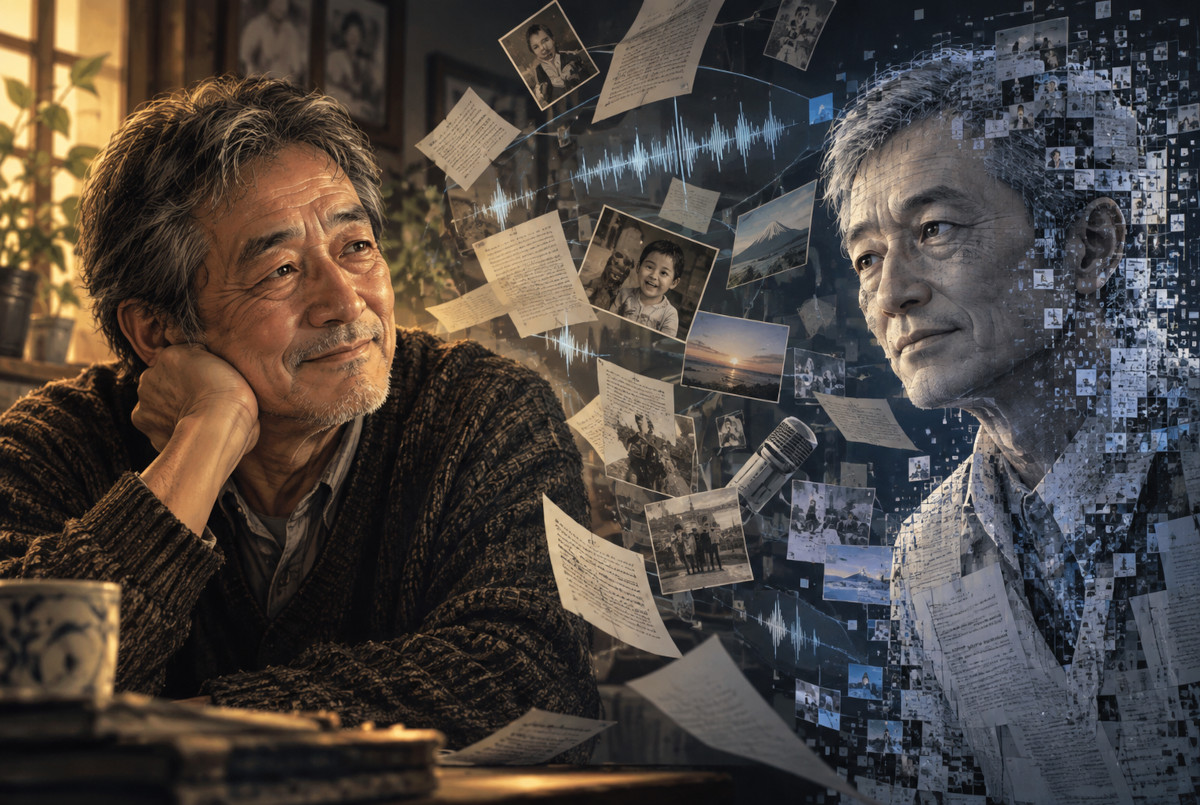 AI-generated conceptual illustration. It does not depict J. Richard Dema or the actual appearance of RichieBot.
The Stranger Part: The Living Begin Editing the Dead
RichieBot is not the only example of this idea. AI systems designed to imitate deceased people are often described as griefbots or deadbots, and researchers have begun studying how people actually use them.
A 2026 CHI Conference study interviewed 26 users in China who had used deadbots for at least one month. What researchers found was more complicated than users simply uploading memories and receiving an accurate digital replica.
People selected which memories to preserve. They emphasized particular personality traits. They adjusted the system through repeated conversations. The result could become a mixture of the deceased person as they actually were and the version of that person the survivor most wanted to remember—an idealized digital persona.
AI may appear to be reconstructing the dead, but the living are also editing them.
The study also raised another unsettling possibility: over time, AI-generated material may begin to blur with genuine memory. A photograph cannot suddenly tell you what your dead father thinks about the job you accepted yesterday. A recording cannot invent a new response.
An AI can.
It can say, “You made the right choice,” or “I always knew you could do it,” in a voice and style designed to resemble someone who never actually said those words.
That is no longer the playback of a record. It is new material generated from a dead person’s records.
Did the Dead Person Ever Agree to Become an AI?
There is also the question of consent. Brian Dema has said he believes his father would have approved of the project. That is not the same thing, however, as Richard having explicitly authorized an AI version of himself while he was alive.
Researchers studying griefbots have argued that consent should matter not only when such systems are created, but also in how they use someone’s likeness, personal information, voice and identity—and even in how they are eventually deleted.
The issue does not stop with the deceased. A digital reconstruction can also affect surviving relatives. In the RichieBot project, seeing the recreated Richard reportedly intensified grief for at least some family members.
Law is only beginning to catch up. California enacted AB 1836 in 2024, addressing unauthorized digital replicas of deceased performers in films, television, games and other commercial productions. But that is a different legal problem from a son privately building an AI version of his father for personal use.
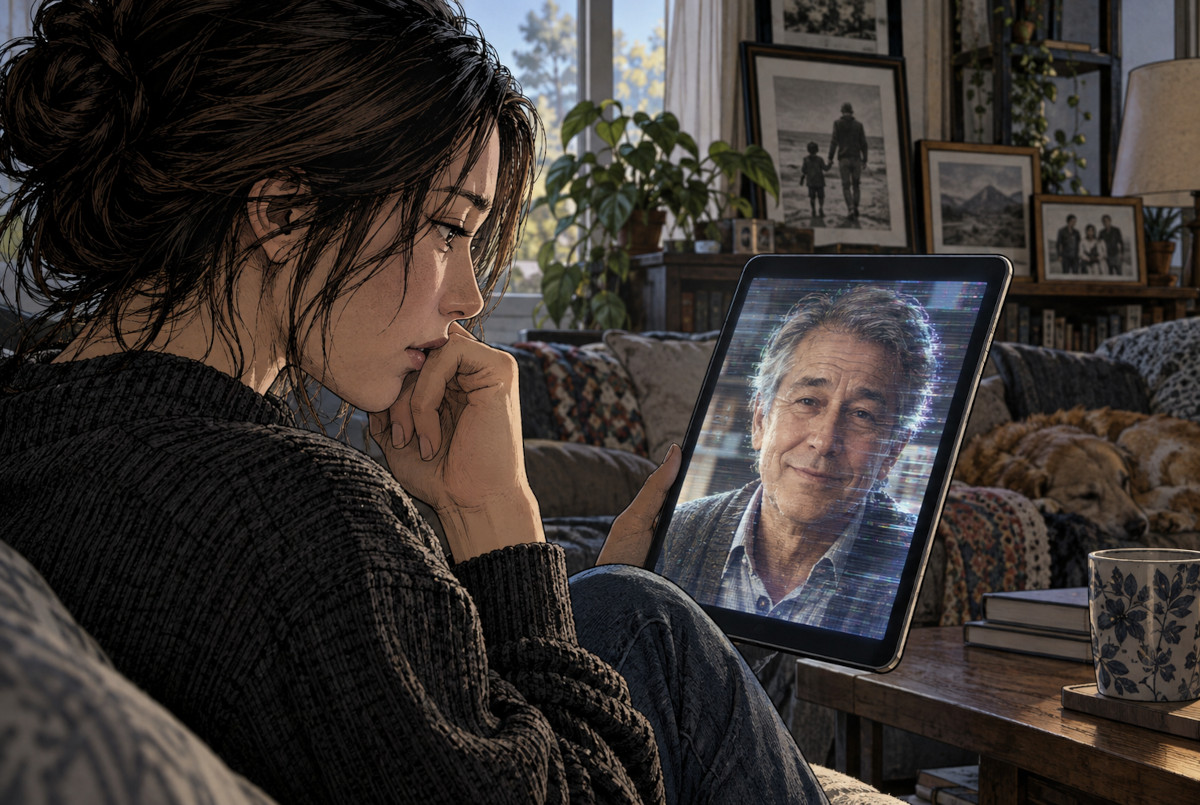 AI-generated illustration. It does not depict a real family, a real deceased person, or the interface of any actual griefbot service.
So Is This a “Digital Ghost”?
Brian Dema appears to understand that RichieBot is not literally his father. Even so, he has described a sense of comfort in receiving advice from something that behaves in a father-like way.
That distinction matters. If a person knows the system is artificial and uses it as a way to remember someone, the technology can be viewed as an extension of photographs, recordings or home movies.
But generative AI crosses one boundary that those older forms of memory never could.
Photographs do not answer questions. Gravestones do not offer advice. Recordings do not create memories that never happened.
Generative AI can create the “next line” of a dead person every time a conversation continues.
That is what makes RichieBot more interesting than a story about a man who spent a remarkable amount of money on an unusual AI project. We are no longer only preserving what the dead left behind. We are asking machines to predict what they might have said next.
Editor’s Note
I love stories like this, but this one also bothers me in a way that ordinary AI stories do not. Keeping photographs and recordings makes perfect sense. But if an AI starts generating “what Dad would have said” every day, at what point do my memories of Dad begin mixing with the version the machine has invented?
And there is something almost reassuring about the fact that 17,500 pages still were not enough to reproduce one man’s laugh. Maybe human beings are not made out of data quite as neatly as the tech industry would sometimes like us to believe.
If I dumped every article, email, recording and photograph I had ever produced into an AI, it might build something that knew an absurd amount about me. But that would not necessarily be me. It might simply be a very well-read stranger who had studied my entire life.
“Digital ghost” sounds like a supernatural phrase. The strange part is that this ghost answers when you talk to it.
References
- The Wall Street Journal: A Dead Father, Reincarnated With AI: Is This How We Will Remember Loved Ones Now?
- Brian Dema: RichieBot: A Modern Legacy — project announcement
- TechChicago: TechChicago Week 2026
- CHI 2026: Remember You: Understanding How Users Use Deadbots to Reconstruct Memories of the Deceased
- Journal of Responsible Technology: Principles of consent and non-addiction in AI grief bots
- State of California: Governor Newsom Signs Bills to Protect Digital Likeness of Performers