
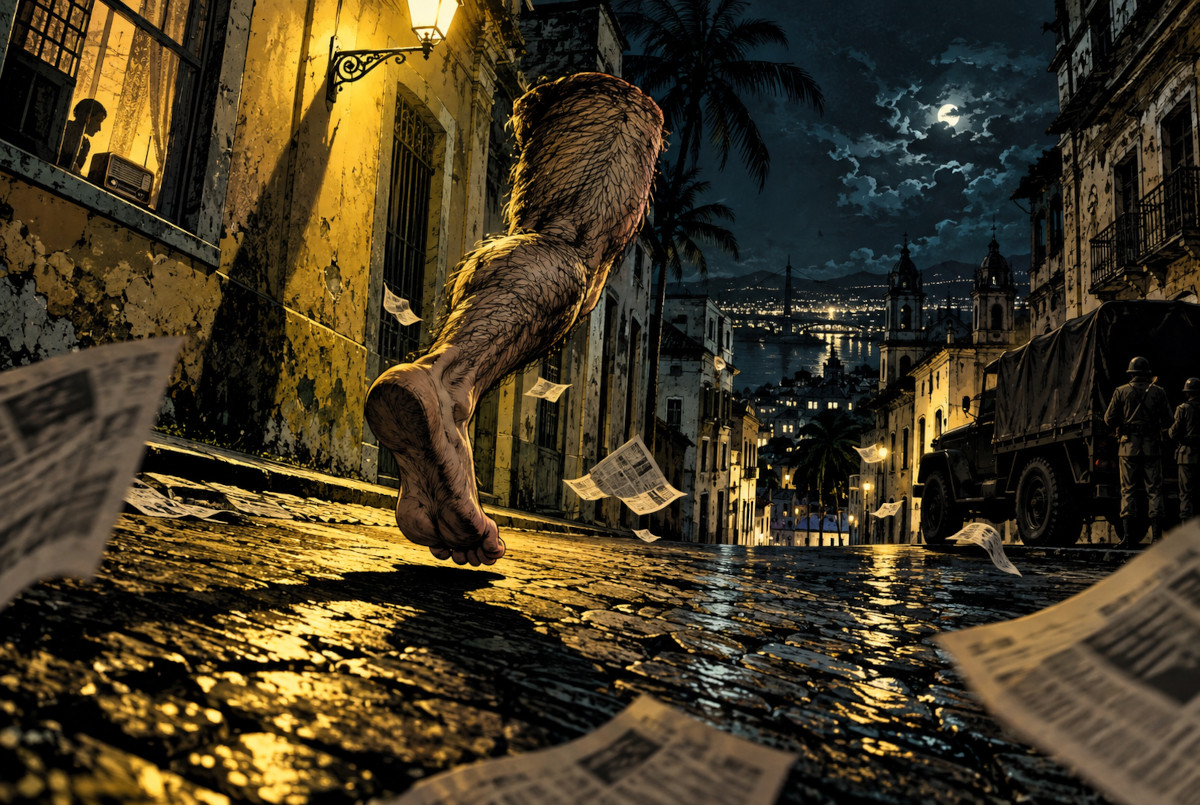
Brazil has an urban legend about a hairy human leg with no torso, no head and apparently no need for the rest of the body. It roams the streets at night, trips people, kicks them and disappears. Its name is Perna Cabeluda — literally, the “Hairy Leg.”
That description alone is strange enough. But the most interesting part of the story is not the monster itself. It is how the monster seems to have been built, piece by piece, in public.
The earliest documented newspaper report dates to December 10, 1975, in Tiúma, a district of São Lourenço da Mata near Recife, the capital of Pernambuco in northeastern Brazil. When Brazilian media revisited the archives in 2025 and 2026, an apparently ridiculous ghost story opened into something much larger: a story about newspapers, radio, popular culture and censorship.
At first, it was not a monster running through the streets
This is the first surprise. Looking only at the legend as it is remembered today, one might assume Perna Cabeluda always existed as a detached leg attacking people at night.
It did not.
On December 10, 1975, the Diario de Pernambuco published a report titled “Perna fantasma surge em moradia em Tiúma” — roughly, “Ghost Leg Appears in a Home in Tiúma.” The central phenomenon was not a leg sprinting down a dark street. It was a leg-like image reportedly appearing on the walls of a house.
The story attracted neighbors and curious visitors. A priest, a Protestant pastor and Spiritist practitioners also entered the account. At this early stage, it looked less like a fully formed urban monster and more like a bizarre haunting that had turned one ordinary house into a local attraction.
In other words, the Hairy Leg did not arrive fully assembled. There was first an apparition on a wall. A follow-up appeared on December 11, and the description of a hairy leg soon became established. Over time, new characteristics accumulated: it kicked people, knocked them down, chased them and appeared on the streets at night.
What makes the case unusual is that parts of this evolution can still be followed through the newspaper record. We are not merely looking at a finished legend. We can see something close to the production process of a legend.
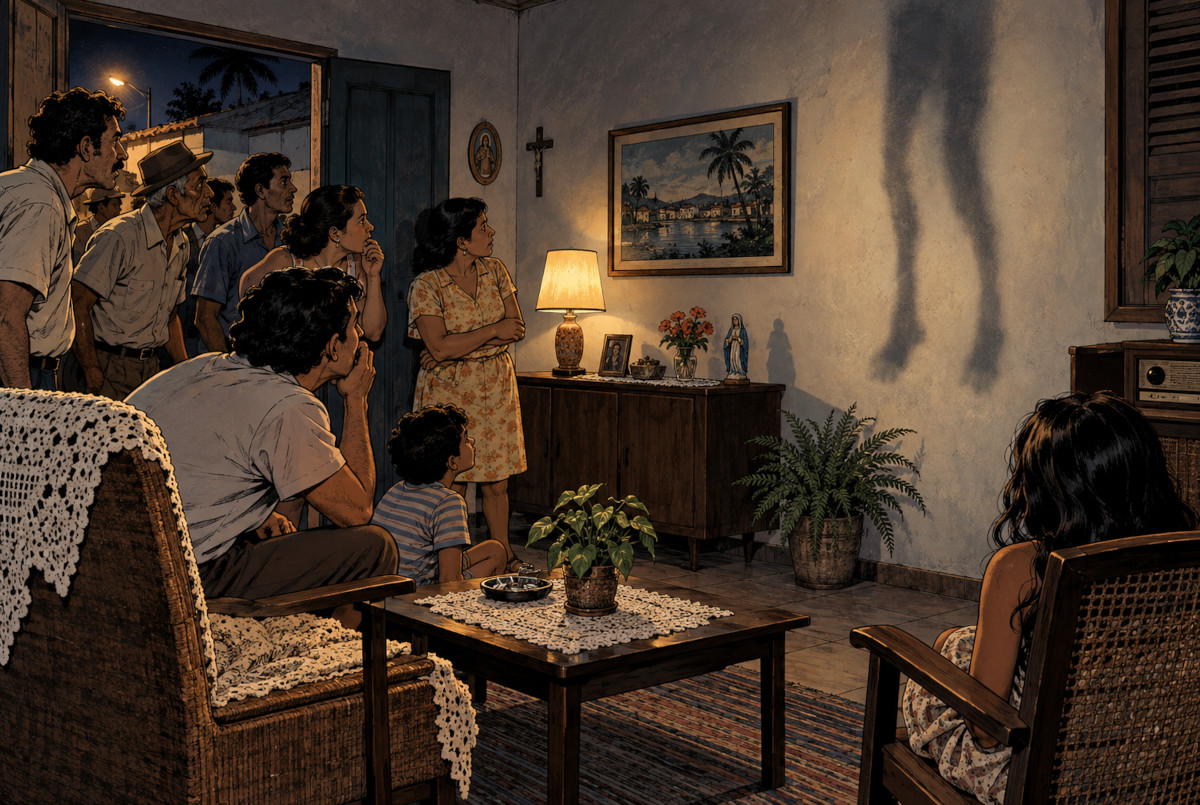
AI-generated explanatory illustration. It does not depict the actual people or location involved in the reports.
Why a leg?
There is no reliable primary source that gives us a neat answer. But the earliest accounts are useful precisely because they are incomplete. They describe images, shadows and partial forms rather than a carefully designed supernatural creature. The monster may have become memorable because it was incomplete. A body part with no body is arguably stranger than another ordinary ghost.
Newspapers and radio did not invent it alone—but they helped it grow
The Tiúma story did not remain a neighborhood curiosity. Newspapers picked it up. Radio amplified it. Then it moved into cordel literature, the popular tradition of inexpensive verse pamphlets strongly associated with northeastern Brazil.
By late January 1976, newspaper reports were already referring to a cordel work about the Hairy Leg. In February, the legend inspired more verse, music and even carnival culture. In modern internet language, a local ghost story had effectively become a meme within a matter of months — without social media, smartphones or viral video.
There is, however, a problem with giving anyone sole credit for creating Perna Cabeluda.
Journalist and novelist Raimundo Carrero later described stories circulating around the newsroom and his own role in developing the legend in print. Radio journalist Jota Ferreira also claimed that a story told on air helped launch it. Academic research published in 2023 treats the origins as contested rather than assigning one definitive creator.
So it is safer to say that newspapers, radio, word of mouth and popular culture collectively enlarged the creature rather than claiming that one journalist simply invented it from nothing.
And that is where the story becomes more interesting than the monster.
Someone reports seeing something. Someone writes about it. Someone else repeats it on the radio. A poet turns it into verse. Another version adds a new detail. The public repeats the improved version. Eventually, a strange image on a wall has become a detached hairy leg roaming Recife and kicking people.
The creature did not simply walk through the city. It was cultivated in newsprint, radio broadcasts and popular culture.
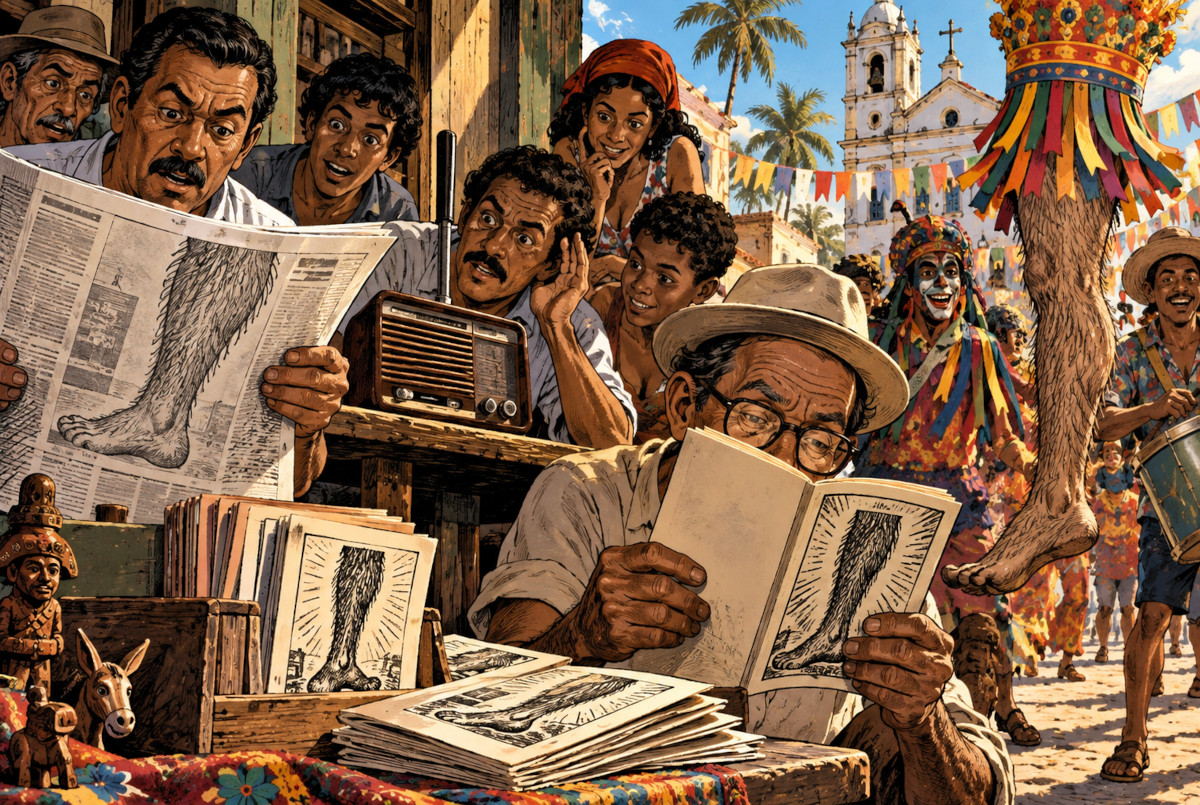
AI-generated conceptual illustration of how the urban legend spread. It does not reproduce any actual newspaper page, broadcast or historical event.
Why 1975 matters
The year matters because Brazil was still under military dictatorship.
Press censorship took several forms during the period. Decree-Law No. 1,077 of January 26, 1970 expanded prior censorship over publications and other forms of cultural expression. Brazil’s National Archives, through the Memórias Reveladas project, documents both prior censorship and the pressure that encouraged self-censorship in Brazilian media.
This does not automatically mean that Perna Cabeluda was “invented by the dictatorship.” The evidence is more complicated than that.
In a 2026 interview with the Diario de Pernambuco, Carrero recalled that criticism of the regime was restricted and that reporting on violence against women was also constrained in the newsroom. According to his recollection, a censor even circulated among journalists asking what they were writing.
That claim needs to be handled carefully. The broader system of censorship is well documented, but the specific claim that reporting on violence against women was universally prohibited rests largely on Carrero’s later testimony. The government material reviewed for this article does not establish a blanket nationwide order phrased in those terms.
Still, his recollection opens a disturbing possibility.
When real violence was difficult to describe openly, an absurd supernatural story may have provided another language for discussing it.
Carrero later recalled cases in which women who could not openly say they had been beaten by their husbands instead said they had been attacked by the Hairy Leg. If that memory reflects at least part of what was happening, Perna Cabeluda was not merely nonsense circulating in the press. It also became a grotesque mask placed over very real violence.
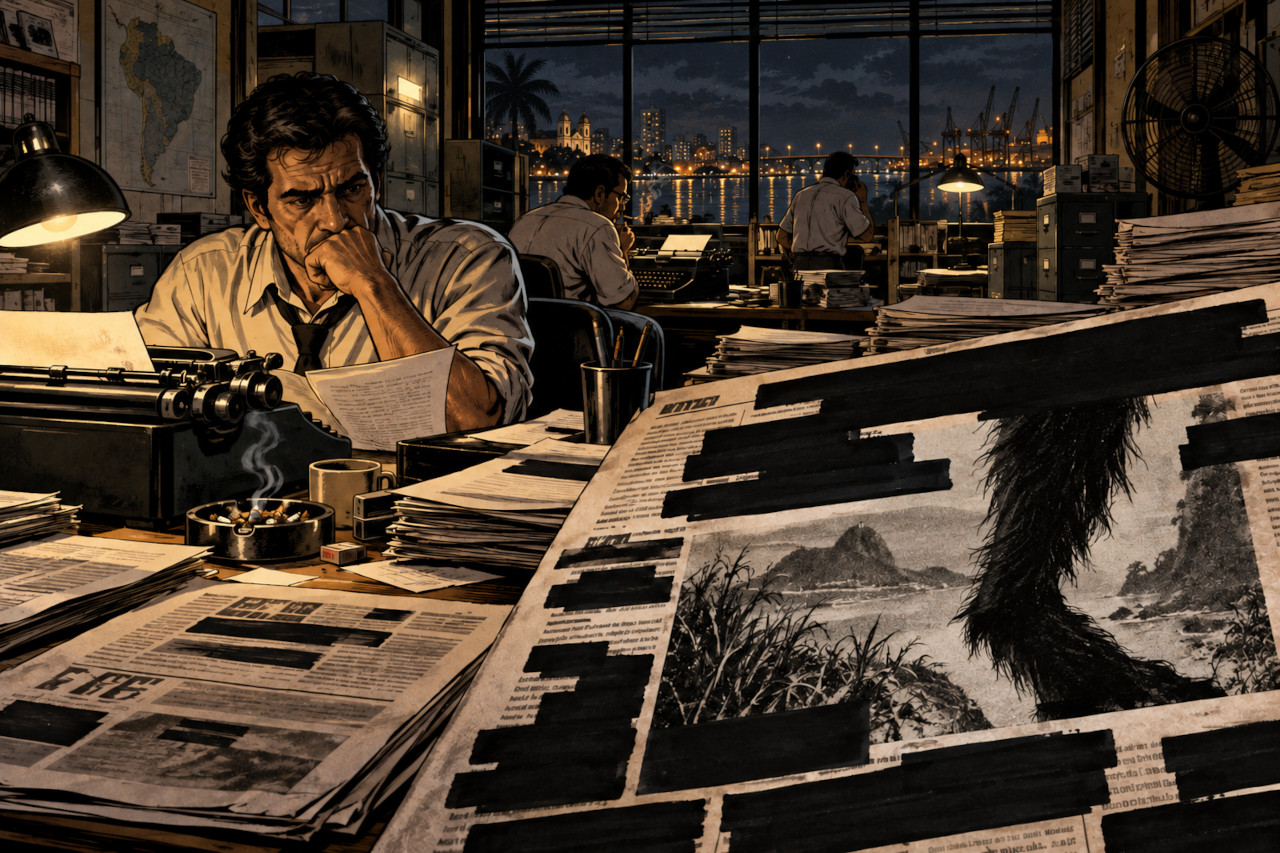
AI-generated conceptual illustration of censorship and journalism during the period. It does not recreate an actual newsroom, journalist, newspaper page or historical photograph.
The monster is strange. Its production line is stranger.
This is why Perna Cabeluda works so well as more than a piece of paranormal trivia.
The entrance to the story is wonderfully ridiculous: Why is it only a leg?
But follow that question far enough and the subject changes. A ghost story becomes a case study in newspapers, radio, popular literature, rumor, censorship and collective memory. The absurdity is still there, but something much less funny is sitting underneath it.
From a Japanese perspective, the story may bring to mind the way modern urban legends can spread through schools, magazines, television and word of mouth. But Perna Cabeluda has an especially useful feature for anyone interested in how folklore forms: parts of its transformation are visible in contemporary newspaper records.
Was the rumor already growing before the media noticed it? Certainly. Did the media then help make the creature larger, stranger and more durable? The surviving record strongly suggests that it did.
Rather than a monster created by a single person, Perna Cabeluda makes more sense as a creature collectively assembled by rumor, journalism and popular culture.
Editor’s Note
I really like stories like this. Not simply because the monster is ridiculous — although a disembodied hairy leg kicking people is difficult to beat in that department.
What catches me is the point where the story changes direction. At first, you think the weird thing is the leg. Then you keep digging and realize that the stranger subject may be the society that manufactured the legend around it.
Seen from Japan, we have no shortage of bizarre urban legends either. But it is unusual to find one where the fingerprints of newspapers and radio are still this visible. A vague apparition on a wall becomes a violent street monster, then a cordel subject, then part of carnival culture.
Maybe that is the real B-side here. The supernatural creature is interesting, but the manufacturing process of the supernatural creature is better. A piece of pulp-grade weirdness turns into media history and social history before you notice what happened. That kind of reversal is exactly why I keep chasing stories like this.
References
- Diario de Pernambuco (January 13, 2026), “Perna Cabeluda driblou a ditadura e colocou violência contra a mulher nas páginas do Diario” — local retrospective on the legend, the newspaper archives and Raimundo Carrero’s recollections.
- Presidency of the Republic of Brazil, Decree-Law No. 1,077 of January 26, 1970 — official legal text concerning censorship of publications and public entertainment.
- Brazilian National Archives (Arquivo Nacional), Memórias Reveladas, “Censura nos meios de comunicação” — overview of censorship in Brazilian media during the dictatorship.
- Brazilian National Archives (Arquivo Nacional), Memórias Reveladas, “Censura Prévia na Ditadura” — documentation of prior censorship and Decree-Law No. 1,077.
- João Paulo Reis Braga and Clóvis Ecco, “A Perna Cabeluda: Violência Sobrenatural e Factual na Cidade do Recife,” PARALELLUS Revista de Estudos de Religião, UNICAP, Vol. 14, No. 35 (2023).
- Observatório da Imprensa (January 28, 2026), “Manchetes, silêncios e versões: a imprensa como personagem em O Agente Secreto” — includes details of the December 10 and 11, 1975 newspaper reports.
- Jornal do Commercio (November 10, 2025), “Perna Cabeluda: O que a lenda de ‘O Agente Secreto’ diz sobre a ditadura” — local reporting on the legend’s origins, competing authorship claims and cultural history.
- Cartas de Cultura, “Perna Cabeluda” — research summary covering newspaper reports, radio accounts, cordel literature and the legend’s spread into carnival culture.