At first glance, this sounds like the kind of story that practically writes its own sensational headline: Buddhist retreats, dozens of human bodies, and a pond containing hundreds of crocodiles.
But the easy version of the story starts to fall apart once the details are checked.
Between November 20 and 26, 2024, Thai authorities investigated three linked Buddhist sites in the central provinces of Kamphaeng Phet and Phichit. Across those sites, a total of 85 human bodies were found.
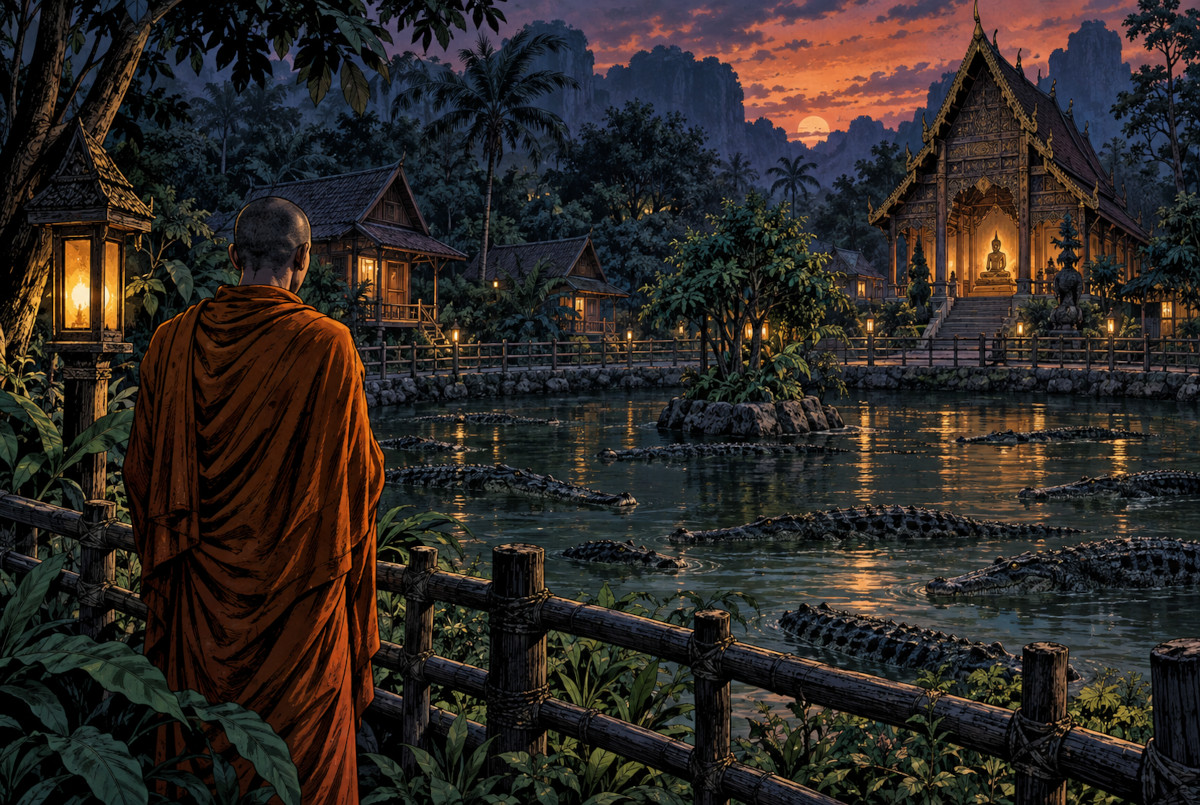
At one of the Phichit sites, where 41 bodies were documented, investigators also found a large enclosure holding more than 600 crocodiles.
That combination sounds deeply unsettling. Yet there is an important complication: Buddhist traditions do include forms of meditation in which practitioners contemplate corpses, bodily decay, mortality, and attachment to the body.
So the real question is not simply, “Why were Buddhists meditating around dead bodies?” The more interesting question is where an established religious practice ends — and where a modern, site-specific system involving dozens of stored bodies begins.
The 85 bodies did not come from a single temple
The numbers need to be separated carefully, because several reports use different totals.
On November 20, 2024, authorities examining a monastic site in Kamphaeng Phet Province found 12 bodies. Thai PBS then reported on November 22 that an inspection at Pa Nakhon Chaibovorn in neighboring Phichit Province had found 41 bodies. AFP later reported the discovery date for those 41 bodies as November 23, so there is a one-day discrepancy between the local and international reporting.
On November 26, another 32 bodies were confirmed at Wat Pa Sriwilai, also in Phichit.
12 + 41 + 32 = 85.
This also explains why some reports refer to “73 bodies.” The two Phichit sites contained 41 and 32 bodies respectively, giving a provincial total of 73.
The 85 figure therefore refers to three linked sites across two provinces, not to 85 bodies discovered inside one temple.
 AI-generated illustration. It does not depict the actual site involved in the investigation.
Corpse contemplation really does exist in Buddhist practice
Thailand is predominantly associated with Theravada Buddhism, and practices involving contemplation of the body and death have long existed within that tradition.
One relevant group of practices is known as asubha meditation, often translated as contemplation of unattractiveness or impurity. Related charnel-ground contemplations also appear in early Buddhist texts.
In the Satipatthana Sutta, a practitioner is instructed to contemplate a corpse in a charnel ground and compare its fate with his or her own body: this body has the same nature and cannot escape the same outcome.
Research published by scholars at Mahachulalongkornrajavidyalaya University in Thailand likewise discusses Asubhakammatthana as a Theravada meditation practice that can use corpses as objects of contemplation, particularly as a way of weakening sensual desire and attachment to the body.
That means the mere presence of corpse contemplation does not automatically make a practice a modern cult invention or something entirely alien to Buddhism.
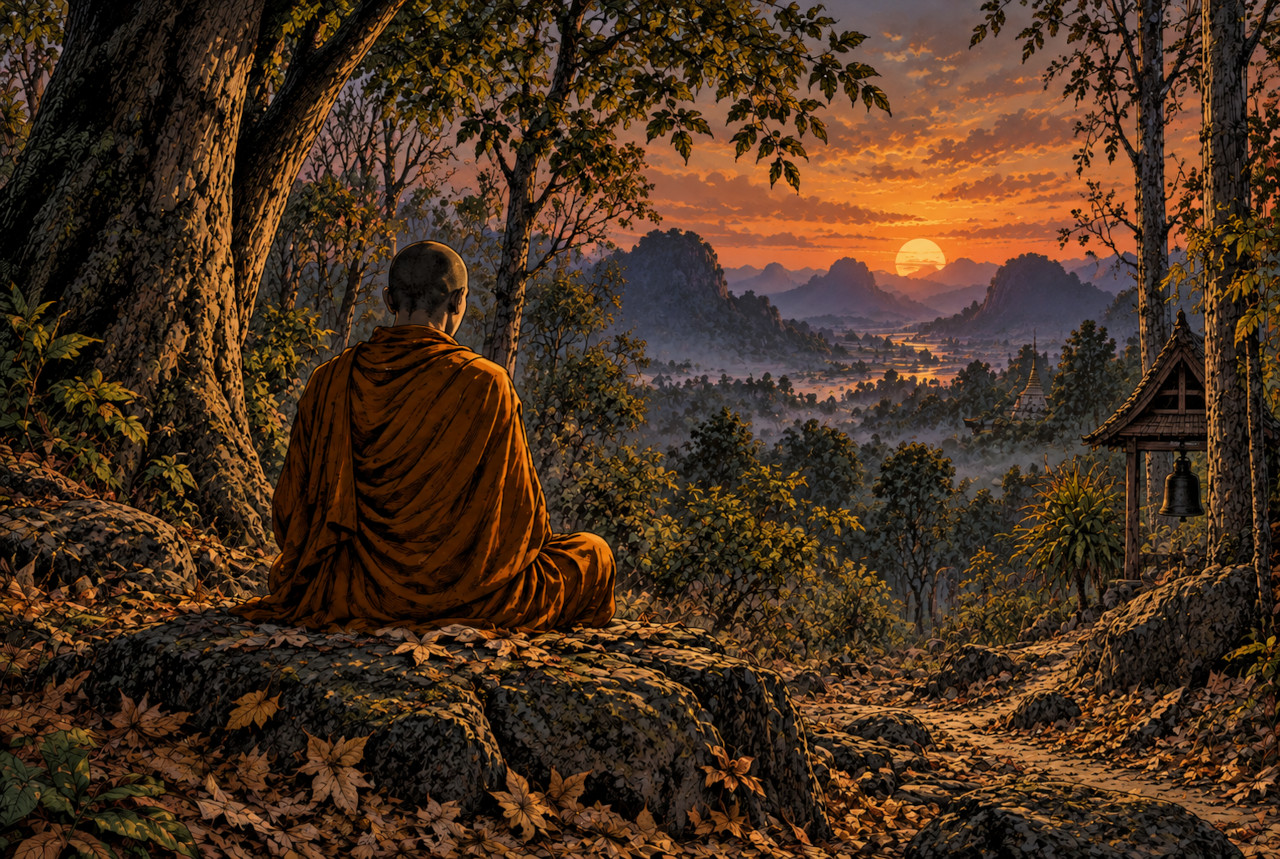 AI-generated conceptual illustration. It does not depict an actual monk, temple, or meditation site.
But traditional contemplation is not the same as storing 85 bodies
This is where the case becomes much more complicated.
The existence of corpse contemplation in Buddhist texts does not automatically justify modern religious facilities storing large numbers of human remains and incorporating them into their own training system.
At the Phichit site where 41 bodies were found, officials reported that death certificates and documents concerning the bodies were present. Authorities nevertheless began contacting relatives and checking identities and the circumstances under which the bodies had been transferred.
The monk leading the Phichit site, Phra Ajarn Saifon Phandito, told Thai media that the use of bodies formed part of a meditation technique he had developed himself. AFP reported that practitioners meditated in pavilions containing coffins with human remains.
A related site was also reported by The Nation as using such practices to train children in concentration and mindfulness, with claims extending as far as developing “psychic powers.” That was a claim associated with the site’s practice, not an established Buddhist doctrine or scientifically verified effect.
This distinction matters. The fact that Buddhism contains old traditions of contemplating death does not mean every modern practice involving stored bodies should automatically be treated as a continuation of those traditions.
Donation consent and legal permission are different questions
There is also a legal issue that exists independently of the religious debate.
Thailand’s Cemeteries and Crematoria Act, B.E. 2528 (1985) regulates where human remains may be stored, buried, or cremated. Section 10 states that human remains generally may not be stored, buried, or cremated outside a public or private cemetery and crematorium, certain medical facilities, or a dwelling place unless written approval is granted by the relevant local official.
The English text published by Thailand’s Department of Provincial Administration is an unofficial translation and notes that it incorporates amendments through 2007; the legally authoritative text remains the Thai version.
This is one of the most important boundaries in the case.
A person may have expressed a wish to donate his or her body to a religious institution. That does not necessarily mean the institution is automatically entitled to store the remains wherever it chooses.
Consent to donation and legal authorization for storage are separate questions.
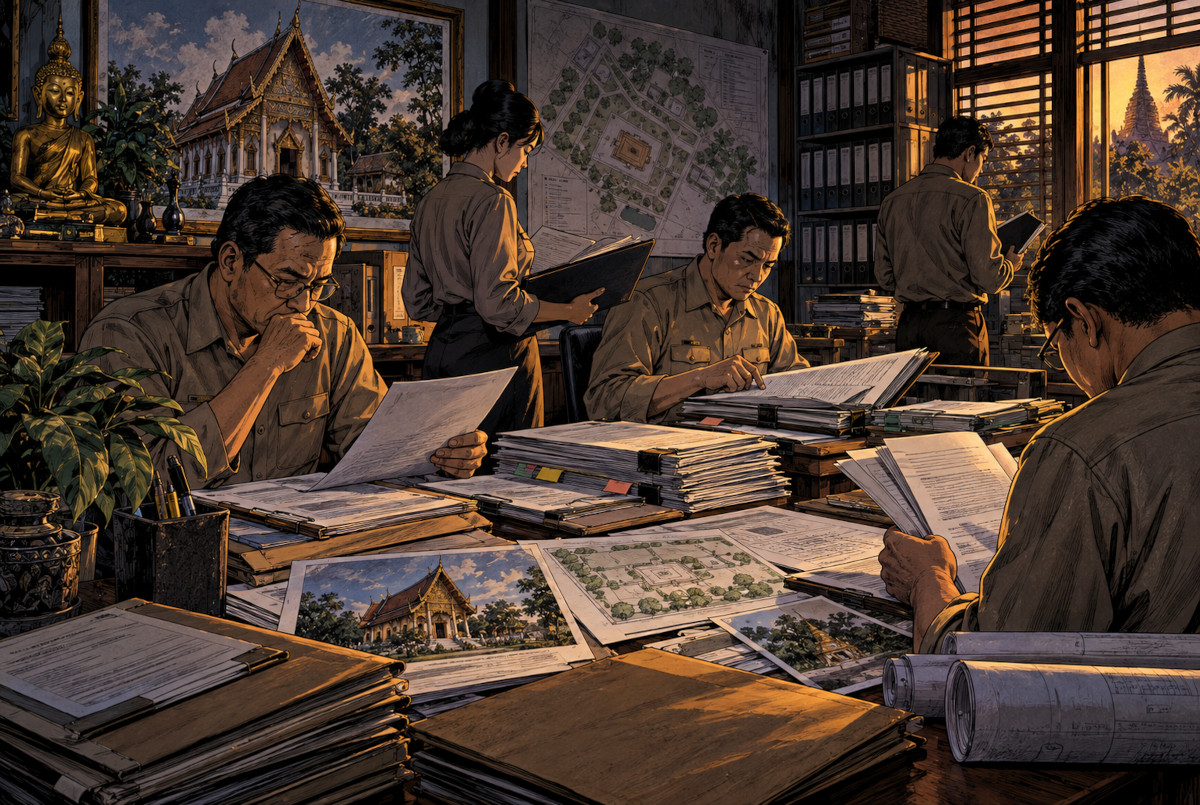 AI-generated explanatory illustration. It does not depict the actual officials, offices, or people involved in the case.
And then there were more than 600 crocodiles
As if the case needed another unusual detail, the Pa Nakhon Chaibovorn site also had a large crocodile pond containing more than 600 animals, according to Thai PBS.
This is exactly the point where a tabloid version of the story could go badly off the rails.
There is no verified evidence that the crocodiles were connected to the human remains. Nothing in the reporting supports that kind of implication.
According to a disciple quoted by Thai PBS, practitioners did not enter the crocodile enclosure. They carried out mental or concentration exercises from outside the fence.
Even without inventing a darker connection, the actual situation is strange enough: dozens of human remains used in a meditation system, alongside a retreat complex containing hundreds of crocodiles.
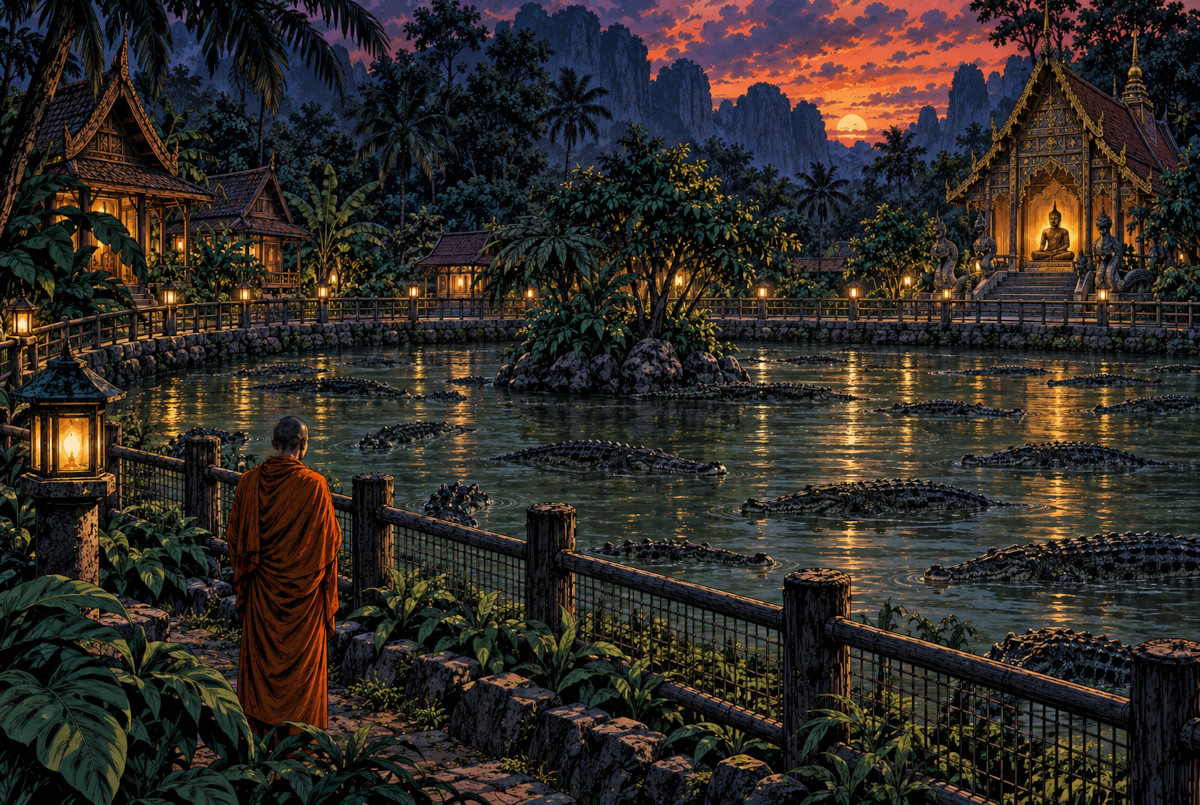 AI-generated illustration. It does not depict the actual crocodile enclosure, religious site, or monk, and it does not imply any connection between the crocodiles and the human remains.
From a Japanese perspective, the first reaction to this story can easily be, “What kind of bizarre temple is this?” But that reaction is almost too convenient.
The more interesting B-side is that the practice was not created in a cultural vacuum. It sat on top of genuine Buddhist traditions concerning mortality and detachment, while also incorporating a modern teacher’s own methods, donated bodies, administrative oversight, and questions of legal permission.
The unusual part is not simply that death was used as an object of meditation. It is how an old religious idea was transformed into a modern institution storing dozens of bodies — and how difficult it became to see where tradition ended and an individual system began.
Editor’s Note
What first caught my attention was the obvious part: 85 bodies, Buddhist monks, and more than 600 crocodiles. It sounds like somebody tried to cram three different B-movie plots into one news story.
Then the research spoiled the easy joke — in a good way. Meditation on death and the corpse is not something a strange modern group simply invented from nowhere. There is a real Buddhist tradition behind it. And that is exactly what makes this case more interesting.
When an old practice is real, it becomes much harder to tell where tradition stops and one teacher’s private system begins. Add body-donation documents, rules on storing human remains, and a crocodile enclosure, and the whole thing becomes less “crazy Thailand” and more a very specific collision between religion, bureaucracy, belief and human behavior.
That uncomfortable border — where something ancient becomes something thoroughly modern and difficult to classify — is exactly the kind of place where B-Side Earth likes to look.
References
- Thai PBS News — Report on 41 bodies found at Pa Nakhon Chaibovorn in Phichit and a crocodile enclosure holding more than 600 animals (November 22, 2024)
- Thai PBS News — Report confirming another 32 bodies at Wat Pa Sriwilai in Phichit (November 26, 2024)
- The Nation Thailand — “12 bodies exhumed from controversial temple in Kamphaeng Phet” (November 21, 2024)
- The Nation Thailand — Report on the additional 32 bodies and the combined total of 85 across three sites (November 26, 2024)
- CBS News / AFP — Report on the 41 bodies in Phichit and the meditation technique described by the site’s religious leader (November 25, 2024)
- Thailand Department of Provincial Administration — Cemeteries and Crematoria Act, B.E. 2528 (1985), unofficial English translation incorporating amendments through 2007
- SuttaCentral — Majjhima Nikaya 10, Satipatthana Sutta, including the charnel-ground contemplations
- Mahachulalongkornrajavidyalaya University — “A Study of Asubhakammatthana as the Base of Vipassanabhavana” (2022)