
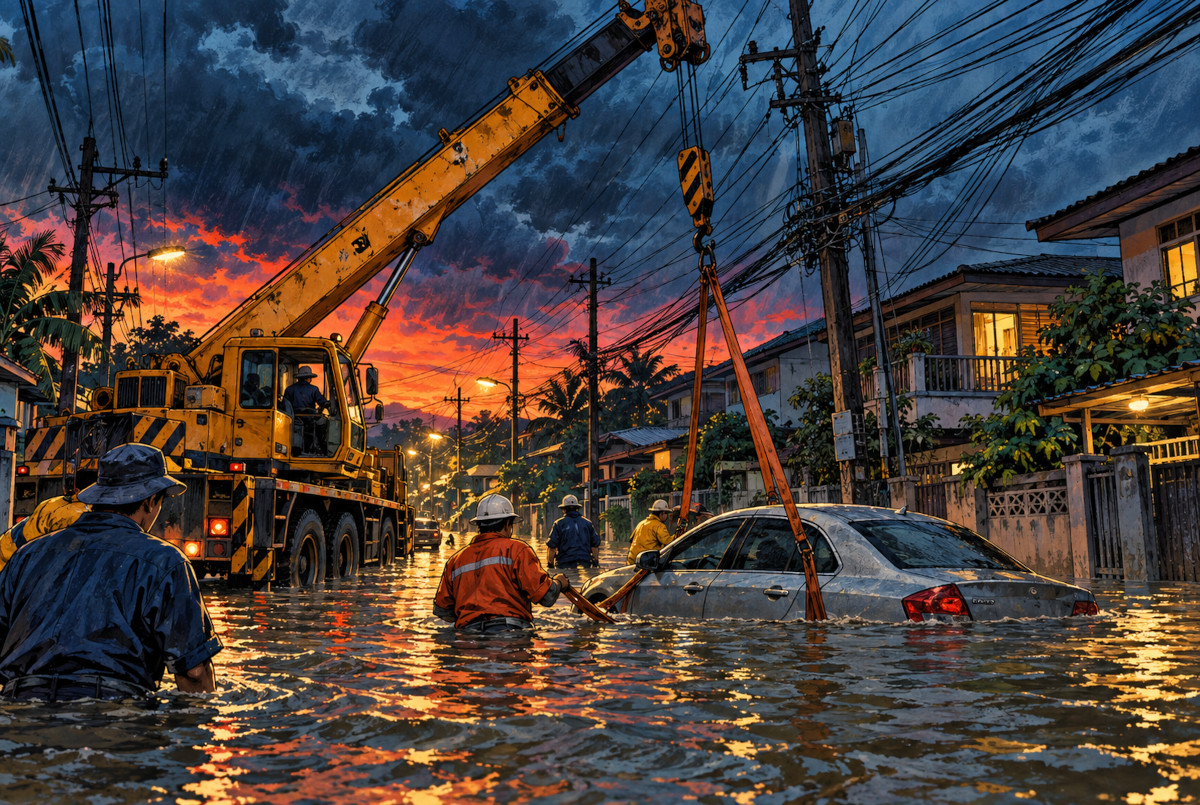
At around 1:20 a.m. on September 27, 2026, in Bang Phli, Samut Prakan Province, just outside Bangkok, an attempt to save a flooded car turned into another disaster.
Floodwater in the residential area had risen above 1.2 meters. According to local reporting and an account from the homeowner’s wife, a truck-mounted crane had been brought in to move a submerged sedan to higher ground. During the operation, the tip of the crane boom came into contact with an overhead power line. The 31-year-old crane operator suffered an electric shock and collapsed into the floodwater. The 40-year-old car owner rushed in to help and was also shocked. Both men died.
An operation meant to save a car from flood damage had become a fatal secondary disaster.
The Flood Was Below. The Hidden Danger Was Overhead.
The accident occurred in a residential development near King Kaew 19 in Bang Phli Yai. Local reports said flooding exceeded 1.2 meters, deep enough that emergency personnel needed a raised four-wheel-drive vehicle to reach the house. This was clearly not an ordinary roadside vehicle-recovery job.
The homeowner had hired a six-wheel crane truck to lift his flooded sedan. According to his wife, the crane boom touched an overhead electrical line during the operation. The operator was shocked and fell into the water. Her husband, who was standing nearby, went to help and was also shocked. She then contacted the electricity authority to have the power cut, but it was already too late.
The homeowner, Thanakrit Chimpalee, was not unknown in Thailand. Sports media identified him as “Coach Rak,” a former member of the Thailand national football team staff during the era of head coach Kiatisuk “Zico” Senamuang.
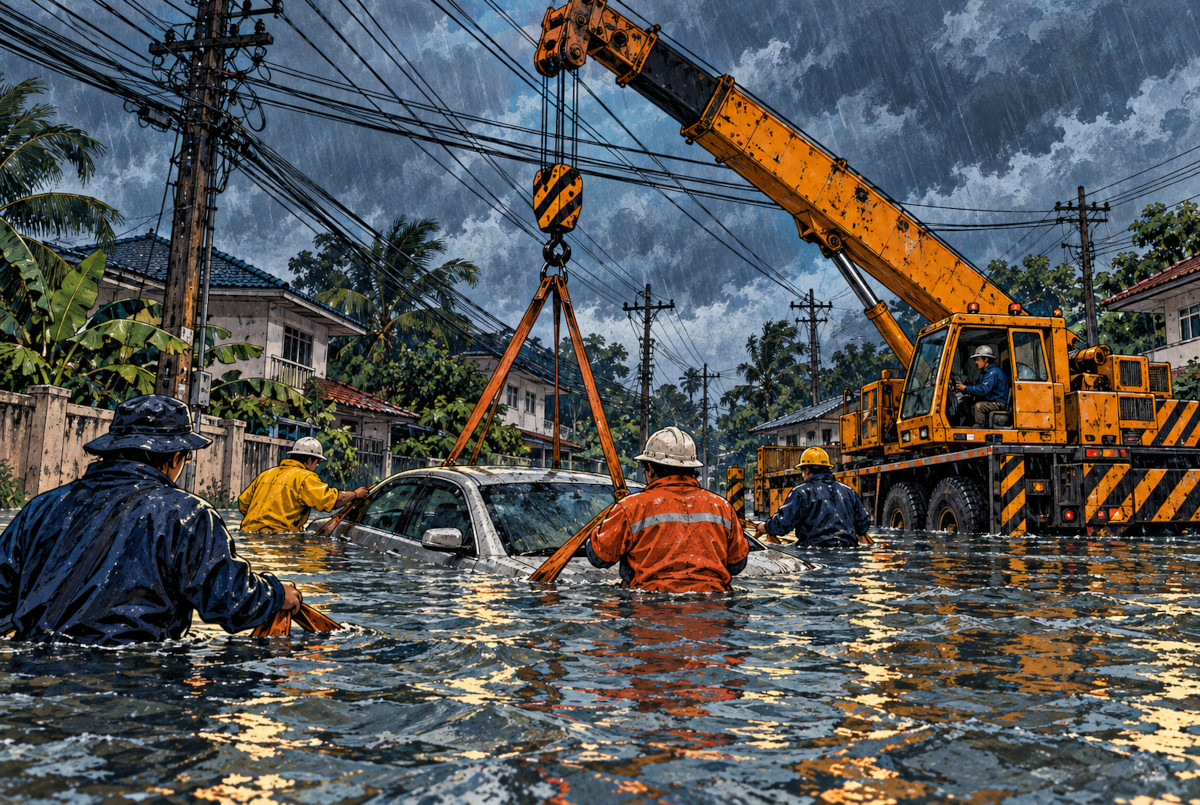 AI-generated illustration for explanatory purposes. It does not depict the actual accident scene, vehicles or people involved.
Not Bangkok Proper, but Part of the Same Flood Emergency
The accident did not occur inside Bangkok itself. Samut Prakan is a neighboring province within the wider Bangkok metropolitan area. But treating this as an unrelated local accident would also miss the broader context.
According to the Thai Meteorological Department, more than 90% of Bangkok and the surrounding metropolitan area experienced rain through much of September 21–27. On September 25, very heavy rain affected nearly all of Samut Prakan and Bangkok. Flooding then continued in Samut Prakan on September 26 and 27.
On September 27, six districts of Samut Prakan Province, including Bang Phli, were declared disaster-affected areas. Authorities cited both heavy rainfall and high tides as factors behind widespread flooding.
So this was not simply an electrical accident that happened to occur on a wet night. It unfolded inside a much larger metropolitan flood emergency.
Thailand Does Have Safety Distances for Power Lines
There is an easy way to read a case like this: assume that basic safety rules simply did not exist. The documents say otherwise.
The Metropolitan Electricity Authority, or MEA, which supplies electricity to Bangkok, Nonthaburi and Samut Prakan, warns anyone operating machinery near high-voltage lines to keep mechanical equipment at least 3.1 meters away from 12–24 kV lines and at least 4 meters away from 69–230 kV lines.
The strange part, then, is not the absence of a safety standard. The harder question is how much of that safety system survives when a neighborhood is under more than a meter of water, it is the middle of the night, and someone is trying to move a valuable car before conditions get worse.
Publicly available information does not establish the voltage of the line involved, the precise clearance between the crane and the line before contact, or whether the electricity authority had been contacted before work began. It would therefore be wrong to state that the crane operator or contractor had violated a specific regulation.
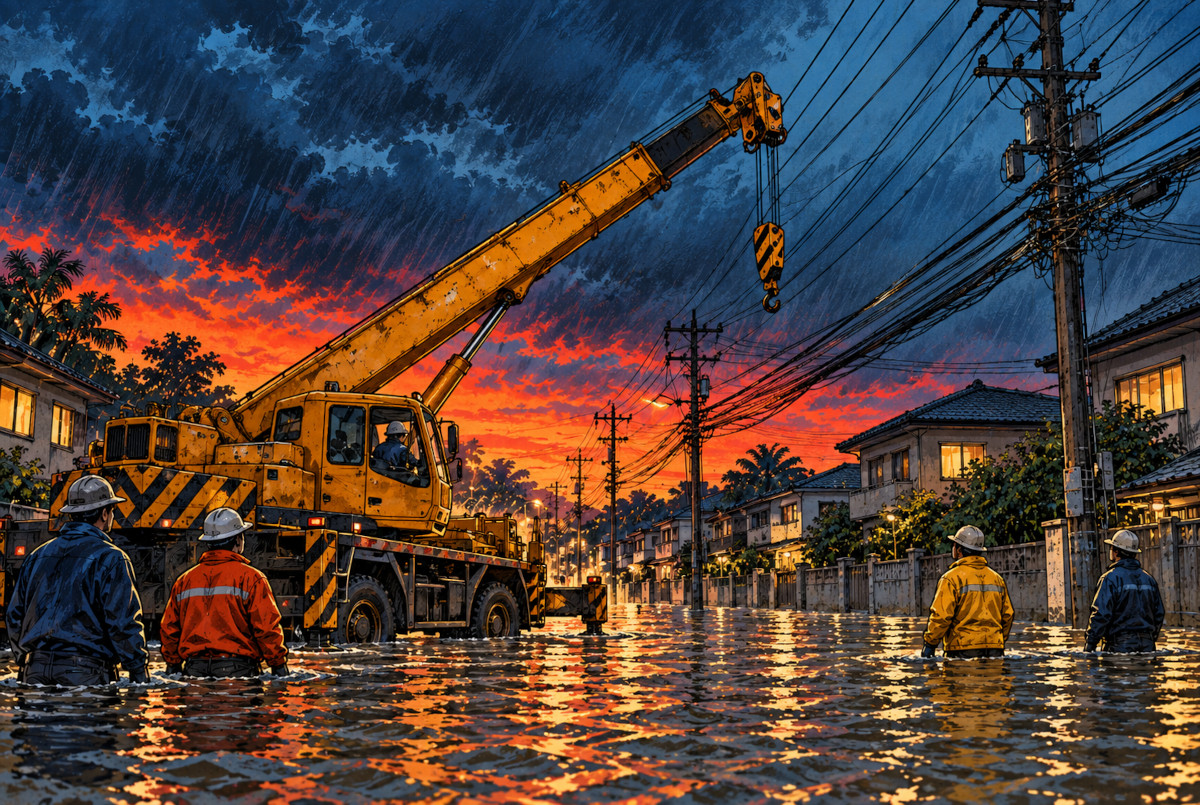 AI-generated safety illustration. It does not reproduce the actual crane position, power-line layout or conditions at the accident scene.
Why the Second Death Matters
The most disturbing part of the case may be the second victim.
If someone collapses in front of you, the natural reaction is to run over and help. But when heavy metal machinery may be in contact with an energized line, approaching the machine or the surrounding area can itself be dangerous. In this case, anyone trying to reach the operator also had to move through floodwater.
In an electrical emergency, rescue can sometimes mean not touching the victim or equipment until the electrical hazard has been isolated. That runs directly against human instinct. Someone is down, so you move toward them. With electricity, that instinct can turn one casualty into two.
Flood safety is often discussed in terms of drainage pumps, sandbags, submerged vehicles and rising water. But a flooded neighborhood still contains utility poles, electrical equipment, machinery, signs and other infrastructure that was designed for normal conditions.
The danger does not simply last until the water recedes. New dangers can appear the moment people begin trying to fix what the flood has damaged.
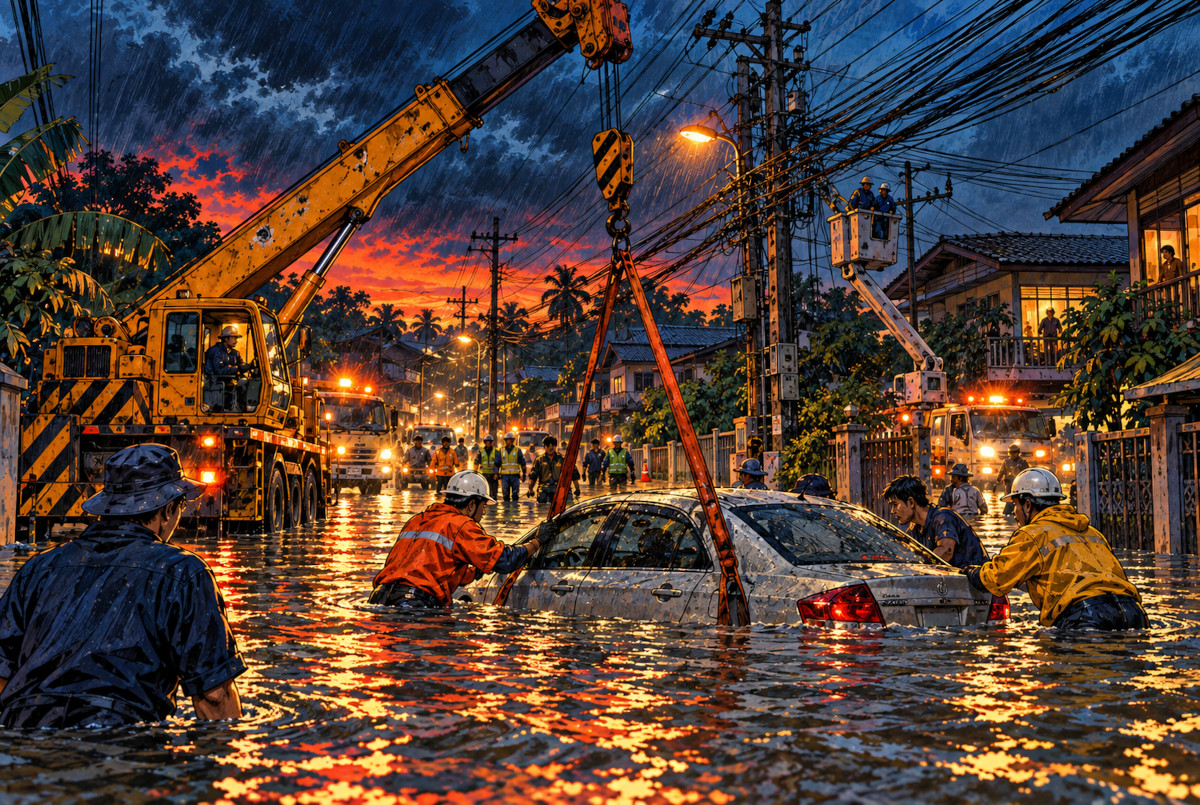 AI-generated conceptual illustration of secondary disaster risks. It does not indicate that the bucket truck, number of responders or exact equipment shown were present at the real accident scene.
Editor’s Note
Seen from Japan, there is an easy first reaction to a story like this: “So this was just loose on-site safety again.” I admit that thought crossed my mind too.
But that is where the story gets more interesting. Thailand’s electricity authority actually gives very specific clearance distances for machinery near high-voltage lines. This was not a country with no rulebook. The gap appears somewhere between the written rule and a flooded residential street after midnight, where people are thinking, “We have to do something about this car now.”
And that part is hardly unique to Thailand. If your own car were slowly disappearing under floodwater in Japan, plenty of people would be tempted to think there was still time to save it.
That is what stays with me about this case. An attempt to reduce the damage from the flood ended up causing a loss far greater than the car itself. Sometimes, during a disaster, “doing something right now” can create a new danger that was not there a moment earlier.
References
- Thai Meteorological Department — Weekly Weather Summary, September 21–27, 2026
- Metropolitan Electricity Authority (MEA) — Safety Warning for Work Near High-Voltage Power Lines
- Thai PBS — “Flooded Car Recovery Ends in Fatal Electric Shock” (September 27, 2026)
- Daily News — Report on the Bang Phli Flooded-Car Crane Accident (September 27, 2026)
- Thai PBS — “Samut Prakan Declares Six Districts Disaster-Affected Areas” (September 27, 2026)
- Matichon — Report on the Death of Former Thailand National Team Staff Member Thanakrit Chimpalee (September 27, 2026)