
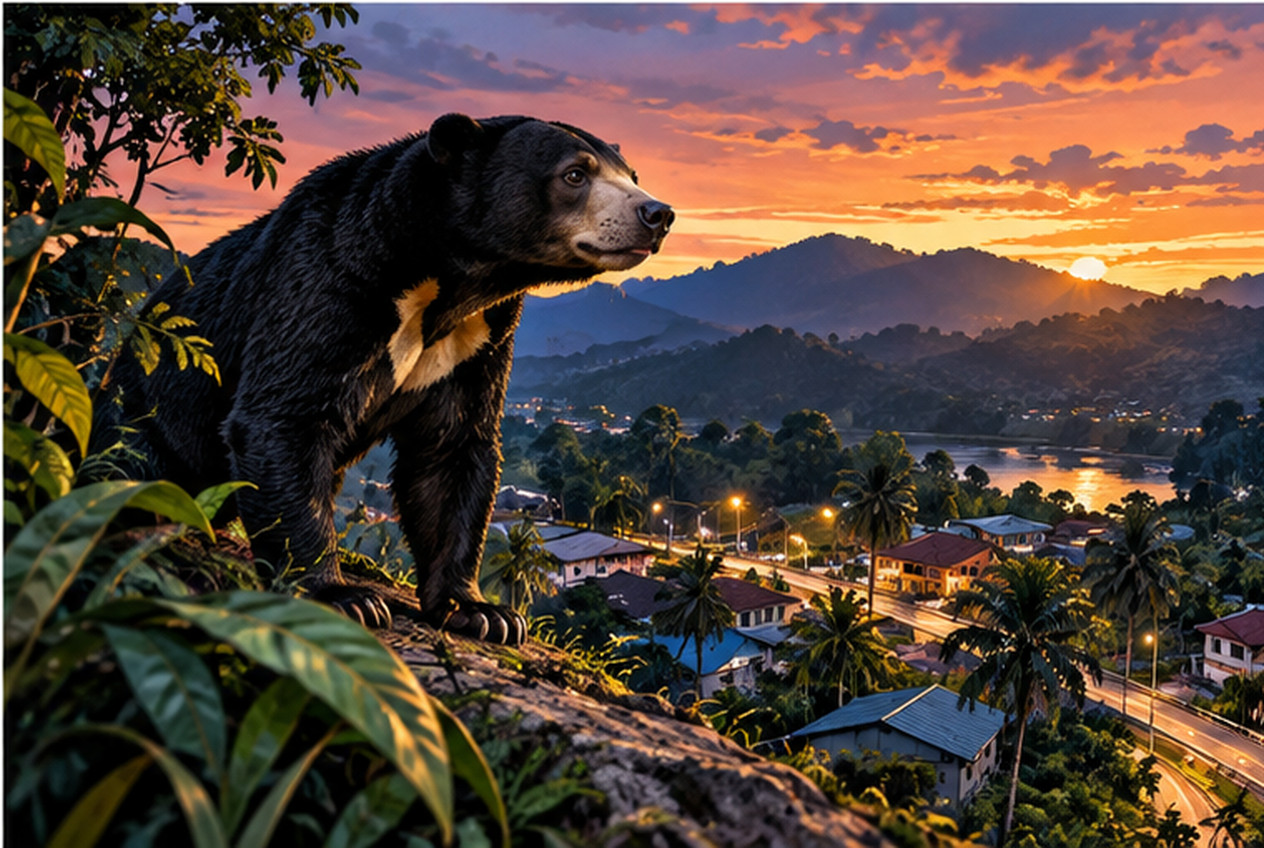
On September 28, 2026, a sun bear was spotted walking through a residential area in Kampung Ulu Kenderong, Gerik, in the northern Malaysian state of Perak. Video of the black bear wandering beside the road spread on TikTok, and the Perak Department of Wildlife and National Parks, better known as PERHILITAN, confirmed the sighting.
It was not the first report. Sightings had already been reported at Taman Raflesia on September 9, Kampung Air Panas on September 12 and 16, followed by another report on September 18 and the Ulu Kenderong sighting on September 28. That makes at least five reports between September 9 and September 28. Authorities have not established that all five involved the same individual bear.
Five reports, but no damage so far
As of October 3, 2026, PERHILITAN said there had been no reported damage to homes, other property or crops. Wildlife officers continued monitoring the affected areas and placed traps in an effort to capture the animal. Residents were advised not to approach, chase or attempt to capture a bear themselves, but to report further sightings to the authorities.
So this is not a story about an aggressive bear attacking a neighborhood. At this stage, it is a story about repeated sun bear reports in places where people live.
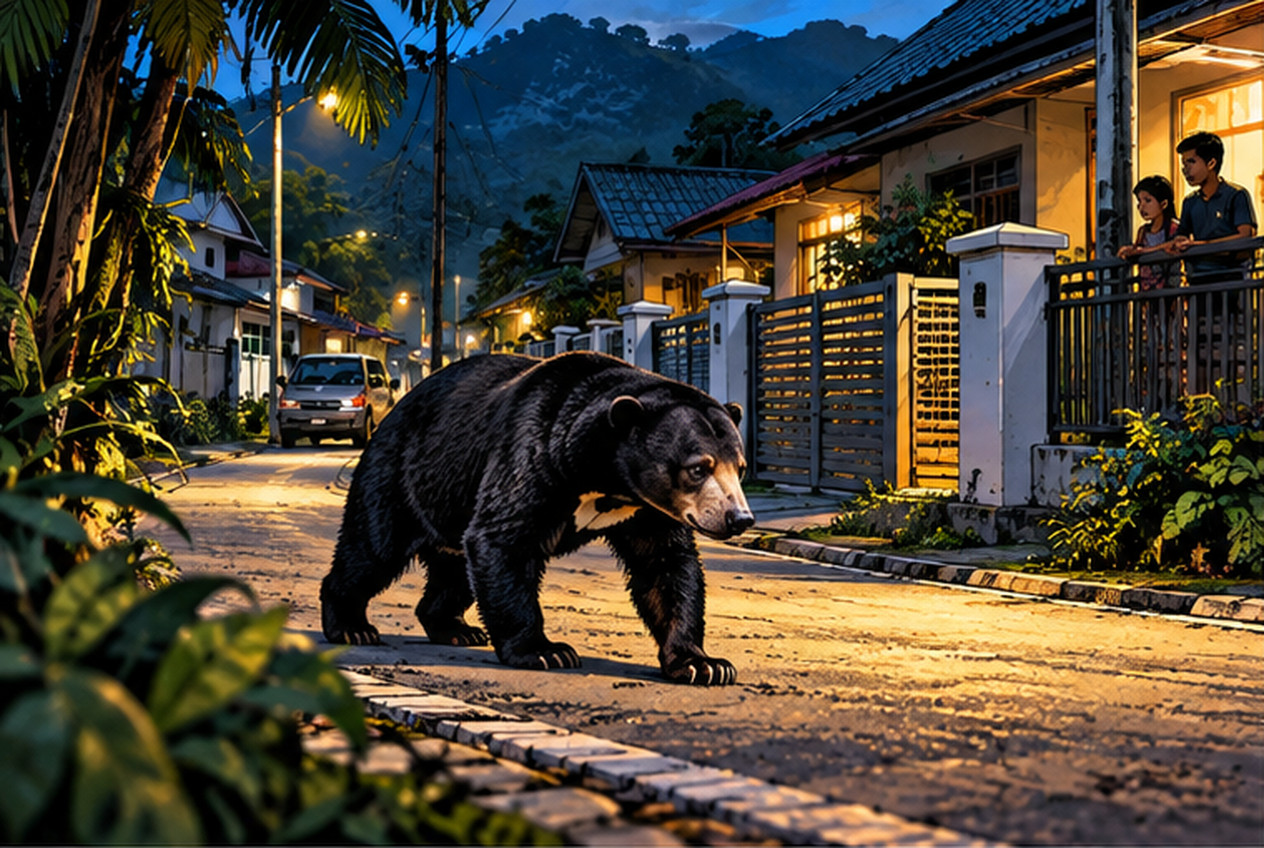
AI-generated illustration. It does not depict the actual location, animal or residents involved in the Gerik sightings.
The world’s smallest bear still comes fully equipped
The sun bear (Helarctos malayanus) is the smallest living bear species and inhabits tropical forests across Southeast Asia. Malaysia’s Biodiversity Information System, MyBIS, lists a body length of up to about 1.5 meters (4.9 feet) and a weight of up to about 65 kilograms (143 pounds). Its pale yellow or cream-colored chest marking often resembles a rising sun, giving the species its English name.
Those numbers may sound modest compared with a brown bear or polar bear. But “small bear” should not be confused with “harmless bear.” Sun bears have long, curved claws adapted for climbing and tearing into rotten wood, insect nests and other food sources. Smithsonian has described those claws as reaching about four inches, or roughly 10 centimeters.
A 60-kilogram bear is still a wild bear, complete with powerful forelimbs, jaws and claws.
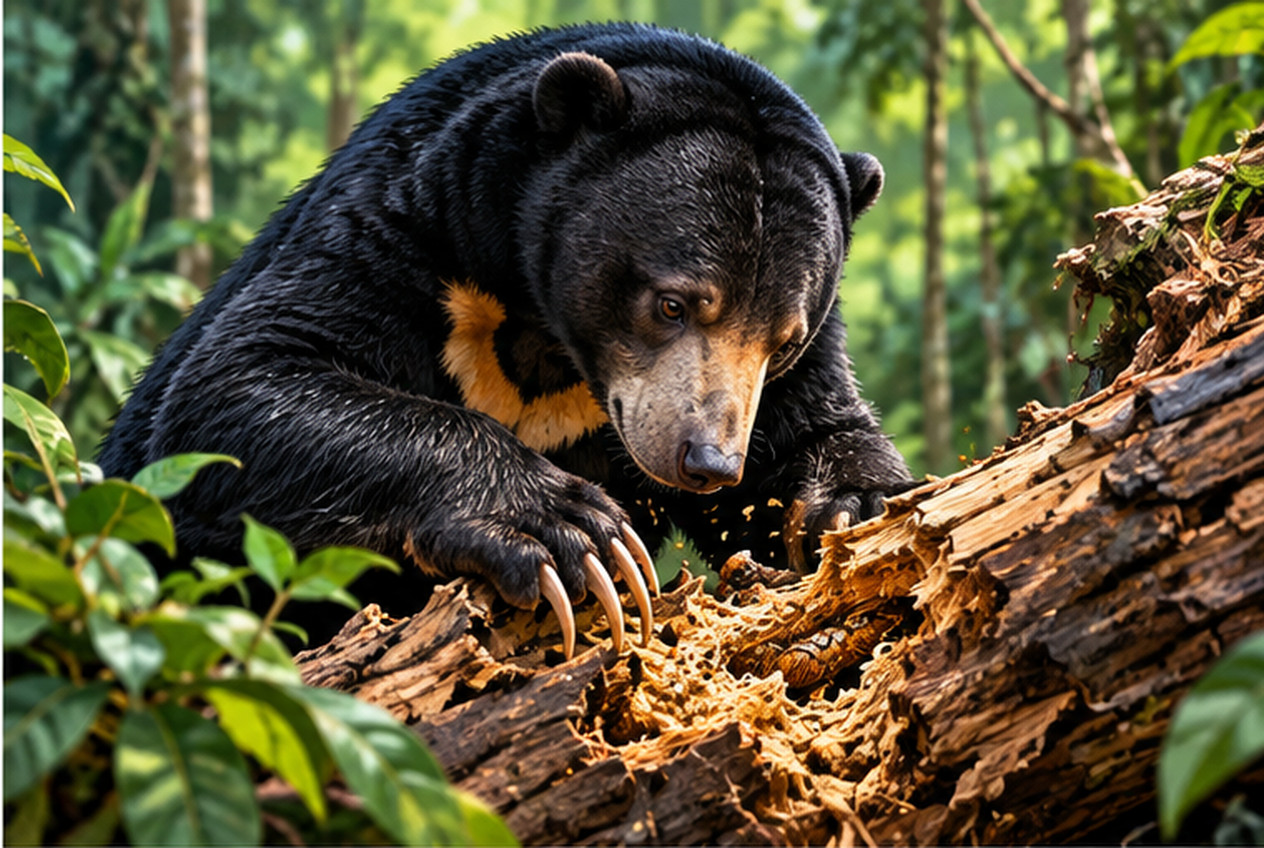
AI-generated wildlife illustration. It does not reproduce a specific bear or an existing wildlife photograph.
They usually avoid people—but “rare” does not mean harmless
So, do sun bears actively attack humans? Usually, no.
Conservation material from the IUCN SSC Bear Specialist Group describes attacks on humans as relatively uncommon and notes that sun bears generally avoid people. When attacks do occur, they are typically understood as defensive behavior rather than predatory hunting.
But “rare” is not the same as “safe.” In September 2024, a 33-year-old man in Gua Musang, Kelantan, suffered severe injuries to his head and legs after being attacked by a bear. He died about a week later. PERHILITAN subsequently captured an adult male sun bear roughly 900 meters from the attack site and said it could have been the same animal involved in the fatal incident.
Sun bears are not known for seeking out humans as prey. But at close range—especially if startled, cornered or threatened—they are physically capable of inflicting fatal injuries.
The law has changed in an unexpectedly specific way
The sun bear is listed as Vulnerable on the IUCN Red List. Under Malaysia’s Wildlife Conservation Act 2010 (Act 716), it is also treated as Totally Protected Wildlife.
There is, however, an interesting legal wrinkle. Before the 2022 amendment, Section 122(4) of Act 716 specifically listed several animals—including elephants, gaur, sun bears, tigers, leopards and wild boar—as “dangerous wildlife” for the purposes of that section.
The Wildlife Conservation (Amendment) Act 2022 replaced that list with a reference to species included in the Eleventh Schedule. The amendment came into force on February 1, 2023. The current Eleventh Schedule includes wild boar, southern pig-tailed macaques, long-tailed macaques and king cobras, but not sun bears.
That does not mean Malaysia has officially declared sun bears “safe.” It means the legal classification used specifically for Section 122’s reporting provisions changed. The animal’s protected status—and its real-world ability to injure someone—are separate issues.
In Gerik, a bear near homes is not as geographically strange as it sounds
Seen from Japan, the phrase “bear in a residential neighborhood” tends to bring to mind a mountain bear descending into suburban streets. Gerik is different.
The town lies close to the vast Belum–Temengor forest landscape. Malaysia’s Central Forest Spine program identifies the wider Gerik area as an important wildlife movement corridor. Along the Gerik–Jeli route, Malaysia also constructed its first dedicated wildlife viaduct, designed to reconnect the Temengor, Amanjaya and Belum forest blocks.
In other words, Gerik is a place where human settlements and a major wildlife landscape already exist almost side by side.
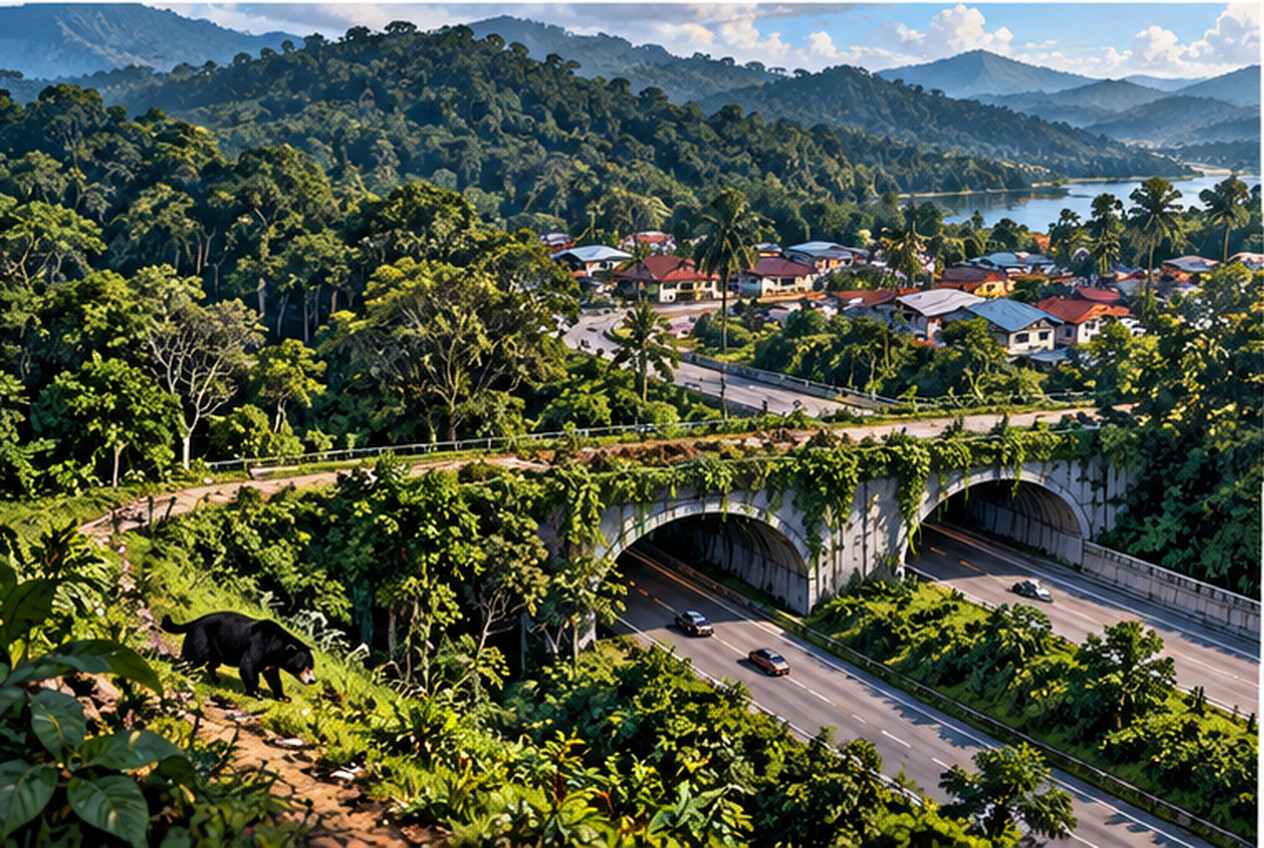
AI-generated conceptual illustration. It does not reproduce the actual geography of Gerik or the real A-PL1 wildlife viaduct.
What remains unknown is why the sun bear—or bears—entered residential areas in this particular series of sightings. There is not enough evidence to blame forest clearing, food shortages or crop feeding, and PERHILITAN has not identified a specific cause. No crop damage had been reported in these cases either.
The convenient story that “a hungry bear was driven into town by deforestation” may sound plausible, but the evidence is not there yet. What we can say is simpler: several sun bear sightings were reported over a short period in Gerik, where tropical forest and human settlement meet.
There is one more curious detail. In 2026, Tourism Malaysia chose two sun bear characters, “Wira” and “Manja,” as official mascots for Visit Malaysia 2026. On tourism material, the species appears cheerful and approachable. In the same year, real sun bears were walking through residential streets.
Wildlife, inconveniently, does not always follow the character profile humans assign to it.
Editor’s Note
Sun bears have an oddly expressive face, a bright chest marking, and now even a starring role as tourism mascots. I can see why people instinctively file them under “cute bear.”
But if I saw one walking down a residential street at night, I would not be going anywhere near it. “World’s smallest bear” sounds reassuring until you remember that the animal can weigh more than 60 kilograms and carry claws close to four inches long.
What caught my attention most, though, is that the Gerik animal had apparently not wrecked houses or raided crops. From a human point of view, we say the bear “entered our neighborhood.” Look at the geography around Gerik, and the wording becomes less obvious. Forest and settlement are already pressed together. From the bear’s point of view, our boundary line may not exist at all.
That is probably the awkward part of living alongside wildlife: do not approach an animal just because it looks cute, but do not treat every animal that crosses an invisible human border as a monster either. Both ideas have to fit in your head at the same time.
References
- BERNAMA, “Perak Perhilitan Confirms Sun Bear Intrusions In Gerik Residential Areas” (October 3, 2026)
- Malaysia Biodiversity Information System (MyBIS), “Helarctos malayanus (Raffles, 1821)”
- IUCN SSC Bear Specialist Group et al., “Sun Bears: Global Status Review & Conservation Action Plan, 2019–2028”
- Central Forest Spine, “CFS Initiatives” — A-PL1 Viaduct, Gerik, Perak
- Department of Wildlife and National Parks (PERHILITAN), “Wildlife Conservation Act 2010 [Act 716]”
- Department of Wildlife and National Parks (PERHILITAN), “Wildlife Conservation (Amendment) Act 2022 [Act A1646]”
- Federal Government Gazette, “Appointment of Date of Coming into Operation” (January 30, 2023)
- Radio Televisyen Malaysia (RTM), report on the capture of a male sun bear in Gua Musang (October 23, 2024)
- Tourism Malaysia, “The Malayan Sun Bear: The Iconic Face of Visit Malaysia 2026” (February 20, 2026)
- Smithsonian Magazine, “To Save Sun Bears, Scientists First Have to Find Them” (2024)