
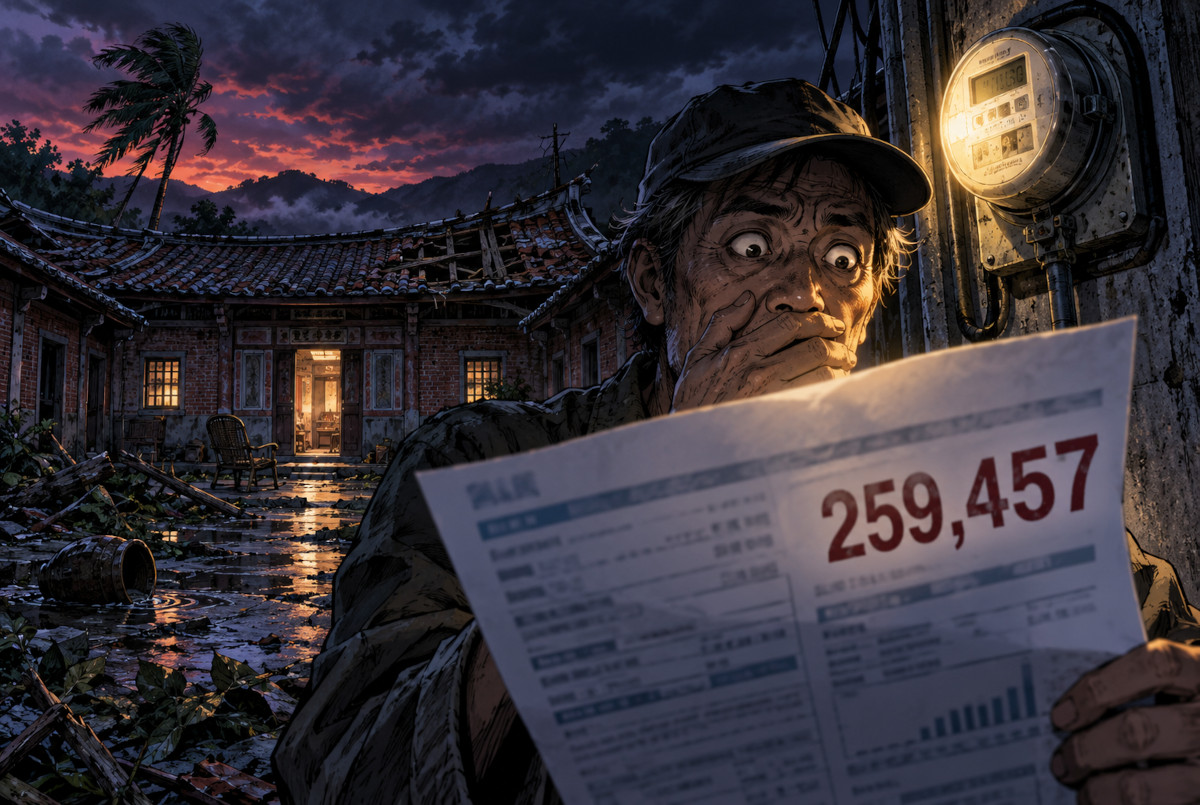
On September 9, 2025, a post from Budai Township in Chiayi County, Taiwan, began attracting attention for a very strange reason. A traditional sanheyuan—a three-sided courtyard house that was barely occupied—had received a July–August electricity bill for NT$259,457.
The family joked that they were not exactly running a Bitcoin mine. And they were right. There was no mysterious power-hungry operation hidden inside the old house. According to Taiwan Power Company, or Taipower, the real cause was much more ordinary: a data-entry error after the electricity meter had been replaced. The correct bill was eventually reduced to just over NT$300.
How does a nearly empty house end up with a bill this large?
The property was a rural sanheyuan that was no longer regularly occupied. Relatives would occasionally return to clean and check on it, but it was hardly the kind of place expected to consume industrial levels of electricity.
The house had also been hit by Typhoon Danas in July 2025. Local reports said its roof was badly damaged and the area experienced an extended power outage. That matters, because the billing mistake occurred against the backdrop of a major restoration effort in southern Taiwan.
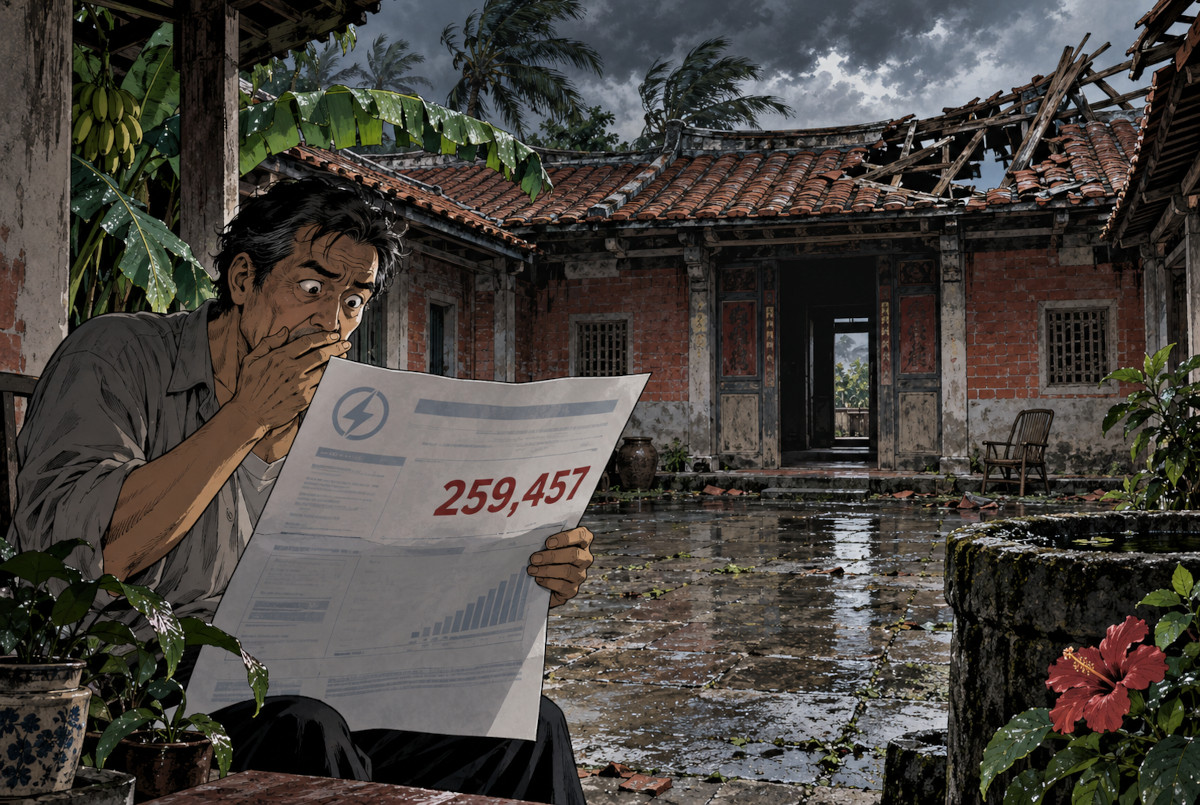 AI-generated illustration. It does not reproduce the actual house, people, or original electricity bill involved in the case.
The reported electricity usage was more than 31,000 kWh. For a house where someone might occasionally switch on a light or an electric fan, that is not merely high. It is the kind of number that should immediately make someone ask whether the data itself is wrong.
There was another twist. The family’s electricity bills were paid automatically from a bank account. The mistake was discovered only after a relative received a notice saying that the account did not contain enough money for the automatic debit.
In other words, the insufficient-balance warning accidentally became the final alarm for a broken electricity bill. Had the account contained enough money, the oversized charge could at least have been debited first and disputed afterward.
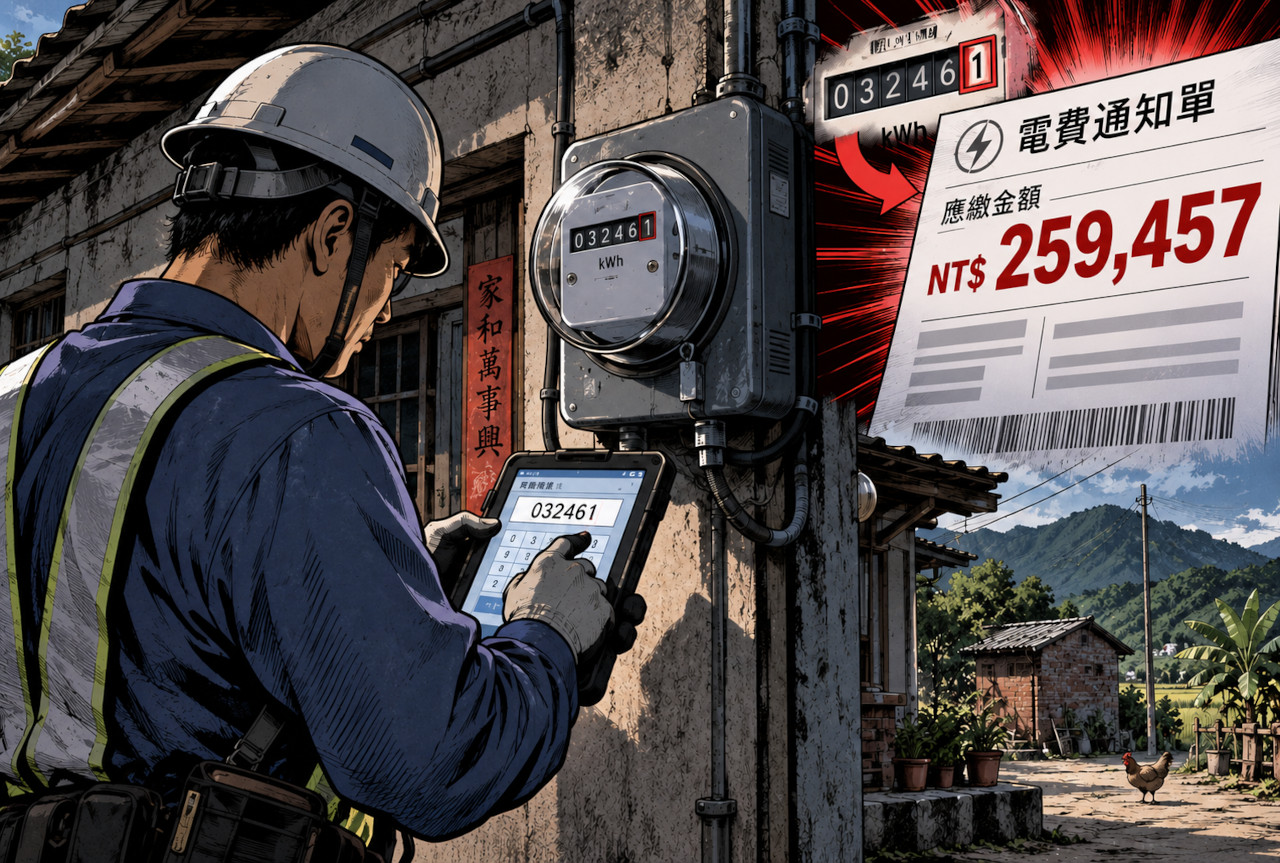 AI-generated illustration. The phone screen, figures, and bill are explanatory visuals and do not reproduce the actual bank notification or original bill.
The culprit was not electricity theft or crypto mining. It was data entry
Taipower’s explanation was remarkably mundane. After a new meter had been installed, meter-reading data were entered incorrectly. The meter itself had not somehow consumed electricity. No hidden mining operation had appeared inside the empty house. A number entered during the billing process was wrong.
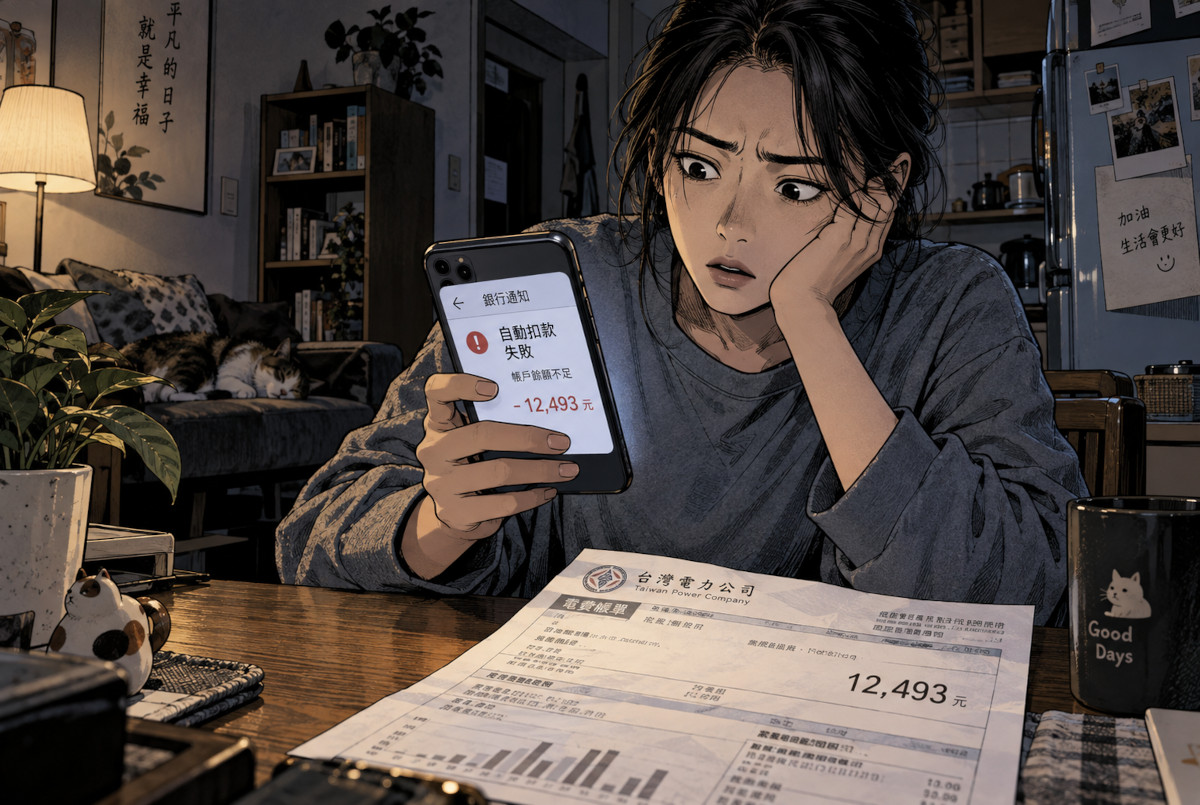 AI-generated explanatory illustration. The meter display, terminal interface, and bill graphic are illustrative and are not reproductions of Taipower’s actual equipment or the original bill.
That is where the real B-side of the story begins. The unusual part is not that someone made a typing or meter-reading mistake. Human beings make those every day. The unusual part is that an obviously abnormal number apparently survived long enough to become an actual NT$259,457 bill.
A meter was replaced. A reading was entered. The billing system processed it. A bill was issued. An automatic bank debit was attempted. There were several stages along that chain where an amount completely out of line with the property’s normal usage might have been questioned.
Taipower said its staff had been heavily occupied with post-typhoon repairs and restoration work, which contributed to the error not being corrected in time. The company apologized and said it would also review bills associated with meters replaced during the same period.
That explanation is understandable. A disaster zone is not a normal working environment. But it also leaves an interesting question: if a nearly empty house suddenly appears to have consumed more than 31,000 kWh, how extreme does a number have to become before a billing system decides that something looks wrong?
 AI-generated illustration. It does not depict the actual Taipower workers, neighborhood, or restoration site involved in this case.
What about reports of other high bills in the same village?
The original social-media post went further. It claimed that several older residents in the same village had already paid electricity bills exceeding NT$10,000.
That part needs more caution. Public reporting confirms Taipower’s acknowledgement of the data-entry mistake in this particular case, and the company said it would review other accounts involving meters replaced around the same period. But there is not enough verified public information to conclude that the other villagers’ bills were caused by the same error.
They may have been related. They may have had different explanations. Or the original poster may simply have been collecting several local complaints together. This is exactly the kind of detail that becomes more important—not less—when a story is strange enough to spread easily online.
From Japan, the strangest part is how familiar this looks
It would be easy to file this under “weird things that happen overseas.” That would miss the more interesting point.
Japan also relies heavily on automated billing, bank debits, digital meters, and computer systems that move numbers from one stage to the next. So from a Japanese perspective, what stands out is not something uniquely Taiwanese. It is something much more universal: an automated system can still faithfully automate a human mistake.
That is the uncomfortable charm of this case. A nearly empty house, a typhoon recovery effort, a newly replaced meter, a data-entry mistake, an automated billing system and a bank account all lined up in exactly the wrong order.
There was no Bitcoin mine hiding inside the house. What the case exposed instead was a rather ordinary hole in the billing process.
Editor’s Note
I have a soft spot for stories like this. Not because there is anything especially funny about Taiwan getting something wrong, but because the mechanism is so familiar. We build systems that look modern, automated and efficient, and then somewhere in the middle sits one very old-fashioned ingredient: a human being entering a number.
What gets me is not even the typo itself. It is the question of why nobody—or nothing—said, “Hold on, why is this nearly empty house suddenly using more than 31,000 kWh?” A modern system can process a mistake at impressive speed if nobody challenges the input.
And the final safety device turned out to be the least sophisticated part of the whole chain: there was not enough money in the bank account. Sometimes the system that saves you from automation is simply another system refusing to cooperate.
References
- Baoliao Commune: Original September 9, 2025 post describing the NT$259,457 electricity bill
- NOWnews: Report on the Chiayi sanheyuan, July–August bill and more than 31,000 kWh of recorded usage
- CTS News: Taipower’s explanation that the abnormal bill resulted from incorrect meter-reading data entry
- TVBS News: Taipower’s response, correction of the bill and review of meters replaced during the same period
- Taiwan Power Company: Official explanation of the two-month billing cycle for ordinary residential and small-business customers
- Central News Agency: Coverage of Typhoon Danas damage and power disruptions in the Chiayi area