
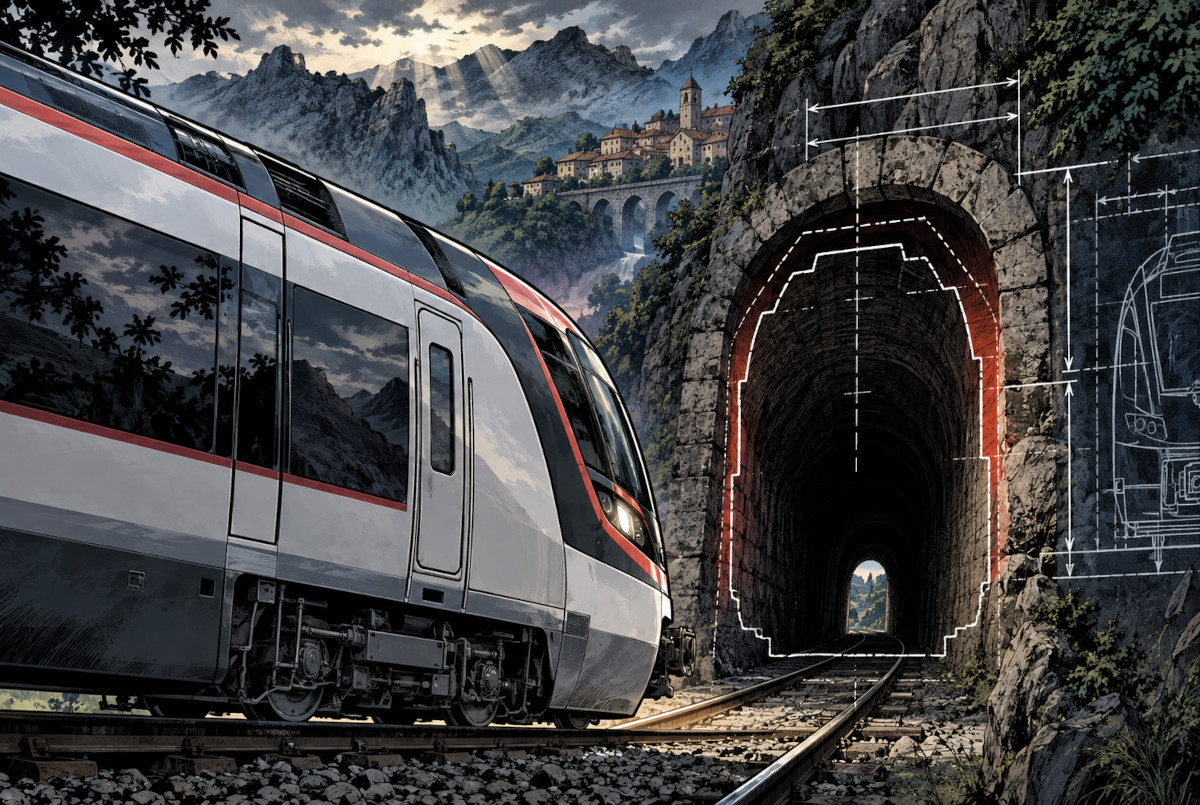
In January 2023, a strange railway story emerged from Asturias in northern Spain and quickly travelled far beyond the country: Spain had ordered new trains that were too large to fit through its own tunnels.
The story concerned the former FEVE meter-gauge network serving Asturias, Cantabria and other parts of northern Spain. Renfe had commissioned new rolling stock from CAF, but the train specifications turned out to conflict with clearances around old tunnels and other infrastructure.
There was, however, a major difference between the viral version and what actually happened. When the problem became public in 2023, there was no completed fleet of 31 oversized trains. No train using the incompatible dimensions had been manufactured.
That much was already clear from the original investigation. But in May 2026, Spain’s Court of Auditors published a detailed audit of the procurement. Its findings revealed a deeper story: the real failure was not simply the size of a train.
The 31 “trains that would not fit” had never been built
Renfe launched the procurement process in February 2019. CAF was selected in 2020, and the rolling-stock supply contract was formally signed on December 29 that year.
The problem was not the distance between the rails. These were 1,000 mm meter-gauge lines. Nobody had ordered a train for the wrong track gauge.
The issue was gálibo: the relationship between the space occupied by a moving train and the clearance available around it at tunnels, platforms, bridges and other structures. In English railway terminology, the problem involved the loading gauge and structure clearance.
Parts of the former FEVE system still use infrastructure dating from the late 19th and early 20th centuries. The procurement specifications, meanwhile, referred to the GEE10 and GED10 gauge profiles established under Spain’s 2015 railway-clearance rules.
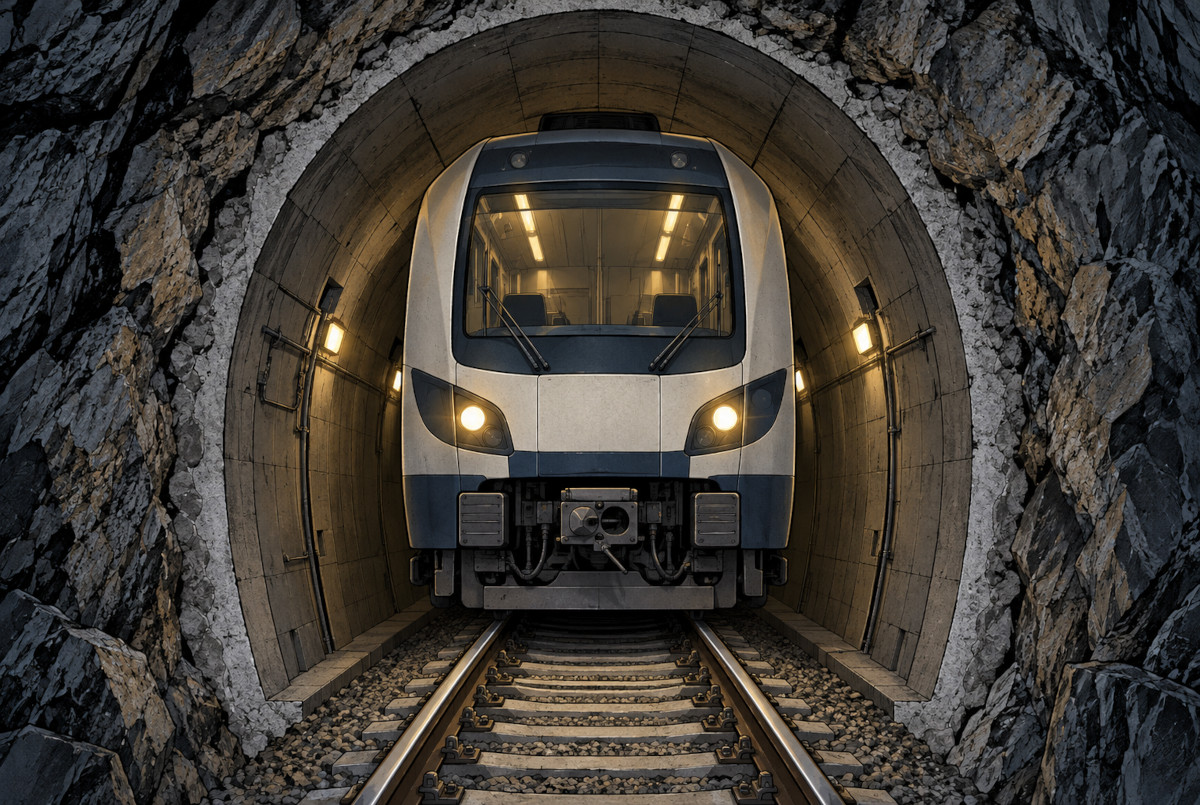 AI-generated explanatory illustration. It does not reproduce an actual train, tunnel or measured engineering profile.
The 2026 audit found that the real failure went beyond train dimensions
On May 28, 2026, Spain’s Court of Auditors, the Tribunal de Cuentas, approved Audit Report No. 1680 on Renfe Viajeros’ contracts for meter-gauge and mountain trains.
Its conclusion was much more serious than “someone measured a tunnel incorrectly.”
The procurement specifications simultaneously required compliance with the GEE10 and GED10 gauges and the ability to operate across all relevant meter-gauge lines in Spain’s General Interest Railway Network, the RFIG.
The problem was that the infrastructure-side requirements associated with those gauges were intended for new or upgraded infrastructure. On old lines that had not been rebuilt to those standards, the necessary space did not necessarily exist.
The Court of Auditors described the technical requirements as impossible to execute.
The audit also found that Renfe could potentially have identified the problem while preparing the tender simply by consulting its own historical rolling-stock information and asking infrastructure manager Adif for the relevant clearance data.
So the age of the railway was certainly part of the background. But the 2026 audit pushed the story further. The procurement process had combined requirements that could not actually be satisfied across the existing network.
The clearance conflict was visible before the final contract was signed
The audit also changes the timeline.
According to the Court of Auditors, on November 6, 2020, the contractor received infrastructure-clearance information from Adif showing multiple conflicts between tunnels or platforms and the GEE10/GED10 profiles.
That was before the rolling-stock contract was formally signed on December 29, 2020.
The public record does not establish exactly when the contractor concluded that the procurement requirements as a whole were impossible to fulfil, or precisely how that concern was communicated to Renfe. So it would go too far to claim that everyone already understood the full scale of the problem in November.
Renfe’s own timeline is clearer. It requested information from Adif on February 17, 2021, and received a response two days later. The material included surveys conducted in 2018 and 2019 showing numerous locations that did not comply with the specified gauge profiles.
Yet at a contract progress meeting on February 26, the issue was still referred to in terms of a “rumor” that such locations existed. The Court of Auditors concluded that Renfe already possessed confirmed information by that point.
| Date | What the public record now shows |
|---|---|
| February 2019 | Renfe begins the procurement process for the new trains |
| November 6, 2020 | The contractor receives Adif clearance data showing conflicts with tunnels and platforms |
| December 29, 2020 | The rolling-stock supply contract is formally signed |
| February 19, 2021 | Renfe receives Adif survey data identifying incompatible locations |
| September 2021 | The comparative method is examined as a practical solution |
| January 2023 | The issue enters the wider public debate |
| November 2024 | The 31-train supply contract is modified, increasing its price by 11.93% |
| February 2025 | The option for seven additional trains is formally exercised |
| May 2026 | The Spanish Court of Auditors approves its audit report |
| October 2026 | The first new train remains on a closed test facility; testing on Cantabria’s network is expected in late October or early November |
 AI-generated explanatory illustration. It does not depict a specific FEVE route, real tunnel or actual railway engineer.
The solution was to use trains that already fit as the reference
The eventual design solution was the método comparativo, or comparative method.
The principle is practical. Instead of defining the new train solely from a theoretical standard profile, engineers can use rolling stock with extensive operating experience on the route as the reference. Its dimensions, movement and relationship with existing infrastructure help determine what the replacement fleet can safely do.
Put simply: do not look only at the standard on paper. Start with the train that has already been passing through the tunnel for years.
In February 2023, Spain amended its railway-clearance rules through Order TMA/135/2023, clarifying the treatment of existing 1,000 mm lines.
But the 2026 audit added another important detail. Spain’s Railway Safety Agency, AESF, had already told Renfe in September 2021 that the comparative method available under UNE-EN 15273 could be used without first amending the national regulation.
So the common version of the story — that Spain had to change the law before the comparative method became possible — is not quite right. The regulation was amended, but the method itself was already available.
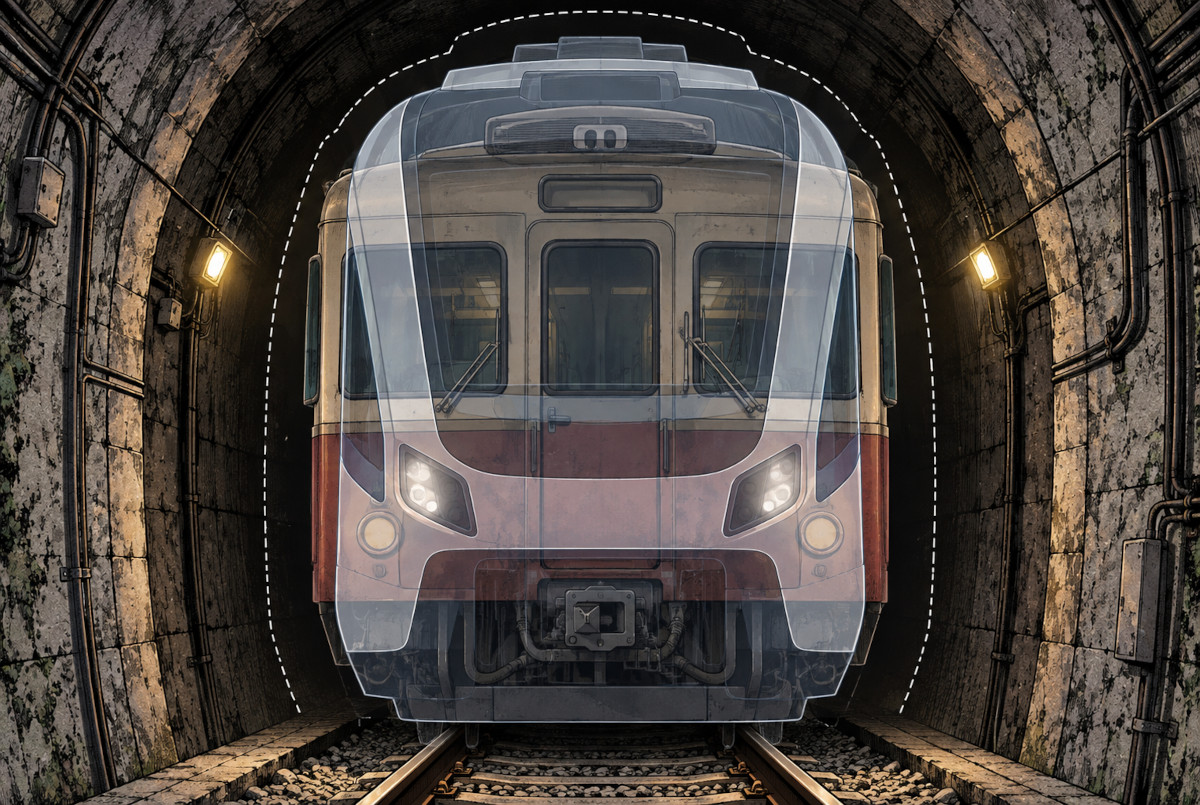 AI-generated concept image. It is not an official engineering drawing and does not show the exact profiles or measured dimensions of the real trains.
“No completed trains” was true. “No public money had been spent” was not
In February 2023, the Spanish government stated in its agreement with Asturias and Cantabria that no trains using the problematic design had been manufactured. The later audit does not overturn that point.
But the same government announcement also said that no public expenditure connected with the contract had yet occurred.
The Court of Auditors found otherwise.
Renfe had already paid the contractor €16,224,589.84 plus VAT on February 25, 2021 as the first contractual payment.
The Court of Auditors concluded that the 2023 statement that no public expenditure had occurred did not reflect the actual situation.
That distinction matters. The €16.2 million was not found to have been simply “wasted,” nor was it the cost of scrapping unusable finished trains. But “no trains had been built” and “no money had been paid” were two different claims.
The order grew from 31 trains to 38 — while the contract price rose 11.93%
The money behind the famous €258 million headline also deserves a closer look.
The original procurement consisted of two lots. According to the audit, Lot 1 was worth €197,586,907.18 before VAT and covered the 31 meter-gauge trains, 15 years of first-level maintenance for 12 of those trainsets, spare parts and tools.
Lot 2 was worth €60,568,221.12 before VAT and covered six mountain trains, 15 years of first-level maintenance for all six, and related items.
Together, the two lots totalled €258,155,128.30 before VAT.
But the original supply price of the 31 meter-gauge trains themselves was €162,245,898.40. So the familiar phrase “€258 million worth of trains that did not fit the tunnels” compresses several different parts of the procurement into one headline-friendly number.
There was also a later increase. On November 5, 2024, the supply contract for the 31 trains was modified by €19,350,282.94, an increase of 11.93%.
The Court of Auditors concluded that this modification did not comply with the law and said Renfe should instead have terminated the contract and launched a new procurement procedure.
Meanwhile, the government’s 2023 plan to add seven more trains did not become a formal order immediately. The option was exercised on February 7, 2025, for €37,184,577.27 plus VAT.
Including the seven additional units, the audit puts the rolling-stock supply contract at roughly €218.78 million plus VAT.
The contractual delivery dates for those extra seven trains run from the end of July to November 15, 2028.
October 2026: the new train is still testing behind closed doors
After the redesign, production began at CAF’s Beasain plant on February 26, 2024. At that stage, the plan was for testing on the railway network to begin during the first half of 2026.
By August 2026, the first completed train had entered dynamic testing on a closed CAF test facility. On September 16, Transport Minister Óscar Puente said on-track testing was expected to begin in October.
The schedule then slipped slightly again.
On October 5, 2026, the Spanish government’s delegate in Cantabria, Pedro Casares, said the train was still undergoing tests on a closed circuit and was expected to begin running on Cantabria’s railway network in late October or early November.
As of October 12, 2026, publicly available information does not confirm that testing on the operating network has begun. The current target remains for the first trains to enter passenger service in 2027.
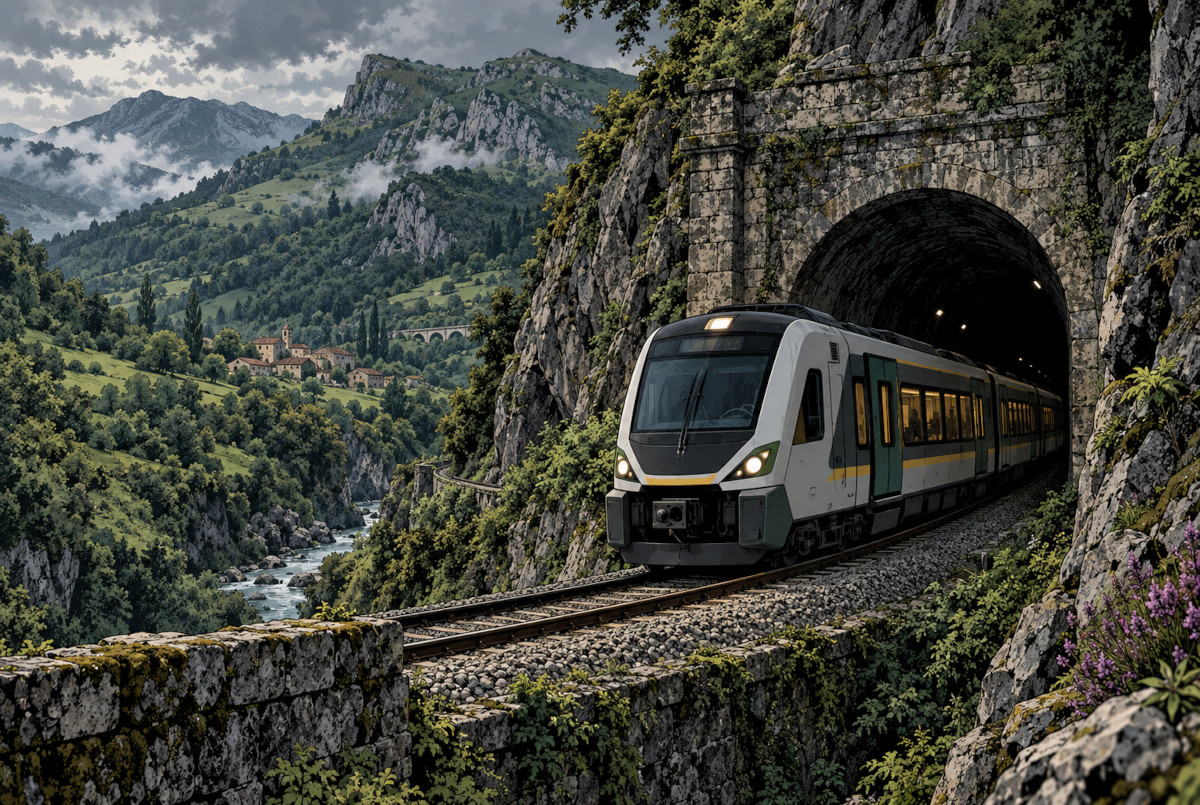 AI-generated illustration. It does not reproduce an actual 2026 test run, real CAF train or specific tunnel on the Spanish network.
The strangest failure was not the train — it was the flow of information and contracts
The claim that Spain built 31 trains and then discovered they would not fit through the tunnels is still wrong. The problem was stopped before mass production, and no fleet of unusable completed trains had to be scrapped.
But after the 2026 audit, it is equally difficult to dismiss the whole affair as nothing more than an exaggerated internet joke.
Infrastructure-conflict information had reached the contractor before the final contract was signed. Renfe had confirmed Adif data by February 2021. The procurement specifications themselves contained incompatible requirements. A later audit contradicted the 2023 claim that no public expenditure had yet occurred. And the legality of the 2024 contract modification was itself called into question.
The real B-side of this story was not an oversized train. It was the failure to translate the physical reality of an old railway into workable specifications, information-sharing and contract management.
A railway network more than a century old cannot always be reduced to the latest standard on paper. But neither does “the infrastructure is old” explain away failures in procurement. The 2026 audit makes both points unusually clear.
Editor’s Note
When I first wrote about this story, the part that grabbed me was the correction to the famous headline: the world talked about trains that could not fit through the tunnels, but no fleet of oversized trains had actually been built.
After reading the 2026 audit, though, stopping there feels too easy.
There were no completed unusable trains. But clearance-conflict data existed before the contract was signed. Renfe had confirmed information from Adif in 2021. The government later said no public money had been spent, while the audit found that more than €16 million had already been paid under the contract.
That does not mean the €16 million was simply thrown away, and it would be misleading to describe it that way. But this was neither the cartoon version — “Spain forgot to measure its tunnels” — nor the opposite version — “nothing serious happened because CAF caught it before production.”
From a Japanese perspective, what stays with me is how much of a railway exists outside the train and the track. Someone has to write the specifications, check old records, talk to the infrastructure manager, sign the contract and decide what to do when the pieces do not match.
The trains themselves never got stuck in a tunnel. The project, however, managed to spend several years inside one.
References
- Spanish Court of Auditors (Tribunal de Cuentas), Audit Report No. 1680, approved May 28, 2026 — Detailed audit of the procurement and maintenance contracts for 31 meter-gauge trains and six mountain trains, including specifications, chronology, payments, contract modifications and the additional seven units.
- Spanish Court of Auditors, “El Tribunal de Cuentas analiza la contratación de trenes de ancho métrico y alpinos por RENFE Viajeros” (May 29, 2026) — Official summary of the audit, including its findings on impossible technical specifications, delays, additional costs and the contract modification.
- Spanish Ministry of Transport, Mobility and Urban Agenda, official statement (February 5, 2023) — States that the problem was detected during the design stage and that the trains had not yet been manufactured.
- Government of Spain, La Moncloa, “Transportes acelera los trabajos para que los nuevos trenes de ancho métrico estén circulando en 2026” (February 8, 2023) — Explains the comparative method and the problem created by applying the conventional clearance method.
- Spanish Official State Gazette (BOE), Order TMA/135/2023 of February 15 — Amends Spain’s railway-clearance rules and clarifies treatment of existing 1,000 mm gauge lines.
- Government of Spain, agreement with Asturias and Cantabria (February 20, 2023) — Announces seven additional trains, continued free Cercanías travel and the government’s statement at the time regarding public expenditure.
- Government Delegation in Cantabria, start of manufacturing at CAF Beasain (February 26, 2024) — Confirms the start of production and the use of the comparative design method.
- Cadena SER, “Los nuevos trenes de cercanías de Cantabria ya están fabricados y en pruebas” (August 25, 2026) — Reports that the first completed train had entered testing on a closed CAF facility.
- Europa Press, “El primero de los nuevos trenes en pruebas circulará por Cantabria a finales de mes o principios de noviembre” (October 5, 2026) — Reports the latest publicly announced schedule for testing on Cantabria’s railway network.