
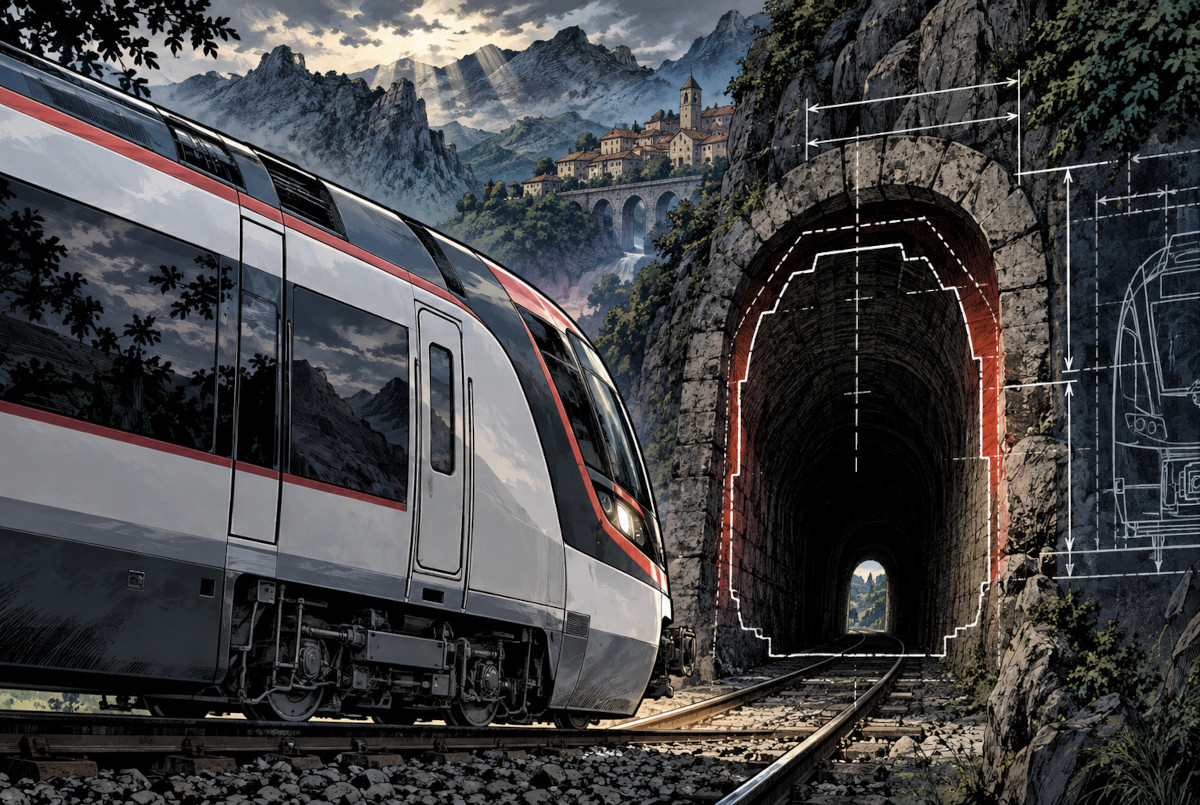
On January 24, 2023, a local newspaper in Asturias broke a strange story about Spain’s new narrow-gauge trains. Within days, it had escaped the railway pages and gone international: Spain had ordered new trains that were too big to fit through its own tunnels.
The problem involved the former FEVE narrow-gauge network in northern Spain, particularly services in Asturias and Cantabria. Renfe had ordered a new fleet from Spanish manufacturer CAF, only for a conflict to emerge between the train specifications and the clearances available through parts of the old infrastructure.
That sounds like the sort of engineering failure where dozens of brand-new trains are built, rolled out of the factory, and then discover the tunnel is smaller than the train. But that is not what happened. The problem was detected during the design stage, before manufacturing began. No train using the incompatible dimensions was ever completed.
The 31 “trains that would not fit” had not been built
Renfe began procuring replacement narrow-gauge rolling stock in 2019, and in June 2020 CAF was awarded the contract. The package covered 31 new meter-gauge trainsets, six trains intended for mountain services, and 15 years of partial fleet maintenance.
Then, in early 2021, CAF encountered a problem during the design process. The clearance assumptions used in the procurement documents did not match conditions across the actual railway infrastructure.
This is where an important distinction gets lost in many versions of the story. The track gauge itself was not the mistake. These are 1,000 mm meter-gauge lines, and nobody had suddenly forgotten how far apart the rails were.
The problem was the Spanish railway concept of gálibo: broadly, the relationship between the maximum envelope occupied by a moving train and the space available around it through tunnels, platforms, bridges and other structures. In English railway terminology, this involves both the loading gauge and structure clearance.
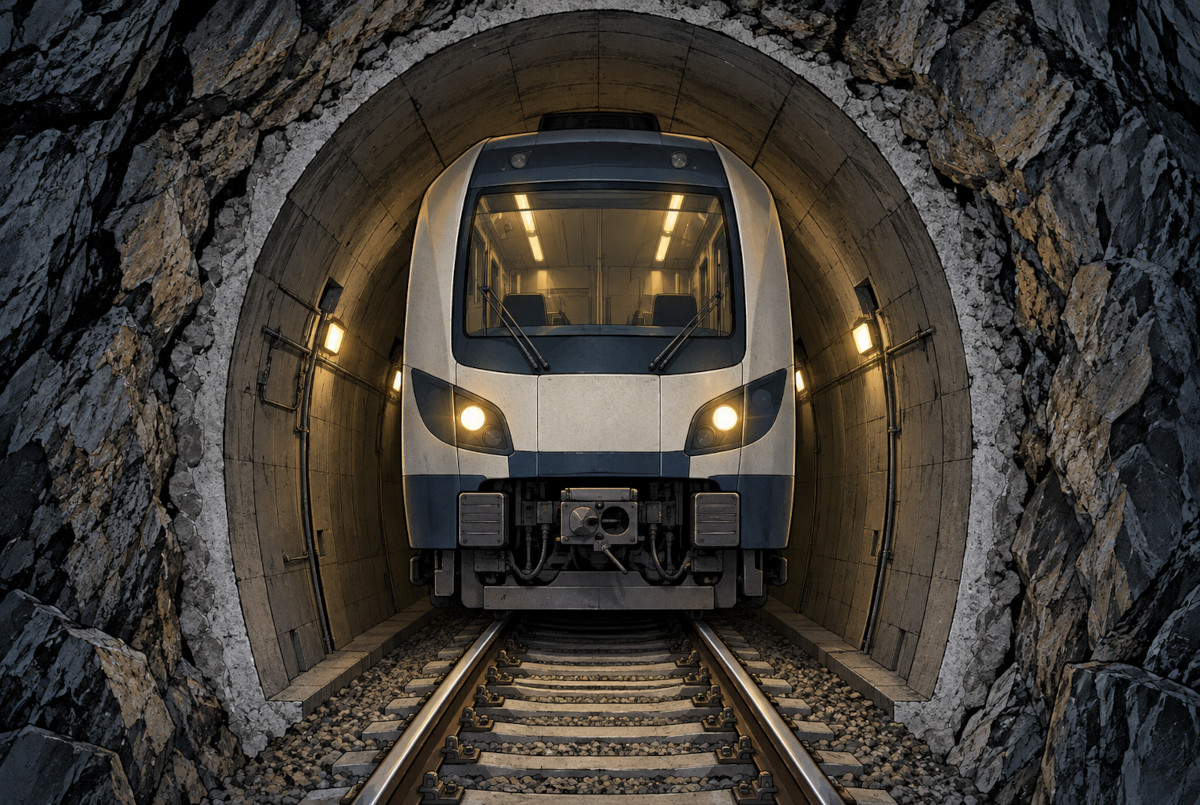 AI-generated explanatory illustration. It does not reproduce an actual train, tunnel or engineering drawing, and the dimensions shown are not measured data.
Applying the “correct” standard created another problem
The former FEVE network contains infrastructure built across many different periods, including old and unusually restrictive tunnels. A modern standard clearance profile could not simply be assumed to describe every part of the system.
So why not play safe and build a much smaller train?
Because that created another absurd result. Spain’s Ministry of Transport said that applying the conventional rules being considered at the time would have produced new trains significantly smaller than the trains already operating on the same railway.
That would undermine the point of replacing the fleet. A new train with unnecessarily restricted interior space and capacity would hardly look like an upgrade. Rebuilding large numbers of old tunnels and structures, on the other hand, would be an enormous infrastructure project of its own.
So this was not simply a case of CAF “measuring the train wrong.” The deeper problem was that modern design rules, procurement specifications and the physical reality of an old narrow-gauge network did not line up neatly.
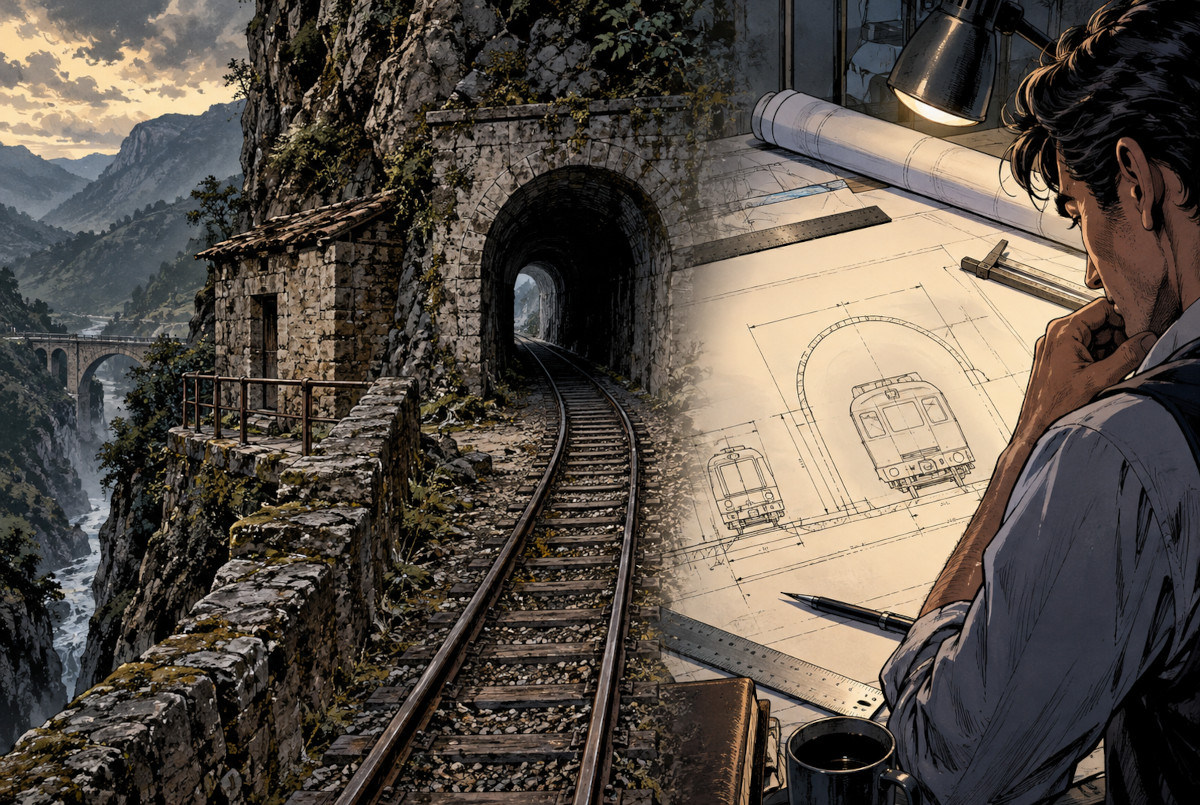 AI-generated explanatory illustration. It does not depict a specific FEVE line, actual tunnel or real railway engineer.
The solution: use trains that already fit as the reference
The solution eventually chosen was the método comparativo, or comparative method.
The basic idea is wonderfully practical. Instead of relying only on a theoretical standard envelope, engineers can use trains with extensive proven operating experience on the route as a reference. Their dimensions, movement and relationship with the infrastructure help establish an acceptable profile for the new trains.
In other words: if the old train has been passing safely through the tunnel for years, start by studying the old train rather than pretending the tunnel exists only on paper.
The comparative approach was already covered by European standard EN 15273. What Spain did in February 2023 was explicitly incorporate its application into the national railway gauge rules for cases where the standard GEE10 or GED10 obstacle clearances could not be met.
The rules require a risk assessment and allow trains with extensive commercial operating experience on the relevant section to be used as the reference system.
What began as a rolling-stock specification problem had therefore reached an unusual point: the controversy helped trigger a formal change to Spain’s railway clearance rules.
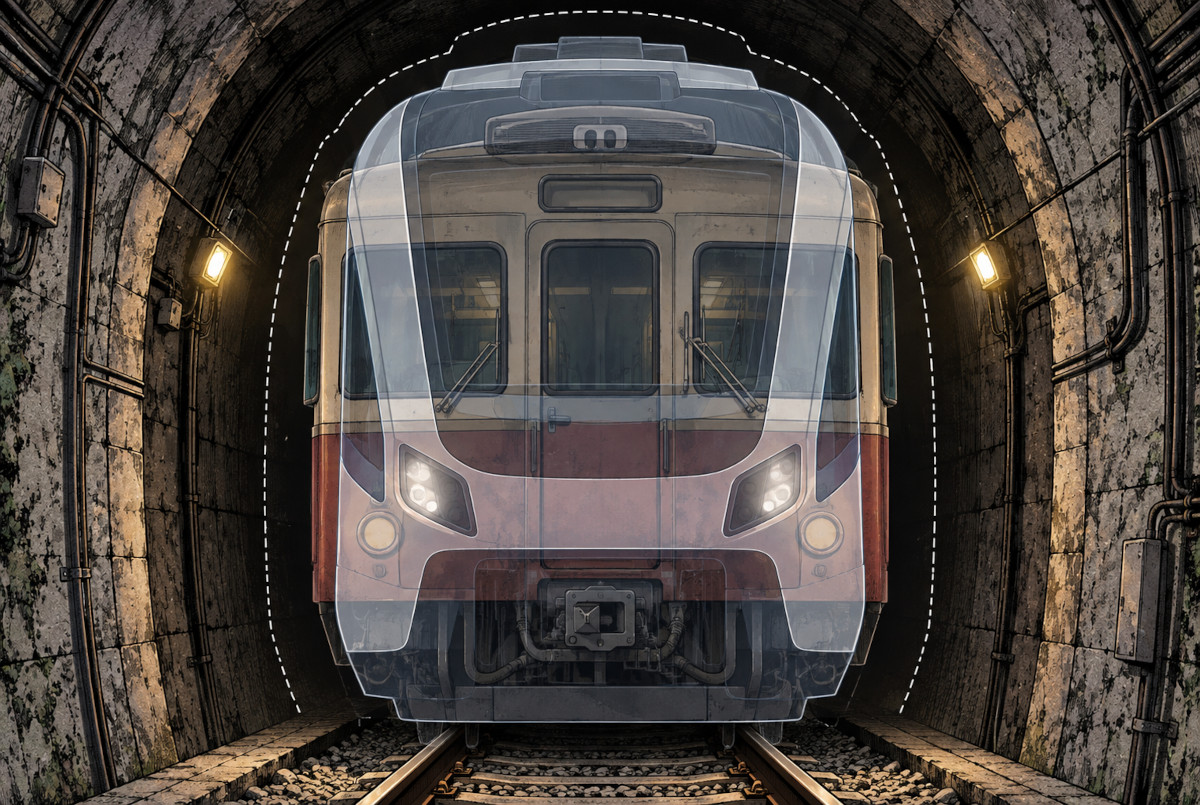 AI-generated concept image illustrating the comparative method. It is not an official engineering diagram and does not show the exact profiles or measurements of real rolling stock.
Then the order grew from 31 trains to 38
You might expect a project that had become this embarrassing to be cut back. Spain did the opposite.
In February 2023, the government agreed to exercise an option in the contract and add seven more trainsets, increasing the total from 31 to 38. It also agreed to extend funding for free Cercanías commuter-rail travel in Asturias and Cantabria until the delayed trains arrived.
That is a very B-Side Earth sort of outcome: a procurement problem becomes a national embarrassment, and the response is to order more trains.
There is an important qualification, however. No fleet of completed oversized trains had to be scrapped. So descriptions suggesting that hundreds of millions of euros’ worth of finished trains were built and then discovered to be unusable are misleading.
The often-cited €258 million figure also needs context. Renfe’s 2020 reporting described that sum as the overall contract covering the 31 meter-gauge trains, six mountain-service trains and 15 years of partial maintenance—not simply the price of 31 supposedly unusable trains.
2026: the replacement fleet is finally reaching the next test stage
After the trains were redesigned using the comparative method, manufacturing officially began at CAF’s Beasain plant on February 26, 2024. At that point, the expectation was for testing on the railway network to begin during the first half of 2026.
The schedule slipped again.
By August 2026, however, the first completed units existed and one was undergoing dynamic testing on a closed CAF test track. On September 16, 2026, Transport Minister Óscar Puente said that, if everything progressed as expected, on-track testing would begin in October.
So as of September 20, 2026, the project that became famous around the world as Spain’s “trains too big for the tunnels” is finally moving into the next phase of testing, roughly three and a half years after the controversy erupted.
The current target is for the first trains to enter passenger service progressively in 2027. The planned October tests had not yet begun at the time of writing.
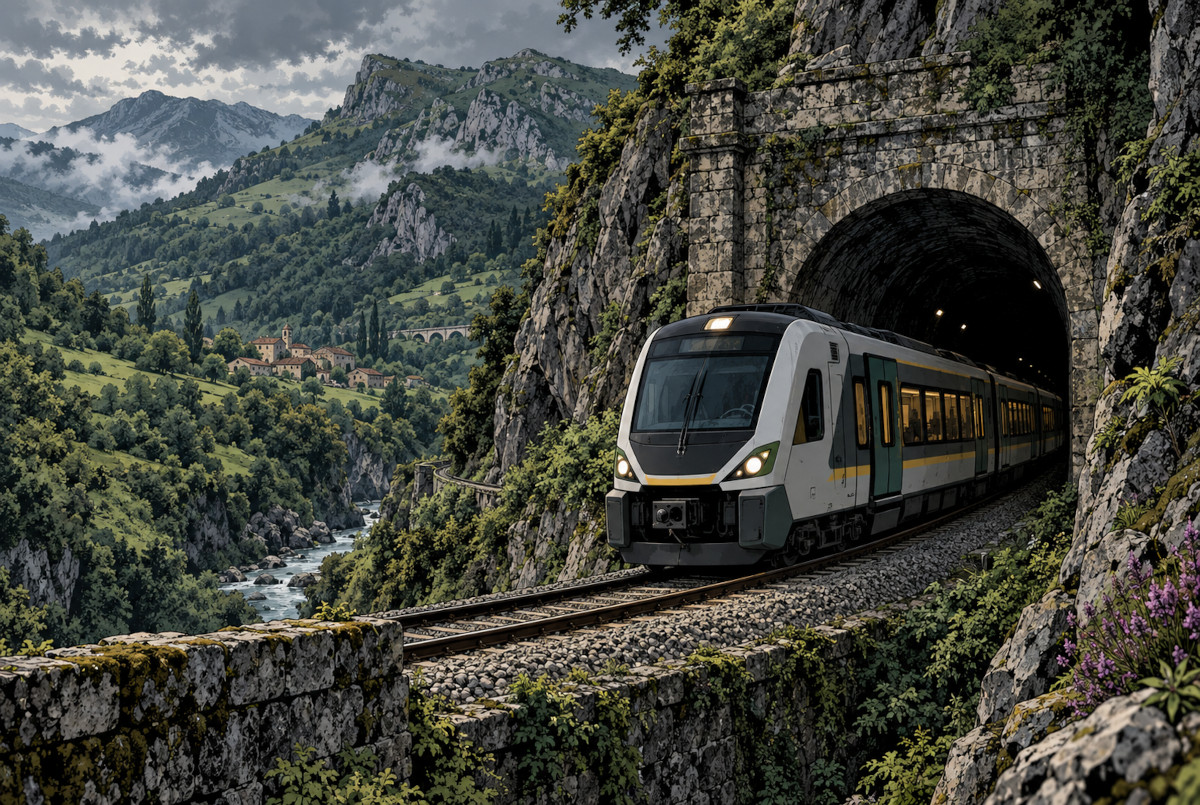 AI-generated illustration. It does not reproduce an actual 2026 test run, real CAF train or specific tunnel on the Spanish network.
The real story was not “train versus tunnel”
“Spain ordered trains that were too big for its tunnels” is a magnificent headline. It is short, visual and instantly ridiculous.
It is also incomplete.
CAF caught the incompatibility before manufacturing began. Conventional design methods then produced another problem: trains smaller than the vehicles already running successfully through the network. Spain ultimately turned to a comparative method based on proven rolling stock and formally adjusted its railway rules.
For railway enthusiasts, that is the more interesting story. On a railway network built up over more than a century, adopting the newest standard does not magically erase the physical history underneath it.Rolling stock and infrastructure evolve together, often through decades of compromises that are invisible until someone tries to replace one side of the equation.
The Spanish case was still a serious procurement and coordination failure. But its real B-side was not a finished train arriving at a tunnel and getting stuck. It was the moment a modern fleet-renewal project exposed inconsistencies that had been quietly embedded in a very old railway system.
Editor’s Note
From where I sit in Japan, my first reaction was exactly the obvious one: “Come on. Just measure the tunnel.” That was why this story sounded so ridiculous in the first place.
But the deeper I went, the less satisfying that explanation became. Follow the rulebook and the new train could end up smaller than the trains already running there. Ignore the rulebook and you have a safety and authorization problem. In the end, the practical answer was basically: “Start with the train that already gets through.”
That is the part I like about this story. Railways look like precision-engineered modern systems, but underneath them are alignments, tunnels and structures inherited from completely different eras. Bring in a shiny new train and the old railway suddenly clears its throat and says, “You did remember I’m still here, right?”
And meanwhile, the internet remembers a different version: Spain built a fleet of trains and then discovered they would not fit through the tunnels. That version is simpler, funnier—and wrong. Sometimes the misinformation left behind by a strange story is almost as interesting as the original mistake.
References
- Spanish Ministry of Transport, Mobility and Urban Agenda, official statement (February 5, 2023) — Confirms that the inconsistencies were detected during the preliminary design stage and that no trains had been manufactured.
- Government of Spain, La Moncloa: “Transportes acelera los trabajos para que los nuevos trenes de ancho métrico estén circulando en 2026” (February 8, 2023) — Explains why conventional gauge calculations would have produced trains substantially smaller than the existing fleet and describes the comparative method.
- Spanish Official State Gazette (BOE), Order TMA/135/2023 of February 15 — Amends Spain’s railway gauge rules and explicitly provides for comparative methods under UNE-EN 15273-1 and UNE-EN 15273-2.
- Government of Spain, La Moncloa: agreement with Asturias and Cantabria (February 20, 2023) — Confirms the addition of seven units, taking the order from 31 to 38 trains, and the extension of funding for free Cercanías services until the new trains arrive.
- Renfe, 2020 consolidated annual and non-financial reporting — Records the contract for 31 meter-gauge trains, six mountain-service trains and 15 years of partial maintenance, with the contract figure reported at €258 million.
- Cinco Días: “Transportes supo del problema de los trenes de Cantabria y Asturias en 2021 y prevé ahora su llegada en 2026” (February 8, 2023) — Reports the chronology of CAF’s warning and the subsequent design process.
- El País: “El Gobierno aprueba de urgencia la norma para frenar la polémica de los trenes de Cantabria y Asturias” (February 18, 2023) — Reports that the issue was first brought into public view by El Comercio on January 24, 2023 and explains the regulatory problem.
- Government Delegation in Cantabria: start of manufacturing at CAF Beasain (February 26, 2024) — Confirms the start of production of the redesigned fleet, the comparative method and the 38-train total.
- Cadena SER: “Los nuevos trenes de cercanías de Cantabria ya están fabricados y en pruebas” (August 25, 2026) — Reports that the first completed unit was undergoing testing on a closed CAF track and that the first trains are targeted for service in 2027.
- Europa Press: “Las pruebas en vía de los nuevos trenes de Cantabria empezarán en octubre, según el ministro” (September 16, 2026) — Reports Transport Minister Óscar Puente’s statement that on-track testing is expected to begin in October, with the first trains targeted for service in 2027.