
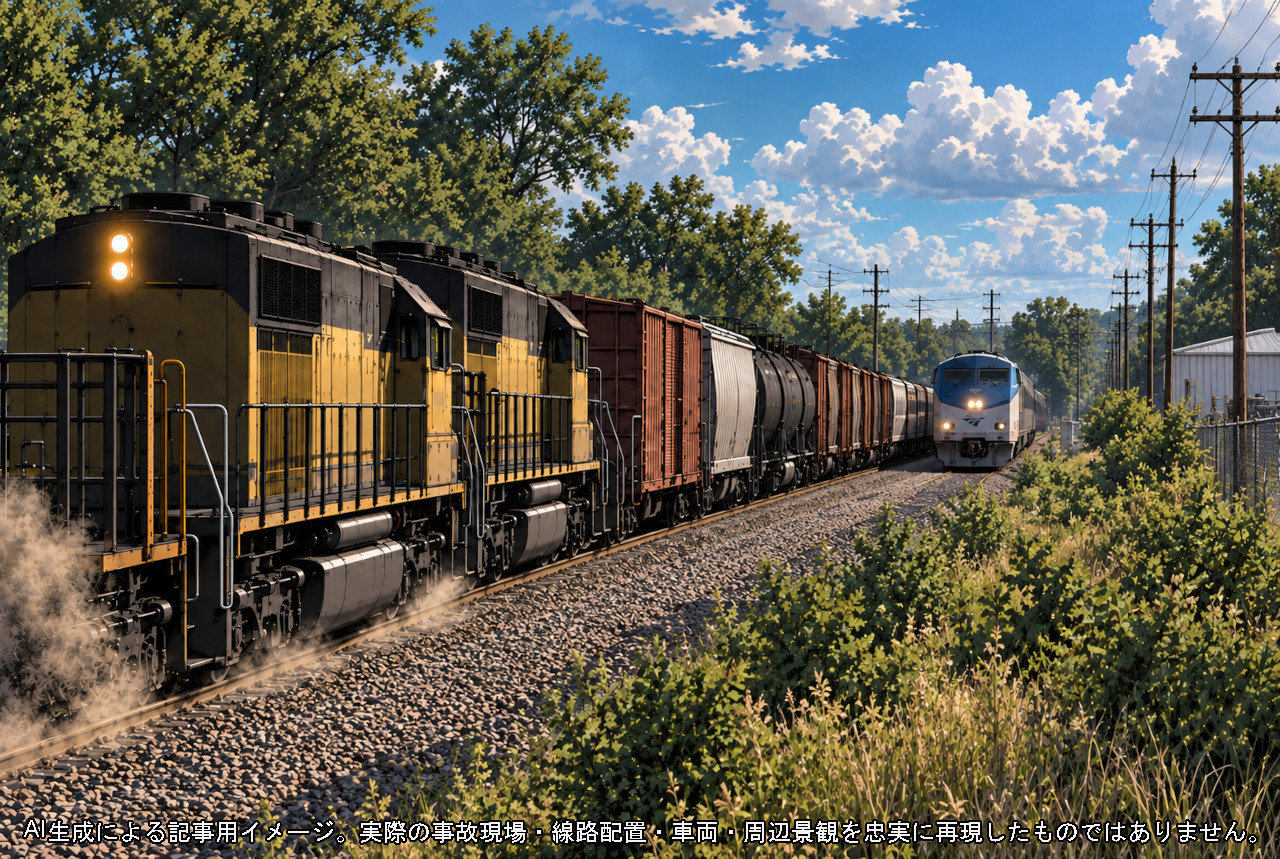
At about 11:00 a.m. on February 22, 2026, an Illinois Central Railroad Company (IC) freight train, Z19491-21, struck a stopped Amtrak train on the same track near Memphis, Tennessee, at milepost 9.6 on the Shelby Subdivision.
The freight consisted of two locomotives and 82 railcars. Amtrak 59-21 had one locomotive and seven passenger cars, carrying 118 passengers and seven Amtrak employees. The IC train was shoving north on Main Track 1 at about 10 mph when the leading end of the freight consist reached the Amtrak locomotive.
That would already qualify as a low-speed train collision. But the National Transportation Safety Board’s preliminary investigation contains a second, much stranger part.
The IC crew told investigators that they interpreted the resistance from the first collision as resistance associated with an air-brake problem. They then moved forward, reversed again, and about three minutes after the first impact, struck the same Amtrak train a second time at low speed.
Two Amtrak employees and two passengers suffered minor injuries. The bigger puzzle is obvious: how does a train hit another train once, then return and hit it again? To understand that, the accident itself is only half the story. The other half is how U.S. railroads handle switching moves, restricted-speed operation and Positive Train Control.
AI-generated explanatory illustration. It does not reproduce the actual accident site, track layout, equipment or signal indications.
Why Were 82 Railcars Being Pushed From Behind?
Seen from Japan, this is the first part that looks odd. Why would two locomotives sit at one end of an 82-car consist and push the cars ahead of them instead of leading the train?
In U.S. railroad terminology, this is a shoving movement. Railcars or a train are pushed from the locomotive end rather than pulled. The NTSB notes that this is common in switching operations.
Before the accident, the IC crew left 21 cars on Main Track 1, entered an intermodal yard and picked up another 61. The train then reversed north and coupled back onto the 21 cars. The conductor directed that coupling from the ground.
After the coupling was completed, the crew continued shoving north so the locomotives could eventually reach the conductor and pick him up. Before that happened, the opposite end of the now 82-car consist reached the stopped Amtrak train.
So the fact that 82 cars were being shoved is not, by itself, proof of improper operation.
Federal regulation 49 CFR §218.99 generally requires point protection for shoving movements. It also contains provisions for movements on main track or signaled sidings where several conditions are met, including dispatcher permission, movement authority and protection against conflicting movements.
The NTSB confirms that the IC crew had received dispatcher permission for the switching operation. But dispatcher permission alone does not prove that every condition of an applicable exception was satisfied. The specific authority, point-protection arrangements and other details have not yet been made public.
AI-generated structural illustration. It does not reproduce the actual accident site or the NTSB accident diagram.
Put the 82 Cars, Restricting and PTC on One Page
When the NTSB’s preliminary information is placed next to the current federal rules, the accident becomes harder to reduce to a simple question such as “Why didn’t PTC stop it?”
Conceptual layout immediately before the collision — not to scale
South
【IC locomotives ×2】→【61 cars】→【21 cars】→
impact point
←【Amtrak locomotive + 7 passenger cars】
North
IC side: The 82-car consist was being shoved north. Dispatcher permission for the switching operation is confirmed.
Amtrak side: Amtrak passed a Restricting signal into the same block, saw the IC train ahead and stopped.
PTC: The accident occurred in PTC-equipped territory. The public preliminary information does not state the IC train’s onboard PTC mode at the time, or whether warnings or enforcement occurred.
| Issue | What is confirmed | What remains unknown |
|---|---|---|
| Shoving movement | The IC crew shoved 82 cars north and had dispatcher permission | The specific movement authority, point protection and compliance with all applicable exception conditions |
| Restricting | Amtrak passed a Restricting indication, saw the IC train and stopped | The full responsibility picture and details of dispatching and operating authority |
| PTC | The territory was equipped with PTC | The IC train’s PTC mode, warnings and any braking enforcement at the time of the accident |
The publicly available material does not yet include a car-by-car consist for all 82 railcars. For that reason, this article does not estimate the train’s total length by assuming an average car length. If consist data appear in the NTSB docket, that calculation can be revisited.
Did Amtrak Ignore a Stop Signal?
According to the NTSB, shortly before the collision Amtrak passed a Restricting signal and entered the block where the IC train was performing switching work.
That wording can easily be misunderstood. Restricting does not mean that Amtrak simply ran a stop signal.
Under 49 CFR §236.812, restricted speed requires a train to operate so that it can stop within one-half the range of vision while not exceeding 20 mph.
The important idea is not “you may travel at 20 mph.” It is “proceed only as fast as you can stop for whatever you can actually see ahead.”
In this case, the Amtrak crew saw the IC train and stopped. Based on the public NTSB information, the accident cannot simply be described as “Amtrak ignored the signal.”
If PTC Was Installed, Why Could a Collision Still Happen?
The accident took place in territory equipped with Positive Train Control, or PTC. PTC is designed to address risks including train-to-train collisions, overspeed derailments and unauthorized movement into certain protected areas.
So the obvious question is: if PTC was there, why did the freight train still reach the stopped Amtrak train?
This is where accident-specific facts have to be separated from general system behavior. The NTSB has not publicly stated what mode the IC train’s onboard PTC was operating in, whether it generated a warning or whether braking enforcement occurred.
Under 49 CFR §236.1005, when restricted speed is required, a PTC system may satisfy train-to-train collision-prevention requirements by enforcing the railroad’s restricted-speed ceiling—typically 15 or 20 mph, depending on the railroad’s rules.
That does not necessarily mean the system continuously identifies every standing railcar or train ahead and automatically stops short of it.
On September 3, 2026, the Federal Railroad Administration issued Safety Advisory 2026-01 on restricted-speed operations. There is an important distinction here: the February 22 Memphis accident is not one of the seven recent accidents listed in that advisory. The advisory therefore should not be read as FRA’s finding about the cause of this specific collision.
It is still highly relevant as background. FRA describes restricted speed as a dynamic requirement: crews must continuously account for visibility, train length and weight, braking capability, grade, curvature and other conditions. The advisory also warns against overreliance on PTC Restricted Mode, noting that in many configurations it enforces a speed ceiling rather than visually detecting standing equipment ahead.
In other words, PTC may enforce “do not exceed this speed,” while the crew must still answer the harder question: “At this speed, can I actually stop for what is in front of me?”
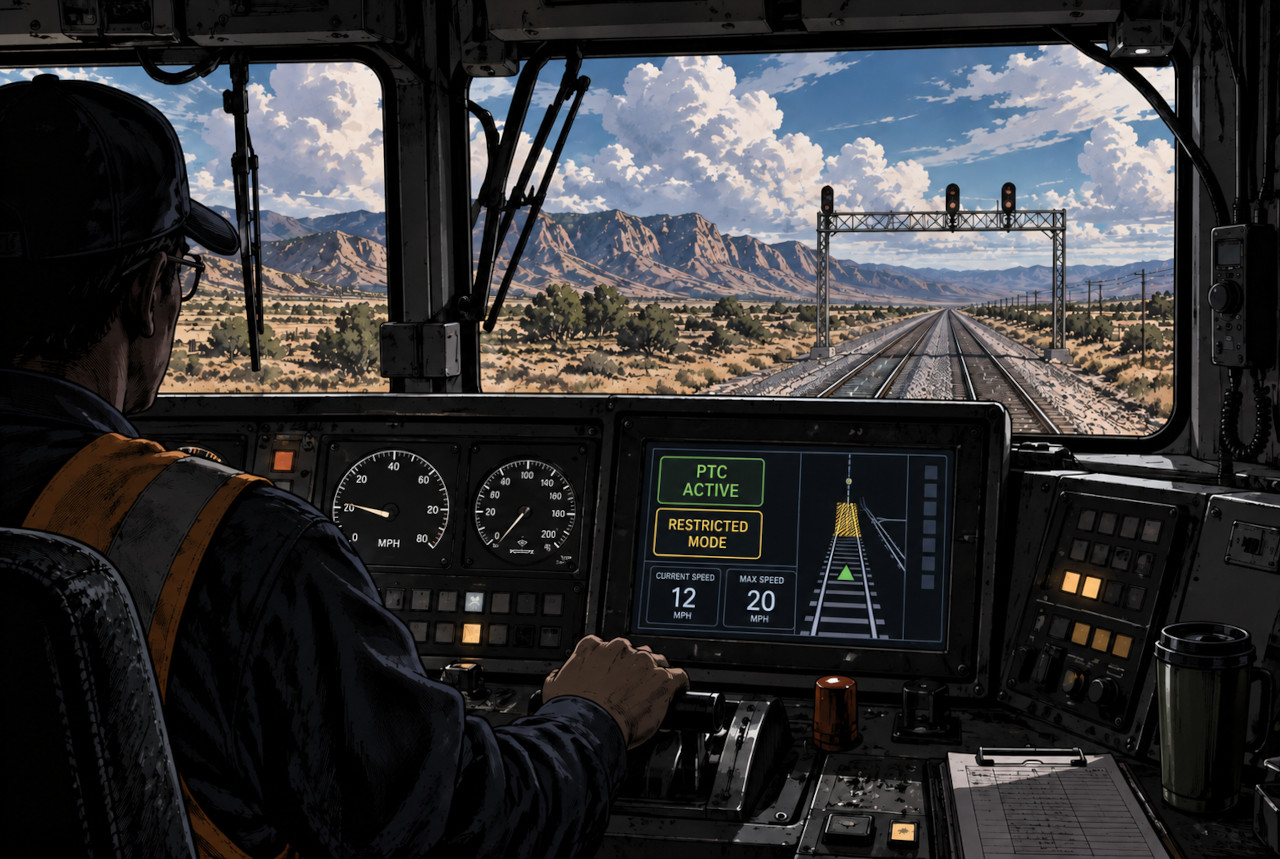
AI-generated conceptual illustration. It does not reproduce an actual locomotive cab or PTC interface. The speeds, display information and signal indications shown are not accident data.
The Question That Still Has No Answer
Once the operating rules are separated out, several things that initially look impossible become less mysterious. Shoving movements are real and common. Restricting does not mean the same thing as a stop signal. And PTC is not necessarily an all-seeing obstacle-detection system at restricted speed.
But the central mystery remains.
Why did the crew interpret the first contact with another train as resistance associated with an air-brake problem?
A long freight train is a complicated mechanical system. The locomotives may be far from the opposite end, and forces can be transmitted through coupler slack, train weight, grade and brake-pipe behavior. But none of those factors has yet been established as the reason for the crew’s interpretation in this accident.
Answering that question will require evidence that has not yet been released publicly: event-recorder data, PTC logs, brake inputs, radio and dispatcher communications, train weight, track profile and detailed crew accounts.
As of October 10, 2026, the NTSB investigation remains ongoing, no probable cause has been announced, and the investigation docket has not yet been released.
That means claims that this was simply engineer error, a PTC failure or a dispatcher mistake still go beyond the available evidence.
AI-generated explanatory illustration. It does not reproduce the actual accident location or accident train.
The Strange Part Is Not Just the Second Impact
“The same Amtrak train was hit twice within about three minutes” sounds like the kind of line an old pulp magazine would have loved.
But once the primary sources and federal rules are placed side by side, the more interesting story is underneath the headline: long freight consists being shoved during switching, Restricting permitting movement under very specific conditions, and PTC that does not necessarily replace human judgment at restricted speed.
The accident looks absurd at first glance. Understanding why it could happen requires understanding the operating system around it.
And even after all of that work, the most important question remains unresolved: what did the first impact actually feel like at the locomotives, and why did the crew interpret it as something other than a collision?
That is where speculation should stop and the NTSB docket should eventually begin.
Editor’s Note
My first reaction was still the obvious one: “You hit the train once—how do you end up going back and hitting it again?” But the more I dug into the rules, the less useful that reaction became.
PTC was the part that bothered me most. From a Japanese perspective, the phrase “train collision prevention system” creates a fairly simple mental picture: if another train is sitting ahead, surely the system stops you before you reach it. The U.S. rules are more complicated. Under restricted speed, technology can enforce a ceiling while the crew still has to decide whether the train can actually stop within the distance they can see.
The September FRA advisory made another point clear. It discusses the same broader problem—restricted speed and overreliance on PTC—but the Memphis accident is not one of the seven incidents FRA lists. It is useful background, not an official answer to this accident. Mixing those two things together would make the story sound more settled than it really is.
What I want to see now is the mechanical and recorded side of the first impact: what the event recorder shows, what the brake system was doing, what the crew heard over the radio, and what the locomotives actually transmitted to the people handling them.
If the docket answers that, this story deserves another look.
References
- National Transportation Safety Board (NTSB), “Amtrak and Illinois Central Railroad Company Train Collision” — Accident location, train numbers and consists, two collisions, shoving movement, Restricting indication, PTC-equipped territory and investigation status.
- NTSB Investigation Docket RRD26FR007 — As of October 10, 2026, the docket had not yet been released.
- Federal Railroad Administration (FRA), “Safety Advisory 2026-01; Restricted Speed” — September 3, 2026 advisory on restricted speed, PTC Restricted Mode and seven recent accidents.
- Federal Railroad Administration, “Restricted Speed Enforcement for Positive Train Control Systems” — Technical material on PTC and restricted-speed enforcement.
- 49 CFR §218.99, “Shoving or pushing movements” — Federal requirements for point protection and certain shoving movements on main track.
- 49 CFR §236.812, “Speed, restricted” — Federal definition of restricted speed.
- 49 CFR §236.1005, “Requirements for Positive Train Control systems” — PTC requirements, including restricted-speed enforcement provisions.