
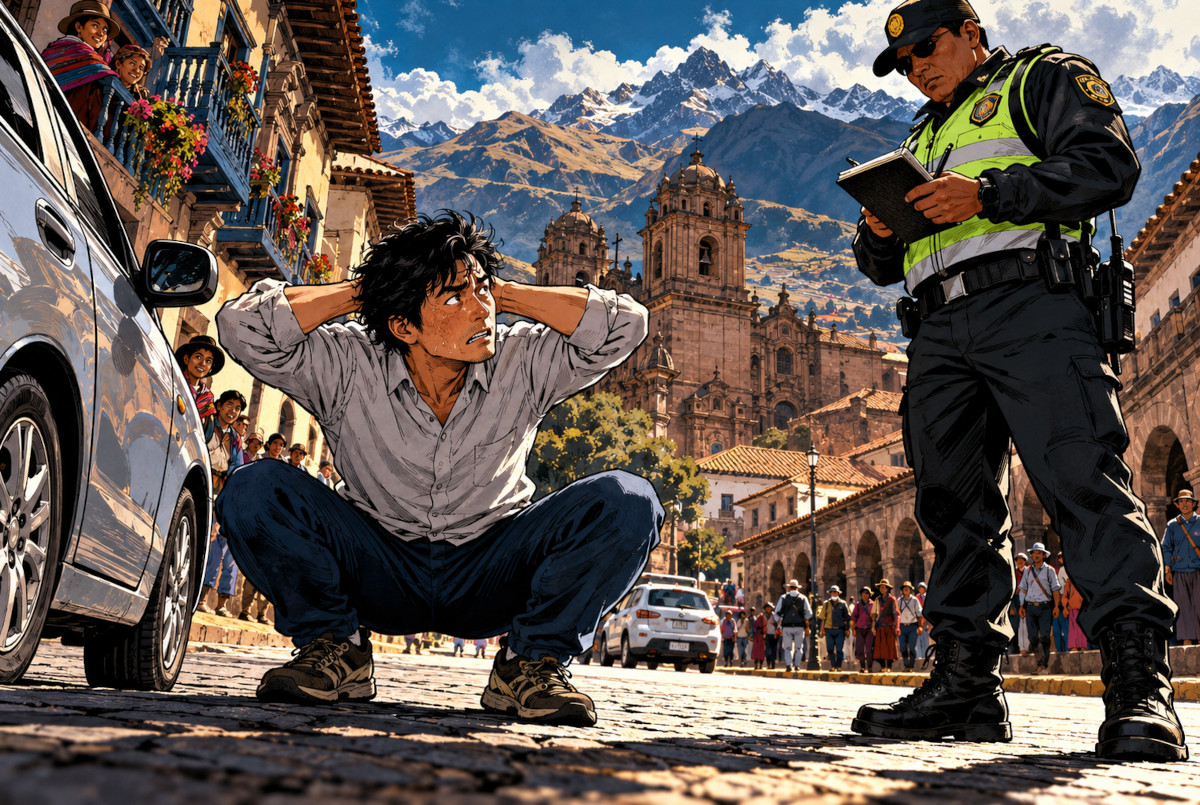
Get stopped for a traffic violation and the next step is usually predictable: a warning, a citation, or a fine.
But in Cusco, southern Peru, one driver ended up crouching in the street and repeatedly moving up and down while a police officer watched. This was not roadside fitness training. The officer was reported to have made the driver perform an exercise known locally as “ranas” instead of issuing a traffic citation.
In footage reported by Peruvian broadcaster ATV on October 1, 2026, the officer can be heard telling the driver, in substance, that the exercise had spared him from getting a ticket. When the driver questioned why he had nearly been cited, the officer continued telling him to exercise and “warm up” so he would not feel cold.
“Ranas” Are Not Just Ordinary Squats
ATV described the exercise as sentadillas, or squats, but the Peruvian use of ranas is slightly more specific. A definition discussed by Peruvian linguist Martha Hildebrandt describes it as an exercise in which a person repeatedly jumps from a crouched position, usually with the hands placed behind the neck.
In English, “frog jumps” or “squat jumps” comes reasonably close. The name is literal: rana means “frog” in Spanish.
What makes the term more interesting is that ranas have also appeared in Peru as a form of punishment rather than simple exercise. Peruvian educational guidance has listed practices such as making late students perform ranas or push-ups among examples of physical punishment.
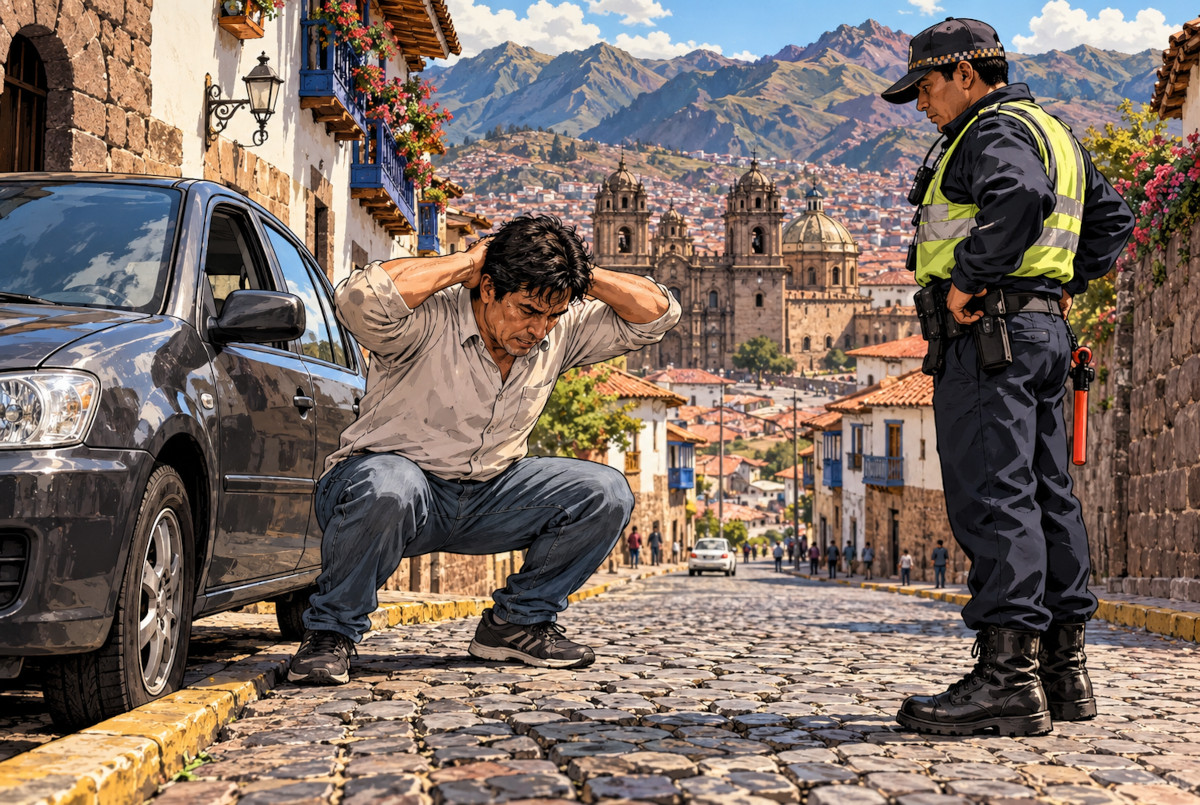 AI-generated illustration. It does not depict the actual people or location involved in the incident.
The Real Issue Is Not the Exercise — It Is Who Gets to Invent the Punishment
In Peru, a traffic citation is commonly referred to as a papeleta. The Policía Nacional del Perú, or PNP, is responsible for traffic enforcement and can issue citations and fines according to the violation involved.
Official PNP guidance treats traffic violations through formal citations and monetary penalties; it does not present physical exercise as an alternative enforcement procedure. In April 2026, Peru’s Ministry of Transport and Communications also announced regulatory changes intended to standardize roadside enforcement through a formal traffic-control protocol.
PNP General Virgilio Velásquez Hurtado, who heads the police region in Cusco, said officers are expected to follow established rules and procedures and that the case would be reviewed. When asked whether the incident amounted to an abuse of authority, he did not make an immediate determination and said the facts first needed to be verified.
As of October 5, 2026, the officer’s name, the exact traffic violation allegedly committed by the driver, the number of ranas performed, and any final disciplinary action had not been confirmed in the material reviewed for this article. ATV’s report was published on October 1, but it did not state exactly when the roadside encounter itself occurred.
 AI-generated explanatory illustration. It does not reproduce any actual police document, location, or person.
This Was Not the First “Frog-Jump” Traffic Stop
That is where the story stops looking like the whim of a single officer.
In Huancayo in 2021, a driver who had reportedly crossed into the opposite lane while overtaking was ordered by a police officer to perform 200 ranas and 50 push-ups. After completing the exercises, the driver was still issued a formal traffic citation. In other words, it was not exercise instead of a ticket. It was exercise plus the ticket.
In Lima in 2019, videos circulated showing motorcycle riders being made to perform ranas after entering lanes reserved for the Pan American Games. Then, in Arequipa in May 2025, footage showing a driver being made to exercise after an alleged traffic violation prompted an internal police review. The regional police chief said the proper procedure was to establish the violation and issue a papeleta.
So the idea of making traffic offenders exercise on the spot has surfaced in different parts of Peru and in different years. That does not prove a formal tradition inside the police. It does show that the same unusual form of improvised punishment has appeared more than once.
 AI-generated conceptual map based on locations discussed in the article. It is not intended as a precise cartographic representation.
A Humane Officer — or Dangerous Discretion?
Seen only as a short video clip, the idea can almost look sympathetic: no fine, no paperwork, just a few exercises and a warning to behave next time. Reports on earlier cases also noted that some viewers praised officers who used exercise instead of simply imposing a monetary penalty.
But that is exactly where the B-side of the story begins.
Ten push-ups today, 20 ranas tomorrow, something else from another officer next week. Once that logic is accepted, a punishment established by law starts becoming something that can be swapped out according to an individual officer’s judgment.
No bribe was reported in this case, and this was not a serious act of physical violence. That is partly why the scene can look almost harmless. But an officer deciding, “Do this and I’ll let you go,” is fundamentally different from following a formal enforcement procedure.
There is one more wrinkle. On May 8, 2026, Latina Noticias had already reported a case in Cusco in which a driver was filmed performing ranas during a police stop and an internal investigation was opened. Based on publicly available information, it is not possible to confirm whether that footage and the ATV report published in October refer to the same incident or to separate incidents.
The overlap itself is worth noticing: Cusco, a police stop, and ranas — appearing again in the news. That makes the story harder to dismiss as nothing more than one bizarre traffic-stop video.
Editor’s Note
I’ll admit it: purely as a scene, there is something oddly appealing about it. A traffic ticket replaced by frog jumps in the middle of the street has the feel of an old-school form of discipline rather than modern bureaucracy.
From a Japanese perspective, it almost resembles the stereotype of a strict Showa-era PE teacher saying, “Do a few squats, learn your lesson, and don’t do it again.” Compared with a fine arriving through an official process, that can even look more human.
But that is also the part that bothers me. If an officer is allowed to make a punishment lighter because he feels generous, the same discretion can work in the other direction. Today it is frog jumps. Tomorrow, who decides what counts as enough?
And once I started looking into it, ranas kept turning up in earlier Peruvian traffic stories. What initially looked like one wonderfully strange piece of local news opened into something more interesting: a recurring form of improvised discipline sitting awkwardly beside the formal rules of traffic enforcement.
That is exactly the kind of story B-Side Earth is interested in. The headline is strange. The machinery underneath it is stranger.
References
- ATV, “Polémica en Cusco: policía hizo hacer ‘ranas’ a conductor en vez de ponerle papeleta por infracción” — report on the Cusco traffic-stop incident (October 1, 2026)
- Latina Noticias, “Hombre es captado haciendo ‘ranas’ durante intervención policial: se investiga si efectivo cometió exceso” — earlier Cusco report involving ranas during a police stop (May 8, 2026)
- Policía Nacional del Perú / Peru Government Platform, “Multas de tránsito” — official guidance on traffic fines and enforcement
- Ministry of Transport and Communications, “MTC actualiza el Reglamento Nacional de Tránsito para fortalecer el control y seguridad en las vías” — regulatory update on traffic enforcement (April 24, 2026)
- Ministry of Transport and Communications, Supreme Decree No. 011-2026-MTC (April 21, 2026)
- El Comercio / Martha Hildebrandt, “el significado de ‘Ranas’” — explanation of the Peruvian usage of the term (December 1, 2017)
- Peru Ministry of Education / UGEL Paruro, school violence and physical-punishment protocols under RM 383-2025-MINEDU
- Panamericana, “Huancayo: policía castigó a un conductor infractor obligándolo a realizar ejercicios físicos” — Huancayo case involving 200 ranas and 50 push-ups (April 9, 2021)
- Panamericana, “Por haber cometido una infracción: Policía habría castigado con ejercicios a chófer en Arequipa” — Arequipa case and subsequent police review (May 22, 2025)
- Diario Correo, “Lima 2019: Policía castiga de esta manera a motociclistas que invadieron carril exclusivo” — Pan American Games lane incident (August 7, 2019)