
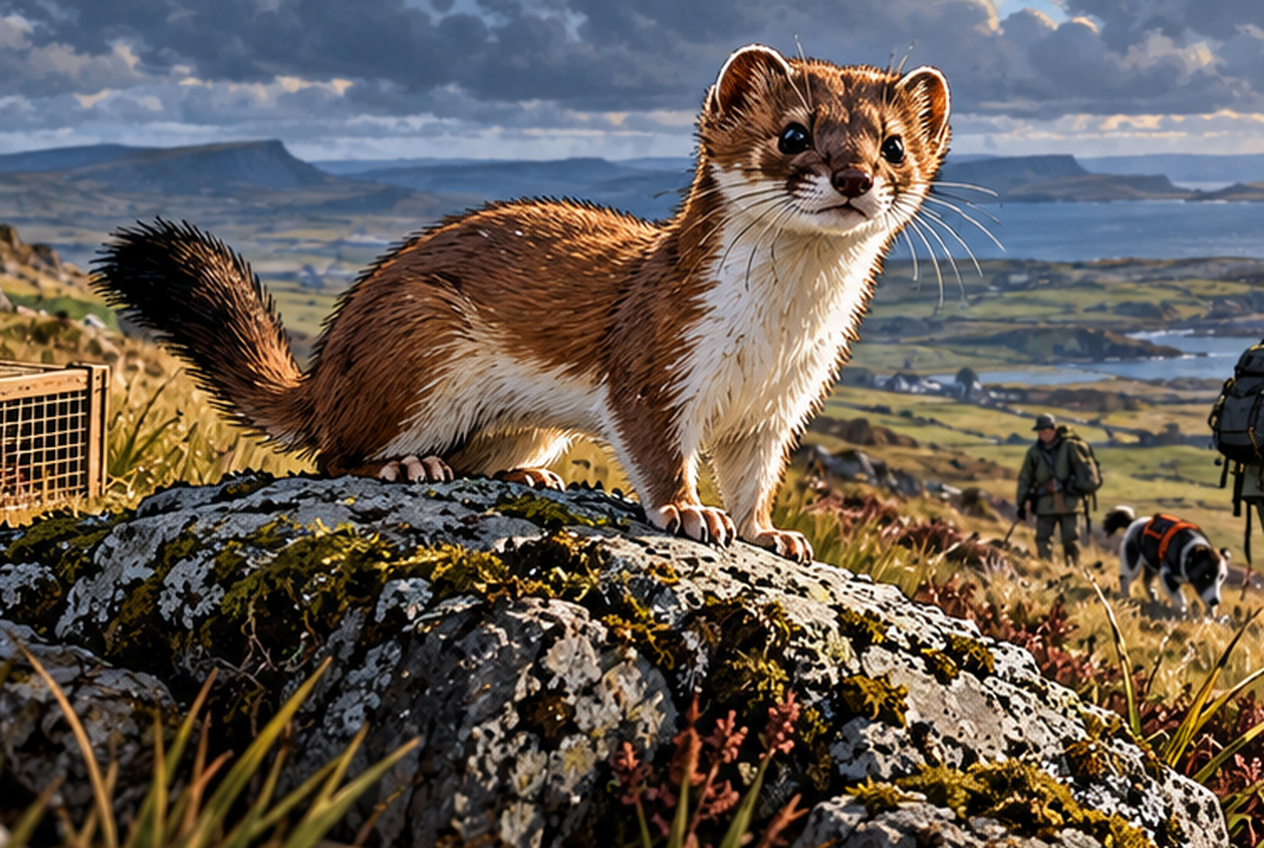
On October 9, 2026, a six-month wildlife hunt on a remote Scottish island finally came to an end.
The quarry was a single stoat, a small carnivorous mammal measuring roughly 30 cm (12 inches) in body length.
Yet catching this one animal involved detection dogs, AI-assisted cameras, an extensive network of traps and an additional £148,790 in approved funding.
There was another twist: the captured stoat was male. No female had been confirmed on the island.
Why did one male stoat warrant an island-wide search and nearly £150,000 in extra funding?
A closer look at the project’s official records, local reporting and financial disclosures reveals a more complicated story than an extraordinarily expensive pest-control operation.
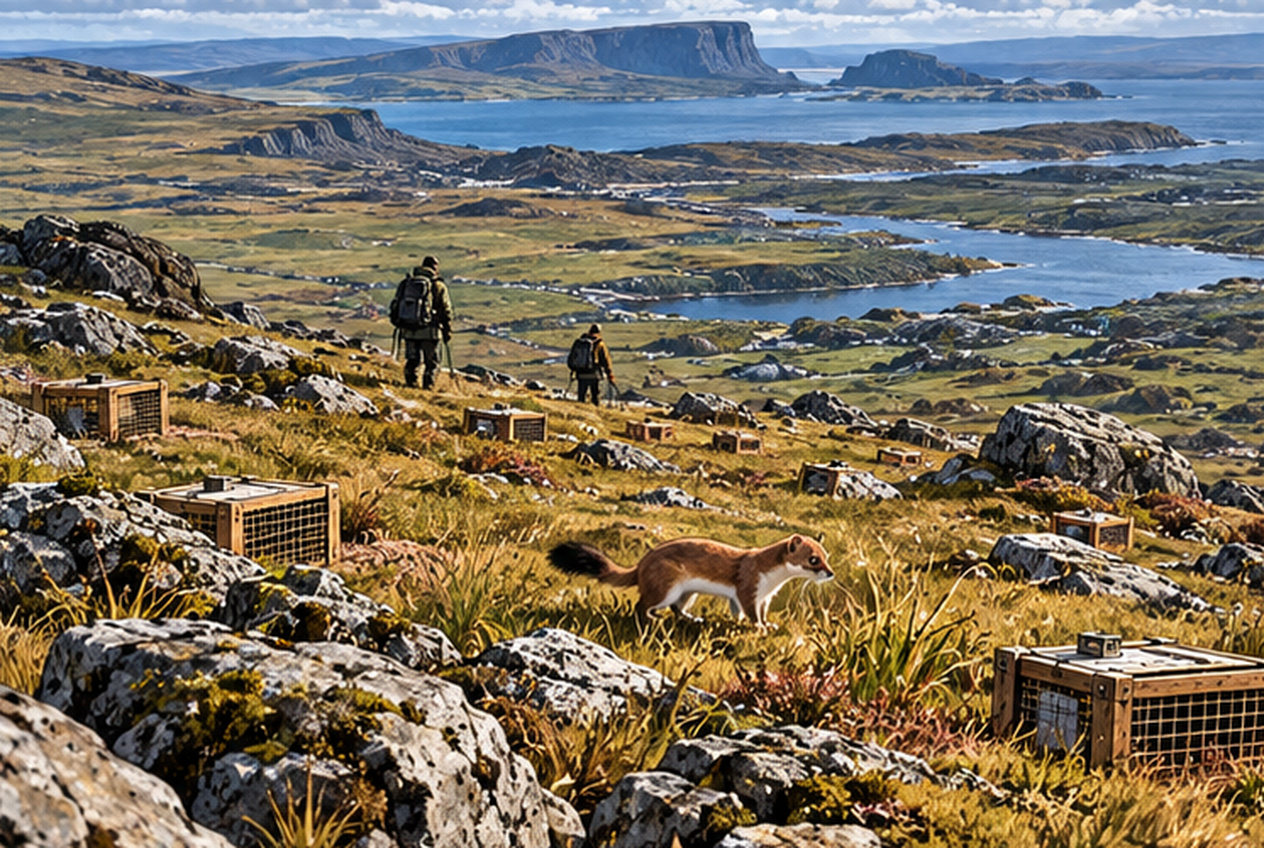
AI-generated illustration. It does not reproduce the actual search site or the locations of the traps.
One Stoat, One Island, 186 Days
The setting was Rousay, an island in Scotland’s Orkney archipelago covering approximately 4,500 hectares (45 square kilometres, or about 17.4 square miles).
The first possible sighting occurred on April 6, when a tourist spotted what appeared to be a stoat near Muckle Water. The sighting was reported two days later. On May 7, images from a trail camera confirmed the animal’s presence.
The response was coordinated by the Orkney Native Wildlife Project (ONWP), a partnership involving conservation organisations and public bodies including the RSPB and NatureScot, Scotland’s nature agency.
| Date | Development |
|---|---|
| April 6 | First possible stoat sighting |
| May 7 | Presence confirmed by trail-camera images |
| July 14 | AI camera detects the stoat at 7:37 a.m. |
| September 22 | ONWP reports 174 additional traps and 61 cameras |
| October 9 | Male stoat caught in a trap near Loch of Loomachun |
From the first reported sighting to the capture, 186 days elapsed. For more than six months, a single elusive animal had kept an extensive monitoring operation busy.
Did Catching One Stoat Really Cost £150,000?
This is where the headline figure needs some scrutiny.
On September 17, local newspaper The Orcadian reported that £148,790 in additional funding had been approved following a Freedom of Information request to NatureScot.
Crucially, the figure represented additional funding for the emergency incursion response, not a confirmed final bill for catching one animal.
The money helped provide staff and resources for the Rousay operation while preventing a loss of momentum in the wider eradication programme on Orkney Mainland.
There is another interesting discrepancy in the reported figures.
| Source | Traps | Cameras |
|---|---|---|
| The Orcadian (Sept. 17) | 229 | 59 |
| ONWP (Sept. 22) | 174 additional traps | 61 |
The difference does not necessarily mean either source was wrong. ONWP explicitly described its figure as additional traps, suggesting that existing preventive traps may have been counted differently. However, the published information does not establish the exact reason for the difference.
Now consider the scale of the search.
Using the newspaper’s figure of 229 traps and dividing Rousay’s 4,500 hectares by that number gives approximately 19.7 hectares (49 acres) per trap.
If those traps had been distributed evenly in a square grid, the theoretical spacing would have been roughly 443 metres (1,450 feet).
Real traps were not arranged in a perfect grid, of course. They were concentrated along likely animal routes, near sightings and in suitable habitats. The calculation is a measure of search density, not a reconstruction of the actual trap network.
Even so, it illustrates the challenge: finding one small, fast-moving animal across an entire island is not a simple matter of setting a few traps and waiting.
The AI Found It. The Trap Still Had to Catch It.
According to ONWP’s September 22 update, 25 of the 61 cameras deployed on Rousay were AI-assisted.
So did the technology fail?
Not exactly. On July 14 at 7:37 a.m., a Zeiss AI-assisted camera detected the stoat near Loch of Loomachun. The animal was eventually captured in a trap near the same loch.
ONWP explained that the Zeiss trail cameras use AI-assisted software to distinguish stoats from other animals and objects in captured images. Automating that initial identification reduces the time staff must spend reviewing photographs, allowing more attention to be devoted to fieldwork and trapping.
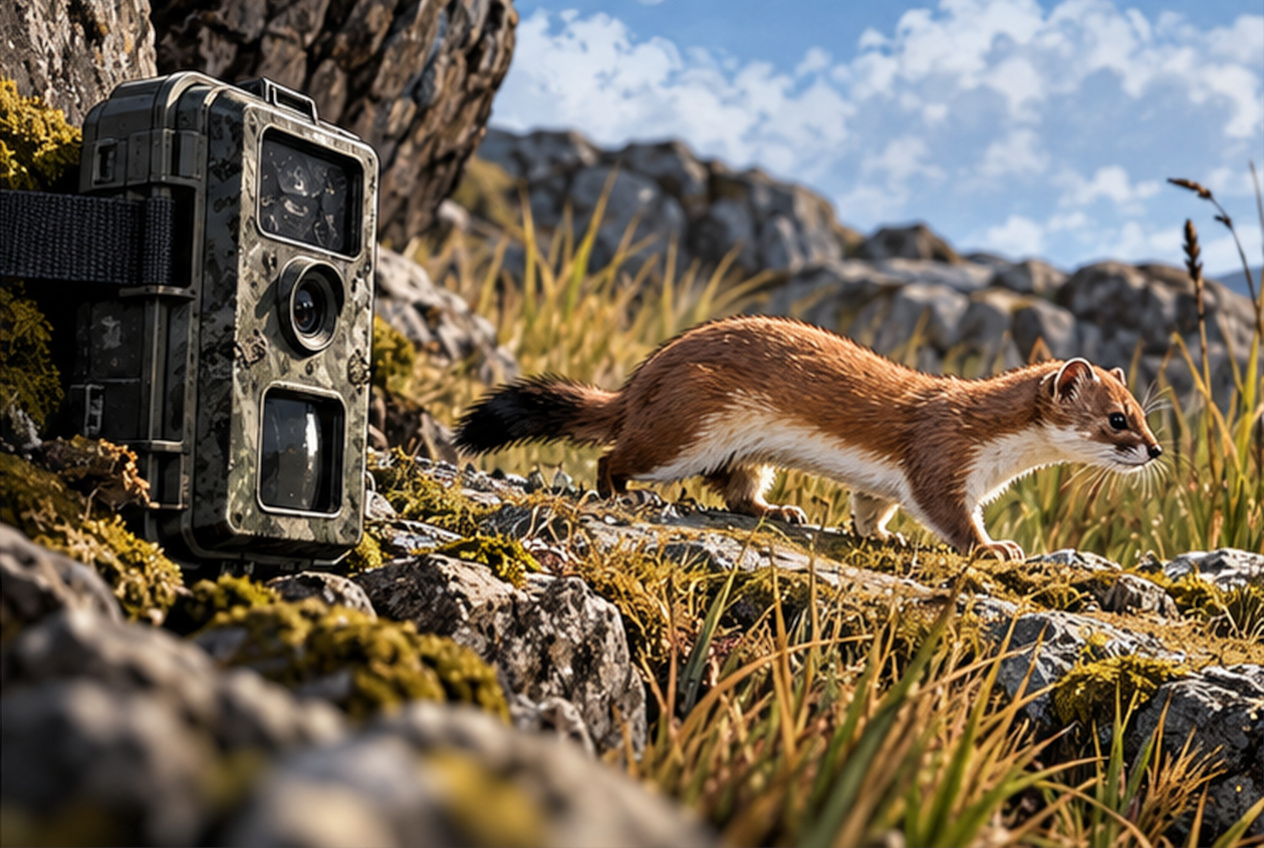
AI-generated explanatory illustration. It is not actual camera footage and does not reproduce the specific equipment used.
Knowing that an animal has passed a camera is very different from getting it into a trap. That distinction remained central to the operation throughout the months-long search.
One Male Cannot Start a Population. So Why Remove It?
The captured stoat was male, and investigators had evidence pointing in that direction well before October.
In July, DNA testing of droppings collected on Rousay confirmed the presence of a male stoat. Its wide-ranging movements and the absence of sightings of young animals or family groups also supported the possibility that there was just one male on the island.
If there truly was only one male, it could not establish a breeding population by itself. But confirming the sex of one animal is not the same as proving that no other stoats are present.
A female would present a different risk. Stoats have a reproductive adaptation called delayed implantation, in which embryonic development is temporarily suspended after fertilisation.
This means a female arriving alone may already be pregnant. Females typically give birth to litters of six to twelve kits in spring. A single pregnant animal could therefore turn a one-stoat problem into a much larger eradication challenge.
What is at stake is the island’s native wildlife, including the Orkney vole, a distinctive subspecies found nowhere else in the world, as well as ground-nesting birds vulnerable to stoat predation.
There is an unexpected historical twist here. A 2023 genomic study found that the ancestors of today’s Orkney voles were themselves introduced by humans more than 5,000 years ago. Over thousands of years of isolation, they developed into genetically distinctive island populations.
So an animal descended from an ancient human introduction is now protected, while a recently arrived predator is targeted for removal.
The distinction is not simply about which species arrived first. It also reflects thousands of years of ecological history and the consequences of introducing a new predator into the present-day island ecosystem.
Was the Extra £148,790 Money Well Spent?
According to ONWP’s published financial information, the wider Orkney stoat eradication project has received approximately £15.2 million in funding.
Of that total, around £9.765 million is allocated to staff costs, equivalent to approximately 64% of the total.
The largest expense in a programme like this is not necessarily buying traps. It is the sustained human effort needed to deploy them, check them, monitor wildlife and maintain the operation over many years.
Documents described in The Orcadian’s Freedom of Information report warned that, if stoats became established on Rousay, a full eradication operation could cost several million pounds.
For a simple comparison, suppose a future eradication campaign cost £3 million. The additional £148,790 approved for the emergency response would amount to approximately 5% of that hypothetical cost.
That does not prove the funding prevented a £3 million loss, nor does it establish the actual probability of a future invasion. It merely puts the relative scale of the two figures into perspective.
There is evidence that the wider conservation effort has benefited wildlife. In March 2026, the RSPB reported increased signs of Orkney vole activity and improvements in some bird breeding indicators.
However, weather and other environmental factors also influence wildlife populations. The recovery cannot automatically be attributed entirely to stoat removal.
One Stoat Caught. Two More Years of Monitoring.
How the animal reached Rousay remains unknown. It may have swum across the water, travelled unintentionally aboard a vessel or in cargo, or been deliberately released. None of those possibilities has been established as the actual route.
And catching one male on October 9 did not prove that it was the island’s only stoat.
ONWP has stated that, in line with international best practice, Rousay must undergo two years of monitoring without further evidence of stoats before the project can declare the island stoat-free.
That means surveillance could continue until around October 2028, assuming no further signs are found.
Catching an animal is one task. Demonstrating that there are no others left is a different and considerably more difficult one.
Editor’s Note
When I first saw the figure, I thought: nearly £150,000 because of one stoat? That’s a remarkably expensive game of hide-and-seek.
But the funding wasn’t simply the price of catching one animal. It was part of an effort to stop a much more expensive ecological problem from developing. And even after catching the male, the team still faces another two years of monitoring.
What strikes me most is that all this technology still cannot easily prove an absence. AI can help identify something that is there. Proving that nothing remains is another matter entirely.
Still, conservation should not mean that every expense is automatically beyond question. I’d like to see the eventual spending figures and results made public, too.
References
- Orkney Native Wildlife Project — Rousay stoat incursion: Ongoing updates (April–October 2026)
- The Orcadian — Extra £150k for stoat scheme after Rousay incursion (September 17, 2026)
- Orkney Native Wildlife Project — August 2026 Recap: Stoat Snippets (AI-assisted camera technology)
- Orkney Native Wildlife Project — July 2026 Recap: Stoat Snippets (DNA confirmation of a male stoat)
- Orkney Native Wildlife Project — Frequently Asked Questions (stoat biology, eradication methods and project funding)
- NatureScot — Freedom of Information Request: Eradication of Stoats on Orkney (September 2024)
- RSPB — Rare Orkney Vole on the Rise Thanks to Ambitious Native Wildlife Project (March 2026)
- Wang, Peischl & Heckel — Demographic History and Genomic Consequences of 10,000 Generations of Isolation in a Wild Mammal, Current Biology (2023)